• The $1.7 Billion Blind Spot: How VA Red Tape is Failing Veterans and Taxpayers Alike

    In the sterile corridors of government oversight, the term “monetary benefits” is often used as a polite euphemism for “money we set on fire.” The 2026 Office of Inspector General (OIG) audit of the Veterans Health Administration (VHA) reveals a bonfire of historic proportions.

    At a time when veterans are forced to navigate a labyrinthine healthcare system, the VHA has managed to lose $1.7 billion in annual unnecessary spending. This was done, not through a single catastrophic error, but through a thousands-of-cuts policy of bureaucratic inertia.

    This is more than a fiscal oversight. It is a systemic failure of a machine that has become so obsessed with its own procedural limitations that it has effectively nullified the legal rights of the men and women it was built to serve.

    Bureaucracy by the Numbers

    The scale of the VHA’s administrative dysfunction is captured in several staggering metrics from the OIG’s findings:

    • $1.7 Billion:  The estimated annual cost of unnecessary community care spending triggered by inaccurate eligibility determinations.
    • 25% Improper Approval Rate:  Approximately 340,000 consults were sent to outside providers despite the veterans being ineligible, often because the VA ignored its own internal capacity.
    • 38% Silence Rate:  Roughly 1.8 million veterans already funnelled into the VA’s direct care system were eligible for outside treatment but were never documented as being informed of their legal right to choose.
    • $114.4 Million:  The conservative estimate of added annual costs incurred because veterans chose community care without being told a faster VA appointment was actually available.
    • $440 Million per Quarter:  The current rate at which the VHA is hemorrhaging taxpayer funds due to its inability or refusal to refer veterans to available VA facilities.

    These figures represent a direct subversion of the legal framework established by Congress to provide veterans with agency over their own healthcare.

    Law vs. Manual: The Subversion of the MISSION Act

    The MISSION Act was designed to be a tool of liberation for the veteran, providing a clear legal path to private care when the VA fails to meet basic standards of wait times or distance. However, as the OIG audit reveals, administrative “guidance” is being used as a weapon to prune back those liberties.

    By creating internal rules that deviate from the plain language of the law, the Office of Integrated Veteran Care (IVC) has effectively created a two-tiered system of rights.

    The Law (MISSION Act)The Bureaucratic Reality (IVC Guidance)
    Makes no distinction between new and established patients regarding eligibility.Instructs staff to check all eligibility criteria only for new patients.
    Requires assessment of wait times, drive times, and service availability for all veterans.For established patients, schedulers assess only wait-time eligibility, ignoring drive-time standards.
    Mandates that veterans be informed of their right to choose between VA and community care.Bypasses drive-time assessments for established patients unless the veteran specifically asks for it.

    The “So What?” Layer

    The VHA’s artificial distinction between patient types is a calculated administrative hurdle. By routinely stripping established patients of their right to drive-time assessments, the VHA prioritizes “continuity of care” (a non-statutory, internal preference) over the veteran’s legal right to see a doctor closer to home.

    This is the administrative state at its most cynical: using a vague institutional preference as a loophole to bypass legal requirements and maintain control over the veteran population.

    The Consult Toolbox: A Case Study in Systematic Blindness

    The VHA’s failure is also a technological one. When legal entitlements are mediated through flawed software, the software becomes the de facto law. The “Consult Toolbox” (CTB), mandated for use in 2023, was supposed to standardize care. Instead, it has become a digital wall between veterans and their care.

    1. Inability to See Alternative Calendars:  While the system can identify a VA facility within a veteran’s drive-time standard, it cannot actually see that facility’s schedule. Schedulers are left blind, unable to book a veteran at a nearby VA center even if an appointment is available.
    2. Lack of Community Wait-Time Data:  The system frequently fails to show how long a veteran will wait in the private sector, making it impossible for a veteran to make a “fully informed decision” as required by law.
    3. Inaccurate Service Mapping:  The software identifies only general clinical categories rather than specific procedures, leading to widespread eligibility errors.

    The Failure of Specificity

    The “Inaccurate Service Identification” issue is particularly egregious. If a veteran needs an  Echocardiogram, but the local VA facility hasn’t digitally linked that specific procedure to the broad  Cardiology category in the toolbox, the system defaults to a “false positive.”

    It assumes the VA cannot provide the service at all, triggering an automatic, and often unnecessary, eligibility for community care. The VA, it seems, would rather pay for an outside referral than fix its own digital index.

    The Human Element: Manual Overrides and Ghost Schedules

    Even when the technology suggests a veteran is ineligible for outside care, the agency finds a way to maintain its own convenience. The OIG found a culture of “unjustified manual overrides” and the use of “ghost” wait times. This happens when schedulers input arbitrary numbers like 30 or 90 days as the “next available” appointment without ever checking the actual facility schedule.

    Examples from the OIG Report

    “Example 1: At Edward Hines Jr. VA Hospital, a veteran needing specialized dental work was told the next appointment was 88 days away. He was referred to the community at a cost of $6,200. However, the Jesse Brown VA Medical Center, just 52 minutes away, had an average wait time of only 18 days. No one checked.” —  OIG Audit Findings

    “Example 3: A veteran at the Miami VA Medical Center was forced to drive 135 miles for a podiatry appointment. Because he was an ‘established patient,’ staff followed internal guidance and simply never informed him he was eligible for care closer to home.” —  OIG Audit Findings

    These cases illustrate a culture that ignores available VA capacity to the tune of $440 million per quarter. It is a system that would rather pay a premium to an outside provider than coordinate a schedule with a neighboring facility.

    The December 2025 Promise: Reform or Red Tape 2.0?

    The VHA’s answer to these shortcomings is the “Integrated Scheduling Solution” (ISS), a web-based platform whose enterprise-wide rollout began in late 2024 with full implementation targeted for February 2025 across most VistA facilities.

    While the VHA markets this as a major step forward, as a modernized replacement for the aging VistA Scheduling Enhancements GUI, a skeptical eye is required for any “technological fix” applied to a deeper structural and cultural crisis.

    The proposed (and partially delivered) capabilities of the ISS include:

    • Consolidated Scheduling Platform: Merging functions into a single web-based tool for scheduling VA appointments, with ambitions for better provider-based and community care comparisons.
    • Cross-Facility Scheduling: Improved visibility and booking across different medical facilities and networks.
    • Expanded Online Options: Greater potential for veterans to exercise direct control over scheduling.

    Reality Check: While ISS is now deployed and receiving ongoing updates into 2026, true end-to-end integration has lagged. Dedicated integrated scheduling pilots combining direct and community care views only launched in January 2026 at select sites (e.g., Charleston and Atlanta), yielding modest early results.

    The OIG has appropriately noted that it remains too early to confirm whether ISS will meaningfully reduce eligibility errors, unnecessary referrals, or the broader inefficiencies plaguing the system.

    History supports this skepticism. Previous efforts, such as expansions of the External Provider Scheduling (EPS) system, showed limited real-world adoption, meaning that certain facilities were slow to accept and use the system. Technological solutions falter when the underlying culture and processes resist them.

    The Under Secretary for Health has “concurred in principle” with the OIG’s recommendations but pushed back formal eligibility verification processes until June 2027. In the entrenched world of VA bureaucracy, such language often signals a slow-walk strategy (read that as ‘more studies, more delays’), while the $1.7 billion annual waste continues to mount and veterans wait.

    Accountability and the Path Forward

    When a government department “loses” $1.7 billion annually while veterans are forced to drive 135 miles for care available much closer, the system isn’t just broken, it’s indifferent. The VHA has successfully built a labyrinth where the MISSION Act goes to die, buried under layers of internal memos and “toolbox” glitches.

    Tough Questions for the VHA:

    1. Transparency: Why is the VHA allowed to maintain internal guidance that directly contradicts the plain language of the MISSION Act regarding established patients?
    2. The 2027 Delay: Why has the Under Secretary for Health delayed the implementation of a formal process to verify eligibility checks until June 2027, effectively signing off on another $1.7 billion in waste?
    3. The Continuity Loophole: What is the true human cost of the VHA’s “continuity of care” interpretation when it is used as a non-statutory preference to deny veterans faster, closer care options?

    True reform did not come from a software update in December 2025. It will only come when the VHA is forced to prioritize a veterans-first approach over a bureaucracy-first survival strategy.

    Until then, the $1.7 billion blind spot will continue to grow.

    This $1.7 billion dysfunction is part of a larger pattern of VA care access failures. The community mental health scheduling crisis — where 128 of 133 VA systems failed their own seven-day standard — operates on the same broken foundation. And inside the facilities veterans reach after waiting, unwritten test result workflows mean the care that does occur may not be communicated at all. The VA’s compliance infrastructure, examined in detail in our Sterile State investigation, shows how the same agency that can’t schedule a mental health appointment in seven days manages to build elaborate bureaucratic machinery around its own internal operations.


    Fediverse reactions
  • The 20-Minute War at 18,000 Feet: FedEx Flight 705 and the FBI Files

    The Ordinary Morning and the Fateful Swap

    For First Officer James Morgan Tucker, Jr., April 7, 1994, began with the clinical routine of the American professional. He spent his morning at a medical office, successfully renewing his FAA medical certificate, the essential paperwork that permitted his continued employment at Federal Express. His afternoon plans were equally routine: a recreational flight in his personal 1946 Luscombe 8A.

    The day’s trajectory shifted due to a rigid bureaucratic quirk. A FedEx crew returning to Memphis had logged exactly one minute over the FAA’s “eight-hour rule.” Under strict company policy, they were disqualified from their next leg. This “one-minute crew swap” forced dispatchers to assemble a replacement team for Flight 705, an out-and-back cargo run to San Jose. Captain David Sanders and Flight Engineer Andy Peterson were called in, along with Tucker, who, despite being a check airman and captain-qualified on the DC-10, agreed to fly as First Officer to fill the administrative gap.

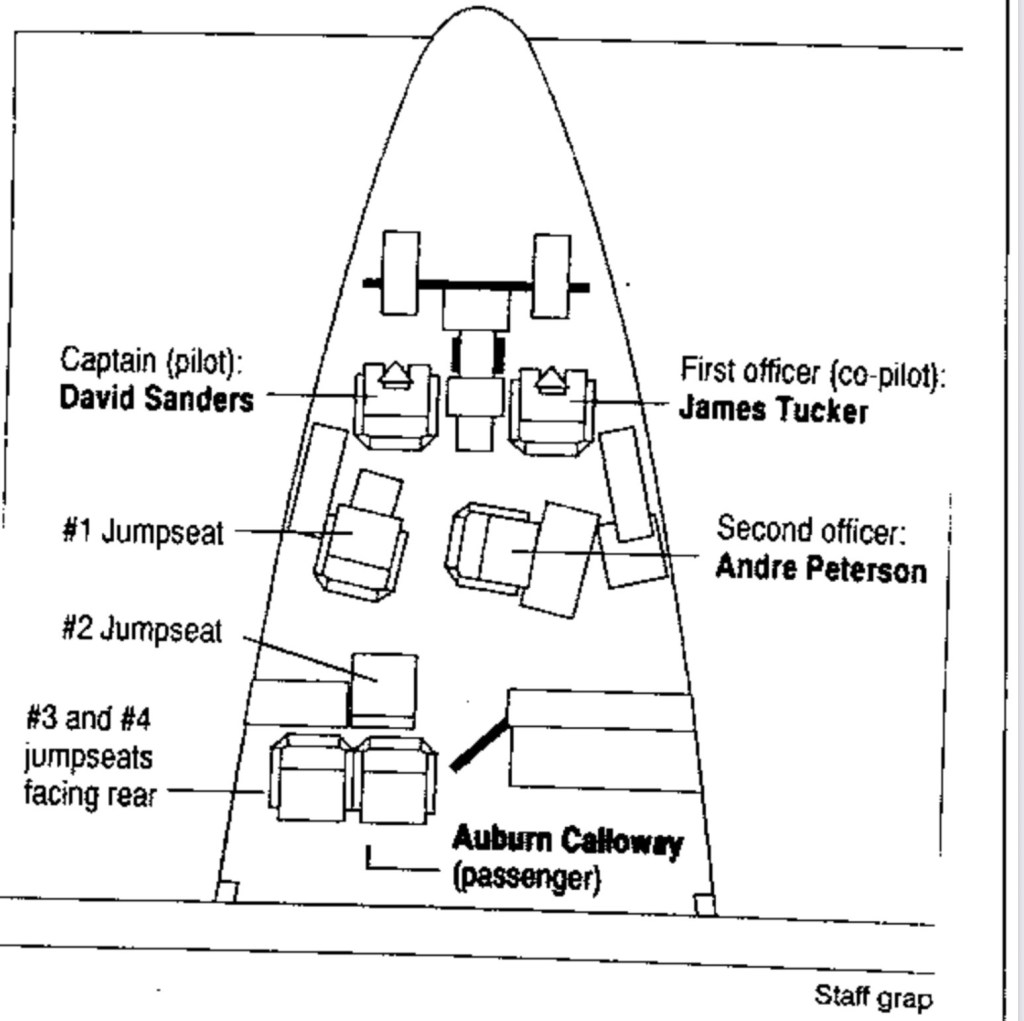
    As the crew boarded the three-engine DC-10-30F (N306FE), they found a fourth man already in the cockpit jumpseat: Auburn Calloway. A 42-year-old FedEx engineer and former Navy pilot, Calloway was officially listed as an off-duty passenger. In the ledger of the airline, he was just another employee catching a ride.

    The Arsenal in the Guitar Case

    The irony of the Flight 705 manifest was systemic. While the flight crew was being policed for a single minute of overtime, Calloway was the subject of a far more grave internal investigation.

    FedEx had discovered irregularities and falsified flight hours in his employment history. As he faced a disciplinary hearing that would end his career, Calloway had calculated a final, desperate move. By staging a “workplace accident” crash, he intended to trigger a $2.5 million life insurance payout to provide for his family following his impending termination.

    To ensure the crash was perceived as a mechanical failure rather than a hijacking, Calloway smuggled a specialized arsenal onto the aircraft inside a guitar case:

    • Two 20-ounce framing hammers
    • Two sledgehammers
    • A spear gun

    Calloway’s preparation was procedural. Before takeoff, he attempted to pull the circuit breaker for the Cockpit Voice Recorder (CVR). He knew that if he were to kill the crew and crash the jet, the “black box” must not contain the sounds of a struggle that would invalidate his family’s insurance claim.

    Chaos at 18,000 Feet

    Twenty minutes after departure, as the aircraft climbed through 18,000 feet, the routine was shattered. Calloway entered the cockpit and began an assault characterized by what the survivors called a “ghastly metallic ring”—the sound of a framing hammer striking the skull of Andy Peterson.

    Calloway attacked with rhythmic, focused brutality. Peterson’s temporal artery was ruptured, causing him to lose nearly half his blood volume in minutes. Turning to the pilots, Calloway struck James Tucker in the left parietal area of his skull, driving bone fragments into the brain and causing immediate numbness across the right side of Tucker’s body.

    Captain Sanders suffered multiple fractures and a partially severed ear. Tucker would later describe the surreal shift into survival mode:

    “The psychology of the whole affair was total madness—the images before me were completely out of context… Blood-slickened hand-to-hand combat had taken place here. They were anaerobic, gasping for breath.”

    The Aircraft as a Weapon: Tucker’s Maneuvers

    Severely injured and losing motor function, James Tucker realized that the crew could not win a physical fight against an armed attacker. He turned to the only weapon available: 390,000 pounds of McDonnell Douglas engineering.

    Utilizing his Navy training as a combat maneuvering instructor, Tucker began to fly the DC-10 into territory the airframe was never designed to inhabit.

    With max climb power selected and the aircraft in Control Wheel Steering (CWS) mode, Tucker rolled the jet toward a 140-degree bank—nearly upside down. Critically, Tucker’s “presence of mind” led him to stop the roll at 140 degrees rather than completing it. He reasoned that if he righted the plane, Calloway would simply regroup; by holding the aircraft at an extreme angle, he kept the attacker pinned and disoriented.

    The technical stress was catastrophic. Tucker plunged the aircraft into a high-speed “Split-S” dive, reaching speeds where “Mach tuck” buffeting began to shake the airframe. The forces were so violent that 200-pound control balance panels were ripped from the elevators.

    • Maximum Bank Angle:  140 degrees (Held tactically to pin attacker).
    • Maneuver:  Modified barrel roll / Split-S dive from 18,000 to 12,000 feet.
    • Airframe Stress:  Mach tuck buffeting; loss of elevator balance panels.

    The Galley Battle and the Will to Live

    The maneuvers threw Calloway from the cockpit into the forward cargo area, but the war continued. Unlike a terrorist, Calloway did not want an immediate crash; he wanted to fly the plane to a target to stage his “accident.”

    This tactical goal is why he did not simply pull the engine fire levers above the engineer’s station, and it resulted in a grueling, 15-minute hand-to-hand battle.

    Despite a ruptured artery, Andy Peterson re-engaged the CVR circuit breaker to ensure the evidence remained. He then threw himself into the fight in the galley, using his weight to pin Calloway while Sanders returned to the controls. Tucker, with his right side paralyzed, used his weight to assist Peterson, fending off Calloway’s attempts to gouge his eyes.

    Diagram of an aircraft cockpit layout, indicating seating positions for the captain (David Sanders), first officer (James Tucker), second officer (Andre Peterson), and several jumpseats, with a passenger position labeled (Auburn Calloway).
    Screenshot

    The Heavy Landing in Memphis

    Captain Sanders took the controls for a desperate emergency return to Memphis. The aircraft was dangerously overweight, laden with kerosene for the long-range trip to San Jose. A standard fuel jettison was impossible given the ongoing combat in the cabin and the structural damage; the wings were already dripping fuel from the massive torque applied to the spars during Tucker’s maneuvers.

    Sanders brought the damaged, leaking jet down for a “heavy landing.” When the aircraft stopped, the cockpit was a visceral crime scene. Paramedics, led by David Teague, had to climb up the emergency slides to reach the crew. They found the survivors still physically restraining Calloway, their flight suits soaked in so much blood it was difficult to distinguish the victims from the attacker.

    The Flight of Justice: Investigation and Trial

    The FBI’s investigation quickly stripped away Calloway’s “accidental” narrative. Agents recovered a suicide note and records of large financial transfers to his ex-wife.

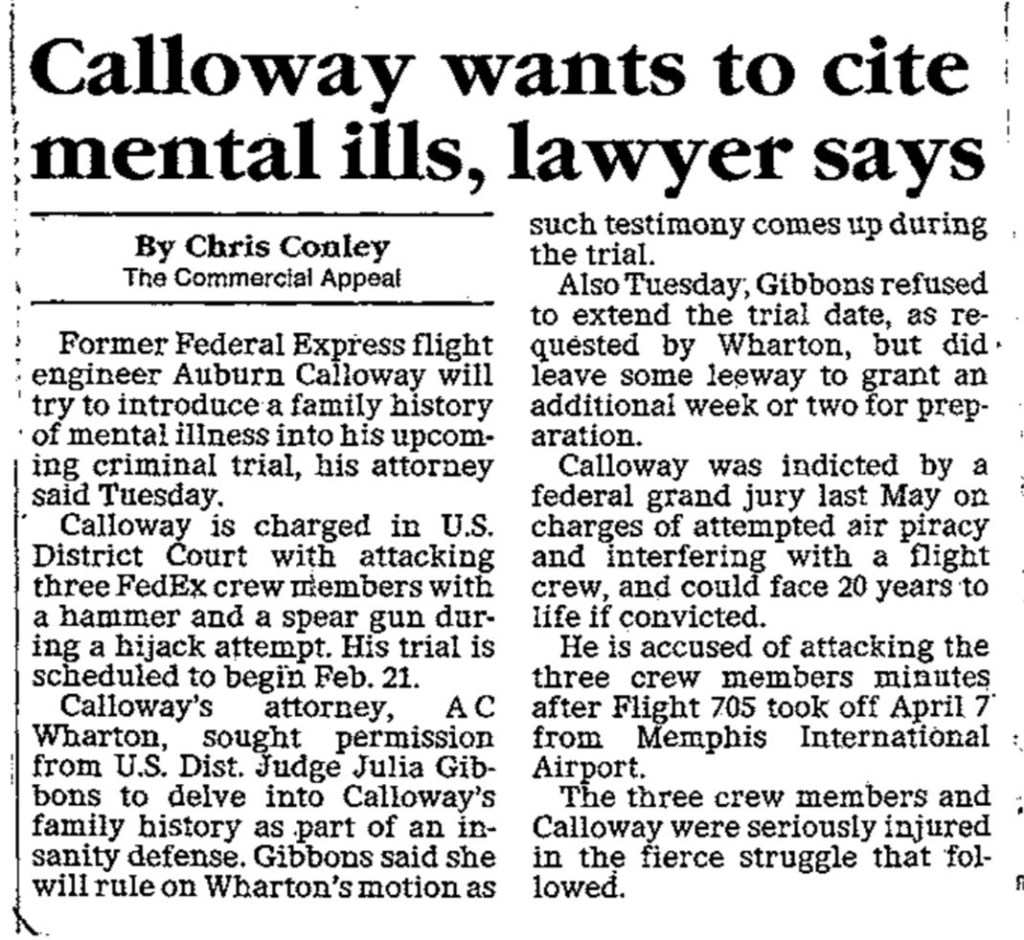
    During the 1995 trial, Calloway’s defense of diminished responsibility was rejected after blaming a sleeping disorder.

    Newspaper article discussing Auburn Calloway's upcoming criminal trial, citing his intention to introduce a family history of mental illness as part of an insanity defense. The article mentions charges against him for attacking FedEx crew members during a hijack attempt and includes details about the trial date and the judge's response.
    Screenshot

    In early 2025, the bureaucracy of the legal system delivered its final word on Calloway. Now 71 years old and citing chronic medical infirmities, Calloway filed motions for compassionate release. On February 10, 2025, the U.S. Court of Appeals for the Sixth Circuit affirmed the denial of his release, citing the “disturbing” nature of his crimes and the permanent trauma inflicted on the crew.

    CategoryDetail
    DefendantAuburn Calloway (Age 71 as of 2025)
    ChargesAttempted aircraft piracy, interference with flight crew
    DefenseSleeping disorder / Insanity (Rejected)
    SentenceTwo consecutive life sentences without parole
    Current StatusIncarcerated at USP Coleman I (Appeal for release denied Feb 2025)

    Life After Flight 705: The Survivors

    On May 28, 1994, the American Pilots’ Association awarded the crew the Gold Medal for Civilian Valor. However, the systemic reality was that their professional lives were over.

    1. James Tucker:  Suffered a depressed skull fracture and subsequent brain abscess. The resulting seizure disorder permanently disqualified him from commercial flying. He moved to rural Alabama, serving as a lay preacher. In 2002, he returned to the sky recreationally in his beloved Luscombe 8A.
    2. David Sanders:  Retired from commercial aviation and became a reclusive but respected speaker for groups like the National Association of State Aviation Officials (NASAO).
    3. Andy Peterson:  Sustained a ruptured temporal artery and massive blood loss. Due to the severity of his head trauma, he never resumed his career, living a quiet, private life.

    The Thin Line of Resilience

    The “20-minute war” was a collision between calculated malice and the ingrained discipline of Navy-trained aviators. The crew’s ability to use a 390,000-pound cargo jet as a tactical weapon while suffering from life-threatening trauma remains a masterclass in resilience.

    The aircraft involved, N306FE, proved as resilient as its crew. After being meticulously cleaned and repaired, the DC-10 returned to the FedEx fleet, serving as a silent workhorse for nearly three more decades.

    It was finally retired in December 2022 and served as a long-lived witness to the day the bureaucracy of a “one-minute swap” accidentally put the right heroes in the cockpit.


    Fediverse reactions
  • Insiders & Outcasts: The Lifecycle of Power Networks

    Investigative Summary

    The fall of Abe Fortas was never an isolated event. It formed one visible node in a deeper, enduring web of influence that connected defense contractors, Senate fixers, FBI surveillance, and executive ambition across administrations.

    What the declassified FBI files portray as bureaucratic caution around a threatened Justice was, in reality, the machinery of state modulating its own; that is, protecting insiders while they proved useful, then carving them out when political winds shifted.

    From Fred Black’s lobbying empire and Bobby Baker’s Serv-U vending operation to the discreet networking at the Quorum Club, these networks blended money, access, sex, and kompromat into a system that delivered comfort to the powerful and selective justice to everyone else. 

    Fortas himself moved fluidly within this ecosystem, leaking Court secrets in the 1966 Black bugging case to shield the FBI and LBJ before becoming its casualty in 1969. The patterns here are not cartoonish conspiracy but something more insidious: predictable institutional self-preservation.

    Governments can advance civil liberties through rulings like Fortas’s, yet they routinely subordinate independence, ethics, and accountability to the demands of power transitions. Tracing this web reveals how little has changed in the fundamentals, even as the venues evolve.

    The Connective Tissue

    At the center sat Fred Black, a Washington lobbyist whose value derived from proximity to power. His contracts with North American Aviation, a giant in Cold War missiles and Apollo rocketry, paid handsomely for “government relations.” Black’s hidden stake in Serv-U Corporation turned vending machines into a cash engine at defense plants.

    Serv-U secured lucrative, non-competitive placements at North American facilities almost overnight, displacing established operators through influence rather than merit. The same FBI that later probed Fortas’s finances had bugged Black’s Sheraton-Carlton suite in 1963 under the banner of organized crime and gambling inquiries. Those recordings captured political chatter and attorney-client conversations, delivering intelligence that served Bureau and White House interests far beyond any racketeering case.

    Abe Fortas stepped into this mess in 1966. As a sitting Justice with deep LBJ ties, he leaked confidential Supreme Court deliberations to Hoover’s deputy, Cartha DeLoach. The goal was clear: contain the fallout from the illegal bug, shift blame toward Robert F. Kennedy, and protect the institutional arrangements that benefited the administration.

    This was not abstract ethics. It was raw executive-judicial entanglement, the kind that blurs separation of powers until it becomes inconvenient.

    Kompromat and Cultural Warfare

    Layered atop the financial and surveillance tracks ran the quieter arts of leverage.

    Publicly, Strom Thurmond’s 1968 hearings weaponized obscenity cases, screening explicit films from decisions Fortas had supported in what became known as the “Fortas Film Festival.” This cultural assault played well to conservative backlash against the Warren Court’s civil liberties expansions.

    Privately, Hoover’s Bureau maintained extensive files on sexual matters and personal vulnerabilities, the kind of compromising material that needed no courtroom. Bobby Baker’s Quorum Club, tucked above the Carroll Arms Hotel near the Senate, embodied the social lubricant of the era, offering drinks, poker, and arranged liaisons that mixed senators, lobbyists, and influence operators.

    Figures like Ellen Rometsch moved through these circles, their stories later fueling whispers of higher-level entanglements. That same ecosystem Fortas helped shield in 1966 would later contribute to the environment that made him expendable.

    The Pivot

    By 1969, the guard had changed. Nixon’s Justice Department, through Will Wilson and others, amplified existing vulnerabilities, namely the Wolfson retainer, the Florida trip, alleged SEC meddling.

    The Bureau’s May 7 decision to hold the conduct probe in abeyance preserved leverage without immediate public explosion. Real threats from antisemitic cranks and the Richmond “last speech” caller received protection details, yet forensic trails like the Philadelphia P.O. Boxes faded. Fortas resigned on May 14, clearing space for a more conservative Court.

    The machinery had done its work: protect when useful, probe when aligned with new priorities, and bury inconvenient details in redactions and silence.

    Enduring Patterns

    This web did not dissolve with Fortas’s resignation. Baker’s Quorum Club model survived relocation and rebranding, evolving into today’s 116 Club at 234 3rd Street NE, which is a venue where lobbyists continue to underwrite access for lawmakers, as modern tax filings quietly confirm. Defense influence, revolving-door networking, and selective enforcement persist because they serve the comfort of insiders and the stability of institutions. Citizens may crave genuine freedom from such entanglements, yet too often submit to the familiar machinery for perceived safety or partisan gain.

    The Fortas episode, when viewed through Black’s contracts, Serv-U’s rapid rise, and the broader kompromat environment, exposes a recurring truth. There are no permanent allies or permanent victims—only shifting utility within the network. Governments can and sometimes do good, delivering stability or rights expansions. But the default remains self-preservation, with bureaucratic abeyance, ignored trails, and timed revelations serving as the quiet tools of realignment.

    Unresolved Threads and the Path Forward

    Several questions linger at the edges of the declassified record:

    What precisely did the specially requested accountant uncover in Fortas’s finances before the pause?

    Were deeper overlaps between Wolfson’s circle and the defense-vending networks ever fully mapped?

    How extensive were Hoover’s private files on Fortas and other justices?

    These are not historical footnotes. They are reminders that vigilance against institutional capture must be constant, regardless of which party holds the levers.

    Fortas’s story, and the web it reveals, should leave us wary but clear-eyed.

    Real ideological threats existed alongside genuine contributions to civil liberties. Real ethical compromises by insiders invited the scalpel. The machinery protected and devoured according to its own logic, not the public’s. Understanding that dynamic is the first defense against its repetition. The patterns endure because they are comfortable for those inside the web.

    Our job is to keep shining light on the dark recesses of government until accountability catches up.


    Sources

    1. FBI Records: The Vault — Abe Fortas (Parts 01–03). Declassified files on threats, investigations, abeyance memos, and related matters.  

    https://vault.fbi.gov/abe-fortas

    2. FBI documents and memos on the Fred Black case (1966), including DeLoach-Fortas communications, released via FOIA. Analyzed in Charns and other historical works.

    3. Life Magazine exposé on Fortas and Louis Wolfson (May 9, 1969). The triggering scandal coverage.

    4. Laura Kalman, *Abe Fortas: A Biography* (Yale University Press, 1990). Comprehensive account of Fortas’s life, LBJ ties, Black case, and resignation.  

    https://www.harvard.com/book/9780300052589 (or libraries/Internet Archive).

    5. Alexander Charns, *Cloak and Gavel: FBI Wiretaps, Bugs, Informers, and the Supreme Court* (University of Illinois Press, 1992). Detailed FOIA-based analysis of Fortas as informant and FBI-Court relations.  

       Available via archives and academic libraries.

    6. Senate investigations and hearings on Bobby Baker and Serv-U Corporation (1963–1965), including North American Aviation contracts. Congressional Record and Rules Committee reports.

    7. Contemporary New York Times coverage of Serv-U scandal, Fred Black, and North American Aviation contracts (1964 articles on vending deals and terminations).

    8. Black v. United States, 385 U.S. 26 (1966). Supreme Court opinion related to the illegal bugging.  

    https://www.law.cornell.edu/supremecourt/text/385/26

    9. ProPublica Nonprofit Explorer — 116 Inc (EIN 52-0742077) Form 990 filings (recent years through 2025). Details on finances, board, and operations of the successor to the Quorum Club.  

    https://projects.propublica.org/nonprofits/organizations/520742077

    10. Additional historical context on Quorum Club, Bobby Baker, Ellen Rometsch, and related influence operations from contemporaneous reporting and Baker’s own accounts (e.g., Senate records and biographies).

    Fediverse reactions
  • The Sterile State: Behind the VA’s New $14 Million Bureaucracy of Reusable Devices

    Where Policy Meets the Operating Table

    In the high-stakes environment of a Veterans Affairs (VA) operating room, the margin for error is measured in microns of bioburden. A single contaminated endoscope or a poorly sterilized scalpel can be the difference between a successful recovery and a life-threatening infection.

    However, behind the life-or-death reality of medical equipment lies a sprawling, multi-layered administrative architecture. VHA Directive 1116(2), bolstered by aggressive 2023 and 2024 updates, has fundamentally transformed how the VA manages Reusable Medical Devices (RMD).

    What was once a localized hospital support function has been elevated into a massive, independent hierarchy. This new “Red Tape of Reused Devices” blends internal oversight with an expensive reliance on private-sector accreditation, which is costing taxpayers millions.

    It’s worth investigating whether these structural updates prioritize the safety of the veteran on the table or merely expand a self-regulating Red-Tape empire designed to shield the institution from public accountability.

    VHA Directive 1116(2): The New Architecture of Control

    The July 2023 publication and subsequent 2024 amendments to Directive 1116(2) represent a total overhaul of Sterile Processing Services (SPS). The directive moves away from simple equipment management toward a “Quality Management System” (QMS), a linguistic favorite of the government that translates to a rigid, top-down command structure.

    Key Bureaucratic Shifts:

    • The Jargon Shift: Rebranding Reusable Medical Equipment (RME) to Reusable Medical Devices (RMD) to align with FDA and AAMI terminology, effectively codifying industry-speak into federal policy.
    • Service Line Independence: The elevation of SPS to a “distinct service line” that is “not subordinate to any other service line.” This creates an autonomous silo within the hospital, answering to its own chain of command rather than local medical leadership.
    • The Mandated Hierarchy: The creation of the “Chief Sterile Processing Officer” (CSPO) at the VISN level. This role must be a dedicated 1.0 Full-Time Equivalent (FTE) with “no collateral duties.” The VA gave regional networks a mere 6-month deadline from publication to establish these roles, signaling an aggressive push for administrative expansion.
    • Expanding the Table: The 2024 amendments further bloated the bureaucracy by mandating new seats for “Patient Safety” and “Infection Prevention” representatives on the VISN RMD Management Boards.
    • The Digital Iron Curtain: The directive mandates the use of an approved “Instrument Tracking System” (ITS) and references the “Office of Sterile Processing Staffing Tool.” However, the VA repeatedly notes that these tools and their underlying criteria are on “internal VA websites that are not available to the public.”

    The “Deemed Status” Doctrine: Outsourced Oversight

    A central pillar of this new bureaucracy is the VA’s reliance on The Joint Commission (TJC), a private, 501(c)(3) corporation. Under the “Deemed Status” doctrine, the VA pays TJC to certify that its facilities meet federal standards, allowing the VA to bypass direct government surveys by CMS or state agencies.

    Public Funding, Private Oversight: The TJC Connection

    Oversight FeatureDescription & Source Context DetailThe Skeptical Angle (Bureaucracy Times Analysis)
    Contract Value~$14M+ annually in federal awards for accreditation and survey services.Taxpayer-funded “voluntary” compliance that funnels millions to a private entity to validate government performance.
    Deemed StatusTJC accreditation allows the VA to skip direct CMS/state surveys by assuming TJC standards meet or exceed federal law.Privatized regulation that effectively removes direct public accountability. It allows the VA to “self-correct” through a contractor.
    Conflict of InterestTJC is a private nonprofit founded by the very hospital and medical associations it regulates (AHA, AMA, ADA).Accreditors are paid by the organizations they survey, encouraging “consultative” surveys rather than strict enforcement. The regulator is a paid partner.

    The Certification Barrier: 400 Hours and Annual Hurdles

    The directive introduces professional barriers that ensure only those indoctrinated into the VHA’s specific systems can lead. These requirements create a closed loop of personnel whose primary skill is navigating the VHA Talent Management System (TMS):

    1. SPS Leadership Certification: All SPS Chiefs, Assistant Chiefs, and supervisors must obtain a VA-recognized sterile processing certification within one year of appointment.
    2. The 400-Hour Rule: To even sit for the VHA SPS Certification exam, an employee must have 400 hours of documented hands-on experience, attested to by a supervisor.
    3. The Annual Recertification Loop: While standard procedures are reviewed every five years, “high-risk” devices, specifically all flexible and channeled endoscopes, require a mandatory competency validation every single year.

    While framed as “ensuring excellence,” these hurdles create a closed loop of accountability. They spend their hours validating “Competency Assessment Tools” (CATs) on internal SharePoint sites that the public, and even some clinical staff, are forbidden from seeing.

    Environmental Surveillance: The HVAC Mandate

    The “Sterile State” extends its control to the very air in the building. Directive 1116(2) establishes “automated, continuous monitoring” for temperature, humidity, and pressure in all reprocessing and storage areas.

    The directive explicitly prohibits “stand-alone systems,” portable air conditioners, without high-level bureaucratic approval from the Healthcare Environment and Facilities Program (HEFP). Furthermore, these monitoring devices must be calibrated annually by a representative from the manufacturer or the VA engineering department, nearly ensuring a permanent reliance on outside vendors.

    The most absurd detail is the reporting chain. Any minor fluctuation in humidity must be reported to the “Comprehensive Environment of Care” and “RMD Committees.” In the VA’s world, a slightly humid afternoon isn’t just a maintenance issue, but a trigger for a multi-committee paper trail.

    Contradictions and The “Knowingly” Loophole

    The updated directive contains a curious tension between “recycling” and clinical safety.

    Paragraph 7.f explicitly forbids the reuse of single-use devices (SUDs), but it allows them to be “recycled” for “raw materials.”

    More troubling is the legalistic language regarding third-party vendors. The directive states that VHA must not “knowingly” use reprocessed single-use devices from third parties. In the world of investigative journalism, “knowingly” is a massive red flag, often interpreted as a plausible deniability clause. If a contaminated third-party device reaches a veteran, the bureaucracy can simply claim it didn’t “knowingly” allow it.

    Finally, the directive attempts to reduce paperwork by eliminating Standard Operating Procedures (SOPs) if Manufacturer’s Instructions for Use (MIFU) are available. Yet, the SPS Chief is still required to create a “Competency Assessment Tool” (CAT) for every device anyway. It is redundancy masquerading as efficiency.

    The Price of Perceived Safety

    The VHA has successfully transformed sterile processing from a hospital support function into an independent, self-regulating service line. This Sterile State answers to regional boards and private contractors (TJC) more than to the doctors and nurses on the front lines.

    Tough Questions To Ask:

    • The Staffing Shell Game: Why does the VA use a private, “internal only” Office of Sterile Processing Staffing Tool to justify its administrative headcount while clinical staffing remains a perennial crisis?
    • The Accountability Gap: Does this $14 million layer of “Deemed Status” and “TMS modules” actually reduce bioburden, or does it merely provide a $14 million shield for institutional failure?
    • The Digital Iron Curtain: Why are the standards for our veterans’ safety, the “SPAT” quality measures, and the “HEFP SharePoint” links kept hidden from the taxpayers who fund them?

    The VA has built a fortress of compliance, but as any veteran knows, a fortress can also be a cage.

    When safety is defined by the accuracy of “automated humidity logs” and the volume of completed certification hours, the agency is serving itself, not the patient.

    The administrative expansion documented here does not exist in isolation. The same VHA that built a self-regulating sterile processing empire is the system documented elsewhere as spending $1.7 billion a year on improper community care referrals while veterans who need outside care go uninformed of their rights. That same system, as our mental health scheduling report shows, failed its own seven-day scheduling standard at 128 of 133 facilities. The VA is not short on policy. It is short on accountability — and the Sterile State is a textbook example of the difference.


    Fediverse reactions
  • Clubs & Deals: The Hidden Hands of Washington

    The Capitol’s Enduring Backroom for Access and Comfort

    The Quorum Club and its successor, the 116 Club, offer a near-perfect window into how Washington really works. Not the public hearings or floor speeches, but the quiet spaces where senators, lobbyists, staffers, and fixers mix business, drinks, and influence away from prying eyes.

    What began in the early 1960s as Bobby Baker’s discreet Senate-side operation survived scandal, relocation, and decades of supposed reform to become today’s 116 Club at 234 3rd Street NE, a low-profile townhouse where the same basic transaction continues: lobbyists subsidize access and comfort for those who write the rules.

    Origins of The Quorum Club

    Bobby Baker, LBJ’s protégé and Senate Majority Secretary (often called the “101st Senator”), understood the value of such a space. In the early 1960s, he helped establish the Quorum Club in a three-room suite upstairs at the Carroll Arms Hotel, literally across from the Senate Office Building.

    The charter spoke innocuously of “literary purposes and promotion of social intercourse.” In practice, it delivered drinks, poker, leather chairs, and a convenient buzzer wired to the Capitol so members could slip back for votes. Membership hovered around 197, heavy with senators, congressmen, lobbyists, and senior staff. Dues were modest. The atmosphere? Male-oriented and discreet. 

    The club quickly became a hub for influence. Lobbyists used it to build relationships with lawmakers. Attractive hostesses and waitresses facilitated the atmosphere, and Baker openly arranged introductions.

    One figure who moved through these circles was Ellen Rometsch, an East German-born hostess described by Baker himself in vivid terms. Her connections reached the White House, feeding later whispers of favors, intelligence risks, and containment efforts by RFK.

    This was classic Washington kompromat territory: sex, access, and potential leverage all blended under the cover of “socializing.”

    The Scandals of Bobby Baker

    The operation tied directly into the larger Baker ecosystem. Baker’s hidden stake in Serv-U Corporation, partnered with Fred Black, turned vending machines into a cash cow at defense plants like North American Aviation.

    The Quorum Club provided the social lubricant for the same networks that later unraveled under Senate scrutiny. When a rival vendor sued and the Baker scandal exploded in 1963–1965, the Quorum Club’s role in influence peddling came under scrutiny. Baker resigned, faced tax and fraud charges, and the original venue faded.

    Yet the model did not die. It relocated, rebranded, and professionalized into the 116 Club.

    The 116 Quora

    Today’s 116 Club sits in a modest red brick townhouse blocks from the Capitol, Supreme Court, and Senate offices. It remains a private 501(c)(7) social club, tax-exempt since 1966.

    Its filings reveal a stable, self-sustaining operation. In the fiscal year ending July 2025, revenue reached $886,644, a significantly rise from prior years. This is likely driven by initiation fees, program services, and food and beverage sales.

    Expenses ran around $822,000, yielding a modest net positive. Compensation for key management (Nicholas C. Paleologos as President and Stacy Paleologos) is substantial but presented as justified for running operations. Schedule O disclosures are standard boilerplate: conflict-of-interest policies, routine governance affirmations, and no flagged unusual transactions. The opacity is structural, as expected for a 501(c)(7).

    The board and operational ties tell the real story.

    Directors have long included figures with deep K Street and revolving-door pedigrees: names like Amy R. Hammer (energy and defense connections), Jesse McCollum, Robert Schramm, Raymond Bragg, Dan Tate, and Neil Chatterjee (former FERC Chairman).

    Lobbyists and industry representatives dominate, enabling the classic subsidy model: lawmakers and staff enjoy relatively low dues (often covered by campaign funds), while outsiders and lobbyists pay premium rates. This is the same dynamic Baker mastered, where insiders get comfort and access and those seeking influence underwrite it.

    The continuity is striking.

    Same Shade, Different Name

    From Baker’s smoke-filled Quorum suite, where defense-vending deals and personal favors mixed freely, to the professionally managed 116 Club of today, the purpose has barely shifted. These venues persist because they serve a predictable human and institutional need.

    Lawmakers crave spaces free from media glare.

    Lobbyists need proximity to power.

    Governments tolerate them because they facilitate the deal-making that keeps the machinery running, even as public trust erodes.

    Citizens may desire genuine transparency and freedom from such insulated networks, yet too many accept the system for the illusion of stability or partisan advantage.

    The Quorum-to-116 evolution demonstrates adaptation rather than reform. Scandals come and go, but the backroom model endures. It is not unique to one party or era. It is a feature of concentrated power, where comfort for insiders often outweighs accountability to the public.


    The full arc of how the Quorum Club ecosystem shaped and ultimately consumed one of its own is documented in our series on Abe Fortas. The FBI files on Fortas show the machinery at work: the same backroom networks that Baker built at the Carroll Arms were the ones Fortas leaned on as a sitting Justice — and the ones that turned on him when the guard changed.

    Sources

    1. FBI Records: The Vault — materials related to Bobby Baker and connected figures (context for Quorum-era networks). https://vault.fbi.gov

    2. Senate Rules Committee investigations and hearings on Bobby Baker and Serv-U Corporation (1963–1965). Congressional Record and committee reports.

    3. Time Magazine and contemporary coverage of the Quorum Club and Baker scandal (1964–1965).

    4. ProPublica Nonprofit Explorer — 116 Inc (EIN 52-0742077) Form 990 filings, including recent years through FY ending July 2025 and Schedule O disclosures. https://projects.propublica.org/nonprofits/organizations/520742077

    5. Politico reporting on the 116 Club (e.g., 2017 coverage of its role as a discreet Hill haunt).

    6. Washington Babylon / Ken Silverstein reporting on the Quorum-to-116 transition and modern operations.

    7. Laura Kalman, *Abe Fortas: A Biography* and Alexander Charns, *Cloak and Gavel* (context on intersecting Baker-Black-Fortas networks).

    8. OpenSecrets data on campaign expenditures and lobbying ties associated with the club.

    Fediverse reactions
  • The Breakroom Panopticon: How the FTC is Micromanaging the Future of the Office Snack

    While the global economy shifts and tectonic geopolitical movements redefine trade, Federal Trade Commission (FTC) Commissioners Andrew Ferguson and Mark Meador have decided that the most pressing threat to the American Republic is the price of a bag of sun-dried tomato basil chips in your office breakroom.

    In a staggering display of the “compliance-industrial complex” in action, the FTC has issued a final decree on the $848 million merger between 365 Retail Markets (the private-equity-backed giant of Providence Equity Partners) and Cantaloupe, Inc.

    The administrative guillotine has fallen on “micromarkets,” which are those unattended self-checkout kiosks that have replaced the humble vending machine. To preserve competition in a market that 365 Retail allegedly dominates with a 70% share, the government is not merely refereeing a deal, but engaging in top-down industrial policy. This, in turn, forces the creation of a government-mandated competitor through bureaucratic fiat.

    The central question for any observer of the administrative state is clear: is this about protecting the office worker, or is it an exercise in building regulatory moats that ensure only the most politically connected and legally well-funded entities can survive?

    The Anatomy of a Forced Divorce: The Divestiture of Three Square Market

    Under the authority of Section 7 of the Clayton Act, the FTC’s June 15, 2026, Consent Order mandates a radical “divorce” of assets. The Respondents must surrender Three Square Market to Seaga Manufacturing, Inc., a smaller player the FTC has hand-picked to become a “viable, independent competitor.”

    This is no mere asset sale. It’s a total operational lobotomy.

    The assets forcibly transferred to Seaga include:

    • The River Falls Lease:  All real property and associated structures in Wisconsin.
    • The Intellectual Property:  A wholesale transfer of all patents, software, trade secrets, and even “goodwill.”
    • Tangible Infrastructure:  Every register, display rack, and tool used to run the business.
    • The “90-Day Gag” on Labor:  The FTC has suspended the basic right of a private employer to retain its staff. For 90 days, 365 Retail and Cantaloupe must hand over sensitive employee data, allow Seaga to privately interview “Relevant Employees,” and (most egregiously) remove all non-compete or confidentiality agreements that might impede Seaga’s hiring. During this window, the original employers are strictly banned from making any counter-offers to keep their own staff.

    The absurdity of this bureaucratic decree peaks with two specific contingencies. First, the FTC retains “wait and see” power over international assets. That means, if the Commission decides within 12 months that Seaga needs the UK-based “Retained Assets,” the Respondents must hand those over as well.

    Second, if the hand-picked sale to Seaga fails, the FTC demands a fire sale. The Respondents would be forced to find an alternative buyer within 180 days and sell the business at “no minimum price,” which effectively allows the government to mandate the destruction of private equity for the sake of its own market definitions.

    The Shadow Overseer: The Monitor’s Blank Check

    To ensure 365 Retail Markets doesn’t deviate from this government-drafted script, the FTC has installed Edward Buthusiem as “Monitor.” He is the administrative state’s permanent shadow, tasked with observing and reporting on every move the companies make.

    The financial structure of this oversight is typical for bureaucratic overreach. The Respondents are required to pay all of Buthusiem’s “customary fees,” but more importantly, they must provide him with a blank check to hire a “shadow staff” of consultants, accountants, and attorneys at the company’s expense.

    To add insult to injury, the companies must indemnify the Monitor, paying for his legal defense if he is sued for his actions while investigating them.

    The Regulator’s Watchman

    FeatureMonitor (Edward Buthusiem)Divestiture Trustee
    Role/AuthorityIndependent observer; observes and reports on ongoing compliance.Executive control; exclusive power to negotiate and execute the sale of assets.
    Appointment TriggerImmediate; appointed as a standard part of the Order.Contingency; appointed only if Respondents fail to divest assets on time.
    CompensationCustomary fees and shadow staff expenses; includes full indemnification by Respondents.Commission-based arrangement contingent on the successful sale of assets.

    Interoperability or Industrial Policy? The NAMA Mandate

    The FTC’s micromanagement extends even into the source code of the breakroom kiosk. Under the “Third-Party Interoperability” requirements, 365 Retail Markets is prohibited from “discriminating” against any integration request from a competitor.

    In a move that reeks of central planning, the FTC has effectively delegated federal lawmaking to a private trade group. The order mandates that 365 must adopt the National Automatic Merchandising Association (NAMA) standards as its baseline for doing business.

    Most invasive is the “Supplemental Integration Compliance Reporting” requirement.

    This requirement stipulates that if a technical integration with a competitor fails for any reason, even legitimate technical hurdles, 365 Retail must effectively tattle on itself by filing a report with the FTC detailing the failure and the name of the competitor involved.

    The Cost of Compliance: Who Really Wins?

    The stated goal of this intervention is to prevent a duopoly and protect innovation. However, we should also look at the “compliance moat” left in the wake of such orders. Only massive entities like Providence Equity Partners can afford 10 years of monitors, supplemental reporting, and the legal fees of a government-mandated shadow staff.

    The incentives are perverse. By turning technical standards into federal mandates, the FTC risks stagnating the very innovation it claims to protect.

    We must also note the selective blindness of the administrative state, in that while the FTC polices the “monopoly” of office snack kiosks with religious fervor, Congressional insider trading and global mercantilist distortions continue with little more than a shrug from Washington.

    The 10-Year Sentence: A Conclusion on Liberty and Markets

    The Consent Order is not a temporary fix, but a decade-long restructuring of a private market by bureaucratic decree.

    For the next 10 years, 365 Retail Markets is a ward of the state, banned from reacquiring any interest in the Three Square Market assets and forced to provide “prior notice” to the Commission before pursuing any future deal in the micromarket kiosk space.

    The FTC has successfully built a regulatory cage. While the agency claims this ensures a fair market, it has done so by replacing the organic movement of capital with federal fiat.

    As we watch Seaga Manufacturing inherit a government-gifted business on a silver platter, we must ask:

    Is the perceived “safety” of a managed breakroom worth the steady erosion of the freedom of private entities to consolidate, compete, or fail on their own merits?

    If the FTC’s micromarket intervention represents regulatory overreach, the SEC’s handling of WealthTutor Corp represents the opposite failure — an agency so credulous about its own disclosure systems that it hosted a fraudster’s forged credentials on its own database while investors lost nearly two million dollars. That story is worth reading alongside this one. Together they define the dial: one regulator that can’t stop fraud, another that won’t stop intervening.


    Fediverse reactions
  • The Caregiver Sunset: How Bureaucratic “Equity” is Phasing Out Veteran Liberty

    A Case Study in Administrative Overreach

    Benjamin Latham is a 100% disabled veteran of the U.S. Marine Corps who served on active duty from 2010 to 2015. Since 2015, he and his wife, Patricia, have relied on the Department of Veterans Affairs (VA) Program of Comprehensive Assistance for Family Caregivers (PCAFC).

    For a decade, Patricia served as a “Tier 2” caregiver, providing the essential support that allowed a severely injured Marine to remain in his home rather than an institution.

    However, following a legal battle decided in June 2026, the Lathams found themselves at the sharp end of a bureaucratic pivot. Under the mandate of the MISSION Act of 2018, the VA has systematically overhauled the PCAFC, using the language of “equity” and “modernization” to tighten eligibility, increase surveillance, and cap compensation.

    The Lathams’ legal struggle, culminating in a denial by the Court of Appeals for the Federal Circuit, illustrates a chilling reality: settled benefits are being traded for administrative convenience, and the courts are refusing to stop it.

    The “Legacy” Ticking Clock: The 2028 Deadline

    For the thousands of families like the Lathams, the 2020 regulatory overhaul created a “legacy” status—a temporary reprieve for those enrolled before the new, more restrictive rules took effect.

    During the rulemaking process, veterans’ advocates pleaded with the VA to “grandfather” these participants. The VA’s response was classic bureaucratic coldness: they rejected grandfathering because maintaining two separate systems would be “administratively prohibitive” and create “inequities.”

    In this perverse logic, “equity” means ensuring that if new veterans are subjected to harsher standards, old veterans must eventually suffer them too.

    The VA’s solution was a “transition period” that has been kicked down the road multiple times, but the clock is about to run out.

    The Road to 2028

    Date of RulemakingSource CitationTransition Deadline
    July 202085 Fed. Reg. 46226Original 12-month period
    September 202186 Fed. Reg. 52614Extended to Sept. 30, 2025
    September 202287 Fed. Reg. 57602Extension maintained
    September 202590 Fed. Reg. 46477Final Cutoff: Sept. 30, 2028

    By September 30, 2028, the “legacy” label expires. At that point, the “geographic residency limit” under 38 U.S.C. § 101(20) and the more stringent medical criteria will apply to everyone, regardless of how many years they have served as the backbone of a veteran’s recovery.

    Surveillance in the Sanctuary: The Fourth Amendment and In-Home Visits

    To keep their benefits, veterans must now permit VA caseworkers to enter the sanctuary of their homes.

    Under 38 U.S.C. § 1720G(a)(9)(C), the VA claims the authority to conduct in-home assessments to “review directly the quality of personal care.”

    The Lathams challenged these visits as an unreasonable search under the Fourth Amendment. However, the court relied on the 1971 precedent Wyman v. James, a case involving the Aid to Families with Dependent Children (AFDC) program.

    By citing Wyman, the court effectively equated 100% disabled veterans to welfare recipients, ruling that home visits are a “reasonable administrative tool” for the “dispensation” of benefits.

    The power dynamic is absolute:

    • Mandatory Submission: The statute’s “may include” language grants discretion to the VA, not the veteran. Beneficiaries have no right to opt out.
    • The Penalty of Privacy: Refusal to allow an agent into the home results in the immediate termination of benefits.
    • The Indignity of Oversight: Domestic privacy is officially secondary to “administrability,” turning a veteran’s home into a site of permanent state surveillance.

    The Financial Squeeze: GS Scales and the 40-Hour Cap

    In 2020, the VA abandoned the Bureau of Labor Statistics (BLS) hourly wage tables in favor of the Office of Personnel Management General Schedule (GS) scale (38 C.F.R. § 71.15). The agency’s “reasoned explanation” was that this would ensure stipends are at least equivalent to what a commercial home health aide earns.

    However, this shift introduced a rigid 40-hour weekly cap on compensation. This is the ultimate bureaucratic fiction: it assumes that family care-giving is a 9-to-5 job.

    While a commercial entity would charge a fortune for 24/7 care, the VA uses the 40-hour cap to limit its liability, ignoring the reality that family caregivers are on duty 168 hours a week. The VA justifies this as “matching commercial rates,” but for families like the Lathams, it is a significant financial squeeze that fails to account for the total sacrifice of the caregiver.

    Redefining Disability: The ADL vs. IADL Pivot

    The VA has also narrowed the definition of who is “disabled enough” by retreating into strict constructionism.

    The agency now focuses almost exclusively on “Activities of Daily Living” (ADLs), physical tasks like bathing and dressing, while explicitly excluding “Instrumental Activities of Daily Living” (IADLs), such as managing finances or medications.

    By relying on 38 U.S.C. § 1720G(a)(2)(C)(i), which mentions ADLs specifically, the VA used this narrow focus to eliminate the “automatic eligibility pathway” for veterans with 100% disability ratings and aid-and-attendance allowances.

    The VA argued that these veterans would “likely” qualify under the new standards anyway. The Lathams’ case exposes this as a bureaucratic mirage, which shows that despite Benjamin’s 100% rating and decades of service-connected injury, the VA’s new framework found him ineligible during his reassessment.

    The Legal Fortress: Why the Courts Won’t Intervene

    Veterans seeking relief from these rules are finding a legal no-man’s land.

    Under 38 U.S.C. § 502, the Court of Appeals for the Federal Circuit has restricted its own power to a “highly deferential” review.

    1. Facial vs. As-Applied: The court will review the rules as they are written (“facial challenges”), but it refuses to review how those rules are applied to a veteran’s specific medical evidence (“as-applied challenges”).
    2. The “Not Equipped” Defense: The court explicitly stated it is “not equipped” to make findings of fact regarding a veteran’s medical needs, effectively insulating the VA’s medical reassessments from judicial oversight.
    3. The Stare Decisis Trap: Even after the landmark 2024 decision in Loper Bright Enterprises v. Raimondo ended Chevron deference, the court refused to help the Lathams. It held that its earlier decision in Veteran Warriors, Inc. v. Secretary of Veterans Affairs (2022) remains binding precedent.

    In the Lathams’ case, the court admitted their VHA ineligibility finding was “moot” for technical reasons, yet used it to grant them standing just to tell them that the law provides no remedy for their specific medical dispute.

    Conclusion: The Price of “Administrability”

    The trajectory of the PCAFC is a cautionary tale of how rights are eroded through the “readjustment of burdens.”

    By September 30, 2028, the VA will have fully purged the legacy protections, leaving thousands of veterans to face an “administrative trap” of 40-hour caps, ADL-only assessments, and mandatory home surveillance.

    Who truly benefits from this “streamlined” system?

    It is not the Marine who gave his health to his country, nor the spouse who gave a decade to his care.

    It is the agency, which has successfully traded the complexity of individual human needs for the simplicity of a General Schedule scale.

    When the state is permitted to prioritize “administrability” over the promises it made to its defenders, the resulting “equity” is merely the equal distribution of a betrayal.

    The Lathams’ case is one piece of a broader picture of the VA’s relationship with the veterans it serves. The community care system that was supposed to fill gaps in VA capacity — the same MISSION Act framework at stake in the Lathams’ case — is examined in our report on how 128 of 133 VA systems failed the seven-day mental health scheduling standard. And the systemic misuse of eligibility rules that costs $1.7 billion annually is documented in our investigation into the VHA’s eligibility blind spot. The VA’s administrative machinery has learned to optimize for its own continuity. The Caregiver Sunset is the price veterans pay for that preference.


    Fediverse reactions
  • Investigating the Fall of Abe Fortas

    A Justice in the Crosshairs (1966–1969)

    SUMMARY OF KEY FINDINGS

    In this, the first article in a short series, declassified FBI files concerning Justice Abe Fortas paint him as a victim of ideological extortion, with the Bureau stepping in as his shield against threatening letters and calls. Yet, just beneath the surface of that narrative, a more familiar pattern of institutional self-interest emerges.

    Close-up portrait of a man in a suit and tie, smiling gently, against a dark background, wearing a judicial robe.
    Supreme Court justice Abe Fortas, head-and-shoulders portrait, facing front.

    It seems that the Bureau ran a dual-track operation: protecting Fortas publicly from antisemitic and segregationist harassment while quietly sharpening tools to probe his financial and political vulnerabilities.

    Even so, Fortas was hardly an innocent outsider swept up in the storm. He was a deeply embedded LBJ insider whose own ethical shortcuts, which include serving as an FBI informant in the 1966 Fred Black bugging affair, left him exposed once power passed from Johnson to Nixon.

    The FBI Vault files reveal real threats rooted in backlash against Fortas’s civil liberties rulings, but they also show bureaucratic abeyance on conduct inquiries timed suspiciously with Nixon-era pressure. Public moral attacks, such as Strom Thurmond’s infamous “Fortas Film Festival” screenings of explicit material from obscenity cases, added another layer of kompromat.

    In the end, Fortas’s fall was less about fringe cranks than the predictable pivot of state machinery, shielding a useful player until it became expedient to dismantle him. Governments can deliver meaningful advances in civil liberties, as some of Fortas’s opinions did; but they just as readily subordinate judicial independence to political necessity.

    The Fortas dossier is a clinical map of that tension.

    CHRONOLOGICAL TIMELINE OF EVENTS

    The timeline exposes the shifting priorities with bureaucratic clarity.

    In August 1966, the first “UnAmerican” letter arrived at Hoover’s desk, laced with criticism of Fortas and “ethnic groups.” That same year, Fortas secretly assisted Hoover and his deputy Cartha DeLoach by leaking confidential Supreme Court deliberations in the Fred Black case.

    Black, a Washington lobbyist with deep ties to North American Aviation and Bobby Baker’s Serv-U vending operation, had been the target of an illegal FBI microphone installed in his Sheraton-Carlton suite. Fortas helped steer the fallout away from the Bureau and LBJ, pinning sloppy oversight on RFK.

    By 1968, the pressure intensified. Fortas’s nomination for Chief Justice collapsed under Strom Thurmond’s relentless attacks, which included private screenings of films from cases where Fortas had voted to protect expression. Around the same period, Philadelphia-postmarked extortion letters from an entity calling itself the “White Racist Majority” escalated the threat environment.

    Then came 1969. On April 14, Nixon’s Assistant Attorney General Will Wilson launched inquiries into Fortas’s 1966 Florida trip and alleged SEC-related associations. By May 7, the Bureau placed the conduct investigation in abeyance to keep it from becoming publicly known.

    Two days later, a Richmond caller warned that Fortas’s upcoming speech would be his last. Fortas spoke anyway on May 10 at The Mosque in Richmond, Virginia, a secular Shriners venue with Moorish Revival architecture. Fortas resigned on May 14.

    Historic building with distinctive architecture, featuring towers and ornate details, surrounded by vintage cars on a street.

    That two-year gap between early threats and the 1968–69 escalation tracks Fortas’s deepening entanglement with the Warren Court and LBJ’s fading influence. The 1969 pause, meanwhile, aligns neatly with the new administration’s desire for Court realignment.

    COLD ANALYSIS OF THE EVIDENCE & SOURCES

    Viewed coldly, the forensic details in the FBI files (cheap Woolworth stationery, Philadelphia P.O. Boxes 30 and 43, handwriting matches) point to a lone actor riding the wave of segregationist fury rather than any genuine mass movement. The Bureau’s own lab connected the dots, yet the trail on those post office boxes was never pursued with real vigor.

    At the same time, parallel inquiries into Fortas’s finances moved forward under the cover of “reliable information” from Will Wilson. That timing, which surfaced years after the fact, carries the distinct odor of opposition research rather than organic discovery.

    The Fred Black episode stands as a pivotal contradiction.

    Black’s world of defense lobbying for North American Aviation and hidden Serv-U vending contracts at federal plants exemplified the crony access that defined the era. The FBI bug, sold as an organized crime probe involving gambling ties, delivered rich political intelligence.

    Fortas’s willingness to leak Court positions to protect the Bureau and LBJ exposed the incestuous reality behind the “protected victim” framing. Contemporary accounts, biographies such as Laura Kalman’s, and analyses by Alexander Charns align closely with the files but fill in the self-serving omissions the Bureau left behind.

    Will Wilson’s sources and the redacted accountant directive in internal memos suggest the machinery was preparing leverage, not merely routine oversight.

    RED FLAGS, OMISSIONS, AND BUREAUCRATIC BIAS

    The decision to hold the conduct investigation in abeyance on May 7, 1969, while protection details ramped up, stands as a textbook red flag. It preserved potential dirt for private use without risking a public spectacle that might rally Fortas’s defenders.

    The P.O. Box trail and deeper connections in Black’s network received far less aggressive attention than the optics demanded. Meanwhile, public attacks on Fortas’s obscenity jurisprudence, via Thurmond’s film screenings, played out in the open as cultural warfare, even as quieter Hoover-era files regarding morals reportedly circulated in the shadows.

    Fortas’s own history complicates any simple victim narrative. His New Deal roots and civil liberties rulings genuinely provoked ideological extremists, including antisemitic rhetoric from Klan-adjacent sources. Yet his role as LBJ fixer and informant in the Black affair made him vulnerable the moment the executive guard changed.

    The Quorum Club, which was Bobby Baker’s discreet Capitol Hill venue for mixing senators, lobbyists, drinks, and influence, represented the same ecosystem of access and potential leverage that Fortas had helped shield in 1966. That the machinery later turned on him illustrates a recurring truth: governments extend comfort and protection to insiders until political necessity demands otherwise.

    Bureaucratic silence around these entanglements speaks louder than the documented threats.

    UNRESOLVED QUESTIONS & INVESTIGATIVE LEADS

    Several threads remain frustratingly loose.

    What exactly did Fortas’s communications with DeLoach reveal about the Black case, and what did that specially requested accountant uncover before the probe was paused?

    Were the Philadelphia letter writer and the Richmond caller ever connected, or were they separate opportunists in the same turbulent climate?

    Deeper overlaps between Wolfson’s circle, SEC defendants, and the defense-vending networks around Black and North American Aviation also deserve fresh scrutiny.

    Looking ahead, some steps to chase down these leads include:

    These are not academic curiosities. They point to how easily the state’s machinery modulates justice when power changes hands.

    Justice Abe Fortas ultimately resigned to spare the Court further damage, yet the episode laid bare how judicial independence erodes under the weight of personal compromise and institutional realpolitik.

    Real threats existed.

    Real ethical lapses enabled the fall.

    The Bureau’s files offer a clinical map, but the fuller picture demands we reject sanitized victim stories and confront the enduring patterns of selective protection and leverage.

    Skepticism here is not cynicism, rather it is the necessary guardrail against future abuses.


    SOURCES

    1. FBI Records: The Vault — Abe Fortas (Parts 01–03). Declassified files on threats, investigations, and related matters.  

    https://vault.fbi.gov/abe-fortas

    2. FBI Memos and DeLoach-Fortas communications regarding the Fred Black case (1966), released via FOIA and analyzed in secondary sources.

    3. Life Magazine, “Fortas of the Supreme Court: A Question of Ethics” by William Lambert (May 9, 1969). The Wolfson exposé.  

       Contemporary reporting archived in major databases (NYT coverage of the article: https://www.nytimes.com/1969/05/05/archives/life-says-fortas-received-and-repaid-a-wolfson-fee-life-asserts.html).

    4. Laura Kalman, *Abe Fortas: A Biography* (Yale University Press, 1990). The definitive biography drawing on Fortas papers and interviews.  

    https://www.harvard.com/book/9780300052589 (or available via libraries/Internet Archive).

    5. Alexander Charns, *Cloak and Gavel: FBI Wiretaps, Bugs, Informers, and the Supreme Court* (University of Illinois Press, 1992). Key analysis of Fortas as FBI informant.  

    https://www.amazon.com/Cloak-Gavel-Wiretaps-Informers-Supreme/dp/0252018710 (and related Charns collections at Villanova Law).

    6. Black v. United States, 385 U.S. 26 (1966). Supreme Court opinion on the illegal bugging.  

    https://www.law.cornell.edu/supremecourt/text/385/26

    7. Senate Judiciary Committee Hearings on the Nomination of Abe Fortas as Chief Justice (1968). Records of Thurmond attacks and obscenity screenings.

    8. CQ Almanac 1969. Summary of Fortas resignation and scandal context.  

       Available via congressional archives.

    9. Athan Theoharis research and related FOIA materials on Hoover’s files and Fortas-DeLoach interactions (e.g., *The Secret Files of J. Edgar Hoover*).

    10. Additional contemporary coverage: New York Times, Time Magazine, and Washington Post archives on the 1968–1969 Fortas events.

    Fediverse reactions
  • The DeBakey Decay: High-Complexity Label, Low-Competence Reality

    The Anesthesia Trap: When Policy Becomes Personal

    At the Michael E. DeBakey VA Medical Center, the “Level 1a high complexity” designation serves as a thin veil for a primitive reality.

    An investigation by the Office of Inspector General (OIG) into the facility’s Sterile Processing Services (SPS) reveals a system so disjointed that it routinely violates the trust, and the bodies, of the veterans it is sworn to protect.

    In a targeted review of just 10 patient records, the OIG found that seven ear, nose, and throat (ENT) surgeries were canceled. Of those, a staggering five were aborted because the tools of the trade (reusable medical devices, or RMDs) were broken, missing, or contaminated.

    This 50-percent failure rate in the sample is compounded by four additional surgical delays caused by the same institutional incompetence.

    The human cost is visceral. In two separate incidents, veterans were chemically prepared for surgery, undergoing the physical vulnerability of anesthesia and preparatory medications, only for the surgical team to realize that the necessary clamps or scalpels were unusable.

    “While the affected veterans were undoubtedly inconvenienced by the delayed and canceled procedures, the OIG’s review did not identify any direct patient harm… however, the OIG acknowledged the unnecessary medical preparation.”

    As a veteran myself, I reject the sterile definition of “no harm.”

    Administering anesthesia for a procedure that cannot be completed due to rusted tools is a physical violation of trust. It is a systemic failure that manages the complex chemistry of sedation but cannot verify if a tray is empty before the patient goes under.

    A Three-Year Ghost Ship: The Leadership Vacuum

    The collapse of the DeBakey surgical pipeline is the logical conclusion of a multi-year leadership vacuum. The department responsible for sterilizing life-saving instruments was left to drift without permanent oversight for nearly three years, creating what can only be described as a “ghost ship” operation.

    Chronicle of a Leadership Void

    PositionVacancy Duration / StatusBureaucratic Impact
    Chief of SPSMay 2022 – April 2025Total breakdown of accountability. Permanent leadership was only installed after OIG intervention became imminent.
    Assistant Chief of SPSOct 2023 – Late April 2026+Policy-mandated failure. Position sat vacant for over 30 months, leaving the department without the VHA-required secondary oversight for outcomes.
    Associate Dir. of Patient Care Services3 Acting Leaders
    (Aug 2024 – Aug 2025)
    The Revolving Door of Accountability. Three executives in 12 months, ensuring zero continuity in quality or staff retention.

    The most damning evidence of institutional rot is the facility’s reliance on “collateral duties.”

    In August 2024, the SPS business manager was named Acting Chief while still performing their original job. This was a direct violation of VHA policy, which requires a dedicated chief with no side-hustle responsibilities. This “policy-mandated failure” ensured that the person at the top was too distracted to notice the inventory was disintegrating.

    High-Tech Failure: The CensiTrac Illusion

    DeBakey leadership touted the CensiTrac electronic tracking system as a high-tech solution to inventory management. In reality, it was an expensive illusion. Because of the constant leadership churn, the facility lacked the institutional knowledge to even use the software correctly.

    The OIG’s site visit in June 2025 revealed the “Red Bins” (designated graveyards for discarded tools) filled with chipped, bent, and rusted instruments. The technical failures included:

    • The Tracking Gap: Not all instruments were laser-etched, rendering the digital tracking system useless and forcing a reliance on manual identification.
    • The Inexperience Loop: High staff turnover led to “inexperienced staff” who could not identify unetched tools by sight, resulting in manual entry errors that poisoned the database.
    • The “Phantom Tool” Phenomenon: Staff sent trays to the operating room with “count sheets” that documented instruments as present when they were physically missing or had long since been tossed into a bin of scrap metal.

    The “high-complexity” facility was essentially operating a multi-million dollar tracking system that couldn’t tell the difference between a functional surgical kit and a bin of garbage.

    The Paper Trail to Nowhere: Missing Issue Briefs

    In the federal bureaucracy, the “Issue Brief” is the primary tool for accountability. VHA directives require these briefs to be initiated whenever a surgery is canceled due to equipment failure. At DeBakey, these documents were treated as optional suggestions rather than mandatory records.

    The OIG found that a June 2024 cancellation had no corresponding brief at all. Even when briefs were filed, they were sent into a void. The “action plans” created to fix the inventory crisis were never confirmed as resolved by the Reusable Medical Device (RMD) Committee.

    While facility leaders claimed to be “aware” of the cancellations through Joint Patient Safety Reports and Pentad Operations meetings, the OIG could find no evidence that these leaders, the highest level of facility management, ever verified that the underlying issues were actually fixed.

    At DeBakey, the Pentad Operations meeting appears to be the room where accountability went to die, buried under a mountain of unread paperwork.

    The “No Harm” Narrative vs. Systemic Waste

    The OIG’s conclusion that there was “no direct patient harm” is a masterpiece of bureaucratic understatement. It ignores the systemic harm of taxpayer waste and the psychological impact on veterans.

    Furthermore, the investigation revealed a transparency void, in that the facility claims that “VISN SPS audit findings” were presented to the Clinical Executive Board, yet the OIG noted that the specific results of these audits were missing from the records.

    What is the VA hiding in those audits?

    If the audits were as clean as the narrative suggests, they would be public. Instead, we are left with Three Core OIG Recommendations:

    1. Recruit and Hire: Force the facility to finally fill the Assistant Chief of SPS role after nearly three years of neglect.
    2. Inventory Compliance: Conduct a comprehensive review of RMD management to finally align with VHA requirements.
    3. Issue Brief Tracking: Implement a process to ensure that when a surgery is canceled, the failure is tracked from “initiation to closure.”

    Conclusion: The 90% Threshold

    The path forward is now tethered to a metric: the facility must sustain 90% compliance for six consecutive months.

    While this may satisfy a spreadsheet, it does little to address the culture of neglect that allowed a business manager to “double-hat” while veterans were being drugged for ghost surgeries.

    Open Questions for the Taxpayer:

    • Can the hiring of a single Assistant Chief truly dismantle a three-year culture of systemic neglect?
    • Why were the specific results of the Veterans Integrated Service Network (VISN) audits withheld from the public record?
    • How many more veterans must be subjected to “unnecessary medical preparation” before the facility leaders are held personally accountable for these policy violations?

    DeBakey leadership has agreed to the recommendations, but we all know that a signed memorandum is not the same as a clean scalpel.

    We will continue to investigate, because truth is the best disinfectant for red tape.


    Fediverse reactions
  • The Capitol Gains Machine

    Inside the 2025 Congressional Trading Boom and the Death of Public Trust

    Public Service or Private Equity?
    While the American public spent 2025 white-knuckling through the “Liberation Day” tariff shocks and the fallout of the longest government shutdown in U.S. history, the inhabitants of Capitol Hill were busy perfecting a different kind of “public service.”

    The 2025 Unusual Whales Congressional Trading Report has dropped, and the verdict is in: while your 401(k) was a casualty of policy-induced volatility, your representatives were rotating into safe-haven bunkers and high-alpha tech bets with the timing of a Swiss watch.

    The official narrative of the “citizen legislator” is dead. In its place is a sophisticated trading machine where market outperformance is the feature, not the bug. While the plebs grapple with a 10% blanket import tax, Congress has spent the year leveraging their positions to front-run the very “One Big Beautiful Bill” they were supposed to be debating.

    The 2025 Performance Scorecard: Beating the Benchmarks
    In a year where the S&P 500 (SPY) delivered a +16.8% return, a elite cadre of lawmakers proved that having a seat at the legislative table is the ultimate edge.

    While only 32.2% of the 311 backtested portfolios managed to beat the benchmark (a figure that suspiciously mirrors the success rate of professional hedge fund managers), the aggregate data by party reveals a clear winners’ circle.

    Group/Entity2025 Return (%)Relative Alpha vs. SPY (+16.8%)
    S&P 500 (SPY)16.8%0.0%
    Republicans17.3%+0.5%
    Democrats14.4%-2.4%
    NANC ETF (Dem-aligned)20.8%+4.0%
    GOP ETF (Rep-aligned)18.8%+2.0%

    The Super-Traders vs. The Danger of Concentration

    The top of the leaderboard belongs to the “Super-Traders.” Rep. Warren Davidson secured a staggering +78.8% return by abandoning diversification for concentrated industrial bets on General Electric and GE Vernova.

    He was joined by Rep. Donald Norcross, who coasted to a +70.8% gain using a minimalist two-stock strategy.

    On the flip side, Rep. Chip Roy provided a masterclass in the “Danger of Concentration,” cratering -59.0% after hitching his wagon to a single energy stock, Atlas Energy Solutions (AESI).

    Hedging the House: The Great Rotation to Safety

    The 2025 data exposes a sharp ideological schism in how the two parties view the economy they are currently breaking.

    In aggregate, members executed a massive tactical retreat, selling $169.6 million in stocks while buying only $125 million, resulting in a $44.6 million net exit from the equity market.

    Where did the money go? Straight into the bunkers.

    Lawmakers poured $89.5 million into fixed-income vehicles, including $57.4 million in bonds and $32.1 million in municipal securities.

    The Tech Split: Even within the Technology sector—the highest volume area—the strategy was a “risk-off” surgical strike:

    The Semiconductor Surge: Lawmakers aggressively acquired $17 million in hardware and semiconductor positions, with NVIDIA (NVDA) sucking up $11.2 million in inflows.

    The Software Exit: High-valuation software positions saw a heavy divestment of $11.7 million.

    Republicans spent the year adopting a “risk-off” posture, dominating the municipal market with 89% of all disclosed purchases. Meanwhile, Democrats maintained a “risk-on” approach through tech accumulation and aggressive options trading ($4.8 million in purchases vs. a measly $555,000 for the GOP).

    USONAR: Decoding the Information Channels

    To us, the aggregate numbers are just the smoke, while USONAR (Unusual Stock Occurrences: News, Alpha, and Representatives) is the fire.

    This tool flags trades that are “statistically improbable,” which means the representative likely knew the news before the press release hit the wire.

    Here are some of those statistical improbabilities:

    The Semiconductor Architect: Rep. Michael McCaul, the “architect of semiconductor advocacy,” traded $1.1 million in NVIDIA while simultaneously steering the nation’s chip policy.

    The Intel Insider: Rep. Tim Moore bought Intel multiple times just before the U.S. government announced a massive stake in the company. The result? A 100% rise and a +43.1% alpha beat on his Super Micro Computer (SMCI) position.

    The Tariff Escape: Rep. Susie Lee exited Full House Resorts on March 28, weeks before the “Liberation Day” tariff package rattled the gaming industry, avoiding a -21.3% relative loss.

    The Dollar General Play: Rep. Marjorie Taylor Greene snagged Dollar General just before news leaked regarding the closure of the “De Minimis” trade loophole, yielding a +10.7% alpha gain.

    Committee “Heat Zones”
    Nowhere is the conflict more toxic than in the committee rooms. While Sen. Sheldon Whitehouse (Judiciary/Antitrust) was busy “scrutinizing” Big Tech, he was liquidating $250,000 of his NVIDIA position. Oversight and interest haven’t just collided, they seem to have merged.

    The Collapse of Disclosure: 1,200 Violations and Counting

    The STOCK Act of 2012 is functionally dead. In 2025, transparency collapsed into a series of “historical dumps”—filings that disclose trades made years prior, effectively hiding market moves until they are irrelevant to the public but profitable for the member.

    The Worst Violators of 2025:

    Sen. Markwayne Mullin:  Disclosed trades on August 13, 2025, that were executed in January 2023, for a whopping 953-day delay.

    Rep. Lisa McClain:  Flooded the register with 504 late transactions in a single day, some dating back over a year.

    Rep. Rich McCormick:  Reported 33 trades that had been hidden for  917 days .

    When caught, the standard defense is the “clerical error” or the “spreadsheet glitch.” With the $200 fine being routinely waived, the penalty for hiding a multi-million dollar portfolio is less than a D.C. parking ticket.

    The Crisis of Legitimacy: Corruption is a Choice

    According to a 2025 study from the UCSD Rady School of Management (Alam & Rai), these trading patterns are a poison pill for democracy. The study found that trust in Congress plummets even if the politician loses money on the trade.

    The toxic element isn’t the gain, it’s the perceived attempt to use public power for private profit.

    To understand the disparity in American justice, look at the case of private citizen Bruce Cameron Conway (Case 3:25-cv-2101-S). For his insider trading, the SEC hit him with a total bill of  $241,599.56  (consisting of a $160,936.22 civil penalty, $61,201.95 in disgorgement, and $19,461.39 in interest).

    Meanwhile, a member of Congress can hide a trade for 953 days and pay $0.

    Corruption in Washington isn’t a lapse in judgment, but a protected perk of the elite.

    The Policy Graveyard: Where Reform Goes to Die

    While 86% of the public supports a total ban on congressional trading, the ETHICS Act and the TRUST in Congress Act continue to languish in the policy graveyard.

    The primary “blocker” is Speaker Mike Johnson, whose refusal to bring these bills to the floor has forced Reps. Anna Paulina Luna and Seth Magaziner into a desperate attempt to bypass his leadership.

    The absurdity of the situation was best captured in November, when  Rep. Bryan Steil, the Committee Chair overseeing the “Taking Stock of the STOCK Act” hearing, sat at the dais while holding a personal year-to-date return of +64%.

    When the fox is the chairman of the henhouse security committee, the chickens shouldn’t expect much.

    Conclusion: A Look Back and the Path Forward

    As we approach the middle of the year, we look back at Nancy Pelosi, the “Queen of the LEAP” and the undisputed GOAT of the disclosure form.

    Remember that time that she pivoted to supporting a trading ban, only after her wealth was secured and her seat was warm?

    The 2025 report makes it clear: the STOCK Act is toothless.

    And yet, the question remains:

    Will Congress finally vote to ban itself from the market, or are we just waiting for the next “historical dump” of secret portfolios to tell us how much they made while we weren’t looking?