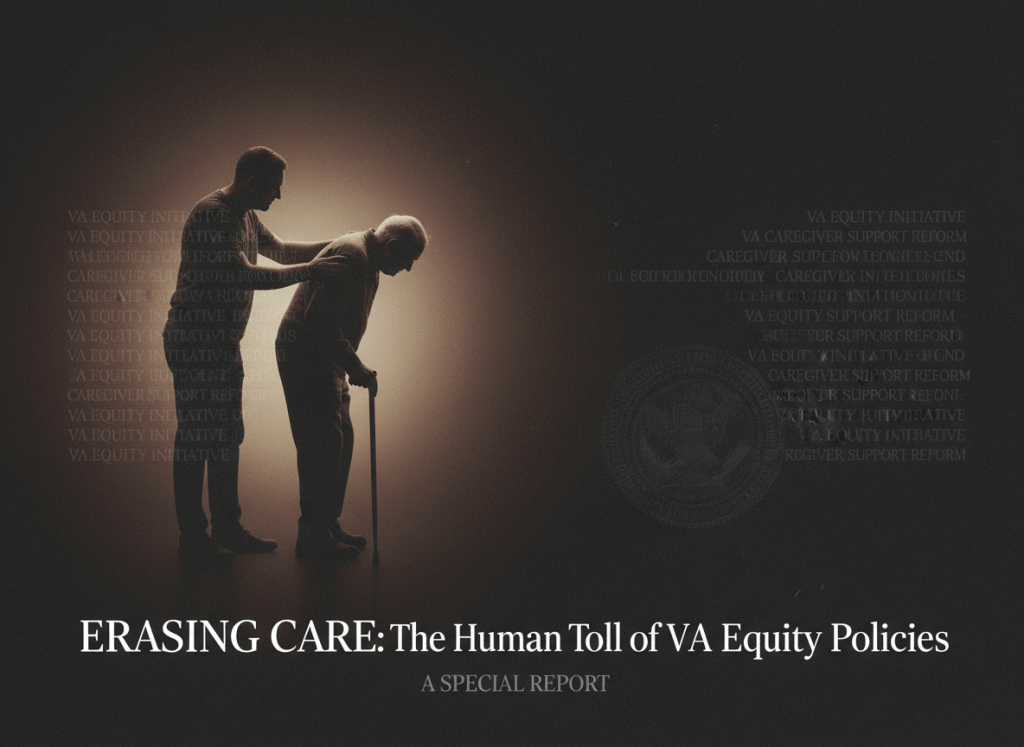
A Case Study in Administrative Overreach
Benjamin Latham is a 100% disabled veteran of the U.S. Marine Corps who served on active duty from 2010 to 2015. Since 2015, he and his wife, Patricia, have relied on the Department of Veterans Affairs (VA) Program of Comprehensive Assistance for Family Caregivers (PCAFC).
For a decade, Patricia served as a “Tier 2” caregiver, providing the essential support that allowed a severely injured Marine to remain in his home rather than an institution.
However, following a legal battle decided in June 2026, the Lathams found themselves at the sharp end of a bureaucratic pivot. Under the mandate of the MISSION Act of 2018, the VA has systematically overhauled the PCAFC, using the language of “equity” and “modernization” to tighten eligibility, increase surveillance, and cap compensation.
The Lathams’ legal struggle, culminating in a denial by the Court of Appeals for the Federal Circuit, illustrates a chilling reality: settled benefits are being traded for administrative convenience, and the courts are refusing to stop it.
The “Legacy” Ticking Clock: The 2028 Deadline
For the thousands of families like the Lathams, the 2020 regulatory overhaul created a “legacy” status—a temporary reprieve for those enrolled before the new, more restrictive rules took effect.
During the rulemaking process, veterans’ advocates pleaded with the VA to “grandfather” these participants. The VA’s response was classic bureaucratic coldness: they rejected grandfathering because maintaining two separate systems would be “administratively prohibitive” and create “inequities.”
In this perverse logic, “equity” means ensuring that if new veterans are subjected to harsher standards, old veterans must eventually suffer them too.
The VA’s solution was a “transition period” that has been kicked down the road multiple times, but the clock is about to run out.
The Road to 2028
| Date of Rulemaking | Source Citation | Transition Deadline |
| July 2020 | 85 Fed. Reg. 46226 | Original 12-month period |
| September 2021 | 86 Fed. Reg. 52614 | Extended to Sept. 30, 2025 |
| September 2022 | 87 Fed. Reg. 57602 | Extension maintained |
| September 2025 | 90 Fed. Reg. 46477 | Final Cutoff: Sept. 30, 2028 |
By September 30, 2028, the “legacy” label expires. At that point, the “geographic residency limit” under 38 U.S.C. § 101(20) and the more stringent medical criteria will apply to everyone, regardless of how many years they have served as the backbone of a veteran’s recovery.
Surveillance in the Sanctuary: The Fourth Amendment and In-Home Visits
To keep their benefits, veterans must now permit VA caseworkers to enter the sanctuary of their homes.
Under 38 U.S.C. § 1720G(a)(9)(C), the VA claims the authority to conduct in-home assessments to “review directly the quality of personal care.”
The Lathams challenged these visits as an unreasonable search under the Fourth Amendment. However, the court relied on the 1971 precedent Wyman v. James, a case involving the Aid to Families with Dependent Children (AFDC) program.
By citing Wyman, the court effectively equated 100% disabled veterans to welfare recipients, ruling that home visits are a “reasonable administrative tool” for the “dispensation” of benefits.
The power dynamic is absolute:
- Mandatory Submission: The statute’s “may include” language grants discretion to the VA, not the veteran. Beneficiaries have no right to opt out.
- The Penalty of Privacy: Refusal to allow an agent into the home results in the immediate termination of benefits.
- The Indignity of Oversight: Domestic privacy is officially secondary to “administrability,” turning a veteran’s home into a site of permanent state surveillance.
The Financial Squeeze: GS Scales and the 40-Hour Cap
In 2020, the VA abandoned the Bureau of Labor Statistics (BLS) hourly wage tables in favor of the Office of Personnel Management General Schedule (GS) scale (38 C.F.R. § 71.15). The agency’s “reasoned explanation” was that this would ensure stipends are at least equivalent to what a commercial home health aide earns.
However, this shift introduced a rigid 40-hour weekly cap on compensation. This is the ultimate bureaucratic fiction: it assumes that family care-giving is a 9-to-5 job.
While a commercial entity would charge a fortune for 24/7 care, the VA uses the 40-hour cap to limit its liability, ignoring the reality that family caregivers are on duty 168 hours a week. The VA justifies this as “matching commercial rates,” but for families like the Lathams, it is a significant financial squeeze that fails to account for the total sacrifice of the caregiver.
Redefining Disability: The ADL vs. IADL Pivot
The VA has also narrowed the definition of who is “disabled enough” by retreating into strict constructionism.
The agency now focuses almost exclusively on “Activities of Daily Living” (ADLs), physical tasks like bathing and dressing, while explicitly excluding “Instrumental Activities of Daily Living” (IADLs), such as managing finances or medications.
By relying on 38 U.S.C. § 1720G(a)(2)(C)(i), which mentions ADLs specifically, the VA used this narrow focus to eliminate the “automatic eligibility pathway” for veterans with 100% disability ratings and aid-and-attendance allowances.
The VA argued that these veterans would “likely” qualify under the new standards anyway. The Lathams’ case exposes this as a bureaucratic mirage, which shows that despite Benjamin’s 100% rating and decades of service-connected injury, the VA’s new framework found him ineligible during his reassessment.
The Legal Fortress: Why the Courts Won’t Intervene
Veterans seeking relief from these rules are finding a legal no-man’s land.
Under 38 U.S.C. § 502, the Court of Appeals for the Federal Circuit has restricted its own power to a “highly deferential” review.
- Facial vs. As-Applied: The court will review the rules as they are written (“facial challenges”), but it refuses to review how those rules are applied to a veteran’s specific medical evidence (“as-applied challenges”).
- The “Not Equipped” Defense: The court explicitly stated it is “not equipped” to make findings of fact regarding a veteran’s medical needs, effectively insulating the VA’s medical reassessments from judicial oversight.
- The Stare Decisis Trap: Even after the landmark 2024 decision in Loper Bright Enterprises v. Raimondo ended Chevron deference, the court refused to help the Lathams. It held that its earlier decision in Veteran Warriors, Inc. v. Secretary of Veterans Affairs (2022) remains binding precedent.
In the Lathams’ case, the court admitted their VHA ineligibility finding was “moot” for technical reasons, yet used it to grant them standing just to tell them that the law provides no remedy for their specific medical dispute.
Conclusion: The Price of “Administrability”
The trajectory of the PCAFC is a cautionary tale of how rights are eroded through the “readjustment of burdens.”
By September 30, 2028, the VA will have fully purged the legacy protections, leaving thousands of veterans to face an “administrative trap” of 40-hour caps, ADL-only assessments, and mandatory home surveillance.
Who truly benefits from this “streamlined” system?
It is not the Marine who gave his health to his country, nor the spouse who gave a decade to his care.
It is the agency, which has successfully traded the complexity of individual human needs for the simplicity of a General Schedule scale.
When the state is permitted to prioritize “administrability” over the promises it made to its defenders, the resulting “equity” is merely the equal distribution of a betrayal.
The Lathams’ case is one piece of a broader picture of the VA’s relationship with the veterans it serves. The community care system that was supposed to fill gaps in VA capacity — the same MISSION Act framework at stake in the Lathams’ case — is examined in our report on how 128 of 133 VA systems failed the seven-day mental health scheduling standard. And the systemic misuse of eligibility rules that costs $1.7 billion annually is documented in our investigation into the VHA’s eligibility blind spot. The VA’s administrative machinery has learned to optimize for its own continuity. The Caregiver Sunset is the price veterans pay for that preference.
- Deja Vu on the Clinch River: TVA’s New Nuclear Bet Looks a Lot Like Its Last One
- SEC Flagged OTC Link’s Access-Control Problem in 2016. It Was Still There in 2023.
- VA Pricing Problems Spread Beyond Drugs, With 11 of 12 Medical-Supply Proposals Flagged
- The Postal Service and Its Watchdog Cannot Agree on Whether They Spoke in 2024
- The Pentagon’s Own Gas Station Is Losing Money on Every Gallon

