
The Ordinary Morning and the Fateful Swap
For First Officer James Morgan Tucker, Jr., April 7, 1994, began with the clinical routine of the American professional. He spent his morning at a medical office, successfully renewing his FAA medical certificate, the essential paperwork that permitted his continued employment at Federal Express. His afternoon plans were equally routine: a recreational flight in his personal 1946 Luscombe 8A.
The day’s trajectory shifted due to a rigid bureaucratic quirk. A FedEx crew returning to Memphis had logged exactly one minute over the FAA’s “eight-hour rule.” Under strict company policy, they were disqualified from their next leg. This “one-minute crew swap” forced dispatchers to assemble a replacement team for Flight 705, an out-and-back cargo run to San Jose. Captain David Sanders and Flight Engineer Andy Peterson were called in, along with Tucker, who, despite being a check airman and captain-qualified on the DC-10, agreed to fly as First Officer to fill the administrative gap.
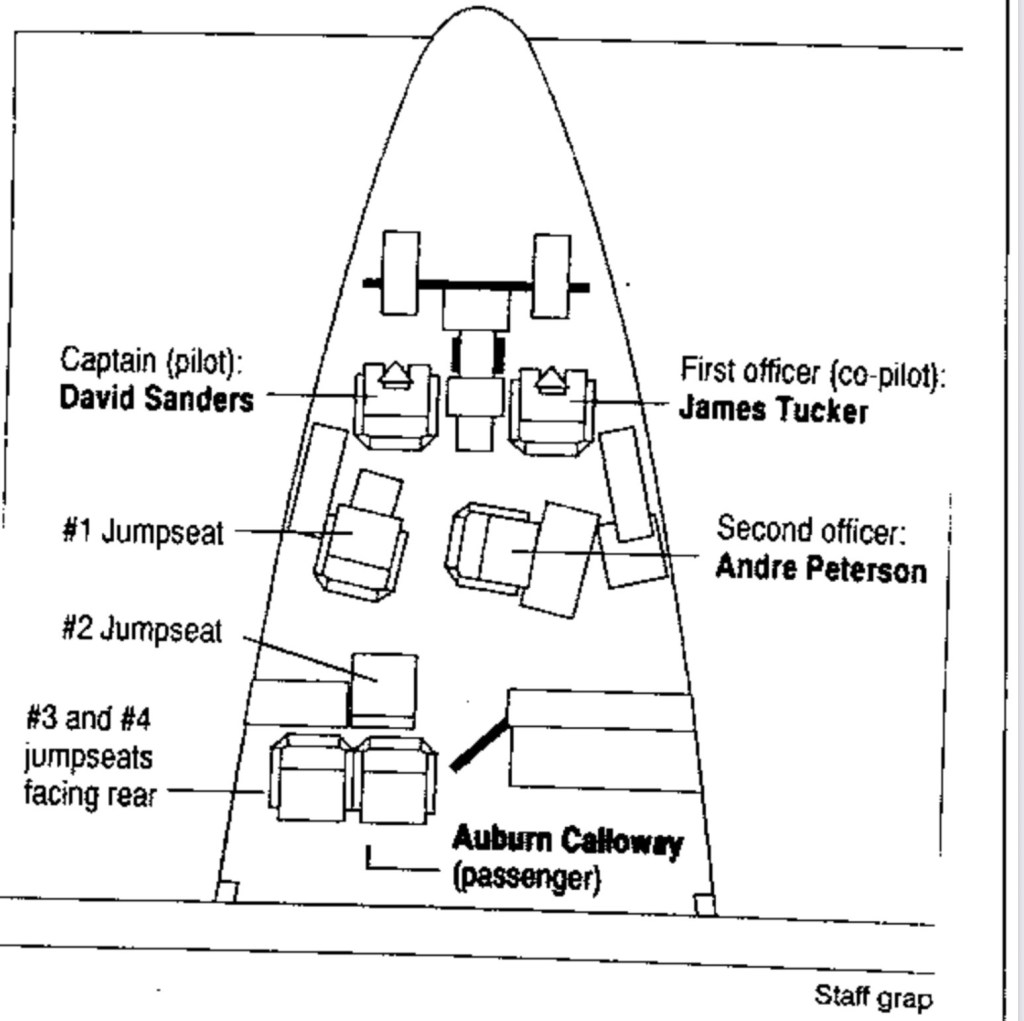
As the crew boarded the three-engine DC-10-30F (N306FE), they found a fourth man already in the cockpit jumpseat: Auburn Calloway. A 42-year-old FedEx engineer and former Navy pilot, Calloway was officially listed as an off-duty passenger. In the ledger of the airline, he was just another employee catching a ride.
The Arsenal in the Guitar Case
The irony of the Flight 705 manifest was systemic. While the flight crew was being policed for a single minute of overtime, Calloway was the subject of a far more grave internal investigation.
FedEx had discovered irregularities and falsified flight hours in his employment history. As he faced a disciplinary hearing that would end his career, Calloway had calculated a final, desperate move. By staging a “workplace accident” crash, he intended to trigger a $2.5 million life insurance payout to provide for his family following his impending termination.
To ensure the crash was perceived as a mechanical failure rather than a hijacking, Calloway smuggled a specialized arsenal onto the aircraft inside a guitar case:
- Two 20-ounce framing hammers
- Two sledgehammers
- A spear gun
Calloway’s preparation was procedural. Before takeoff, he attempted to pull the circuit breaker for the Cockpit Voice Recorder (CVR). He knew that if he were to kill the crew and crash the jet, the “black box” must not contain the sounds of a struggle that would invalidate his family’s insurance claim.
Chaos at 18,000 Feet
Twenty minutes after departure, as the aircraft climbed through 18,000 feet, the routine was shattered. Calloway entered the cockpit and began an assault characterized by what the survivors called a “ghastly metallic ring”—the sound of a framing hammer striking the skull of Andy Peterson.
Calloway attacked with rhythmic, focused brutality. Peterson’s temporal artery was ruptured, causing him to lose nearly half his blood volume in minutes. Turning to the pilots, Calloway struck James Tucker in the left parietal area of his skull, driving bone fragments into the brain and causing immediate numbness across the right side of Tucker’s body.
Captain Sanders suffered multiple fractures and a partially severed ear. Tucker would later describe the surreal shift into survival mode:
“The psychology of the whole affair was total madness—the images before me were completely out of context… Blood-slickened hand-to-hand combat had taken place here. They were anaerobic, gasping for breath.”
The Aircraft as a Weapon: Tucker’s Maneuvers
Severely injured and losing motor function, James Tucker realized that the crew could not win a physical fight against an armed attacker. He turned to the only weapon available: 390,000 pounds of McDonnell Douglas engineering.
Utilizing his Navy training as a combat maneuvering instructor, Tucker began to fly the DC-10 into territory the airframe was never designed to inhabit.
With max climb power selected and the aircraft in Control Wheel Steering (CWS) mode, Tucker rolled the jet toward a 140-degree bank—nearly upside down. Critically, Tucker’s “presence of mind” led him to stop the roll at 140 degrees rather than completing it. He reasoned that if he righted the plane, Calloway would simply regroup; by holding the aircraft at an extreme angle, he kept the attacker pinned and disoriented.
The technical stress was catastrophic. Tucker plunged the aircraft into a high-speed “Split-S” dive, reaching speeds where “Mach tuck” buffeting began to shake the airframe. The forces were so violent that 200-pound control balance panels were ripped from the elevators.
- Maximum Bank Angle: 140 degrees (Held tactically to pin attacker).
- Maneuver: Modified barrel roll / Split-S dive from 18,000 to 12,000 feet.
- Airframe Stress: Mach tuck buffeting; loss of elevator balance panels.
The Galley Battle and the Will to Live
The maneuvers threw Calloway from the cockpit into the forward cargo area, but the war continued. Unlike a terrorist, Calloway did not want an immediate crash; he wanted to fly the plane to a target to stage his “accident.”
This tactical goal is why he did not simply pull the engine fire levers above the engineer’s station, and it resulted in a grueling, 15-minute hand-to-hand battle.
Despite a ruptured artery, Andy Peterson re-engaged the CVR circuit breaker to ensure the evidence remained. He then threw himself into the fight in the galley, using his weight to pin Calloway while Sanders returned to the controls. Tucker, with his right side paralyzed, used his weight to assist Peterson, fending off Calloway’s attempts to gouge his eyes.
The Heavy Landing in Memphis
Captain Sanders took the controls for a desperate emergency return to Memphis. The aircraft was dangerously overweight, laden with kerosene for the long-range trip to San Jose. A standard fuel jettison was impossible given the ongoing combat in the cabin and the structural damage; the wings were already dripping fuel from the massive torque applied to the spars during Tucker’s maneuvers.
Sanders brought the damaged, leaking jet down for a “heavy landing.” When the aircraft stopped, the cockpit was a visceral crime scene. Paramedics, led by David Teague, had to climb up the emergency slides to reach the crew. They found the survivors still physically restraining Calloway, their flight suits soaked in so much blood it was difficult to distinguish the victims from the attacker.
The Flight of Justice: Investigation and Trial
The FBI’s investigation quickly stripped away Calloway’s “accidental” narrative. Agents recovered a suicide note and records of large financial transfers to his ex-wife.
During the 1995 trial, Calloway’s defense of diminished responsibility was rejected after blaming a sleeping disorder.
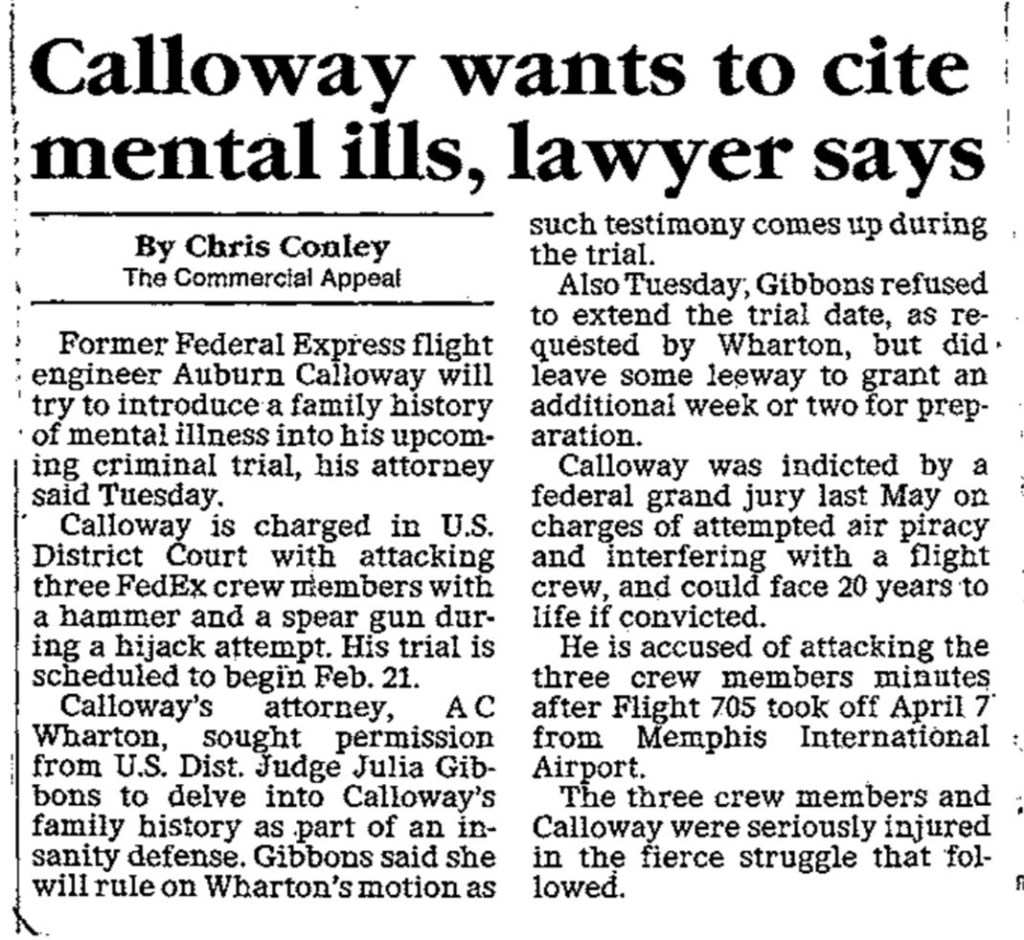
In early 2025, the bureaucracy of the legal system delivered its final word on Calloway. Now 71 years old and citing chronic medical infirmities, Calloway filed motions for compassionate release. On February 10, 2025, the U.S. Court of Appeals for the Sixth Circuit affirmed the denial of his release, citing the “disturbing” nature of his crimes and the permanent trauma inflicted on the crew.
| Category | Detail |
|---|---|
| Defendant | Auburn Calloway (Age 71 as of 2025) |
| Charges | Attempted aircraft piracy, interference with flight crew |
| Defense | Sleeping disorder / Insanity (Rejected) |
| Sentence | Two consecutive life sentences without parole |
| Current Status | Incarcerated at USP Coleman I (Appeal for release denied Feb 2025) |
Life After Flight 705: The Survivors
On May 28, 1994, the American Pilots’ Association awarded the crew the Gold Medal for Civilian Valor. However, the systemic reality was that their professional lives were over.
- James Tucker: Suffered a depressed skull fracture and subsequent brain abscess. The resulting seizure disorder permanently disqualified him from commercial flying. He moved to rural Alabama, serving as a lay preacher. In 2002, he returned to the sky recreationally in his beloved Luscombe 8A.
- David Sanders: Retired from commercial aviation and became a reclusive but respected speaker for groups like the National Association of State Aviation Officials (NASAO).
- Andy Peterson: Sustained a ruptured temporal artery and massive blood loss. Due to the severity of his head trauma, he never resumed his career, living a quiet, private life.
The Thin Line of Resilience
The “20-minute war” was a collision between calculated malice and the ingrained discipline of Navy-trained aviators. The crew’s ability to use a 390,000-pound cargo jet as a tactical weapon while suffering from life-threatening trauma remains a masterclass in resilience.
The aircraft involved, N306FE, proved as resilient as its crew. After being meticulously cleaned and repaired, the DC-10 returned to the FedEx fleet, serving as a silent workhorse for nearly three more decades.
It was finally retired in December 2022 and served as a long-lived witness to the day the bureaucracy of a “one-minute swap” accidentally put the right heroes in the cockpit.
- The Fund That Worked Until It Almost Didn’t: FDIC, 2023, and the Return of the Bank Run
- The Two Year Emergency Order That Needed Seven Years and an Act of Congress to End
- The Department of Veterans Affairs Discovers a New Definition of “Still Under Review”
- The $1.4 Billion HUD Couldn’t Be Bothered to Count
- America.gov Is Anonymous Until It Isn’t

