Investigative Summary
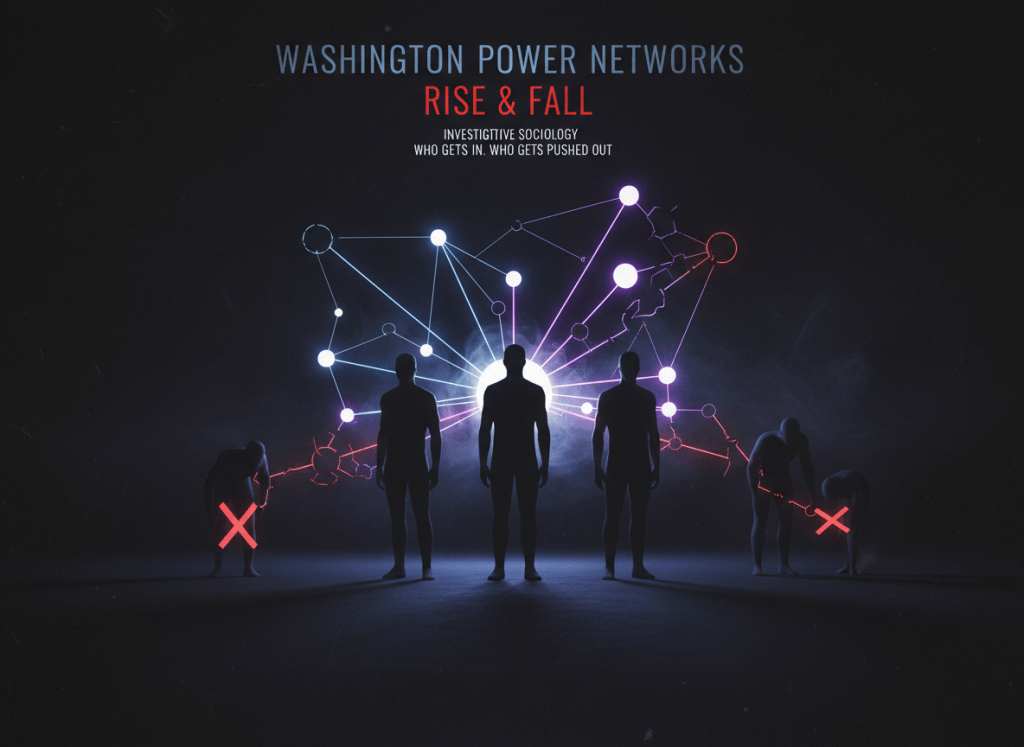
The fall of Abe Fortas was never an isolated event. It formed one visible node in a deeper, enduring web of influence that connected defense contractors, Senate fixers, FBI surveillance, and executive ambition across administrations.
What the declassified FBI files portray as bureaucratic caution around a threatened Justice was, in reality, the machinery of state modulating its own; that is, protecting insiders while they proved useful, then carving them out when political winds shifted.
From Fred Black’s lobbying empire and Bobby Baker’s Serv-U vending operation to the discreet networking at the Quorum Club, these networks blended money, access, sex, and kompromat into a system that delivered comfort to the powerful and selective justice to everyone else.
Fortas himself moved fluidly within this ecosystem, leaking Court secrets in the 1966 Black bugging case to shield the FBI and LBJ before becoming its casualty in 1969. The patterns here are not cartoonish conspiracy but something more insidious: predictable institutional self-preservation.
Governments can advance civil liberties through rulings like Fortas’s, yet they routinely subordinate independence, ethics, and accountability to the demands of power transitions. Tracing this web reveals how little has changed in the fundamentals, even as the venues evolve.
The Connective Tissue
At the center sat Fred Black, a Washington lobbyist whose value derived from proximity to power. His contracts with North American Aviation, a giant in Cold War missiles and Apollo rocketry, paid handsomely for “government relations.” Black’s hidden stake in Serv-U Corporation turned vending machines into a cash engine at defense plants.
Serv-U secured lucrative, non-competitive placements at North American facilities almost overnight, displacing established operators through influence rather than merit. The same FBI that later probed Fortas’s finances had bugged Black’s Sheraton-Carlton suite in 1963 under the banner of organized crime and gambling inquiries. Those recordings captured political chatter and attorney-client conversations, delivering intelligence that served Bureau and White House interests far beyond any racketeering case.
Abe Fortas stepped into this mess in 1966. As a sitting Justice with deep LBJ ties, he leaked confidential Supreme Court deliberations to Hoover’s deputy, Cartha DeLoach. The goal was clear: contain the fallout from the illegal bug, shift blame toward Robert F. Kennedy, and protect the institutional arrangements that benefited the administration.
This was not abstract ethics. It was raw executive-judicial entanglement, the kind that blurs separation of powers until it becomes inconvenient.
Kompromat and Cultural Warfare
Layered atop the financial and surveillance tracks ran the quieter arts of leverage.
Publicly, Strom Thurmond’s 1968 hearings weaponized obscenity cases, screening explicit films from decisions Fortas had supported in what became known as the “Fortas Film Festival.” This cultural assault played well to conservative backlash against the Warren Court’s civil liberties expansions.
Privately, Hoover’s Bureau maintained extensive files on sexual matters and personal vulnerabilities, the kind of compromising material that needed no courtroom. Bobby Baker’s Quorum Club, tucked above the Carroll Arms Hotel near the Senate, embodied the social lubricant of the era, offering drinks, poker, and arranged liaisons that mixed senators, lobbyists, and influence operators.
Figures like Ellen Rometsch moved through these circles, their stories later fueling whispers of higher-level entanglements. That same ecosystem Fortas helped shield in 1966 would later contribute to the environment that made him expendable.
The Pivot
By 1969, the guard had changed. Nixon’s Justice Department, through Will Wilson and others, amplified existing vulnerabilities, namely the Wolfson retainer, the Florida trip, alleged SEC meddling.
The Bureau’s May 7 decision to hold the conduct probe in abeyance preserved leverage without immediate public explosion. Real threats from antisemitic cranks and the Richmond “last speech” caller received protection details, yet forensic trails like the Philadelphia P.O. Boxes faded. Fortas resigned on May 14, clearing space for a more conservative Court.
The machinery had done its work: protect when useful, probe when aligned with new priorities, and bury inconvenient details in redactions and silence.
Enduring Patterns
This web did not dissolve with Fortas’s resignation. Baker’s Quorum Club model survived relocation and rebranding, evolving into today’s 116 Club at 234 3rd Street NE, which is a venue where lobbyists continue to underwrite access for lawmakers, as modern tax filings quietly confirm. Defense influence, revolving-door networking, and selective enforcement persist because they serve the comfort of insiders and the stability of institutions. Citizens may crave genuine freedom from such entanglements, yet too often submit to the familiar machinery for perceived safety or partisan gain.
The Fortas episode, when viewed through Black’s contracts, Serv-U’s rapid rise, and the broader kompromat environment, exposes a recurring truth. There are no permanent allies or permanent victims—only shifting utility within the network. Governments can and sometimes do good, delivering stability or rights expansions. But the default remains self-preservation, with bureaucratic abeyance, ignored trails, and timed revelations serving as the quiet tools of realignment.
Unresolved Threads and the Path Forward
Several questions linger at the edges of the declassified record:
What precisely did the specially requested accountant uncover in Fortas’s finances before the pause?
Were deeper overlaps between Wolfson’s circle and the defense-vending networks ever fully mapped?
How extensive were Hoover’s private files on Fortas and other justices?
These are not historical footnotes. They are reminders that vigilance against institutional capture must be constant, regardless of which party holds the levers.
Fortas’s story, and the web it reveals, should leave us wary but clear-eyed.
Real ideological threats existed alongside genuine contributions to civil liberties. Real ethical compromises by insiders invited the scalpel. The machinery protected and devoured according to its own logic, not the public’s. Understanding that dynamic is the first defense against its repetition. The patterns endure because they are comfortable for those inside the web.
Our job is to keep shining light on the dark recesses of government until accountability catches up.
- SEC Flagged OTC Link’s Access-Control Problem in 2016. It Was Still There in 2023.
- VA Pricing Problems Spread Beyond Drugs, With 11 of 12 Medical-Supply Proposals Flagged
- The Postal Service and Its Watchdog Cannot Agree on Whether They Spoke in 2024
- The Pentagon’s Own Gas Station Is Losing Money on Every Gallon
- The $215 Million Quantum Race That Took Washington a Decade to Build
Sources
1. FBI Records: The Vault — Abe Fortas (Parts 01–03). Declassified files on threats, investigations, abeyance memos, and related matters.
https://vault.fbi.gov/abe-fortas
2. FBI documents and memos on the Fred Black case (1966), including DeLoach-Fortas communications, released via FOIA. Analyzed in Charns and other historical works.
3. Life Magazine exposé on Fortas and Louis Wolfson (May 9, 1969). The triggering scandal coverage.
4. Laura Kalman, *Abe Fortas: A Biography* (Yale University Press, 1990). Comprehensive account of Fortas’s life, LBJ ties, Black case, and resignation.
https://www.harvard.com/book/9780300052589 (or libraries/Internet Archive).
5. Alexander Charns, *Cloak and Gavel: FBI Wiretaps, Bugs, Informers, and the Supreme Court* (University of Illinois Press, 1992). Detailed FOIA-based analysis of Fortas as informant and FBI-Court relations.
Available via archives and academic libraries.
6. Senate investigations and hearings on Bobby Baker and Serv-U Corporation (1963–1965), including North American Aviation contracts. Congressional Record and Rules Committee reports.
7. Contemporary New York Times coverage of Serv-U scandal, Fred Black, and North American Aviation contracts (1964 articles on vending deals and terminations).
8. Black v. United States, 385 U.S. 26 (1966). Supreme Court opinion related to the illegal bugging.
https://www.law.cornell.edu/supremecourt/text/385/26
9. ProPublica Nonprofit Explorer — 116 Inc (EIN 52-0742077) Form 990 filings (recent years through 2025). Details on finances, board, and operations of the successor to the Quorum Club.
https://projects.propublica.org/nonprofits/organizations/520742077
10. Additional historical context on Quorum Club, Bobby Baker, Ellen Rometsch, and related influence operations from contemporaneous reporting and Baker’s own accounts (e.g., Senate records and biographies).

