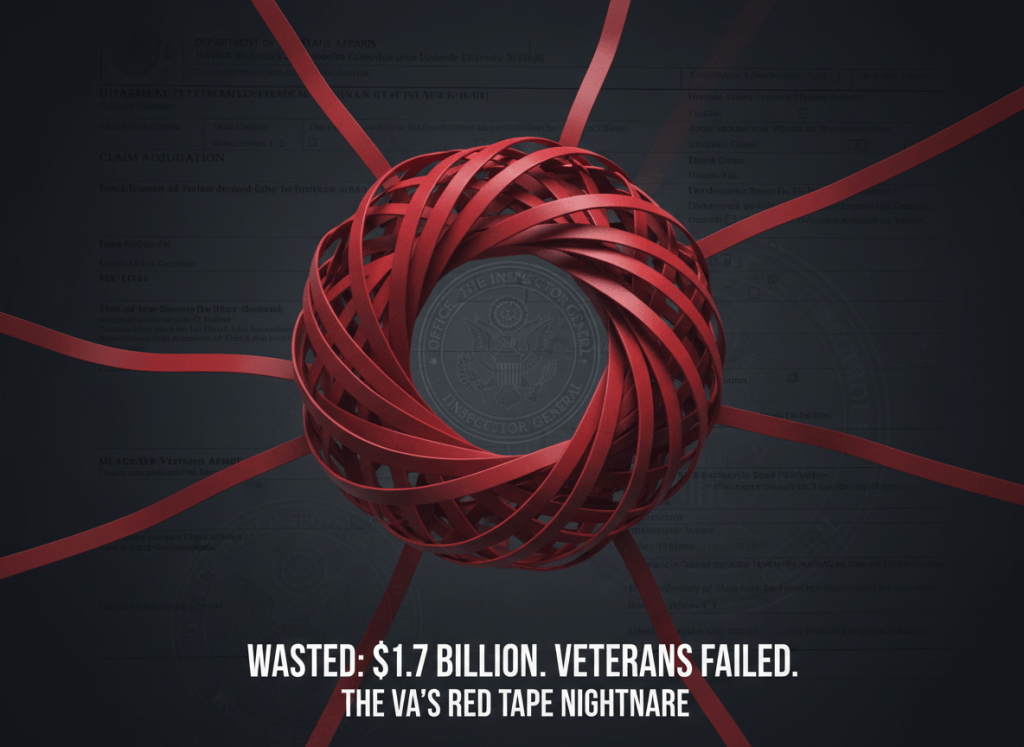
In the sterile corridors of government oversight, the term “monetary benefits” is often used as a polite euphemism for “money we set on fire.” The 2026 Office of Inspector General (OIG) audit of the Veterans Health Administration (VHA) reveals a bonfire of historic proportions.
At a time when veterans are forced to navigate a labyrinthine healthcare system, the VHA has managed to lose $1.7 billion in annual unnecessary spending. This was done, not through a single catastrophic error, but through a thousands-of-cuts policy of bureaucratic inertia.
This is more than a fiscal oversight. It is a systemic failure of a machine that has become so obsessed with its own procedural limitations that it has effectively nullified the legal rights of the men and women it was built to serve.
Bureaucracy by the Numbers
The scale of the VHA’s administrative dysfunction is captured in several staggering metrics from the OIG’s findings:
- $1.7 Billion: The estimated annual cost of unnecessary community care spending triggered by inaccurate eligibility determinations.
- 25% Improper Approval Rate: Approximately 340,000 consults were sent to outside providers despite the veterans being ineligible, often because the VA ignored its own internal capacity.
- 38% Silence Rate: Roughly 1.8 million veterans already funnelled into the VA’s direct care system were eligible for outside treatment but were never documented as being informed of their legal right to choose.
- $114.4 Million: The conservative estimate of added annual costs incurred because veterans chose community care without being told a faster VA appointment was actually available.
- $440 Million per Quarter: The current rate at which the VHA is hemorrhaging taxpayer funds due to its inability or refusal to refer veterans to available VA facilities.
These figures represent a direct subversion of the legal framework established by Congress to provide veterans with agency over their own healthcare.
Law vs. Manual: The Subversion of the MISSION Act
The MISSION Act was designed to be a tool of liberation for the veteran, providing a clear legal path to private care when the VA fails to meet basic standards of wait times or distance. However, as the OIG audit reveals, administrative “guidance” is being used as a weapon to prune back those liberties.
By creating internal rules that deviate from the plain language of the law, the Office of Integrated Veteran Care (IVC) has effectively created a two-tiered system of rights.
| The Law (MISSION Act) | The Bureaucratic Reality (IVC Guidance) |
|---|---|
| Makes no distinction between new and established patients regarding eligibility. | Instructs staff to check all eligibility criteria only for new patients. |
| Requires assessment of wait times, drive times, and service availability for all veterans. | For established patients, schedulers assess only wait-time eligibility, ignoring drive-time standards. |
| Mandates that veterans be informed of their right to choose between VA and community care. | Bypasses drive-time assessments for established patients unless the veteran specifically asks for it. |
The “So What?” Layer
The VHA’s artificial distinction between patient types is a calculated administrative hurdle. By routinely stripping established patients of their right to drive-time assessments, the VHA prioritizes “continuity of care” (a non-statutory, internal preference) over the veteran’s legal right to see a doctor closer to home.
This is the administrative state at its most cynical: using a vague institutional preference as a loophole to bypass legal requirements and maintain control over the veteran population.
The Consult Toolbox: A Case Study in Systematic Blindness
The VHA’s failure is also a technological one. When legal entitlements are mediated through flawed software, the software becomes the de facto law. The “Consult Toolbox” (CTB), mandated for use in 2023, was supposed to standardize care. Instead, it has become a digital wall between veterans and their care.
- Inability to See Alternative Calendars: While the system can identify a VA facility within a veteran’s drive-time standard, it cannot actually see that facility’s schedule. Schedulers are left blind, unable to book a veteran at a nearby VA center even if an appointment is available.
- Lack of Community Wait-Time Data: The system frequently fails to show how long a veteran will wait in the private sector, making it impossible for a veteran to make a “fully informed decision” as required by law.
- Inaccurate Service Mapping: The software identifies only general clinical categories rather than specific procedures, leading to widespread eligibility errors.
The Failure of Specificity
The “Inaccurate Service Identification” issue is particularly egregious. If a veteran needs an Echocardiogram, but the local VA facility hasn’t digitally linked that specific procedure to the broad Cardiology category in the toolbox, the system defaults to a “false positive.”
It assumes the VA cannot provide the service at all, triggering an automatic, and often unnecessary, eligibility for community care. The VA, it seems, would rather pay for an outside referral than fix its own digital index.
The Human Element: Manual Overrides and Ghost Schedules
Even when the technology suggests a veteran is ineligible for outside care, the agency finds a way to maintain its own convenience. The OIG found a culture of “unjustified manual overrides” and the use of “ghost” wait times. This happens when schedulers input arbitrary numbers like 30 or 90 days as the “next available” appointment without ever checking the actual facility schedule.
Examples from the OIG Report
“Example 1: At Edward Hines Jr. VA Hospital, a veteran needing specialized dental work was told the next appointment was 88 days away. He was referred to the community at a cost of $6,200. However, the Jesse Brown VA Medical Center, just 52 minutes away, had an average wait time of only 18 days. No one checked.” — OIG Audit Findings
“Example 3: A veteran at the Miami VA Medical Center was forced to drive 135 miles for a podiatry appointment. Because he was an ‘established patient,’ staff followed internal guidance and simply never informed him he was eligible for care closer to home.” — OIG Audit Findings
These cases illustrate a culture that ignores available VA capacity to the tune of $440 million per quarter. It is a system that would rather pay a premium to an outside provider than coordinate a schedule with a neighboring facility.
The December 2025 Promise: Reform or Red Tape 2.0?
The VHA’s answer to these shortcomings is the “Integrated Scheduling Solution” (ISS), a web-based platform whose enterprise-wide rollout began in late 2024 with full implementation targeted for February 2025 across most VistA facilities.
While the VHA markets this as a major step forward, as a modernized replacement for the aging VistA Scheduling Enhancements GUI, a skeptical eye is required for any “technological fix” applied to a deeper structural and cultural crisis.
The proposed (and partially delivered) capabilities of the ISS include:
- Consolidated Scheduling Platform: Merging functions into a single web-based tool for scheduling VA appointments, with ambitions for better provider-based and community care comparisons.
- Cross-Facility Scheduling: Improved visibility and booking across different medical facilities and networks.
- Expanded Online Options: Greater potential for veterans to exercise direct control over scheduling.
Reality Check: While ISS is now deployed and receiving ongoing updates into 2026, true end-to-end integration has lagged. Dedicated integrated scheduling pilots combining direct and community care views only launched in January 2026 at select sites (e.g., Charleston and Atlanta), yielding modest early results.
The OIG has appropriately noted that it remains too early to confirm whether ISS will meaningfully reduce eligibility errors, unnecessary referrals, or the broader inefficiencies plaguing the system.
History supports this skepticism. Previous efforts, such as expansions of the External Provider Scheduling (EPS) system, showed limited real-world adoption, meaning that certain facilities were slow to accept and use the system. Technological solutions falter when the underlying culture and processes resist them.
The Under Secretary for Health has “concurred in principle” with the OIG’s recommendations but pushed back formal eligibility verification processes until June 2027. In the entrenched world of VA bureaucracy, such language often signals a slow-walk strategy (read that as ‘more studies, more delays’), while the $1.7 billion annual waste continues to mount and veterans wait.
Accountability and the Path Forward
When a government department “loses” $1.7 billion annually while veterans are forced to drive 135 miles for care available much closer, the system isn’t just broken, it’s indifferent. The VHA has successfully built a labyrinth where the MISSION Act goes to die, buried under layers of internal memos and “toolbox” glitches.
Tough Questions for the VHA:
- Transparency: Why is the VHA allowed to maintain internal guidance that directly contradicts the plain language of the MISSION Act regarding established patients?
- The 2027 Delay: Why has the Under Secretary for Health delayed the implementation of a formal process to verify eligibility checks until June 2027, effectively signing off on another $1.7 billion in waste?
- The Continuity Loophole: What is the true human cost of the VHA’s “continuity of care” interpretation when it is used as a non-statutory preference to deny veterans faster, closer care options?
True reform did not come from a software update in December 2025. It will only come when the VHA is forced to prioritize a veterans-first approach over a bureaucracy-first survival strategy.
Until then, the $1.7 billion blind spot will continue to grow.
This $1.7 billion dysfunction is part of a larger pattern of VA care access failures. The community mental health scheduling crisis — where 128 of 133 VA systems failed their own seven-day standard — operates on the same broken foundation. And inside the facilities veterans reach after waiting, unwritten test result workflows mean the care that does occur may not be communicated at all. The VA’s compliance infrastructure, examined in detail in our Sterile State investigation, shows how the same agency that can’t schedule a mental health appointment in seven days manages to build elaborate bureaucratic machinery around its own internal operations.
- America.gov Is Anonymous Until It Isn’t
- The Agency That Fired the People Who Knew Where the Files Were
- VA Can’t Count Its Own Toxic Exposures Staff. It Also Can’t Track What They Do.
- The Timesheet That Refused to Change, Four Audits Running
- A Watchdog’s Budget Meets One Objection, and the Senate Leaves for Five Weeks

