Category: Declassified & FBI Files

  • The 20-Minute War at 18,000 Feet: FedEx Flight 705 and the FBI Files

    The Ordinary Morning and the Fateful Swap

    For First Officer James Morgan Tucker, Jr., April 7, 1994, began with the clinical routine of the American professional. He spent his morning at a medical office, successfully renewing his FAA medical certificate, the essential paperwork that permitted his continued employment at Federal Express. His afternoon plans were equally routine: a recreational flight in his personal 1946 Luscombe 8A.

    The day’s trajectory shifted due to a rigid bureaucratic quirk. A FedEx crew returning to Memphis had logged exactly one minute over the FAA’s “eight-hour rule.” Under strict company policy, they were disqualified from their next leg. This “one-minute crew swap” forced dispatchers to assemble a replacement team for Flight 705, an out-and-back cargo run to San Jose. Captain David Sanders and Flight Engineer Andy Peterson were called in, along with Tucker, who, despite being a check airman and captain-qualified on the DC-10, agreed to fly as First Officer to fill the administrative gap.

    As the crew boarded the three-engine DC-10-30F (N306FE), they found a fourth man already in the cockpit jumpseat: Auburn Calloway. A 42-year-old FedEx engineer and former Navy pilot, Calloway was officially listed as an off-duty passenger. In the ledger of the airline, he was just another employee catching a ride.

    The Arsenal in the Guitar Case

    The irony of the Flight 705 manifest was systemic. While the flight crew was being policed for a single minute of overtime, Calloway was the subject of a far more grave internal investigation.

    FedEx had discovered irregularities and falsified flight hours in his employment history. As he faced a disciplinary hearing that would end his career, Calloway had calculated a final, desperate move. By staging a “workplace accident” crash, he intended to trigger a $2.5 million life insurance payout to provide for his family following his impending termination.

    To ensure the crash was perceived as a mechanical failure rather than a hijacking, Calloway smuggled a specialized arsenal onto the aircraft inside a guitar case:

    • Two 20-ounce framing hammers
    • Two sledgehammers
    • A spear gun

    Calloway’s preparation was procedural. Before takeoff, he attempted to pull the circuit breaker for the Cockpit Voice Recorder (CVR). He knew that if he were to kill the crew and crash the jet, the “black box” must not contain the sounds of a struggle that would invalidate his family’s insurance claim.

    Chaos at 18,000 Feet

    Twenty minutes after departure, as the aircraft climbed through 18,000 feet, the routine was shattered. Calloway entered the cockpit and began an assault characterized by what the survivors called a “ghastly metallic ring”—the sound of a framing hammer striking the skull of Andy Peterson.

    Calloway attacked with rhythmic, focused brutality. Peterson’s temporal artery was ruptured, causing him to lose nearly half his blood volume in minutes. Turning to the pilots, Calloway struck James Tucker in the left parietal area of his skull, driving bone fragments into the brain and causing immediate numbness across the right side of Tucker’s body.

    Captain Sanders suffered multiple fractures and a partially severed ear. Tucker would later describe the surreal shift into survival mode:

    “The psychology of the whole affair was total madness—the images before me were completely out of context… Blood-slickened hand-to-hand combat had taken place here. They were anaerobic, gasping for breath.”

    The Aircraft as a Weapon: Tucker’s Maneuvers

    Severely injured and losing motor function, James Tucker realized that the crew could not win a physical fight against an armed attacker. He turned to the only weapon available: 390,000 pounds of McDonnell Douglas engineering.

    Utilizing his Navy training as a combat maneuvering instructor, Tucker began to fly the DC-10 into territory the airframe was never designed to inhabit.

    With max climb power selected and the aircraft in Control Wheel Steering (CWS) mode, Tucker rolled the jet toward a 140-degree bank—nearly upside down. Critically, Tucker’s “presence of mind” led him to stop the roll at 140 degrees rather than completing it. He reasoned that if he righted the plane, Calloway would simply regroup; by holding the aircraft at an extreme angle, he kept the attacker pinned and disoriented.

    The technical stress was catastrophic. Tucker plunged the aircraft into a high-speed “Split-S” dive, reaching speeds where “Mach tuck” buffeting began to shake the airframe. The forces were so violent that 200-pound control balance panels were ripped from the elevators.

    • Maximum Bank Angle:  140 degrees (Held tactically to pin attacker).
    • Maneuver:  Modified barrel roll / Split-S dive from 18,000 to 12,000 feet.
    • Airframe Stress:  Mach tuck buffeting; loss of elevator balance panels.

    The Galley Battle and the Will to Live

    The maneuvers threw Calloway from the cockpit into the forward cargo area, but the war continued. Unlike a terrorist, Calloway did not want an immediate crash; he wanted to fly the plane to a target to stage his “accident.”

    This tactical goal is why he did not simply pull the engine fire levers above the engineer’s station, and it resulted in a grueling, 15-minute hand-to-hand battle.

    Despite a ruptured artery, Andy Peterson re-engaged the CVR circuit breaker to ensure the evidence remained. He then threw himself into the fight in the galley, using his weight to pin Calloway while Sanders returned to the controls. Tucker, with his right side paralyzed, used his weight to assist Peterson, fending off Calloway’s attempts to gouge his eyes.
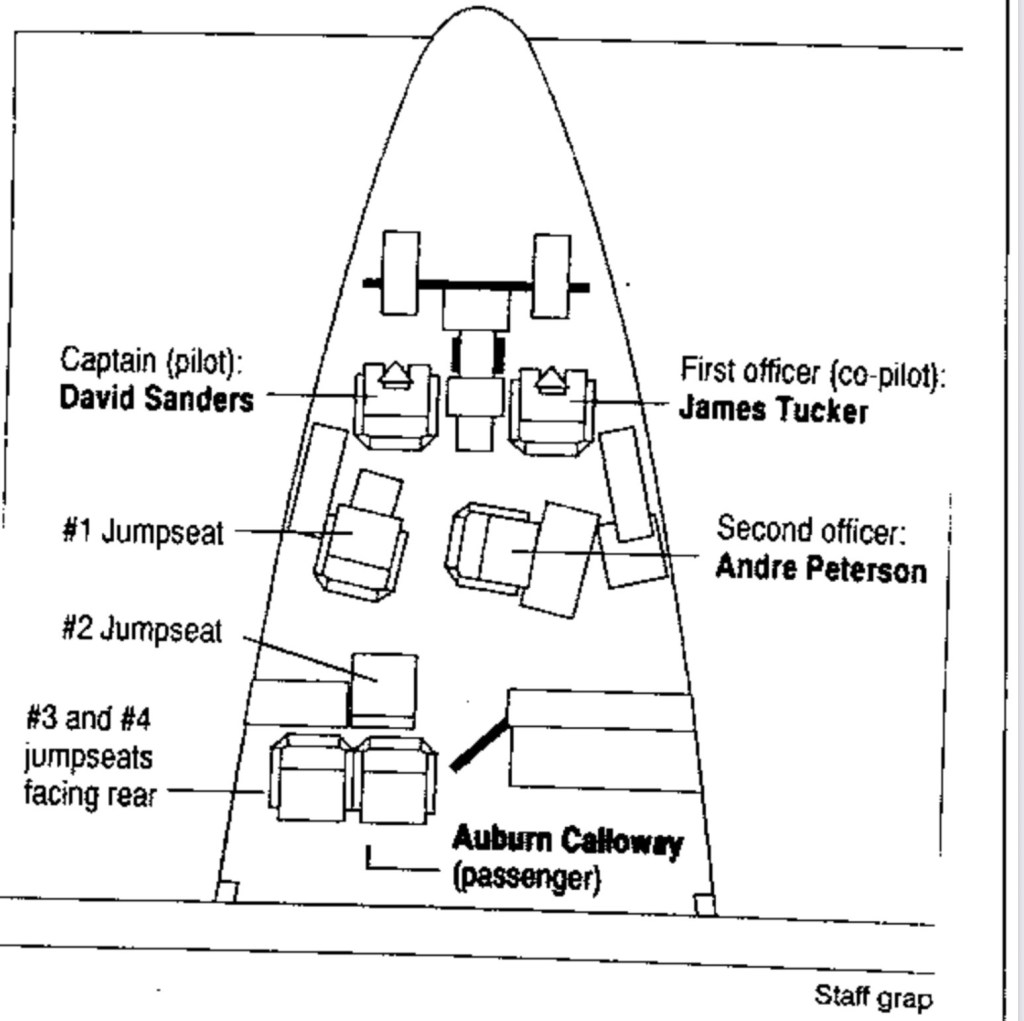
    Diagram of an aircraft cockpit layout, indicating seating positions for the captain (David Sanders), first officer (James Tucker), second officer (Andre Peterson), and several jumpseats, with a passenger position labeled (Auburn Calloway).
    Screenshot

    The Heavy Landing in Memphis

    Captain Sanders took the controls for a desperate emergency return to Memphis. The aircraft was dangerously overweight, laden with kerosene for the long-range trip to San Jose. A standard fuel jettison was impossible given the ongoing combat in the cabin and the structural damage; the wings were already dripping fuel from the massive torque applied to the spars during Tucker’s maneuvers.

    Sanders brought the damaged, leaking jet down for a “heavy landing.” When the aircraft stopped, the cockpit was a visceral crime scene. Paramedics, led by David Teague, had to climb up the emergency slides to reach the crew. They found the survivors still physically restraining Calloway, their flight suits soaked in so much blood it was difficult to distinguish the victims from the attacker.

    The Flight of Justice: Investigation and Trial

    The FBI’s investigation quickly stripped away Calloway’s “accidental” narrative. Agents recovered a suicide note and records of large financial transfers to his ex-wife.

    During the 1995 trial, Calloway’s defense of diminished responsibility was rejected after blaming a sleeping disorder.
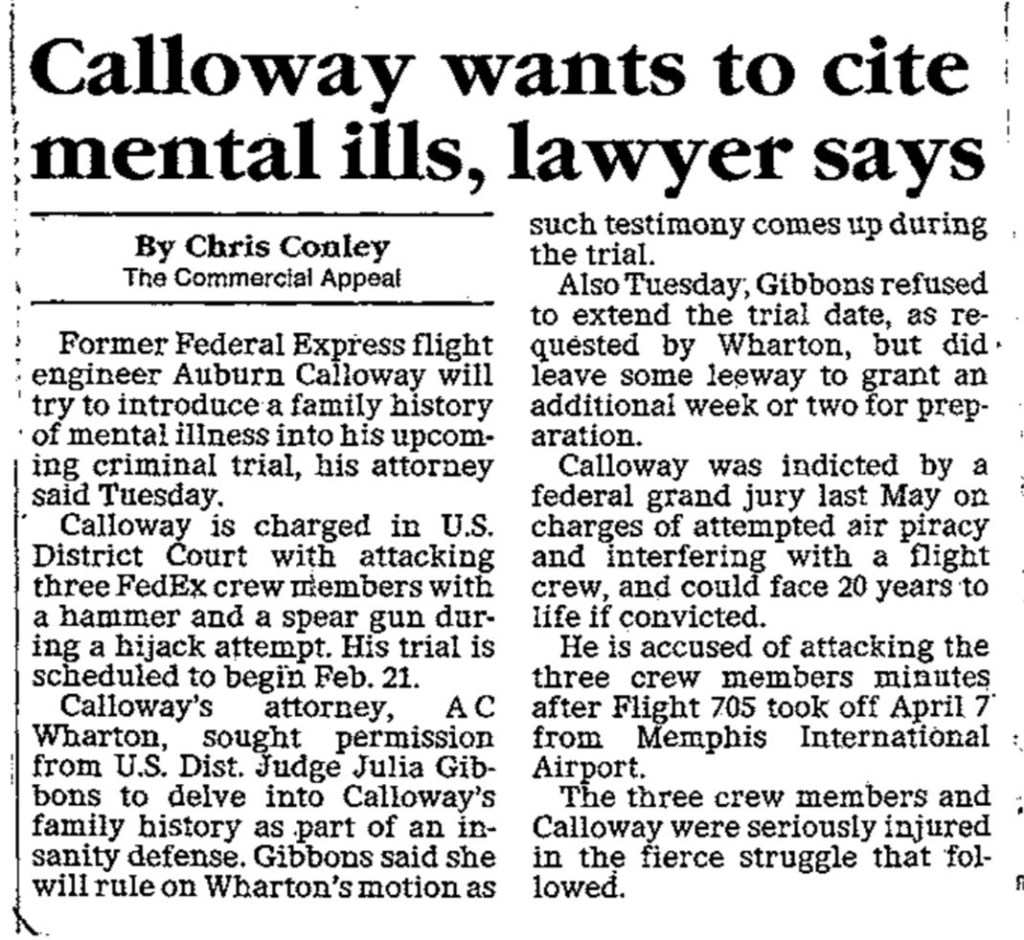
    Newspaper article discussing Auburn Calloway's upcoming criminal trial, citing his intention to introduce a family history of mental illness as part of an insanity defense. The article mentions charges against him for attacking FedEx crew members during a hijack attempt and includes details about the trial date and the judge's response.
    Screenshot

    In early 2025, the bureaucracy of the legal system delivered its final word on Calloway. Now 71 years old and citing chronic medical infirmities, Calloway filed motions for compassionate release. On February 10, 2025, the U.S. Court of Appeals for the Sixth Circuit affirmed the denial of his release, citing the “disturbing” nature of his crimes and the permanent trauma inflicted on the crew.

    CategoryDetail
    DefendantAuburn Calloway (Age 71 as of 2025)
    ChargesAttempted aircraft piracy, interference with flight crew
    DefenseSleeping disorder / Insanity (Rejected)
    SentenceTwo consecutive life sentences without parole
    Current StatusIncarcerated at USP Coleman I (Appeal for release denied Feb 2025)

    Life After Flight 705: The Survivors

    On May 28, 1994, the American Pilots’ Association awarded the crew the Gold Medal for Civilian Valor. However, the systemic reality was that their professional lives were over.

    1. James Tucker:  Suffered a depressed skull fracture and subsequent brain abscess. The resulting seizure disorder permanently disqualified him from commercial flying. He moved to rural Alabama, serving as a lay preacher. In 2002, he returned to the sky recreationally in his beloved Luscombe 8A.
    2. David Sanders:  Retired from commercial aviation and became a reclusive but respected speaker for groups like the National Association of State Aviation Officials (NASAO).
    3. Andy Peterson:  Sustained a ruptured temporal artery and massive blood loss. Due to the severity of his head trauma, he never resumed his career, living a quiet, private life.

    The Thin Line of Resilience

    The “20-minute war” was a collision between calculated malice and the ingrained discipline of Navy-trained aviators. The crew’s ability to use a 390,000-pound cargo jet as a tactical weapon while suffering from life-threatening trauma remains a masterclass in resilience.

    The aircraft involved, N306FE, proved as resilient as its crew. After being meticulously cleaned and repaired, the DC-10 returned to the FedEx fleet, serving as a silent workhorse for nearly three more decades.

    It was finally retired in December 2022 and served as a long-lived witness to the day the bureaucracy of a “one-minute swap” accidentally put the right heroes in the cockpit.


    Fediverse Reactions
  • Investigating the Fall of Abe Fortas

    A Justice in the Crosshairs (1966–1969)

    SUMMARY OF KEY FINDINGS

    In this, the first article in a short series, declassified FBI files concerning Justice Abe Fortas paint him as a victim of ideological extortion, with the Bureau stepping in as his shield against threatening letters and calls. Yet, just beneath the surface of that narrative, a more familiar pattern of institutional self-interest emerges.

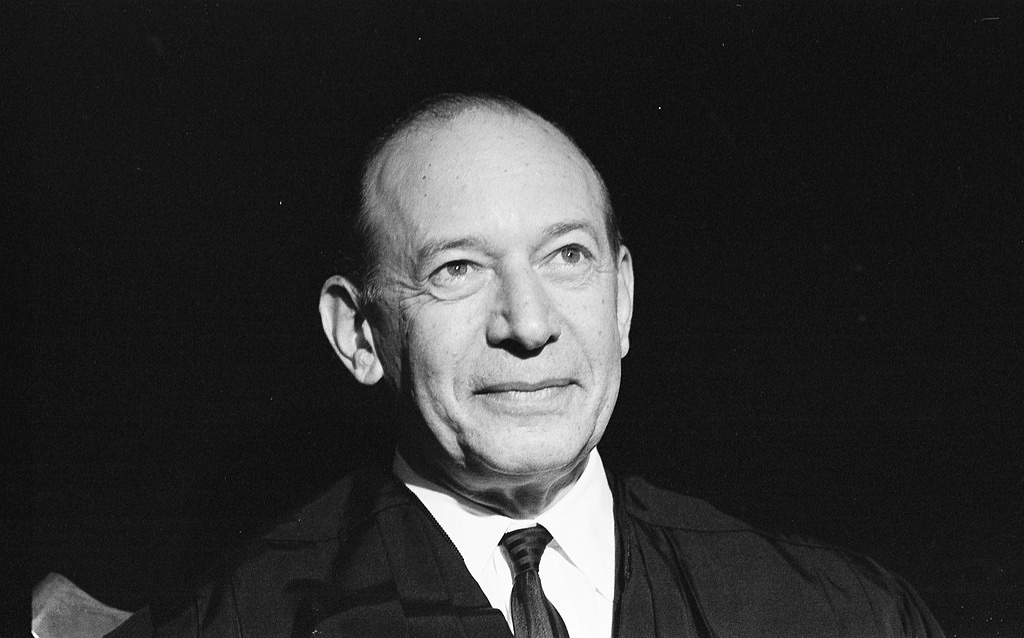
    Close-up portrait of a man in a suit and tie, smiling gently, against a dark background, wearing a judicial robe.
    Supreme Court justice Abe Fortas, head-and-shoulders portrait, facing front.

    It seems that the Bureau ran a dual-track operation: protecting Fortas publicly from antisemitic and segregationist harassment while quietly sharpening tools to probe his financial and political vulnerabilities.

    Even so, Fortas was hardly an innocent outsider swept up in the storm. He was a deeply embedded LBJ insider whose own ethical shortcuts, which include serving as an FBI informant in the 1966 Fred Black bugging affair, left him exposed once power passed from Johnson to Nixon.

    The FBI Vault files reveal real threats rooted in backlash against Fortas’s civil liberties rulings, but they also show bureaucratic abeyance on conduct inquiries timed suspiciously with Nixon-era pressure. Public moral attacks, such as Strom Thurmond’s infamous “Fortas Film Festival” screenings of explicit material from obscenity cases, added another layer of kompromat.

    In the end, Fortas’s fall was less about fringe cranks than the predictable pivot of state machinery, shielding a useful player until it became expedient to dismantle him. Governments can deliver meaningful advances in civil liberties, as some of Fortas’s opinions did; but they just as readily subordinate judicial independence to political necessity.

    The Fortas dossier is a clinical map of that tension.

    CHRONOLOGICAL TIMELINE OF EVENTS

    The timeline exposes the shifting priorities with bureaucratic clarity.

    In August 1966, the first “UnAmerican” letter arrived at Hoover’s desk, laced with criticism of Fortas and “ethnic groups.” That same year, Fortas secretly assisted Hoover and his deputy Cartha DeLoach by leaking confidential Supreme Court deliberations in the Fred Black case.

    Black, a Washington lobbyist with deep ties to North American Aviation and Bobby Baker’s Serv-U vending operation, had been the target of an illegal FBI microphone installed in his Sheraton-Carlton suite. Fortas helped steer the fallout away from the Bureau and LBJ, pinning sloppy oversight on RFK.

    By 1968, the pressure intensified. Fortas’s nomination for Chief Justice collapsed under Strom Thurmond’s relentless attacks, which included private screenings of films from cases where Fortas had voted to protect expression. Around the same period, Philadelphia-postmarked extortion letters from an entity calling itself the “White Racist Majority” escalated the threat environment.

    Then came 1969. On April 14, Nixon’s Assistant Attorney General Will Wilson launched inquiries into Fortas’s 1966 Florida trip and alleged SEC-related associations. By May 7, the Bureau placed the conduct investigation in abeyance to keep it from becoming publicly known.

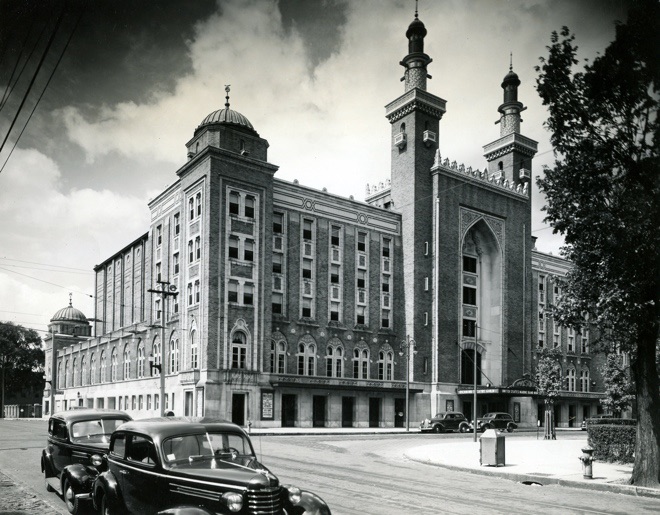
    Two days later, a Richmond caller warned that Fortas’s upcoming speech would be his last. Fortas spoke anyway on May 10 at The Mosque in Richmond, Virginia, a secular Shriners venue with Moorish Revival architecture. Fortas resigned on May 14.

    Historic building with distinctive architecture, featuring towers and ornate details, surrounded by vintage cars on a street.

    That two-year gap between early threats and the 1968–69 escalation tracks Fortas’s deepening entanglement with the Warren Court and LBJ’s fading influence. The 1969 pause, meanwhile, aligns neatly with the new administration’s desire for Court realignment.

    COLD ANALYSIS OF THE EVIDENCE & SOURCES

    Viewed coldly, the forensic details in the FBI files (cheap Woolworth stationery, Philadelphia P.O. Boxes 30 and 43, handwriting matches) point to a lone actor riding the wave of segregationist fury rather than any genuine mass movement. The Bureau’s own lab connected the dots, yet the trail on those post office boxes was never pursued with real vigor.

    At the same time, parallel inquiries into Fortas’s finances moved forward under the cover of “reliable information” from Will Wilson. That timing, which surfaced years after the fact, carries the distinct odor of opposition research rather than organic discovery.

    The Fred Black episode stands as a pivotal contradiction.

    Black’s world of defense lobbying for North American Aviation and hidden Serv-U vending contracts at federal plants exemplified the crony access that defined the era. The FBI bug, sold as an organized crime probe involving gambling ties, delivered rich political intelligence.

    Fortas’s willingness to leak Court positions to protect the Bureau and LBJ exposed the incestuous reality behind the “protected victim” framing. Contemporary accounts, biographies such as Laura Kalman’s, and analyses by Alexander Charns align closely with the files but fill in the self-serving omissions the Bureau left behind.

    Will Wilson’s sources and the redacted accountant directive in internal memos suggest the machinery was preparing leverage, not merely routine oversight.

    RED FLAGS, OMISSIONS, AND BUREAUCRATIC BIAS

    The decision to hold the conduct investigation in abeyance on May 7, 1969, while protection details ramped up, stands as a textbook red flag. It preserved potential dirt for private use without risking a public spectacle that might rally Fortas’s defenders.

    The P.O. Box trail and deeper connections in Black’s network received far less aggressive attention than the optics demanded. Meanwhile, public attacks on Fortas’s obscenity jurisprudence, via Thurmond’s film screenings, played out in the open as cultural warfare, even as quieter Hoover-era files regarding morals reportedly circulated in the shadows.

    Fortas’s own history complicates any simple victim narrative. His New Deal roots and civil liberties rulings genuinely provoked ideological extremists, including antisemitic rhetoric from Klan-adjacent sources. Yet his role as LBJ fixer and informant in the Black affair made him vulnerable the moment the executive guard changed.

    The Quorum Club, which was Bobby Baker’s discreet Capitol Hill venue for mixing senators, lobbyists, drinks, and influence, represented the same ecosystem of access and potential leverage that Fortas had helped shield in 1966. That the machinery later turned on him illustrates a recurring truth: governments extend comfort and protection to insiders until political necessity demands otherwise.

    Bureaucratic silence around these entanglements speaks louder than the documented threats.

    UNRESOLVED QUESTIONS & INVESTIGATIVE LEADS

    Several threads remain frustratingly loose.

    What exactly did Fortas’s communications with DeLoach reveal about the Black case, and what did that specially requested accountant uncover before the probe was paused?

    Were the Philadelphia letter writer and the Richmond caller ever connected, or were they separate opportunists in the same turbulent climate?

    Deeper overlaps between Wolfson’s circle, SEC defendants, and the defense-vending networks around Black and North American Aviation also deserve fresh scrutiny.

    Looking ahead, some steps to chase down these leads include:

    These are not academic curiosities. They point to how easily the state’s machinery modulates justice when power changes hands.

    Justice Abe Fortas ultimately resigned to spare the Court further damage, yet the episode laid bare how judicial independence erodes under the weight of personal compromise and institutional realpolitik.

    Real threats existed.

    Real ethical lapses enabled the fall.

    The Bureau’s files offer a clinical map, but the fuller picture demands we reject sanitized victim stories and confront the enduring patterns of selective protection and leverage.

    Skepticism here is not cynicism, rather it is the necessary guardrail against future abuses.


    SOURCES

    1. FBI Records: The Vault — Abe Fortas (Parts 01–03). Declassified files on threats, investigations, and related matters.  

    https://vault.fbi.gov/abe-fortas

    2. FBI Memos and DeLoach-Fortas communications regarding the Fred Black case (1966), released via FOIA and analyzed in secondary sources.

    3. Life Magazine, “Fortas of the Supreme Court: A Question of Ethics” by William Lambert (May 9, 1969). The Wolfson exposé.  

       Contemporary reporting archived in major databases (NYT coverage of the article: https://www.nytimes.com/1969/05/05/archives/life-says-fortas-received-and-repaid-a-wolfson-fee-life-asserts.html).

    4. Laura Kalman, *Abe Fortas: A Biography* (Yale University Press, 1990). The definitive biography drawing on Fortas papers and interviews.  

    https://www.harvard.com/book/9780300052589 (or available via libraries/Internet Archive).

    5. Alexander Charns, *Cloak and Gavel: FBI Wiretaps, Bugs, Informers, and the Supreme Court* (University of Illinois Press, 1992). Key analysis of Fortas as FBI informant.  

    https://www.amazon.com/Cloak-Gavel-Wiretaps-Informers-Supreme/dp/0252018710 (and related Charns collections at Villanova Law).

    6. Black v. United States, 385 U.S. 26 (1966). Supreme Court opinion on the illegal bugging.  

    https://www.law.cornell.edu/supremecourt/text/385/26

    7. Senate Judiciary Committee Hearings on the Nomination of Abe Fortas as Chief Justice (1968). Records of Thurmond attacks and obscenity screenings.

    8. CQ Almanac 1969. Summary of Fortas resignation and scandal context.  

       Available via congressional archives.

    9. Athan Theoharis research and related FOIA materials on Hoover’s files and Fortas-DeLoach interactions (e.g., *The Secret Files of J. Edgar Hoover*).

    10. Additional contemporary coverage: New York Times, Time Magazine, and Washington Post archives on the 1968–1969 Fortas events.

    Fediverse Reactions
  • The Spy Who Read Psychoanalysis: 5 Surprising Lessons from the FBI’s Declassified Peace Files

    The Curiosity of the “Double Agent” Intellectual

    In the summer of 1962, the world was a powder keg. As an investigative archivist sifting through the yellowing, salt-and-peppered pages of declassified Bureau dossiers, one can almost feel the static of the early sixties as a world vibrating with the threat of nuclear annihilation.

    In July of that year, Moscow hosted the “World Congress for General Disarmament and Peace,” an event the FBI viewed through a lens of deep suspicion. To J. Edgar Hoover’s Bureau, the Congress was a front for Communist infiltration; and to the Soviet authorities, it was a grand stage for propaganda.

    Yet, tucked away in the inter-office memos and reports from legal attachés is the story of an intellectual middle ground that both superpowers found dangerous. At the center was Erich Fromm, a man whose “independent position” made him a paradox of the Cold War.

    Fromm was a man the FBI watched with relentless scrutiny, even as sensitive informants in Mexico reported that the Communist Party was reprimanding its members for contacting him, labeling the psychoanalyst an “anticommunist.” These files reveal a forgotten struggle: the attempt to maintain an independent conscience when every dissent is categorized as treason.

    Takeaway 1: Dissent Was a Two-Way Street in Moscow

    Scanning the November 1965 memos and the earlier reports from 1962, it becomes clear that the Western delegates weren’t the “puppets” the FBI feared. Figures like Erich Fromm, Lord Bertrand Russell, and  Canon L. John Collins, the latter of whom was actually threatened with expulsion from the British Labor Party for his attendance, refused to follow the Soviet script. Along with Senator Wayne Morse and his wife, this group issued a “separate statement” for the official record that aggressively criticized both the U.S. and the U.S.S.R.

    The Bureau’s investigative files acknowledge this friction. Memos describe these individuals not as agents of a foreign power, but under a distinct, nuanced classification: “peace advocates on the American scene.” They utilized the Moscow platform to denounce the military-industrial strategies of both sides, insisting that true advocacy required criticizing one’s own government as much as the enemy’s.

    “It called on peace advocates to maintain their independence by criticizing their own governments as well as foreign ones.”

    Takeaway 2: The Disarmament “Deadlock” Was a Technical Choice

    The declassified records from the 1962 Congress contain a biting analysis of why peace remained elusive.

    The Western delegates’ “separate statement” dissected the disarmament negotiations not as a failure of diplomacy, but as a deliberate “deadlock” maintained through technicalities.

    The peace advocates saw through the tactical stalling of both superpowers:

    • The United States: The statement accused Washington of “stalling disarmament” by making it conditional on a “previous setting up of an impossibly strict system of inspection.” This was a condition the U.S. knew would be inherently unacceptable to the Kremlin.
    • The Soviet Union: Conversely, the delegates described the U.S.S.R. as “obstructive” because it insisted that all inspections be postponed until after the disarmament process had already been initiated.

    The archives reveal a cynical reality: both sides used these mutually exclusive technical demands to maintain the military status quo while publicly performing a desire for peace.

    Takeaway 3: The FBI’s Ideological Paradox (The “Anticommunist” Social-Democrat)

    The FBI’s surveillance of Erich Fromm exposes a glaring irony in Cold War intelligence.

    Bureau reports from a sensitive informant on June 29, 1962, reveal a struggle to categorize Fromm’s political identity. The informant noted that while Fromm was “somewhat influenced” by his psychoanalytic background, he was influenced “more so” by his social-democrat viewpoint.

    The Bureau was well aware that Fromm was a member of the National Committee of the  Socialist Party-Social Democratic Federation (SP-SDF). The ultimate irony, buried in a 1955 report from a Mexican informant, was that the Communist Party had officially reprimanded its members for associating with Fromm, explicitly labeling him an “anticommunist.”

    Despite knowing the Communists distrusted and avoided him, the FBI continued its massive surveillance, unable to compute an “independent position” that sat outside the binary of the Cold War.

    Takeaway 4: The Policy of “Limited Risks” and the Berlin Thesis

    One of the primary reasons for the Bureau’s fixation on Fromm was his advocacy for a departure from established U.S. foreign policy, specifically his “Berlin Thesis.” In these writings, Fromm called for a “new approach” by the United States based entirely on the objective of “no war over Berlin.”

    To the FBI, this was subversive. Fromm and his colleagues urged both superpowers to abandon brinkmanship in favor of “limited risks.” They argued that taking a unilateral, limited risk for the sake of disarmament was a rational alternative to the unlimited risk of a nuclear exchange.”

    The statement denounced nuclear tests and urged both sides of the Cold War to take ‘limited risks’ through unilateral actions toward disarmament.” The Bureau viewed this specific policy departure not as a humanitarian plea, but as a reason to monitor Fromm’s “ideological influence,” as it bucked the standard government line on the defense of West Berlin.

    Takeaway 5: Dissent as a “Who’s Who” of 1960s Culture

    The declassified files read like a registry of mid-century intellectual life.

    To gather intelligence on these figures, the Bureau often employed “suitable pretexts.” For instance, one memo describes a Special Agent calling the offices of Liberation magazine on April 21, 1965, using the pretext of being a student preparing a term paper to gather information on their personnel and contributors.

    The surveillance extended across organizations like SANE, the American Friends Service Committee (AFSC), and the War Resisters League. The files reveal an incredible list of names monitored for their “ideological influence”:

    • Writers:  Saul Bellow, Arthur Miller, James Baldwin, Ray Bradbury, and Lawrence Ferlinghetti.
    • Scientists & Physicians:  Dr. Benjamin Spock, Dr. Linus Pauling, and Albert Szent-Gyorgyi.
    • Public Intellectuals & Activists:  Norman Thomas, Michael Harrington, Lewis Mumford, and Reverend Stephen Fritchman.

    These weren’t just names on a list. The FBI tracked the “bulk distribution” of their circulars. When figures signed a “Declaration of Conscience,” they were taking a massive personal risk.

    A “Note” in the files warns that signing such documents was viewed by the government as a potential violation of the Universal Military Training and Service Act, carrying a penalty of up to five years’ imprisonment.

    The Legacy of the Independent Conscience

    The 1962 Moscow Congress served as a prelude to the 1965 March on Washington for Peace in Vietnam. These files document a clear arc in the “Call to Mobilize the Conscience of America.“

    By 1965, the Bureau was tracking the “bulk distribution” of march circulars by the Communist Party to fuel a “Communist infiltration” narrative, even as the march’s sponsors were the very same independent social-democrats the Communists had previously denounced.

    The declassified “peace files” tell the story of a struggle for an independent position in a polarized world. As we look back at the efforts of Fromm, Russell, and Thomas, the archival record leaves us with a haunting question for the modern era:
    In a world of increasing polarization, is it still possible—or perhaps more necessary than ever—to maintain a conscience that refuses to align with either side of a conflict?

    References:

    FBI Files: Erich Fromm


    Fediverse Reactions
  • FBI Surveillance of Social-Democratic Dissent During Cold War

    Investigative Framework and Strategic Context

    During the early 1960s, the height of the Cold War necessitated an expansive “Counter-Subversion” mandate for the Federal Bureau of Investigation. Beyond the detection of active espionage, the Bureau’s strategic requirements dictated the monitoring of public intellectuals who utilized their platforms to dissent from official U.S. foreign policy.

    This mandate was predicated on the intelligence baseline that ideological deviance, even when originating from non-communist sources, could facilitate “Communist infiltration” or provide a tactical opening for Soviet influence operations.

    Let’s evaluate the Bureau’s intelligence cycle regarding the distinction between social-democratic dissent and orthodox Communism. By analyzing specific target characterizations and the monitoring of international peace gatherings, the intent is to explore how the FBI utilized “strategic literacy” to map the shifting ideological landscape of the American Left.

    The Case of Erich Fromm: Characterizing the ‘Social-Democrat’

    For the Bureau, precise target characterization was a procedural necessity to justify the continued expenditure of investigative resources. Defining a subject’s specific political identity allowed the Bureau to weigh the “potential” for subversion against the subject’s stated ideology.

    The Ideological Profile of Erich Fromm
    The Bureau characterized Erich Fromm as an intellectual maintaining an “independent position” rooted in a “social-democrat viewpoint.” Reports confirmed his high-level affiliations, specifically his membership in the Socialist Party-Social Democratic Federation (SP-SDF) and his seat on its National Committee.

    While confidential sources noted Fromm was “somewhat influenced” by his psychoanalytic framework, they emphasized that his political actions were driven primarily by his social-democratic commitments.

    The “Berlin Thesis” Analysis and the Logic of Scrutiny
    The Bureau prioritized Fromm based on ideological deviance found in his writings on Berlin, which advocated for a “new approach” by the United States to avoid war. This “Berlin Thesis” triggered intense scrutiny because it diverged from the established foreign policy baseline.

    The “So What?” factor for the Bureau was the fear that Fromm’s advocacy could foster a climate of “neutralism” among the American public, which the Bureau equated with the first stage of Soviet subversion.

    Critically, the Bureau’s surveillance was “informed” rather than blind, as investigative files from 1955 show that Mexican informants reported the Communist Party (CP) had reprimanded its own members for contacting Fromm, explicitly labeling him an “anticommunist.”

    Despite the Bureau’s awareness that the CP regarded Fromm as an adversary, they refused to terminate surveillance, viewing his intellectual independence as a unique and dangerous ideological bridge.

    Target Descriptors from Confidential Sources:

    • Social-Democrat / Social and Democrat Viewpoint:  Primary political identifier.
    • Independent Position:  Refusal to adhere to Soviet or U.S. state orthodoxy.
    • Psychoanalytic Influence:  Secondary factor in his intellectual framework.
    • Anticommunist:  A characterization paradoxically shared by the Bureau’s sources and the Communist Party itself.

    Intelligence Methodologies: The 1962 Moscow World Congress

    The 1962 World Congress for General Disarmament and Peace in Moscow served as a primary site for identifying ideological contamination. The Bureau deployed a multi-layered surveillance apparatus to monitor American participation.

    Operational Mechanisms

    • Intelligence Sharing:  Active cooperation with the British Security Service (MI-5) to track international peace advocates like Canon L. John Collins and Lord Bertrand Russell.
    • Sensitive Informants:  Inter-office memos provided real-time reporting on delegate statements and internal conflicts.
    • Pretextual Operations:  Deployment of agents or informants using pretexts to identify organizational personnel and secure internal documents.

    The “Separate Statement” and Western Dissent

    A group of Western delegates, including Fromm, Lord Bertrand Russell, Kingsley Martin, and Sydney Silverman, issued a “Separate Statement” that complicated the Bureau’s narrative of the Congress as a monolithic Soviet puppet show.

    The statement criticized the U.S. for “stalling disarmament” via impossible inspection systems, but also labeled the U.S.S.R. as “obstructive” for postponing inspections until after disarmament.

    By urging advocates to maintain the right to criticize their own governments and take “limited risks” toward unilateral disarmament, the delegates established an independent stance that the Bureau characterized as having “sharp differences” with Soviet orthodoxy.

    | Observers and Peace Advocates | Organizational Affiliation | Role/Notes || —— | —— | —— || Homer Jack | SANE | Clergyman; described as the “most important functioning person in SANE.” || Stewart Meachem | American Friends Service Committee | Peace Secretary; Quaker and labor movement contact. || Erich Fromm | SP-SDF / SANE | Independent observer; identified as “anticommunist” by CP sources. || Lord Bertrand Russell | Congress Sponsor | Sent a tape-recorded message; critic of both global superpowers. || Canon L. John Collins | Western Delegate | Interviewed Khrushchev; faced expulsion threats from the Labor Party. |

    The Infiltration Narrative: SANE and the March on Washington (1965)

    As the Vietnam War escalated, the Bureau shifted focus toward domestic protest movements, specifically searching for a “trigger” of Communist Party (CPUSA) infiltration.

    The Trigger Event

    The Bureau’s transition from monitoring individuals to an “Internal Security” case for the broader movement was catalyzed on October 29, 1965. A confidential source at a meeting of the 11th Assembly District CPUSA Club obtained a circular for the upcoming “March on Washington for Peace in Vietnam.“

    The Bureau noted that the CPUSA was engaged in the “bulk distribution” of this propaganda, with club leadership urging members to mobilize their social circles for the November 27 event.

    The Competitive Landscape of Opinion

    The march, sponsored by SANE, utilized the circular, “A Call To Mobilize the Conscience of America,” to challenge U.S. policy. The Bureau tracked the sponsors of this effort and the “Declaration of Conscience,” viewing them as influential figures capable of swaying public sentiment toward a negotiated settlement.

    Key Sponsors Tracked by the Bureau:

    • Norman Thomas and A. J. Muste:  Veteran peace and social-democratic leaders. |  Benjamin Spock:  Co-Chairman of SANE. |  James Baldwin and Saul Bellow:  High-profile cultural and literary figures. |  Bayard Rustin and John Lewis:  Prominent civil rights leaders. |  Erich Fromm and Stuart Chase:  Intellectuals and social critics.The Bureau used the involvement of the  War Resisters League  and the  Student Peace Union  to justify the “Internal Security” status of the movement, despite the clearly non-communist profiles of the primary sponsors.

    Organizational Profiles and Affiliation Analysis

    The Bureau utilized systematic “characterization” to determine the subversiveness of various entities, often employing pretextual contacts to identify internal personnel.

    1. Committee for a Sane Nuclear Policy (SANE):  Profiled as the central hub for coordinating high-profile elite dissent and disarmament advocacy.
    2. Liberation Magazine:  Investigated via a “suitable pretext” on April 21, 1965, where a Special Agent posed as a student preparing a term paper. This operation identified Editor-in-Chief David Dellinger and Richard Gilpin. The Bureau noted the magazine was founded in 1956 with the assistance of the  War Resisters League  and maintained a global reach, circulating approximately 4,000 copies to South America, Canada, and the rest of the world.
    3. The Libertarian League:  Monitored through its “Internal Bulletin” and monthly publication  Views and Comments . Based at Box 261, NYC, its leadership (Russell Blackwell and William Rose) was tracked during an internal split influenced by the  Socialist Workers Party (SWP).

    The Paradox of Infiltration

    The Bureau’s internal reporting highlighted a recurring contradiction: while the CPUSA displayed intense interest in these groups, the actual participants often maintained “sharp differences” with the Party.

    The Bureau’s sophisticated intelligence showed that organizations like SANE were often hostile to the CPUSA, yet the FBI continued monitoring based on the “potential” for these groups to eventually serve as front organizations.

    The Paradox of Informed Surveillance

    The FBI’s investigative approach between 1960 and 1966 was defined by a remarkable “strategic literacy.” The Bureau did not operate in a vacuum of paranoia. Rather, it possessed a clinical and sophisticated understanding of the American Left. It accurately identified social-democratic dissent and noted when its subjects were viewed as enemies by the Soviet-aligned CPUSA.

    The core paradox, however, lies in the fact that this knowledge did not lead to the termination of surveillance. Instead, the Bureau utilized its sophisticated reporting to better map the potential for future subversion. The clinical objectivity of its ideological reporting was perpetually balanced against a proactive security mandate that viewed any significant departure from U.S. foreign policy as a threat to internal stability.

    This era remains a definitive study in how high-level intelligence can be used not to exonerate the innocent, but to more effectively manage perceived ideological deviance.

    Has anything really changes since then?


  • The Federal Bureau’s Surveillance of Albert Einstein (File 61-7099)

    Investigative Framework and Operational Scope

    In the nascent stages of the Cold War, the Federal Bureau of Investigation (FBI) utilized a sophisticated administrative architecture to monitor the political and social influence of Professor Albert Einstein.

    The primary mechanism for this surveillance was the “Correlation Summary,” a retrospective analytical document. Exemplified by the summary dated January 7, 1950, this document consolidated years of disparate reporting into a single operational profile under the “Internal Security – C” (IS-C) classification.

    This bureaucratic imperative was designed to transform a world-renowned scientist’s political advocacy into a quantifiable security liability, tracking his influence as a potential catalyst for ideological subversion.

    Operational protocols dictated that data be organized into “source blocks,” each assigned a serial number and cross-referenced with meticulous care. Central to this methodology was the use of the technical notation “SI” (Same Information), which analysts used to indicate that a designated file contained information identical to that already recorded, thereby streamlining the aggregation of redundant reporting.

    The search parameters were exhaustive, utilizing various name iterations to ensure no mention of the subject escaped Bureau notice.

    Subject Identifiers and File Data

    Primary Bufile Number:  61-7099

    Name Variants Targeted in Search:

    • Albert Einstein
    • Albert A. Einstein
    • Albert E. Einstein
    • Albert M. Einstein
    • Albert S. Einstein
    • Alter Einstein
    • A. Einstein
    • One Einstein
    • Doctor Einstein
    • Professor Einstein

    This obsessive cross-referencing, particularly the inclusion of variants such as “Alter Einstein” or the vague “One Einstein,” allowed the Bureau to construct a totalizing view of the subject. By leveraging even minor misspellings or aliases found in obscure field reports, analysts ensured that the administrative dragnet captured every documented social, professional, or political interaction.

    Physical Surveillance and Direct Observation Methodologies

    As the Bureau’s focus intensified on the intersection of high-level physics and international security, analytical efforts moved beyond paper trails to “boots on the ground” monitoring. This transition was strategically centered on the subject’s associations within sensitive scientific circles, specifically those connected to the Manhattan Engineer District.

    A critical tactical review of physical surveillance involves the observation of Wolfgang Kurt Hermann Panofsky on January 25, 1946. This surveillance was conducted by the Counter-Intelligence Corps (CIC) of the Manhattan Engineer District. The CIC observed Panofsky visiting Einstein’s residence, which triggered an immediate investigation into Panofsky’s background.

    The Bureau’s strategic concern was heightened by Panofsky’s employment at the Radiation Laboratory in Berkeley, the operational heart of electromagnetic separation for uranium, and the fact that his father was a staff member at the Institute for Advanced Study and a close confidant of Einstein.

    In the logic of mid-century internal security, this interaction was viewed through the lens of “guilt by association.” A visitor’s employment at a sensitive nuclear facility transformed a social call into a potential security breach, allowing the Bureau to map the subject’s private network as a web of potential intelligence risks.

    HUMINT: Informant Networks and Confidential Reporting

    To penetrate the subject’s private social and professional gatherings, the Bureau relied on Human Intelligence (HUMINT) from confidential “Sources.”

    These assets allowed the Bureau to “weaponize social courtesy,” transforming informal chats and social events into documented intelligence assets.

    Structured Summary of Informant Contributions

    1. Institute for Advanced Study Conferral (1946/1948):  Reporting from the Boston-Cambridge Branch of the American Association of Scientific Workers documented an informal discussion following a March 1948 luncheon. The informant noted that Madame Irene Joliot Curie stated she and her husband had spent two days in 1946 at the Institute for Advanced Study conferring specifically with Dr. Einstein.
    2. “Espionage-X” and Operation Telescope:  A memorandum from L.K. Mumford (April 1946) detailed interviews regarding “Operation Telescope” and “Operation Microscope.” These reports were categorized under the high-priority heading of “Espionage-X,” documenting instances where the subject was referred to informally as “Albert” in discussions concerning sensitive scientific projects.
    3. JAFRC Conclave Monitoring:  Informants monitored the Joint Anti-Fascist Refugee Committee (JAFRC) in Madison, Wisconsin. These reports identified literature listing Einstein as a national sponsor, which the Bureau utilized to link his name to the committee’s closed-door organizational activities.

    By converting private professional exchanges, such as the Curies’ visit to Princeton, into intelligence data, the Bureau mapped the subject’s unvarnished political sympathies and personal endorsements with high granularity.

    OSINT and Media Tracking: The Surveillance of Public Intellectualism

    The Bureau utilized Open Source Intelligence (OSINT) to monitor the subject’s ideological alignment, viewing his public statements through the prism of “Soviet Influence Operations.” Publications like The Daily Worker and The Peoples Voice were tracked as indicators of potential communist infiltration.

    Media Tracking and Strategic Analysis

    DatePublicationEvent/Subject MatterStrategic Concern
    Jan 1946The Daily WorkerJewish Committee for Books for USSREinstein as Honorary Chairman; coordination with Soviet relief.
    Mar 1946Bulletin of Atomic Scientists“One World or None” publicationStrategic influence on international nuclear policy and control.
    Apr 1946The Peoples Voice“Whites Indicted in Columbia”Alignment with NAACP/Civil Rights as a radical indicator.
    Apr 1946Newark Evening NewsNat. Council of Amer-Soviet FriendshipSponsorship of “Friendship Unity” with Ilya Ehrenburg, Konstantine Simonov, and Maj. Gen. Mikhail Galaktionov.

    The Bureau used the subject’s advocacy for “World Government” and his engagement with high-level Soviet delegations, including writers like Ehrenburg and Simonov, to build a narrative of radicalism.

    The strategic concern was not the humanitarian nature of these activities, but the subject’s perceived role as a vehicle for Soviet-aligned subversion.

    Organizational Mapping and the “Front Group” Narrative

    Central to the Bureau’s methodology was the systematic revision of “Communist Charts” to identify “front organizations.” The Bureau documented the subject’s roles as a “National Sponsor” or “Honorary President” to create visual evidence of his supposed infiltration into American policy-making spheres.

    Evaluated Organizational Affiliations

    • Independent Citizens Committee of the Arts, Sciences, and Professions (ICCASP):  Bureau records listed the subject as a member of the Board of Directors.
    • Japanese-American Committee for Democracy:  The subject was identified as a member of the Advisory Board.
    • American Birobidjan Committee:  Following its merger with the “Icor” association, the Bureau tracked the subject as Honorary President, viewing the group as a primary target for “foreign language group infiltration.”
    • National Citizens Political Action Committee (NC-PAC):  The Bureau monitored the NC-PAC through the profile of Vice-Chairman Anna M. Rosenberg, tracking the subject’s involvement in their program materials alongside other “notorious pro-Communists.”

    These charts served as an analytical tool to visualize a coordinated network of influence, where membership in a humanitarian relief group was equated to active participation in a foreign-directed political front.

    Inter-Agency Intelligence Fusion and External Reporting

    The FBI acted as a central clearinghouse for data provided by the State Department, Military Intelligence Division (MID), and foreign Legal Attachés, broadening the investigation from domestic politics to international espionage risks.

    Critical Inter-Agency Intelligence

    1. Department of State (Passport Division):  Reports indicated that the subject personally recommended an individual from the Albert Einstein Foundation, Inc. for a 1946 trip to England to assist in the founding of a university honoring Justice Louis D. Brandeis.
    2. Military Intelligence Division (MID) – The Kaul Case:  An MID report from December 1946 detailed the activities of Paul Fidremuc, an independent agent for Abwehr HQ Berlin. A fellow internee known as “Kaul” claimed to have “excellent connections” with Einstein’s laboratory and possessed a letter signed by Einstein recommending his release.
    3. Legal Attaché (London):  Correspondence focused on intercepted communications and international efforts regarding the release of wartime internees.

    The strategic impact of the “Kaul” case is significant: even though reports suggested Kaul might be fabricating the connection, the Bureau used the mere allegation of a link to a suspected Nazi/Abwehr agent to reinforce the subject’s status as a high-level security risk.

    Assessment of Intelligence Efficacy and Conclusion

    A strategic assessment of these operations reveals a massive expenditure of Bureau resources that produced a high volume of data but identified no actionable security threats. The investigation largely documented the public-facing life of a humanitarian, yet the Bureau’s internal security (IS-C) protocols necessitated the continuous transformation of this data into evidence of subversion.

    Core Intelligence Findings

    1. Control of Atomic Energy:  Persistent monitoring of “One World or None” and advocacy for international nuclear oversight.
    2. Zionist and Racial Advocacy:  Tracking of the “Black Book” presentation at Madison Square Garden as an indicator of “Zionist/Jewish radicalism” being equated to communist infiltration.
    3. Soviet Relief Coordination:  Scrutiny of leadership roles in organizations providing material aid to the USSR.
    4. International Espionage Allegations:  Utilization of unverified reports (e.g., the Kaul/MID data) to justify high-risk security classifications.The legacy of these files illustrates the bureaucratic inertia of the security state. The surveillance of Albert Einstein reflects the totalizing nature of mid-20th-century internal security (IS-C) protocols, where scientific prominence and intellectual independence were systematically categorized as inherent liabilities to national stability.


  • The Einstein Files: 4 Surprising Revelations from the Physicist’s FBI Shadow

    In the popular imagination, Albert Einstein remains the quintessential “benign genius.” That is, a man of equations and eccentric hair whose mind drifted through the cosmos, far above the terrestrial squabbles of mid-century politics.

    However, digging through the declassified archives of the Federal Bureau of Investigation reveals a far more contentious reality. J. Edgar Hoover’s Bureau didn’t see a harmless mathematician; they saw a high-profile target.

    Inside Einstein’s sprawling, 1,500-plus page FBI dossier (Bufile Number: 61-7099) is an intense period of surveillance during the mid-1940s, where every speech, pamphlet, and association was scrutinized for “subversive” potential.

    1. Human Rights Over National Borders: The “Black Book” Declaration

    On March 27, 1946, ten thousand people gathered at Madison Square Garden for a mass rally to present the “Black Book,” a chilling indictment of Nazi atrocities. The event was sponsored by the American Committee of Jewish Writers, Artists and Scientists, where Einstein served as Honorary Chairman.

    While Einstein remained at his home in Princeton, his presence was felt through a telephone message delivered to the crowd. The Bureau’s informants were listening closely. The message was read to the audience by the actor Sam Jaffee, and it contained a biting moral judgment that the FBI dutifully recorded.

    Einstein did not merely blame the Nazi leadership, he asserted that “the German people could have prevented the Nazi atrocities if they had sincerely wished to.” More radically, he used the platform to challenge the legal sanctity of the nation-state itself, a stance that agents found significant enough to highlight:

    “Einstein said that the protection of human beings was more important than the sovereignty of the state.”

    In the immediate wake of World War II, Einstein was already arguing for a global standard of human rights that superseded national law.

    To the FBI, this was more than just a philosophy. It was a direct challenge to the authority of the United States government.

    2. The Quest for “One World”: Einstein’s Post-Atomic Political Mission

    As the dust settled on Hiroshima and Nagasaki, Einstein realized that the “full meaning of the atomic bomb” changed the requirements for human survival.

    In early 1946, he contributed a pivotal chapter titled “The Way Out” to the book  One World or None. In it, he argued that civilization could no longer afford the luxury of a nuclear arms race. Instead, a “world control of the atomic bomb” was essential.

    The Bureau didn’t view this as scientific concern, but tracked it as political agitation. By May 1947, agents were filing pamphlets from the World Federalists, USA, directly into Einstein’s growing dossier, noting his role as an Honorary Director.

    The surveillance was explicitly fueled by the paranoia of the Manhattan Engineer District (the administrative body of the Manhattan Project). To the Counter-Intelligence Corps, Einstein’s “One World” advocacy was a potential security threat to the very atomic secrets his own theories had helped unlock.

    3. Literary Diplomacy: Replacing the Books the Nazis Burned

    One of the more poignant yet heavily scrutinized entries in the files involves Einstein’s work as the honorary chairman of the Jewish Committee for Books for Russia.

    In January 1946, the Bureau began tracking a campaign to ship one million Yiddish, English, and Hebrew classics, along with scientific references, to the Soviet Union. The mission was one of cultural restoration, aimed at replacing the intellectual history destroyed by the Nazis during their occupation.

    There is a sharp, archival irony in how the Bureau processed this act of solidarity. While Einstein saw a way to heal the scars of fascism through the written word, a Bureau note from January 22, 1946, stripped the humanity from the project, labeling it with cold “Bureau-speak” as a “new Red set of the number 3 group.”

    The physicist’s attempt at literary diplomacy was reduced to a data point on a “Communist Chart” of foreign language groups, illustrating the state’s deep-seated suspicion of any intellectual bridge built toward the East.

    4. The FBI’s “Six Degrees of Einstein”: Surveillance by Association

    The FBI’s Vault files reveal that the agency’s shadow extended far beyond Einstein himself. The Bureau employed a “guilt by proximity” methodology, monitoring those in the physicist’s orbit to gauge his influence.

    A report from “Source A” of the Counter-Intelligence Corps, Manhattan Engineer District, reveals that on January 25, 1946, Wolfgang Kurt Hermann Panofsky was placed under physical surveillance in Berkeley, California.

    The justification for tracking the young physicist was not based on his own actions, but on his lineage. The Bureau noted that Panofsky’s father was “a member of the staff of the Institute of Advanced Study at Princeton University and a close friend of Albert Einstein.”

    This methodology highlights the pervasive climate of the era: to be a friend of Einstein was to be a person of interest. To be the child of a friend was to be a subject of physical surveillance.

    The Price of a Public Conscience

    The FBI’s shadow over Albert Einstein reveals the steep price he paid for his refusal to remain “just” a scientist. He used his global stature to advocate for refugees, challenge the concept of state sovereignty, and demand international control over the world-ending weapons his genius made possible.

    These files force us to confront a chilling tension: when does a citizen’s intellectual freedom become a “national security” threat?

    One is left to wonder if a modern Einstein, speaking with the same radical conscience today, would find himself under a similar shadow.

    Albert Einstein’s legacy proves that the pursuit of scientific truth is inseparable from the responsibility to speak truth to power.

    References:

    Declassified FBI Files: Albert Einstein


    Fediverse Reactions
  • The Secret Files of Danny Kaye: Espionage, Draft-Dodging Rumors, and FBI Interrogations

    Introducing The Man Behind the Mirth

    To the mid-century American public, Danny Kaye was the kinetic “vessel of nonsense,” a beloved comedian whose tongue-twisting lyrics and rubber-faced antics made him a household fixture. But while the man born David Kaminsky was busy filming Up In Arms or earning $200 a week headlining for Sam H. Harris at the Alvin Theatre, J. Edgar Hoover’s FBI was looking past the greasepaint.

    Behind the laughter lies a declassified paper trail that includes a collection of memos, teletypes, and surveillance reports that paint a startlingly different picture.

    Why would the federal government expend such immense resources on a man famous for “vaudeville acts”?

    As it turns out, the Bureau was deeply suspicious of the performer, narrowing their lens on him for everything from high-level espionage to “pulling a fast one” on the military draft.

    The “Technical” Spy: When the FBI Feared the Funny Man

    In the fall of 1946, the Bureau’s lens shifted from Kaye’s fitness for service to his potential as a threat to national security. The flashpoint was a Baltimore FBI office teletype dated October 13, 1946.

    It contained a list of individuals under scrutiny for espionage, but Kaye stood out for one chilling reason: he was the only person on that list for whom the Bureau already held “pertinent information.”

    The Bureau wasn’t concerned with Kaye’s timing; they were worried about his “technical questions.” Agents scrutinized his interactions with a redacted associate to determine if Kaye had expressed an “unusual interest” in sensitive subjects or if he had “made notes” during conversations. The fear was a literal “information transfer” disguised by the comedian’s public persona. To break the case, the FBI didn’t just watch Kaye…they pressured his inner circle.

    The Director of the FBI ordered that this individual be ‘closely interrogated’ regarding their interactions with the actor. While Kaye’s role as treasurer for the Independent Citizens Committee of the Arts, Sciences and Professions (ICCASP) and his political rallies provided the Bureau with “context,” the inquiry ultimately hit a wall. Memos eventually noted that despite his activism, there was “no record of Communist Party membership” for Kaye at the time.

    The Five-Show Surveillance: Testing the “Vaudeville Act”

    If the espionage charges were high-concept, the 1944 Selective Service investigation was pure Broadway drama. The trouble started in the neon-lit booths of Lindy’s Restaurant in New York, a legendary haunt where “common gossip” suggested Kaye had successfully “pulled a fast one” on induction officials to secure a 4-F classification.

    The military’s response was as surreal as a Kaye musical number. A Lieutenant Colonel attached to the National Headquarters of Selective Service was dispatched to watch Kaye’s vaudeville act five times. His mission was as precise as it was absurd: to determine if the symptoms Kaye exhibited during his physical exam, which had just resulted in a 4-F rejection, were merely a “first-rate act” being recycled for the doctors.

    This highlights the unique peril of being a professional performer. That is, when your entire career is built on simulating reality, the government struggles to believe you’re telling the truth, even when you’re on a medical examination table.

    Bureaucratic Pettiness: The Local Board’s Grudge

    The conflict between David Kaminsky and the bureaucratic labyrinth of Local Board 229 in Brooklyn was a war of attrition. While higher military authorities eventually accepted his medical status, the local board held a distinct grudge. They voted unanimously (4-0) to deny Kaye permission to travel overseas with the USO to entertain troops, essentially grounding the star out of spite.

    The board’s assessment was biting and reflected their firm belief that Kaye was “malingering,” a term that became the centerpiece of their resistance. They were so unconvinced of his sincerity that they officially recorded a stinging rebuke regarding his value to the war effort. The board stated that Kaye’s performance would not benefit the “morale of the armed forces.”

    The situation became so contentious that the Director of Selective Service himself, Lewis B. Hershey, had to intervene. Hershey actually appealed the local board’s decision on Kaye’s behalf, arguing that the War Department should not be deprived of the performer’s unique talents.

    The Medical Mystery: From “1A” to “4-F”

    The files reveal a flip-flopping medical history that fueled the government’s suspicions of foul play. In early 1943, Kaye was classified as “1A”, or fit for service. By December 1, 1943, he was reclassified as “4-F,” a transition that the FBI scrutinized for “fraudulent rejection.”

    The reported ailments were documented with clinical precision:

    • Musculo-skeletal Issues:  A history of backaches (“clinically N.D.”) and a specific fracture of the coccyx from a fall four years prior.
    • Tuberculosis Contact:  Kaye’s mother had died of the disease, and X-rays showed an “old fibrotic tubercular lesion” in his lung.
    • Nervous Symptoms:  A pulse that fluctuated wildly between 90 and 120.

    Kaye was even held for a mandatory three-day “Medical Holdover” at Fort Jay on Governor’s Island to verify these findings. The local board remained skeptical until the very end, even after a joint examination by Dr. Simon Moore of Brooklyn State Hospital.

    It was Kaye’s personal physician, Dr. Janet Rioch, who provided the most biting defense against the Bureau’s favorite accusation. Dr. Rioch stated that careful observation left her “convinced that there is no problem here of malingering.”

    The Case That Closed Itself

    The Bureau’s obsession didn’t die easily. It simply morphed from the 1944 draft-dodging case into the 1946 espionage hunt, a cycle of continuous government harassment.

    Ultimately, however, the mountain of surveillance resulted in a legal molehill. The facts were eventually presented to the Assistant U.S. Attorney, who brought the curtain down on the drama.

    Assistant U.S. Attorney Vincent Quinn declined prosecution on the grounds that there was “no evidence to indicate any criminal violation of law.”

    The file was finally marked “CLOSED.”

    Danny Kaye remained a free man, his “vaudeville act” having survived one of the most intense backstage reviews in FBI history.

    Yet, the Kaye files leave us with a haunting question:

    In an era of heightened anxiety, do we ever truly “know” the public figures we admire, or are we simply watching the act the government allows us to see?