The VA Office of Inspector General visited the Thomas E. Creek VA Medical Center in Amarillo for four days in February 2026 and found a hospital that had spent the previous three months heating itself with the equipment version of a séance. The resulting Healthcare Facility Inspection report reads like most of its siblings in this OIG series, calm, procedural, and quietly damning. Two recommendations. Zero questioned costs. A director who concurred with everything and asked, politely, for one of them to be closed before the ink dried. It is the kind of report that could put you to sleep if you didn’t notice that the sleeping happened in a hospital where nobody was checking whether the medication was still good.
A Building That Kept Its Own Time
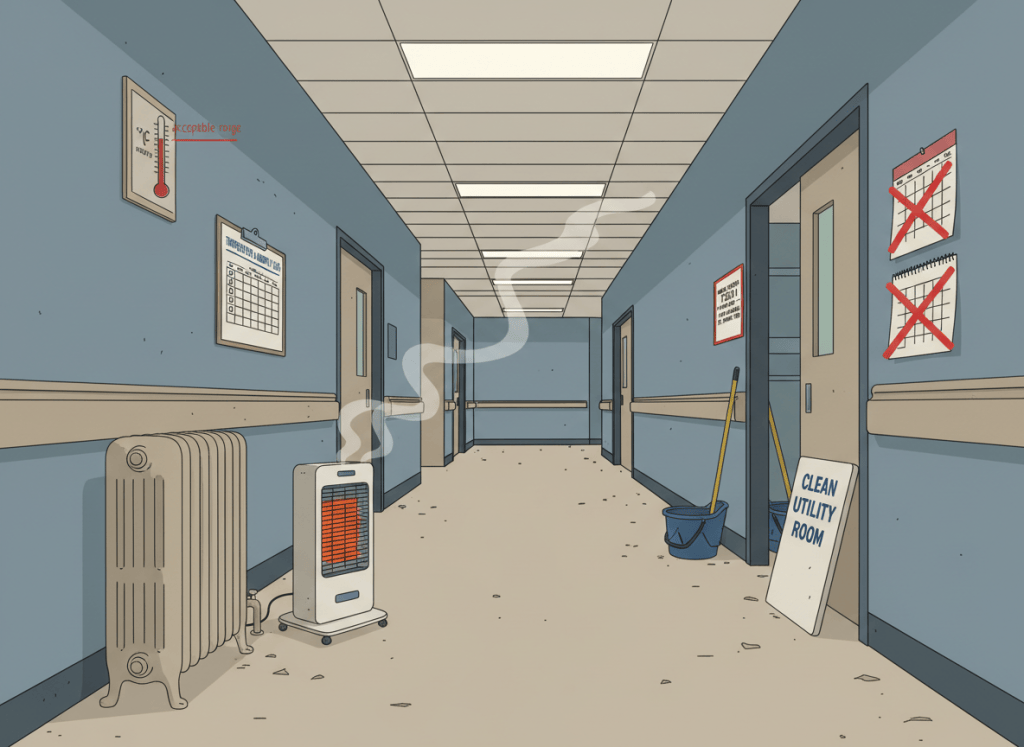
In late November 2025, the heating system at Amarillo’s main hospital stopped working. Not a fuse, not a thermostat, an aged air handling unit whose replacement parts, executive leaders told inspectors, “were not readily available to order.” The outage ran for approximately three months. Engineering staff got by reviving old steam furnaces that had presumably been left in place for exactly this occasion, and when that wasn’t enough, they deployed space heaters and moved veterans out of a medical surgical unit that never did get adequate heat back. The Associate Director said the facility’s infrastructure plan includes replacing other aging systems “to prevent similar disruptions in the future,” which is the sentence every institution says right after the thing it was supposed to prevent has already happened.
This is presented in the report’s Culture section, under the heading “System Shocks,” as a story about resilience. The staff adapted. The mission continued. Nobody froze. All of that is true, and none of it changes the fact that a facility with a $597 million medical care budget kept a wing of veterans warm with the hospital equivalent of camping gear for a full winter because a part could not be sourced. The OIG made no recommendation on this. It did not need to. The next section of the report supplies its own commentary.
The Room Where Nobody Checked the Weather
The Environment of Care section is where the actual grading happens, and Amarillo did not do well. Inspectors touring the medical surgical units, the ICU, the emergency department, and the community living center (VA’s term for its nursing homes) found wall damage in the emergency department and CLC hallways, damaged floors in the CLC, stained ceiling tiles over the emergency waiting area and the CLC dining room, and, in the CLC’s clean utility room, dirty equipment and items simply left on the floor next to whatever was supposed to stay clean. VHA Directive 1608(1) requires facilities to keep those two categories physically separated for the obvious reason that “clean” and “next to a mop bucket” are not the same condition.
Then there’s the medication rooms. Staff in the ICU and the CLC were not monitoring temperature and humidity, a basic requirement under VHA Directive 1108.07(2) that exists because medications stored outside 68 to 77 degrees Fahrenheit and 30 to 60 percent relative humidity can degrade without anyone noticing. The Associate Director told inspectors he had no idea staff weren’t doing this. The facility’s own written policy, in place since 2023, said they were supposed to be. Nobody had checked whether the policy was being followed until the OIG did.
The facility’s fix for this one is worth sitting with. In its written response, Amarillo reported that nursing staff, when interviewed, “were unable to speak to the established process,” which is a generous way of saying the people responsible for the room didn’t know there was a room to be responsible for. The corrective action was staff education and new signage identifying a point of contact. The facility then reviewed a year of monitoring data, found humidity excursions had in fact occurred, decided none of the affected medications needed to be thrown out, and asked the OIG to close the recommendation. The OIG agreed, on September 28, 2026, the same day this report was published. Recommendation open, evaluated, and closed inside the same document. That is not oversight moving quickly. That is oversight arriving exactly in time to watch the facility grade its own test.
A Finding With Its Own Frequent Flyer Program
None of this would be especially newsworthy if it were unique to Amarillo. It isn’t. The VA Indiana Healthcare System’s inspection, completed earlier in this same cycle, cited supplies and debris left on a clean supply room floor and chipped, damaged walls with visible residue in a patient room, language close enough to Amarillo’s that it could be a find and replace job. The VA Western Colorado Healthcare System’s inspection went further, issuing eight recommendations that included the identical clean and dirty item separation failure, plus ceiling vent dust, wall repair, and a call for the regional VISN office itself to start actually overseeing the environment of care program it was supposed to be overseeing all along.
Three different facilities, three different states, three different inspection windows, and the same finding under the same directive with the same prescribed remedy: develop a plan, educate staff, monitor compliance until it holds for six consecutive months. VHA Directive 1608(1) has been in place since 2021. It has been amended once, in 2023, seemingly without anyone updating the muscle memory of the maintenance staff tasked with following it. This is not three unlucky facilities. This is what a compliance program looks like when the response to a finding is standardized but the underlying behavior isn’t.
Closed, In the Sense That the Paperwork Says So
The Amarillo report closes on an uneasy note of institutional self-awareness. In its conclusion, the OIG mentions, almost in passing, that it is tracking VHA’s ongoing restructuring, the collapse of 18 regional networks down to five, completed just months before this inspection was published, and that the agency plans to “monitor VHA’s change management” going forward. It is a tidy sentence to end on, and it says nothing about who, in a newly consolidated five-network structure, will be responsible for making sure the next facility’s clean utility room stays clean.
The honest reading of this report is not that Amarillo is a badly run hospital. Employee survey responses describe leaders who communicate often, veterans who travel from three states away specifically to be treated there, and a 94 percent trust rating that beats the VA average. The honest reading is that a facility can do nearly everything right and still leave a heating system to fail for three months because a part wasn’t in stock, and still let a medication room go unmonitored for however long it takes an inspector with a clipboard to notice. The OIG will be back in roughly three years to check again. Given the pattern at Indiana and Western Colorado, there is no particular reason to expect the sequel to look different, only that it will, once again, be resolved with an action plan, a monitoring period, and a director who concurs.

