Category: Federal Agencies & Oversight

  • Paper Workflows and Empty Corridors: The VA’s Mountain Home Problem

    Mountain Home Has Been Here Since 1903. It Still Needs Written Instructions To Call You Back.

    VA Mountain Home Healthcare System sits on a historic campus that opened around 1903 as the Mountain Branch of the National Home for Disabled Volunteer Soldiers. A century and change later, the institution that learned how to treat trench lung and mustard gas injuries just received a formal reminder from its own watchdog that staff should have written instructions for telling patients their test results. Not how to interpret the results. Not how to treat the disease. How to pick up the phone.

    On August 28, 2026, the VA Office of Inspector General released an inspection of the VA Mountain Home Healthcare System in Johnson City, Tennessee, also known as the James H. Quillen VA Medical Center. The system serves veterans across a 32 county patch of northeastern Tennessee, southwestern Virginia, and southeastern Kentucky. After examining quality, leadership, and patient care, the OIG landed on a single recommendation: the facility must create written, service level workflows for communicating test results, consistent with Veterans Health Administration Directive 1088(1), Communicating Test Results to Providers and Patients.

    In plainer English, the oldest veteran campus in the system needed Washington to tell it to write down who calls whom, when, and how, after a lab machine finishes humming. The OIG closed that recommendation the same day the report came out. Which raises a blunt question. If the paperwork looks fixed in a single afternoon, how long have the patients been living with the gap?

    What VHA Directive 1088(1) Actually Demands

    VHA Directive 1088(1), issued July 11, 2023, is not exactly beach reading. It sets requirements for timely, traceable communication of test results to both providers and patients. The directive spells out responsibilities, time frames, and documentation so there is a clear trail from the lab to the chart to the patient. The whole point is to stop test results from vanishing into the electronic equivalent of a desk drawer.

    When the OIG tells Mountain Home to develop written, service level workflows, it is saying that each clinic and service line needs a step by step process that matches the directive. Who reviews the result. How quickly. How abnormal findings reach the treating clinician. How and when the patient gets notified. How the contact gets documented so supervisors and inspectors can verify that someone actually did the job.

    That may sound bureaucratic. It is also the difference between a caught tumor and a missed one. Directive 1088(1) exists because the system has a long history of test results that fell through cracks wide enough to swallow an entire oncology ward.

    Staffing Shortages Meet Paper Thin Workflows

    The inspection of Mountain Home does not land in a vacuum. In the VA OIG’s fiscal year 2023 staffing shortages report, the same system shows up in Table C.58 with shortages across a familiar roster of jobs. Social workers. Nurse anesthetists. Practical nurses. Nursing assistants. Custodial workers. Food service workers. In other words, the people who stabilize a patient, keep the operating room moving, and make sure the place does not literally fall apart.

    Short staffing does not just mean longer waits in the lobby. It means that nurses race between beds, clerks juggle phones and inboxes, and supervisors quietly accept that some tasks will not get done. When there is no clear, written workflow for test result communication, the missing tasks often involve calls that no one can see. A lab result comes back. The ordering provider is off, or already drowning in alerts. A nurse means to follow up after the next medication round. A reminder gets buried. No policy pins responsibility on a specific role, within a specific time frame, with a specific way to document closure. The patient never hears a word.

    The scheduling breakdown at Mountain Home is not isolated. As covered in our report on the VA community mental health system, 128 out of 133 VA healthcare systems failed to meet the department’s own seven-day standard for scheduling mental health consults in FY2025 — a pattern that begins with the same undocumented, untracked workflow gaps visible at Mountain Home.

    That is the context in which the Mountain Home inspection tells leaders to put workflows on paper. Not because veterans need more binders. Because in an understaffed system, anything that is not written, tracked, and measured will be the first thing to disappear.

    Mountain Home Is Not An Outlier

    The OIG did not invent concern about test result communication for Mountain Home. It has been walking this same trail across the country. At the VA Dublin Healthcare System in Georgia, an April 2024 root cause analysis documented 25 patient safety events tied to failures in communicating test results. The OIG’s March 2025 report on Dublin tied those events directly to gaps in how results moved from lab to provider to patient.

    In February 2025, the OIG reported on the VA Salem Healthcare System in Virginia and found problems with communication of urgent and noncritical test results, again citing VHA Directive 1088(1). In December 2024, the OIG’s review of VA Durham in North Carolina concluded that leaders lacked hospital wide oversight to validate whether providers followed requirements for communicating test results. That is the same directive number haunting multiple campuses from Georgia to North Carolina to Virginia to Tennessee.

    Meanwhile, Mountain Home has drawn attention for issues well beyond lab results. In 2024, the House Committee on Veterans Affairs announced an investigation into allegations of workplace misconduct at the Quillen VA Medical Center. The same campus that now needs to formalize how it tells patients their test results was already on the congressional radar for broader cultural and management concerns.

    Layer on top of that a broader federal critique. A Government Accountability Office report, GAO 26 107528, examines how VA reviews and reports providers with clinical care concerns and calls for better training and oversight. Different investigators. Different document numbers. Same theme. The system struggles to consistently identify, track, and respond when patient care depends on staff following through.

    What A Missed Test Result Really Means

    The phrase “test result communication failure” sounds like something you fix with a software patch. The reality is uglier. A missed pathology report can mean a cancer that moves from treatable to terminal. A lab value that never reaches a clinician can mean sepsis that runs unchecked. An imaging finding that sits unreviewed can turn a manageable condition into a permanent disability.

    Every inspection and directive cited above exists because somewhere, a veteran sat at home waiting for a call that never came. Families do not sue over high level policy memos. They sue, and grieve, over the scan that no one followed up.

    This is why the timing in the Mountain Home report deserves scrutiny. The OIG issued the recommendation on August 28, 2026 and closed it the same day. On paper, that means the facility responded quickly and accepted the requirement to create those written workflows. In practice, the same day closure tells the public very little about whether the new procedures exist on the ground, whether staff know them, or whether anyone will check compliance three months from now.

    When a watchdog closes a recommendation the day it appears, it signals trust in leadership promises and in the documentation provided. It does not tell us how many veterans experienced delayed or missed results before the paperwork caught up. It does not tell us whether the same staffing shortages that drove the problem will sabotage the solution.

    So the question practically asks itself. In a system that needed a 2023 directive to spell out how to communicate test results, a string of OIG reports from Dublin to Durham to Mountain Home, a congressional investigation, and a GAO warning about weak oversight of problematic providers, how confident should a veteran feel that a normal lab result and a life changing one will both trigger the right call, at the right time, from the right person?

    Mountain Home has stood for veterans since 1903. Its history is carved in stone on a National Historic Landmark campus. The real test now is written somewhere else. In the workflows, checklists, and audit trails that show whether a twenty first century veteran will hear about a dangerous test result before it is too late.

    The deeper context for these failures is documented in our coverage of the $1.7 billion blind spot in VHA eligibility determinations — a systemic audit of how the VA’s internal guidance, broken scheduling software, and phantom wait times combine to fail veterans at every step of the care access chain.


    Fediverse Reactions
  • The Loneliest Job in Federal Oversight: Congress Finally Moves on NOAA Observer Harassment

    Congress Discovers NOAA Observers Are Human After All

    Alone On The Boat With Everyone Pretending Nothing Is Wrong

    The federal government calls them observers. In practice, they are one unarmed person with a clipboard, a tablet, and a mandate, dropped onto a commercial fishing vessel for days or weeks at a time. They count every fish, record every discarded catch, and document anything that smells like a violation of the Magnuson Stevens Act. They share cramped bunks with the crew they may later help prosecute. Their presence can shave thousands of dollars off a haul if what they write down does not match what the captain wants to land.

    Observers, at sea monitors, and catch monitors are the federal government’s eyes and ears on the water. They supply the data NOAA Fisheries uses to set catch limits, justify management decisions, and defend them in court. According to NOAA’s own materials on observer safety and harassment, they do all this while facing a steady risk of verbal abuse, intimidation, and worse. NOAA has highlighted a North Pacific case where harassment of an observer led to a Notice of Violation and Assessment of tens of thousands of dollars against a vessel. That incident made it into an enforcement action. Many others, as NOAA sponsored research has shown, never make it into any official record at all.

    Peer reviewed work in journals such as Frontiers in Marine Science, along with NOAA funded studies on the Alaska maritime workplace, has described systematic underreporting of harassment and obstruction of observers. The pattern is not subtle. One worker, often the youngest and least powerful person on board, lives and works in close quarters with the very people whose behavior they are supposed to document. Federal policy historically told them that if something happens, they should report it through channels designed for office parks and research labs instead of rolling decks and hostile wheelhouses.

    What H.R. 2406 Actually Does, Behind The Branding

    Enter H.R. 2406, the National Oceanic and Atmospheric Administration Sexual Harassment and Assault Prevention Improvements Act of 2025. The title reads like a committee staffer tried to squeeze every relevant noun into one line. The substance, laid out in House Report 119-761 and in the bill text on GovInfo, is more focused.

    The bill, introduced by Representative Suzanne Bonamici with bipartisan cosponsors including Representatives Maria Salazar, Jared Huffman, and Brian Fitzpatrick, starts with a simple admission that took Congress far too long to articulate. NOAA’s existing sexual harassment and assault policies did not explicitly protect the people the agency sends onto boats to enforce federal fisheries law. H.R. 2406 expands those policies to cover observers, at sea monitors, catch monitors, and staff of the regional fishery management councils.

    The bill also creates a restricted reporting option so that observers and other covered personnel can make confidential disclosures without automatically triggering a full investigation. That kind of option already exists in other federal contexts. Here, it is treated as a novel improvement for people who have been filing incident reports from the middle of the ocean for years.

    H.R. 2406 requires NOAA to refer vessel related incidents of sexual harassment and assault to the Coast Guard, along with the names of the individuals involved, the vessel, and the time and location of the incident. It directs the agency to strip out older “forcible” qualifiers in policy language so that non stranger sexual assaults and a wider range of coercive conduct clearly fall within the rules. It expands the annual report to Congress so that lawmakers stop receiving glossy aggregate counts and instead see case synopses, information on disciplinary actions, and breakdowns across observer categories.

    One more provision speaks volumes about how literally Congress expects NOAA to take all this. The bill prohibits individuals with certain sexual offense convictions from joining the NOAA Corps. The fact that this needed to be spelled out in legislative text tells its own quiet story about gaps the system had tolerated.

    According to House Report 119-761, the Natural Resources Committee reported the bill favorably on August 20, 2026, with bipartisan support and no meaningful opposition. For a Congress that can turn a routine reauthorization into a multi year culture war, that level of consensus is its own data point.

    How A “Success Story” Managed To Leave Observers Exposed

    The backstory, documented in GAO reports and NOAA’s own studies, will not reassure anyone who thought federal workplace protections were already universal. In 2021, the Government Accountability Office released GAO 21 560 on NOAA’s sexual harassment and assault prevention efforts. The report concluded that NOAA had made “substantial progress” on prevention and response. In Washington, that phrase functions as both praise and warning. It begs the question of what conditions looked like before the progress and what still sat outside the frame.

    NOAA’s public facing materials on observer safety acknowledge that harassment incidents have been significantly underreported. Its summary of a new study on harassment in the Alaska maritime workplace describes observers who did not come forward at all or waited until long after returning from deployments. A paper in Frontiers in Marine Science details harassment and obstruction of observers in multiple fisheries, reinforcing the same pattern. Observers described behavior that would violate any modern harassment policy. The problem was that the policy did not clearly reach them.

    The gap was not abstract. The North Pacific Observer Program has highlighted specific enforcement actions, including a Notice of Violation and Assessment of about fifty five thousand dollars against a vessel following harassment of an observer. That case, plastered on NOAA’s own website as an example of seriousness, stands out precisely because it is an exception. The agency’s own research says the incident iceberg is larger than the visible tip.

    Yet for years, as observers lived and worked in this environment, NOAA’s sexual harassment policies focused on employees and settings that looked much more like traditional offices. Observers contracted through providers, at sea monitors, and some council staff sat in a gray zone that could leave them without the same protections or clear reporting paths. According to the committee report and bill text, H.R. 2406 is meant to close that gap. The timeline raises an obvious question. If the problem is so plain now that both parties agreed to plug it, why did everyone tolerate the hole for so long.

    Why Observer Safety Is Not Just A Human Resources Issue

    Fisheries observers illustrate a basic truth about federal oversight. The government often relies on a single individual to stand in for the public interest in places that are hard to reach and easy to ignore. Under the Magnuson Stevens Act, observer coverage helps set catch limits, trigger enforcement, and defend management decisions in court. The accuracy of those data feeds depends on observers who feel safe enough to record what they actually see and report it without fear that the next deployment will become punishment.

    NOAA’s own messaging about observer harassment admits that underreporting and lack of confidential reporting options have distorted the picture. Before H.R. 2406, whole categories of people who were central to fisheries management sat outside the strongest protections. That is not just a workplace policy oversight. It is a structural flaw in the way the government manages the nation’s fisheries.

    The bill will not repair every weak joint in that structure. H.R. 2406 does not rewrite deployment practices that place a lone observer on vessels for weeks at a time. It does not change vessel culture or the basic power imbalance between an observer whose contract depends on successful deployments and a captain whose income depends on how much catch gets recorded. It does not guarantee that every retaliation risk disappears just because reporting options have better labels.

    What the bill does, according to the committee report and supporting documents from sponsors such as Representative Huffman, is drag observer safety and harassment out of the gray zone where it has sat for too long. It pulls observers, at sea monitors, catch monitors, and council staff clearly into NOAA’s harassment and assault framework, insists on Coast Guard notification when incidents happen on vessels, and forces more detailed information into Congress’s hands.

    For a rare bipartisan effort in a polarized Congress, the most damning part is how modest it is. None of this should be innovative. Confidential reporting, clear coverage of contract like workers, basic screening of Corps officers, and transparent case reporting are the floor of any credible harassment regime. In this sector, that floor took years of reports, studies, and one too many horror stories at sea before lawmakers finally bothered to pour the concrete.

    H.R. 2406 is the kind of bipartisan accomplishment that rarely makes news because it fixes something that should never have been broken. The Chuck Edwards censure recommendation — also cleared by a bipartisan Ethics Committee that same August — is another rare instance of the institution applying its own rules with consistency. That case involves a different congressional power structure, but the same underlying question: what it takes to make federal workplace protections mean something for people who lack the power to enforce them on their own.


  • Poetry Is Not Sexual Misconduct, and Other Arguments That Did Not Save Chuck Edwards

    When the House Ethics Committee Actually Uses Its Teeth

    The House Ethics Committee does not often recommend censure. It prefers the soft touch of confidential investigations, delayed reports, and sternly worded letters that vanish into the Congressional Record. Yet Rep. Chuck Edwards, Republican of North Carolina’s 11th District, managed to clear that high bar. After reviewing nearly 1,500 pages of evidence and interviewing 16 witnesses, the bipartisan committee concluded that Edwards engaged in what it called persistent unprofessional and inappropriate conduct toward two young female staffers. Faced with that judgment, Edwards produced a 22 page letter arguing, among other things, that poetry is not sexual misconduct and that an affectionate friendship is not a sexual proposition. Those lines will outlast his time in Congress, which suddenly has an expiration date.

    What the Committee Actually Found

    The Ethics Committee’s report in H. Rept. 119 756 reads less like a misunderstanding and more like a pattern. According to the report, Edwards showered the two aides with repeated and lavish gifts, commented on their appearance and dress, invited them to what the committee described as intimate dinners and vacations, and wrote effusive handwritten notes that went well beyond professional appreciation. The committee did not find evidence of explicit sexual propositions or sexual activity. That absence did not save him.

    Instead, the investigators stepped back and asked how a reasonable observer would read the whole picture. Their answer, laid out in the report, was that the pattern of gifts, comments, invitations, and personal notes would reasonably be interpreted as romantic or sexual in nature and that both women were made uncomfortable. The committee emphasized that the aides were not peers or friends in a vacuum. They were subordinates whose careers depended on the approval of the man writing the notes and paying for the trips.

    That power imbalance is what pushed the case out of the familiar gray zone of Capitol Hill gossip and into the territory of official misconduct. The committee found that Edwards violated the House Code of Official Conduct by failing to live up to the spirit of chamber rules that prohibit sexual harassment. On July 22, 2026, the committee voted to adopt its report, and on August 3, 2026, it transmitted the findings publicly. The punishment it recommended was not a slap on the wrist. It urged the full House to censure Edwards, a penalty one step below expulsion that requires a majority vote and forces the member to stand in the well of the House while the resolution is read aloud.

    Committee leaders underscored the gravity in their joint statement. The Republican chair and Democratic ranking member issued a rare united front, describing the process and the findings in careful but unmistakably serious terms. Their public statement reinforced what the report already conveyed: this was not casual or partisan.

    The Defense: Poetry, Friendship, and a Vanishing Campaign

    Two days after the report dropped, Edwards ended his reelection bid for North Carolina’s 11th District, as first reported by outlets including the Washington Post. Reporting from the Post and others noted that House Republicans had privately encouraged him to step aside. That timing was not subtle. A member under threat of censure for sexual harassment findings is a heavy lift even for a party accustomed to weathering scandal.

    Edwards did not go quietly. According to Axios and NC Newsline, he circulated a 22 page letter to colleagues, along with a one page fact sheet titled 15 Questions Members Should Ask Before Accepting the Ethics Report. In those materials, Edwards asserted that the committee had made what he called an extraordinary leap in classifying his behavior as sexual harassment. The now famous line poetry is not sexual misconduct appeared there, along with his insistence that what he described as affectionate friendship was not a sexual proposition.

    Reporters at the Associated Press, Washington Post, Roll Call, and WUNC all chronicled the same pattern. Rather than accept the bipartisan findings and the proposed censure, Edwards spent the August recess trying to persuade colleagues to reject the report. He framed his conduct as misread sentimentality, the committee’s reasoning as prosecutorial overreach, and the sanction as unjust.

    The House was expected to vote on the censure recommendation when it returned from recess on August 31, 2026. While the committee report spoke in the formal idiom of congressional discipline, Edwards’s public and private pushback gave the case a catchphrase. Poetry is not sexual misconduct became shorthand not just for his defense but for its blind spot. The factual record described a workplace dominated by a member’s personal attention. His letter described hurt feelings and misunderstood verse.

    Why This Case Breaks the Pattern

    Congressional ethics cases are usually studies in inertia. The House created a process that is slow, secretive, and highly resistant to public punishment. Complaints often vanish into confidential referrals or are resolved with negotiated admonishments that only surface years later. A bipartisan committee that unanimously recommends censure breaks that pattern. It signals conduct that was serious enough to clear the institution’s own hurdles, not just a partisan skirmish or a fleeting news cycle.

    The Edwards matter is also a textbook workplace power story. The two women at the center of the report worked for him. According to H. Rept. 119 756, they experienced his attention as uncomfortable and untenable, precisely because he controlled their assignments and their futures. The committee did not need an explicit proposition to see a problem. It looked at the gifts, the comments about their appearance, the invitations to intimate dinners and vacations, and the handwritten notes, then weighed those against the simple fact that they were junior staffers in a congressional office.

    Edwards’s poetry defense tries to recast that story as one about tone policing or cultural misunderstanding. The report reads differently. It reads like a rare official acknowledgment that the problem in Congress has never been a lack of policy on paper. The problem has been a culture that treats persistent, unwanted attention from a powerful boss as something less than misconduct unless it escalates to outright solicitation.

    Here, the committee drew the line earlier. It said that sustained, personal attention from a member of Congress to two subordinate employees, accompanied by gifts, personal comments, and intimate invitations, violated the House’s own standard of conduct. That conclusion did not come from a political opponent or an outside activist. It came from a committee evenly split between Republicans and Democrats, working inside a system built to bend over backward for incumbents.

    The Edwards case shows what it looks like when that system finally says no. Whether the full House will reinforce that judgment with a censure vote is a live question. The report already exists, archived on Congress.gov and GovInfo, along with the statement from the committee leadership. Edwards’s own quoted lines now stand beside them. Long after he leaves the House floor, one sentence will still explain how he chose to answer a finding that his conduct crossed the line: poetry is not sexual misconduct.

    The Edwards case sits alongside another rare act of congressional self-regulation from the same period. H.R. 2406 — the NOAA observer harassment bill that cleared the House Natural Resources Committee with bipartisan support in August 2026 — addresses a different but structurally similar problem: workers whose safety depends on institutions that had every incentive not to look too closely. That story and this one share the same uncomfortable premise — that federal workplaces required an act of Congress to extend basic protections to people who were already supposed to have them.


    Fediverse Reactions
  • The Model Bureaucracy: Inside the PBGC’s Efficiency Engine and the Pension “De-Risking” Trap

    The Paradox of Perfect Transparency

    In the labyrinthine corridors of Washington, the Pension Benefit Guaranty Corporation (PBGC) is a rare bird, in that it claims to have solved the “Red Tape” problem.

    While most federal entities languish under mounting backlogs and decades of administrative decay, the PBGC boasts an 11-year streak of zero FOIA backlogs. It presents itself as a paragon of “model” transparency.

    Yet, this bureaucratic perfection operates as the gatekeeper for the retirement security of 33 million American workers and the $3 trillion in benefits that underwrite their future. For the specialized auditor, this efficiency raises a chilling tension:

    Is a lightning-fast disclosure office a sign of genuine openness, or is it a high-speed machine designed to manage public perception while the “Federal Backstop” is systematically dismantled?

    Beneath the gloss of 12-day response times lies a high-stakes reality where corporate maneuvers and massive taxpayer infusions are reshaping the American social contract. To understand the future of retirement, one must first look through the high-tech lens of the agency’s disclosure engine to see what, and who, is being left behind.

    The Anatomy of a “Model” Program (FOIA by the Numbers)

    The Freedom of Information Act (FOIA) is the primary weapon against government opacity. But in the hands of a master bureaucracy, it can also become a tool for “High-Speed Opacity.”

    The PBGC has integrated FOIA into its core strategic plan, not merely as a legal requirement, but as a performance metric to be optimized. According to the 2025 Chief FOIA Officer Report, the agency’s Disclosure Division operates with a corporate-level efficiency that effectively silences critics of government sluggishness.

    PBGC FOIA Performance (FY 2024)

    MetricStatutory RequirementPBGC Performance (FY 2024)
    Median Response Time (Complex)20 Working Days12 Working Days
    Median Response Time (Simple)20 Working Days10.28 Working Days
    Backlogged Requests/AppealsN/A0 (11 consecutive years)
    Expedited Adjudication10 Calendar Days6.52 Days (average)

    This administrative “perfection” is powered by a technological arms race. The agency utilizes sophisticated AI and machine learning tools that serve as high-tech filters, allowing the bureaucracy to process and redact massive volumes of data at a scale manual reviewers could never match.

    • Veritone Redact:  An AI-enabled cognitive engine that automates redaction in audio and video files, extracting text to ensure the agency’s narrative remains tightly controlled even in multimedia formats.
    • FOIAXpress EDR & Relativity:  Automated platforms that sift through voluminous email caches to “identify” (and exclude) duplicative or non-responsive content.
    • Rapid Redact:  Predictive coding software that the agency claims has saved 50% of review time for bulk records.

    While the PBGC prides itself on these tools, the auditor must ask:

    “Is the speed of the response a service to the requester, or a method of quickly sanitizing the record of the billion-dollar shifts occurring within the Special Financial Assistance program?”

    The Billion-Dollar General Fund Infusion (SFA Transparency)

    The American Rescue Plan’s Special Financial Assistance (SFA) program represents a tectonic shift in the PBGC’s DNA. Historically, the agency was a self-sustaining insurer funded by premiums and investments.

    Today, it has become a conduit for the Treasury’s General Fund. The SFA is “funded entirely by an appropriation from the General Fund,” moving the burden of multiemployer plan sustainability directly onto the taxpayer.

    The SFA is intended to keep insolvent plans afloat through 2051, but the “proactive disclosures” the agency touts are heavily managed. The Disclosure Division reviews every SFA application for “PII and confidential commercial information” before publication.

    This “transparency” serves a dual purpose. First it provides the public with a glimpse of the payouts. Second, it shields the specific financial vulnerabilities and “commercial” secrets of the troubled plans being bailed out.

    As the PBGC manages the optics of these taxpayer-funded lifelines, it oversees a simultaneous and opposite trend on the corporate side, which is the total abandonment of the federal safety net.

    The ERISA Shield and the Verizon Precedent

    While the government bails out multi-employer plans with taxpayer cash, corporations are executing a strategic exit through “Pension Risk Transfers” (PRTs). By offloading liabilities to private insurers, companies effectively dismantle the federal backstop for their retirees, trading ERISA protections for a variable patchwork of state guaranty associations.

    The litigation context of Dempsey v. Verizon (dismissed Jan. 8, 2026) exposes the “ERISA Shield” protecting these maneuvers. In 2024, Verizon transferred $5.7 billion in liabilities for 56,000 retirees to Prudential and RGA Reinsurance.

    The “Core Grievances” were clear:

    • Total Loss of PBGC Backstop:  The federal guarantee vanishes the moment the transfer is signed.
    • Regulatory Fragility:  Retirees are moved from federal safeguards to state associations with varying solvency standards.
    • “Cheapest vs. Safest”:  Allegations that fiduciaries ignored DOL Interpretive Bulletin 95-1 by prioritizing corporate accounting gains over provider safety.

    Judge Alvin K. Hellerstein’s dismissal of the case “with prejudice” highlights a judicial dead-end for workers.

    By ruling that retirees lacked “Article III Standing” because their benefits were not currently reduced, the court labeled the risk of insurer insolvency as “speculative harm.”

    This creates a legal shield, of sorts, where retirees cannot sue until the private insurer fails, at which point the PBGC backstop they once relied upon is already gone.

    The Mechanics of Power—Exemptions and Gaps

    The PBGC’s “Model” status is a carefully constructed outlier. A recent GAO audit of 117 agencies found that many federal entities lack even basic backlog reduction plans, leading the GAO to issue specific recommendations to 16 agencies just to develop them. The PBGC uses this contrast to frame itself as a leader in transparency, yet it leverages the same statutory “gears of secrecy” as its less efficient peers.

    Beyond the standard use of PII and Confidential Business Info exemptions, a significant transparency gap exists. While the agency claims a “customer service” model, it refuses to post FOIA logs in a machine-readable CSV format. The PBGC cites “requester privacy” as the justification, but the effect is the prevention of systemic oversight.

    Without CSV logs, independent auditors cannot track who is requesting information about PRTs or SFA payouts across agencies, effectively creating a “black box” around the influencers of pension policy.

    Accountability vs. Efficiency

    The PBGC has mastered the art of the fast answer.

    A zero-backlog office in a town defined by delay is a legitimate administrative feat. However, we must not mistake a fast response for a secure benefit. Efficiency in disclosure does not equate to security in retirement.

    The PBGC is presiding over a landscape where the “Federal Promise” is being bifurcated: one half is sustained by taxpayer bailouts (SFA), and the other is being sold off to the private market (Verizon).

    The “Model Agency” is effectively the high-speed clerk of a dismantling process, ensuring the paperwork for the erosion of the federal safety net is filed perfectly and on time.

    Open Questions for the Taxpayer:

    • Is a FOIA program truly “transparent” if it hides its request logs behind a privacy shield to prevent systemic, cross-agency oversight?
    • Does the “Article III Standing” hurdle mean that the federal government has effectively licensed corporations to offload pension risks with zero legal accountability to the workers?
    • As the PBGC shifts from a premium-based insurer to a manager of General Fund appropriations, has its primary mission become that of a taxpayer-funded bailout manager for a failing system?

    The PBGC’s erosion of the federal promise to retirees has a parallel in how the VA has handled its promises to veterans and their caregivers. The Caregiver Sunset investigation documents how the VA used the language of ‘equity’ and ‘administrability’ to phase out grandfathered protections for families who built their lives around a benefit that was quietly being restructured beneath them. Different agencies, same mechanism: settled commitments traded for administrative convenience, and the courts declining to intervene.


    Fediverse Reactions
  • The $1.7 Billion Blind Spot: How VA Red Tape is Failing Veterans and Taxpayers Alike

    In the sterile corridors of government oversight, the term “monetary benefits” is often used as a polite euphemism for “money we set on fire.” The 2026 Office of Inspector General (OIG) audit of the Veterans Health Administration (VHA) reveals a bonfire of historic proportions.

    At a time when veterans are forced to navigate a labyrinthine healthcare system, the VHA has managed to lose $1.7 billion in annual unnecessary spending. This was done, not through a single catastrophic error, but through a thousands-of-cuts policy of bureaucratic inertia.

    This is more than a fiscal oversight. It is a systemic failure of a machine that has become so obsessed with its own procedural limitations that it has effectively nullified the legal rights of the men and women it was built to serve.

    Bureaucracy by the Numbers

    The scale of the VHA’s administrative dysfunction is captured in several staggering metrics from the OIG’s findings:

    • $1.7 Billion:  The estimated annual cost of unnecessary community care spending triggered by inaccurate eligibility determinations.
    • 25% Improper Approval Rate:  Approximately 340,000 consults were sent to outside providers despite the veterans being ineligible, often because the VA ignored its own internal capacity.
    • 38% Silence Rate:  Roughly 1.8 million veterans already funnelled into the VA’s direct care system were eligible for outside treatment but were never documented as being informed of their legal right to choose.
    • $114.4 Million:  The conservative estimate of added annual costs incurred because veterans chose community care without being told a faster VA appointment was actually available.
    • $440 Million per Quarter:  The current rate at which the VHA is hemorrhaging taxpayer funds due to its inability or refusal to refer veterans to available VA facilities.

    These figures represent a direct subversion of the legal framework established by Congress to provide veterans with agency over their own healthcare.

    Law vs. Manual: The Subversion of the MISSION Act

    The MISSION Act was designed to be a tool of liberation for the veteran, providing a clear legal path to private care when the VA fails to meet basic standards of wait times or distance. However, as the OIG audit reveals, administrative “guidance” is being used as a weapon to prune back those liberties.

    By creating internal rules that deviate from the plain language of the law, the Office of Integrated Veteran Care (IVC) has effectively created a two-tiered system of rights.

    The Law (MISSION Act)The Bureaucratic Reality (IVC Guidance)
    Makes no distinction between new and established patients regarding eligibility.Instructs staff to check all eligibility criteria only for new patients.
    Requires assessment of wait times, drive times, and service availability for all veterans.For established patients, schedulers assess only wait-time eligibility, ignoring drive-time standards.
    Mandates that veterans be informed of their right to choose between VA and community care.Bypasses drive-time assessments for established patients unless the veteran specifically asks for it.

    The “So What?” Layer

    The VHA’s artificial distinction between patient types is a calculated administrative hurdle. By routinely stripping established patients of their right to drive-time assessments, the VHA prioritizes “continuity of care” (a non-statutory, internal preference) over the veteran’s legal right to see a doctor closer to home.

    This is the administrative state at its most cynical: using a vague institutional preference as a loophole to bypass legal requirements and maintain control over the veteran population.

    The Consult Toolbox: A Case Study in Systematic Blindness

    The VHA’s failure is also a technological one. When legal entitlements are mediated through flawed software, the software becomes the de facto law. The “Consult Toolbox” (CTB), mandated for use in 2023, was supposed to standardize care. Instead, it has become a digital wall between veterans and their care.

    1. Inability to See Alternative Calendars:  While the system can identify a VA facility within a veteran’s drive-time standard, it cannot actually see that facility’s schedule. Schedulers are left blind, unable to book a veteran at a nearby VA center even if an appointment is available.
    2. Lack of Community Wait-Time Data:  The system frequently fails to show how long a veteran will wait in the private sector, making it impossible for a veteran to make a “fully informed decision” as required by law.
    3. Inaccurate Service Mapping:  The software identifies only general clinical categories rather than specific procedures, leading to widespread eligibility errors.

    The Failure of Specificity

    The “Inaccurate Service Identification” issue is particularly egregious. If a veteran needs an  Echocardiogram, but the local VA facility hasn’t digitally linked that specific procedure to the broad  Cardiology category in the toolbox, the system defaults to a “false positive.”

    It assumes the VA cannot provide the service at all, triggering an automatic, and often unnecessary, eligibility for community care. The VA, it seems, would rather pay for an outside referral than fix its own digital index.

    The Human Element: Manual Overrides and Ghost Schedules

    Even when the technology suggests a veteran is ineligible for outside care, the agency finds a way to maintain its own convenience. The OIG found a culture of “unjustified manual overrides” and the use of “ghost” wait times. This happens when schedulers input arbitrary numbers like 30 or 90 days as the “next available” appointment without ever checking the actual facility schedule.

    Examples from the OIG Report

    “Example 1: At Edward Hines Jr. VA Hospital, a veteran needing specialized dental work was told the next appointment was 88 days away. He was referred to the community at a cost of $6,200. However, the Jesse Brown VA Medical Center, just 52 minutes away, had an average wait time of only 18 days. No one checked.” —  OIG Audit Findings

    “Example 3: A veteran at the Miami VA Medical Center was forced to drive 135 miles for a podiatry appointment. Because he was an ‘established patient,’ staff followed internal guidance and simply never informed him he was eligible for care closer to home.” —  OIG Audit Findings

    These cases illustrate a culture that ignores available VA capacity to the tune of $440 million per quarter. It is a system that would rather pay a premium to an outside provider than coordinate a schedule with a neighboring facility.

    The December 2025 Promise: Reform or Red Tape 2.0?

    The VHA’s answer to these shortcomings is the “Integrated Scheduling Solution” (ISS), a web-based platform whose enterprise-wide rollout began in late 2024 with full implementation targeted for February 2025 across most VistA facilities.

    While the VHA markets this as a major step forward, as a modernized replacement for the aging VistA Scheduling Enhancements GUI, a skeptical eye is required for any “technological fix” applied to a deeper structural and cultural crisis.

    The proposed (and partially delivered) capabilities of the ISS include:

    • Consolidated Scheduling Platform: Merging functions into a single web-based tool for scheduling VA appointments, with ambitions for better provider-based and community care comparisons.
    • Cross-Facility Scheduling: Improved visibility and booking across different medical facilities and networks.
    • Expanded Online Options: Greater potential for veterans to exercise direct control over scheduling.

    Reality Check: While ISS is now deployed and receiving ongoing updates into 2026, true end-to-end integration has lagged. Dedicated integrated scheduling pilots combining direct and community care views only launched in January 2026 at select sites (e.g., Charleston and Atlanta), yielding modest early results.

    The OIG has appropriately noted that it remains too early to confirm whether ISS will meaningfully reduce eligibility errors, unnecessary referrals, or the broader inefficiencies plaguing the system.

    History supports this skepticism. Previous efforts, such as expansions of the External Provider Scheduling (EPS) system, showed limited real-world adoption, meaning that certain facilities were slow to accept and use the system. Technological solutions falter when the underlying culture and processes resist them.

    The Under Secretary for Health has “concurred in principle” with the OIG’s recommendations but pushed back formal eligibility verification processes until June 2027. In the entrenched world of VA bureaucracy, such language often signals a slow-walk strategy (read that as ‘more studies, more delays’), while the $1.7 billion annual waste continues to mount and veterans wait.

    Accountability and the Path Forward

    When a government department “loses” $1.7 billion annually while veterans are forced to drive 135 miles for care available much closer, the system isn’t just broken, it’s indifferent. The VHA has successfully built a labyrinth where the MISSION Act goes to die, buried under layers of internal memos and “toolbox” glitches.

    Tough Questions for the VHA:

    1. Transparency: Why is the VHA allowed to maintain internal guidance that directly contradicts the plain language of the MISSION Act regarding established patients?
    2. The 2027 Delay: Why has the Under Secretary for Health delayed the implementation of a formal process to verify eligibility checks until June 2027, effectively signing off on another $1.7 billion in waste?
    3. The Continuity Loophole: What is the true human cost of the VHA’s “continuity of care” interpretation when it is used as a non-statutory preference to deny veterans faster, closer care options?

    True reform did not come from a software update in December 2025. It will only come when the VHA is forced to prioritize a veterans-first approach over a bureaucracy-first survival strategy.

    Until then, the $1.7 billion blind spot will continue to grow.

    This $1.7 billion dysfunction is part of a larger pattern of VA care access failures. The community mental health scheduling crisis — where 128 of 133 VA systems failed their own seven-day standard — operates on the same broken foundation. And inside the facilities veterans reach after waiting, unwritten test result workflows mean the care that does occur may not be communicated at all. The VA’s compliance infrastructure, examined in detail in our Sterile State investigation, shows how the same agency that can’t schedule a mental health appointment in seven days manages to build elaborate bureaucratic machinery around its own internal operations.


    Fediverse Reactions
  • The 20-Minute War at 18,000 Feet: FedEx Flight 705 and the FBI Files

    The Ordinary Morning and the Fateful Swap

    For First Officer James Morgan Tucker, Jr., April 7, 1994, began with the clinical routine of the American professional. He spent his morning at a medical office, successfully renewing his FAA medical certificate, the essential paperwork that permitted his continued employment at Federal Express. His afternoon plans were equally routine: a recreational flight in his personal 1946 Luscombe 8A.

    The day’s trajectory shifted due to a rigid bureaucratic quirk. A FedEx crew returning to Memphis had logged exactly one minute over the FAA’s “eight-hour rule.” Under strict company policy, they were disqualified from their next leg. This “one-minute crew swap” forced dispatchers to assemble a replacement team for Flight 705, an out-and-back cargo run to San Jose. Captain David Sanders and Flight Engineer Andy Peterson were called in, along with Tucker, who, despite being a check airman and captain-qualified on the DC-10, agreed to fly as First Officer to fill the administrative gap.

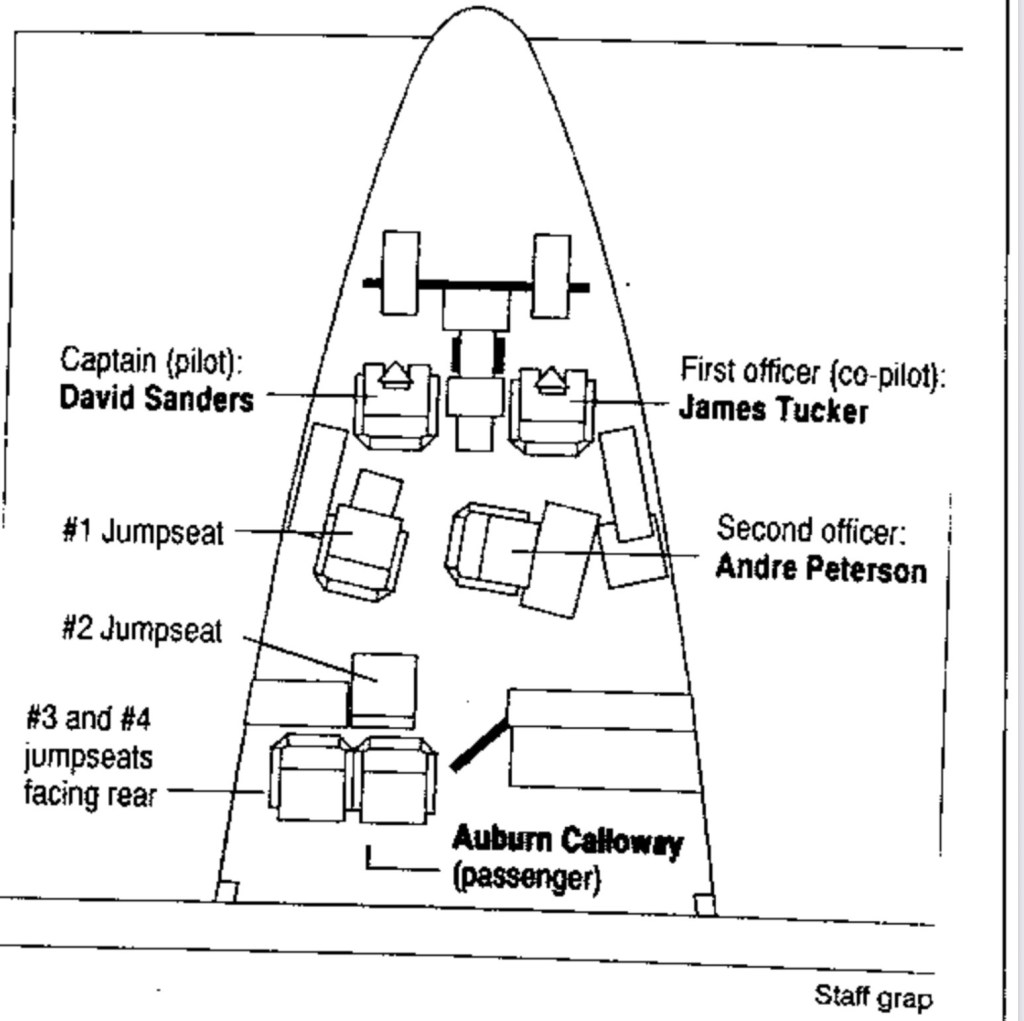
    As the crew boarded the three-engine DC-10-30F (N306FE), they found a fourth man already in the cockpit jumpseat: Auburn Calloway. A 42-year-old FedEx engineer and former Navy pilot, Calloway was officially listed as an off-duty passenger. In the ledger of the airline, he was just another employee catching a ride.

    The Arsenal in the Guitar Case

    The irony of the Flight 705 manifest was systemic. While the flight crew was being policed for a single minute of overtime, Calloway was the subject of a far more grave internal investigation.

    FedEx had discovered irregularities and falsified flight hours in his employment history. As he faced a disciplinary hearing that would end his career, Calloway had calculated a final, desperate move. By staging a “workplace accident” crash, he intended to trigger a $2.5 million life insurance payout to provide for his family following his impending termination.

    To ensure the crash was perceived as a mechanical failure rather than a hijacking, Calloway smuggled a specialized arsenal onto the aircraft inside a guitar case:

    • Two 20-ounce framing hammers
    • Two sledgehammers
    • A spear gun

    Calloway’s preparation was procedural. Before takeoff, he attempted to pull the circuit breaker for the Cockpit Voice Recorder (CVR). He knew that if he were to kill the crew and crash the jet, the “black box” must not contain the sounds of a struggle that would invalidate his family’s insurance claim.

    Chaos at 18,000 Feet

    Twenty minutes after departure, as the aircraft climbed through 18,000 feet, the routine was shattered. Calloway entered the cockpit and began an assault characterized by what the survivors called a “ghastly metallic ring”—the sound of a framing hammer striking the skull of Andy Peterson.

    Calloway attacked with rhythmic, focused brutality. Peterson’s temporal artery was ruptured, causing him to lose nearly half his blood volume in minutes. Turning to the pilots, Calloway struck James Tucker in the left parietal area of his skull, driving bone fragments into the brain and causing immediate numbness across the right side of Tucker’s body.

    Captain Sanders suffered multiple fractures and a partially severed ear. Tucker would later describe the surreal shift into survival mode:

    “The psychology of the whole affair was total madness—the images before me were completely out of context… Blood-slickened hand-to-hand combat had taken place here. They were anaerobic, gasping for breath.”

    The Aircraft as a Weapon: Tucker’s Maneuvers

    Severely injured and losing motor function, James Tucker realized that the crew could not win a physical fight against an armed attacker. He turned to the only weapon available: 390,000 pounds of McDonnell Douglas engineering.

    Utilizing his Navy training as a combat maneuvering instructor, Tucker began to fly the DC-10 into territory the airframe was never designed to inhabit.

    With max climb power selected and the aircraft in Control Wheel Steering (CWS) mode, Tucker rolled the jet toward a 140-degree bank—nearly upside down. Critically, Tucker’s “presence of mind” led him to stop the roll at 140 degrees rather than completing it. He reasoned that if he righted the plane, Calloway would simply regroup; by holding the aircraft at an extreme angle, he kept the attacker pinned and disoriented.

    The technical stress was catastrophic. Tucker plunged the aircraft into a high-speed “Split-S” dive, reaching speeds where “Mach tuck” buffeting began to shake the airframe. The forces were so violent that 200-pound control balance panels were ripped from the elevators.

    • Maximum Bank Angle:  140 degrees (Held tactically to pin attacker).
    • Maneuver:  Modified barrel roll / Split-S dive from 18,000 to 12,000 feet.
    • Airframe Stress:  Mach tuck buffeting; loss of elevator balance panels.

    The Galley Battle and the Will to Live

    The maneuvers threw Calloway from the cockpit into the forward cargo area, but the war continued. Unlike a terrorist, Calloway did not want an immediate crash; he wanted to fly the plane to a target to stage his “accident.”

    This tactical goal is why he did not simply pull the engine fire levers above the engineer’s station, and it resulted in a grueling, 15-minute hand-to-hand battle.

    Despite a ruptured artery, Andy Peterson re-engaged the CVR circuit breaker to ensure the evidence remained. He then threw himself into the fight in the galley, using his weight to pin Calloway while Sanders returned to the controls. Tucker, with his right side paralyzed, used his weight to assist Peterson, fending off Calloway’s attempts to gouge his eyes.

    Diagram of an aircraft cockpit layout, indicating seating positions for the captain (David Sanders), first officer (James Tucker), second officer (Andre Peterson), and several jumpseats, with a passenger position labeled (Auburn Calloway).
    Screenshot

    The Heavy Landing in Memphis

    Captain Sanders took the controls for a desperate emergency return to Memphis. The aircraft was dangerously overweight, laden with kerosene for the long-range trip to San Jose. A standard fuel jettison was impossible given the ongoing combat in the cabin and the structural damage; the wings were already dripping fuel from the massive torque applied to the spars during Tucker’s maneuvers.

    Sanders brought the damaged, leaking jet down for a “heavy landing.” When the aircraft stopped, the cockpit was a visceral crime scene. Paramedics, led by David Teague, had to climb up the emergency slides to reach the crew. They found the survivors still physically restraining Calloway, their flight suits soaked in so much blood it was difficult to distinguish the victims from the attacker.

    The Flight of Justice: Investigation and Trial

    The FBI’s investigation quickly stripped away Calloway’s “accidental” narrative. Agents recovered a suicide note and records of large financial transfers to his ex-wife.

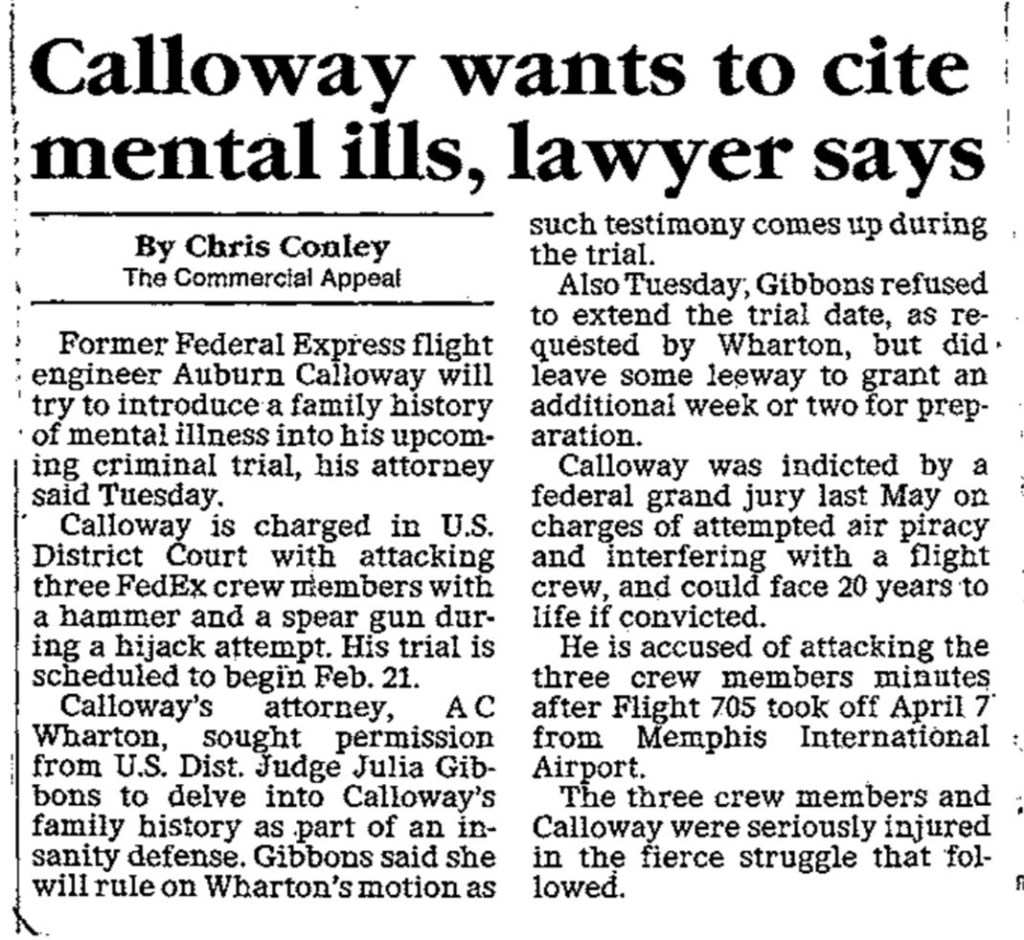
    During the 1995 trial, Calloway’s defense of diminished responsibility was rejected after blaming a sleeping disorder.

    Newspaper article discussing Auburn Calloway's upcoming criminal trial, citing his intention to introduce a family history of mental illness as part of an insanity defense. The article mentions charges against him for attacking FedEx crew members during a hijack attempt and includes details about the trial date and the judge's response.
    Screenshot

    In early 2025, the bureaucracy of the legal system delivered its final word on Calloway. Now 71 years old and citing chronic medical infirmities, Calloway filed motions for compassionate release. On February 10, 2025, the U.S. Court of Appeals for the Sixth Circuit affirmed the denial of his release, citing the “disturbing” nature of his crimes and the permanent trauma inflicted on the crew.

    CategoryDetail
    DefendantAuburn Calloway (Age 71 as of 2025)
    ChargesAttempted aircraft piracy, interference with flight crew
    DefenseSleeping disorder / Insanity (Rejected)
    SentenceTwo consecutive life sentences without parole
    Current StatusIncarcerated at USP Coleman I (Appeal for release denied Feb 2025)

    Life After Flight 705: The Survivors

    On May 28, 1994, the American Pilots’ Association awarded the crew the Gold Medal for Civilian Valor. However, the systemic reality was that their professional lives were over.

    1. James Tucker:  Suffered a depressed skull fracture and subsequent brain abscess. The resulting seizure disorder permanently disqualified him from commercial flying. He moved to rural Alabama, serving as a lay preacher. In 2002, he returned to the sky recreationally in his beloved Luscombe 8A.
    2. David Sanders:  Retired from commercial aviation and became a reclusive but respected speaker for groups like the National Association of State Aviation Officials (NASAO).
    3. Andy Peterson:  Sustained a ruptured temporal artery and massive blood loss. Due to the severity of his head trauma, he never resumed his career, living a quiet, private life.

    The Thin Line of Resilience

    The “20-minute war” was a collision between calculated malice and the ingrained discipline of Navy-trained aviators. The crew’s ability to use a 390,000-pound cargo jet as a tactical weapon while suffering from life-threatening trauma remains a masterclass in resilience.

    The aircraft involved, N306FE, proved as resilient as its crew. After being meticulously cleaned and repaired, the DC-10 returned to the FedEx fleet, serving as a silent workhorse for nearly three more decades.

    It was finally retired in December 2022 and served as a long-lived witness to the day the bureaucracy of a “one-minute swap” accidentally put the right heroes in the cockpit.


    Fediverse Reactions
  • The Sterile State: Behind the VA’s New $14 Million Bureaucracy of Reusable Devices

    Where Policy Meets the Operating Table

    In the high-stakes environment of a Veterans Affairs (VA) operating room, the margin for error is measured in microns of bioburden. A single contaminated endoscope or a poorly sterilized scalpel can be the difference between a successful recovery and a life-threatening infection.

    However, behind the life-or-death reality of medical equipment lies a sprawling, multi-layered administrative architecture. VHA Directive 1116(2), bolstered by aggressive 2023 and 2024 updates, has fundamentally transformed how the VA manages Reusable Medical Devices (RMD).

    What was once a localized hospital support function has been elevated into a massive, independent hierarchy. This new “Red Tape of Reused Devices” blends internal oversight with an expensive reliance on private-sector accreditation, which is costing taxpayers millions.

    It’s worth investigating whether these structural updates prioritize the safety of the veteran on the table or merely expand a self-regulating Red-Tape empire designed to shield the institution from public accountability.

    VHA Directive 1116(2): The New Architecture of Control

    The July 2023 publication and subsequent 2024 amendments to Directive 1116(2) represent a total overhaul of Sterile Processing Services (SPS). The directive moves away from simple equipment management toward a “Quality Management System” (QMS), a linguistic favorite of the government that translates to a rigid, top-down command structure.

    Key Bureaucratic Shifts:

    • The Jargon Shift: Rebranding Reusable Medical Equipment (RME) to Reusable Medical Devices (RMD) to align with FDA and AAMI terminology, effectively codifying industry-speak into federal policy.
    • Service Line Independence: The elevation of SPS to a “distinct service line” that is “not subordinate to any other service line.” This creates an autonomous silo within the hospital, answering to its own chain of command rather than local medical leadership.
    • The Mandated Hierarchy: The creation of the “Chief Sterile Processing Officer” (CSPO) at the VISN level. This role must be a dedicated 1.0 Full-Time Equivalent (FTE) with “no collateral duties.” The VA gave regional networks a mere 6-month deadline from publication to establish these roles, signaling an aggressive push for administrative expansion.
    • Expanding the Table: The 2024 amendments further bloated the bureaucracy by mandating new seats for “Patient Safety” and “Infection Prevention” representatives on the VISN RMD Management Boards.
    • The Digital Iron Curtain: The directive mandates the use of an approved “Instrument Tracking System” (ITS) and references the “Office of Sterile Processing Staffing Tool.” However, the VA repeatedly notes that these tools and their underlying criteria are on “internal VA websites that are not available to the public.”

    The “Deemed Status” Doctrine: Outsourced Oversight

    A central pillar of this new bureaucracy is the VA’s reliance on The Joint Commission (TJC), a private, 501(c)(3) corporation. Under the “Deemed Status” doctrine, the VA pays TJC to certify that its facilities meet federal standards, allowing the VA to bypass direct government surveys by CMS or state agencies.

    Public Funding, Private Oversight: The TJC Connection

    Oversight FeatureDescription & Source Context DetailThe Skeptical Angle (Bureaucracy Times Analysis)
    Contract Value~$14M+ annually in federal awards for accreditation and survey services.Taxpayer-funded “voluntary” compliance that funnels millions to a private entity to validate government performance.
    Deemed StatusTJC accreditation allows the VA to skip direct CMS/state surveys by assuming TJC standards meet or exceed federal law.Privatized regulation that effectively removes direct public accountability. It allows the VA to “self-correct” through a contractor.
    Conflict of InterestTJC is a private nonprofit founded by the very hospital and medical associations it regulates (AHA, AMA, ADA).Accreditors are paid by the organizations they survey, encouraging “consultative” surveys rather than strict enforcement. The regulator is a paid partner.

    The Certification Barrier: 400 Hours and Annual Hurdles

    The directive introduces professional barriers that ensure only those indoctrinated into the VHA’s specific systems can lead. These requirements create a closed loop of personnel whose primary skill is navigating the VHA Talent Management System (TMS):

    1. SPS Leadership Certification: All SPS Chiefs, Assistant Chiefs, and supervisors must obtain a VA-recognized sterile processing certification within one year of appointment.
    2. The 400-Hour Rule: To even sit for the VHA SPS Certification exam, an employee must have 400 hours of documented hands-on experience, attested to by a supervisor.
    3. The Annual Recertification Loop: While standard procedures are reviewed every five years, “high-risk” devices, specifically all flexible and channeled endoscopes, require a mandatory competency validation every single year.

    While framed as “ensuring excellence,” these hurdles create a closed loop of accountability. They spend their hours validating “Competency Assessment Tools” (CATs) on internal SharePoint sites that the public, and even some clinical staff, are forbidden from seeing.

    Environmental Surveillance: The HVAC Mandate

    The “Sterile State” extends its control to the very air in the building. Directive 1116(2) establishes “automated, continuous monitoring” for temperature, humidity, and pressure in all reprocessing and storage areas.

    The directive explicitly prohibits “stand-alone systems,” portable air conditioners, without high-level bureaucratic approval from the Healthcare Environment and Facilities Program (HEFP). Furthermore, these monitoring devices must be calibrated annually by a representative from the manufacturer or the VA engineering department, nearly ensuring a permanent reliance on outside vendors.

    The most absurd detail is the reporting chain. Any minor fluctuation in humidity must be reported to the “Comprehensive Environment of Care” and “RMD Committees.” In the VA’s world, a slightly humid afternoon isn’t just a maintenance issue, but a trigger for a multi-committee paper trail.

    Contradictions and The “Knowingly” Loophole

    The updated directive contains a curious tension between “recycling” and clinical safety.

    Paragraph 7.f explicitly forbids the reuse of single-use devices (SUDs), but it allows them to be “recycled” for “raw materials.”

    More troubling is the legalistic language regarding third-party vendors. The directive states that VHA must not “knowingly” use reprocessed single-use devices from third parties. In the world of investigative journalism, “knowingly” is a massive red flag, often interpreted as a plausible deniability clause. If a contaminated third-party device reaches a veteran, the bureaucracy can simply claim it didn’t “knowingly” allow it.

    Finally, the directive attempts to reduce paperwork by eliminating Standard Operating Procedures (SOPs) if Manufacturer’s Instructions for Use (MIFU) are available. Yet, the SPS Chief is still required to create a “Competency Assessment Tool” (CAT) for every device anyway. It is redundancy masquerading as efficiency.

    The Price of Perceived Safety

    The VHA has successfully transformed sterile processing from a hospital support function into an independent, self-regulating service line. This Sterile State answers to regional boards and private contractors (TJC) more than to the doctors and nurses on the front lines.

    Tough Questions To Ask:

    • The Staffing Shell Game: Why does the VA use a private, “internal only” Office of Sterile Processing Staffing Tool to justify its administrative headcount while clinical staffing remains a perennial crisis?
    • The Accountability Gap: Does this $14 million layer of “Deemed Status” and “TMS modules” actually reduce bioburden, or does it merely provide a $14 million shield for institutional failure?
    • The Digital Iron Curtain: Why are the standards for our veterans’ safety, the “SPAT” quality measures, and the “HEFP SharePoint” links kept hidden from the taxpayers who fund them?

    The VA has built a fortress of compliance, but as any veteran knows, a fortress can also be a cage.

    When safety is defined by the accuracy of “automated humidity logs” and the volume of completed certification hours, the agency is serving itself, not the patient.

    The administrative expansion documented here does not exist in isolation. The same VHA that built a self-regulating sterile processing empire is the system documented elsewhere as spending $1.7 billion a year on improper community care referrals while veterans who need outside care go uninformed of their rights. That same system, as our mental health scheduling report shows, failed its own seven-day scheduling standard at 128 of 133 facilities. The VA is not short on policy. It is short on accountability — and the Sterile State is a textbook example of the difference.


    Fediverse Reactions
  • The Breakroom Panopticon: How the FTC is Micromanaging the Future of the Office Snack

    While the global economy shifts and tectonic geopolitical movements redefine trade, Federal Trade Commission (FTC) Commissioners Andrew Ferguson and Mark Meador have decided that the most pressing threat to the American Republic is the price of a bag of sun-dried tomato basil chips in your office breakroom.

    In a staggering display of the “compliance-industrial complex” in action, the FTC has issued a final decree on the $848 million merger between 365 Retail Markets (the private-equity-backed giant of Providence Equity Partners) and Cantaloupe, Inc.

    The administrative guillotine has fallen on “micromarkets,” which are those unattended self-checkout kiosks that have replaced the humble vending machine. To preserve competition in a market that 365 Retail allegedly dominates with a 70% share, the government is not merely refereeing a deal, but engaging in top-down industrial policy. This, in turn, forces the creation of a government-mandated competitor through bureaucratic fiat.

    The central question for any observer of the administrative state is clear: is this about protecting the office worker, or is it an exercise in building regulatory moats that ensure only the most politically connected and legally well-funded entities can survive?

    The Anatomy of a Forced Divorce: The Divestiture of Three Square Market

    Under the authority of Section 7 of the Clayton Act, the FTC’s June 15, 2026, Consent Order mandates a radical “divorce” of assets. The Respondents must surrender Three Square Market to Seaga Manufacturing, Inc., a smaller player the FTC has hand-picked to become a “viable, independent competitor.”

    This is no mere asset sale. It’s a total operational lobotomy.

    The assets forcibly transferred to Seaga include:

    • The River Falls Lease:  All real property and associated structures in Wisconsin.
    • The Intellectual Property:  A wholesale transfer of all patents, software, trade secrets, and even “goodwill.”
    • Tangible Infrastructure:  Every register, display rack, and tool used to run the business.
    • The “90-Day Gag” on Labor:  The FTC has suspended the basic right of a private employer to retain its staff. For 90 days, 365 Retail and Cantaloupe must hand over sensitive employee data, allow Seaga to privately interview “Relevant Employees,” and (most egregiously) remove all non-compete or confidentiality agreements that might impede Seaga’s hiring. During this window, the original employers are strictly banned from making any counter-offers to keep their own staff.

    The absurdity of this bureaucratic decree peaks with two specific contingencies. First, the FTC retains “wait and see” power over international assets. That means, if the Commission decides within 12 months that Seaga needs the UK-based “Retained Assets,” the Respondents must hand those over as well.

    Second, if the hand-picked sale to Seaga fails, the FTC demands a fire sale. The Respondents would be forced to find an alternative buyer within 180 days and sell the business at “no minimum price,” which effectively allows the government to mandate the destruction of private equity for the sake of its own market definitions.

    The Shadow Overseer: The Monitor’s Blank Check

    To ensure 365 Retail Markets doesn’t deviate from this government-drafted script, the FTC has installed Edward Buthusiem as “Monitor.” He is the administrative state’s permanent shadow, tasked with observing and reporting on every move the companies make.

    The financial structure of this oversight is typical for bureaucratic overreach. The Respondents are required to pay all of Buthusiem’s “customary fees,” but more importantly, they must provide him with a blank check to hire a “shadow staff” of consultants, accountants, and attorneys at the company’s expense.

    To add insult to injury, the companies must indemnify the Monitor, paying for his legal defense if he is sued for his actions while investigating them.

    The Regulator’s Watchman

    FeatureMonitor (Edward Buthusiem)Divestiture Trustee
    Role/AuthorityIndependent observer; observes and reports on ongoing compliance.Executive control; exclusive power to negotiate and execute the sale of assets.
    Appointment TriggerImmediate; appointed as a standard part of the Order.Contingency; appointed only if Respondents fail to divest assets on time.
    CompensationCustomary fees and shadow staff expenses; includes full indemnification by Respondents.Commission-based arrangement contingent on the successful sale of assets.

    Interoperability or Industrial Policy? The NAMA Mandate

    The FTC’s micromanagement extends even into the source code of the breakroom kiosk. Under the “Third-Party Interoperability” requirements, 365 Retail Markets is prohibited from “discriminating” against any integration request from a competitor.

    In a move that reeks of central planning, the FTC has effectively delegated federal lawmaking to a private trade group. The order mandates that 365 must adopt the National Automatic Merchandising Association (NAMA) standards as its baseline for doing business.

    Most invasive is the “Supplemental Integration Compliance Reporting” requirement.

    This requirement stipulates that if a technical integration with a competitor fails for any reason, even legitimate technical hurdles, 365 Retail must effectively tattle on itself by filing a report with the FTC detailing the failure and the name of the competitor involved.

    The Cost of Compliance: Who Really Wins?

    The stated goal of this intervention is to prevent a duopoly and protect innovation. However, we should also look at the “compliance moat” left in the wake of such orders. Only massive entities like Providence Equity Partners can afford 10 years of monitors, supplemental reporting, and the legal fees of a government-mandated shadow staff.

    The incentives are perverse. By turning technical standards into federal mandates, the FTC risks stagnating the very innovation it claims to protect.

    We must also note the selective blindness of the administrative state, in that while the FTC polices the “monopoly” of office snack kiosks with religious fervor, Congressional insider trading and global mercantilist distortions continue with little more than a shrug from Washington.

    The 10-Year Sentence: A Conclusion on Liberty and Markets

    The Consent Order is not a temporary fix, but a decade-long restructuring of a private market by bureaucratic decree.

    For the next 10 years, 365 Retail Markets is a ward of the state, banned from reacquiring any interest in the Three Square Market assets and forced to provide “prior notice” to the Commission before pursuing any future deal in the micromarket kiosk space.

    The FTC has successfully built a regulatory cage. While the agency claims this ensures a fair market, it has done so by replacing the organic movement of capital with federal fiat.

    As we watch Seaga Manufacturing inherit a government-gifted business on a silver platter, we must ask:

    Is the perceived “safety” of a managed breakroom worth the steady erosion of the freedom of private entities to consolidate, compete, or fail on their own merits?

    If the FTC’s micromarket intervention represents regulatory overreach, the SEC’s handling of WealthTutor Corp represents the opposite failure — an agency so credulous about its own disclosure systems that it hosted a fraudster’s forged credentials on its own database while investors lost nearly two million dollars. That story is worth reading alongside this one. Together they define the dial: one regulator that can’t stop fraud, another that won’t stop intervening.


    Fediverse Reactions
  • The Caregiver Sunset: How Bureaucratic “Equity” is Phasing Out Veteran Liberty

    A Case Study in Administrative Overreach

    Benjamin Latham is a 100% disabled veteran of the U.S. Marine Corps who served on active duty from 2010 to 2015. Since 2015, he and his wife, Patricia, have relied on the Department of Veterans Affairs (VA) Program of Comprehensive Assistance for Family Caregivers (PCAFC).

    For a decade, Patricia served as a “Tier 2” caregiver, providing the essential support that allowed a severely injured Marine to remain in his home rather than an institution.

    However, following a legal battle decided in June 2026, the Lathams found themselves at the sharp end of a bureaucratic pivot. Under the mandate of the MISSION Act of 2018, the VA has systematically overhauled the PCAFC, using the language of “equity” and “modernization” to tighten eligibility, increase surveillance, and cap compensation.

    The Lathams’ legal struggle, culminating in a denial by the Court of Appeals for the Federal Circuit, illustrates a chilling reality: settled benefits are being traded for administrative convenience, and the courts are refusing to stop it.

    The “Legacy” Ticking Clock: The 2028 Deadline

    For the thousands of families like the Lathams, the 2020 regulatory overhaul created a “legacy” status—a temporary reprieve for those enrolled before the new, more restrictive rules took effect.

    During the rulemaking process, veterans’ advocates pleaded with the VA to “grandfather” these participants. The VA’s response was classic bureaucratic coldness: they rejected grandfathering because maintaining two separate systems would be “administratively prohibitive” and create “inequities.”

    In this perverse logic, “equity” means ensuring that if new veterans are subjected to harsher standards, old veterans must eventually suffer them too.

    The VA’s solution was a “transition period” that has been kicked down the road multiple times, but the clock is about to run out.

    The Road to 2028

    Date of RulemakingSource CitationTransition Deadline
    July 202085 Fed. Reg. 46226Original 12-month period
    September 202186 Fed. Reg. 52614Extended to Sept. 30, 2025
    September 202287 Fed. Reg. 57602Extension maintained
    September 202590 Fed. Reg. 46477Final Cutoff: Sept. 30, 2028

    By September 30, 2028, the “legacy” label expires. At that point, the “geographic residency limit” under 38 U.S.C. § 101(20) and the more stringent medical criteria will apply to everyone, regardless of how many years they have served as the backbone of a veteran’s recovery.

    Surveillance in the Sanctuary: The Fourth Amendment and In-Home Visits

    To keep their benefits, veterans must now permit VA caseworkers to enter the sanctuary of their homes.

    Under 38 U.S.C. § 1720G(a)(9)(C), the VA claims the authority to conduct in-home assessments to “review directly the quality of personal care.”

    The Lathams challenged these visits as an unreasonable search under the Fourth Amendment. However, the court relied on the 1971 precedent Wyman v. James, a case involving the Aid to Families with Dependent Children (AFDC) program.

    By citing Wyman, the court effectively equated 100% disabled veterans to welfare recipients, ruling that home visits are a “reasonable administrative tool” for the “dispensation” of benefits.

    The power dynamic is absolute:

    • Mandatory Submission: The statute’s “may include” language grants discretion to the VA, not the veteran. Beneficiaries have no right to opt out.
    • The Penalty of Privacy: Refusal to allow an agent into the home results in the immediate termination of benefits.
    • The Indignity of Oversight: Domestic privacy is officially secondary to “administrability,” turning a veteran’s home into a site of permanent state surveillance.

    The Financial Squeeze: GS Scales and the 40-Hour Cap

    In 2020, the VA abandoned the Bureau of Labor Statistics (BLS) hourly wage tables in favor of the Office of Personnel Management General Schedule (GS) scale (38 C.F.R. § 71.15). The agency’s “reasoned explanation” was that this would ensure stipends are at least equivalent to what a commercial home health aide earns.

    However, this shift introduced a rigid 40-hour weekly cap on compensation. This is the ultimate bureaucratic fiction: it assumes that family care-giving is a 9-to-5 job.

    While a commercial entity would charge a fortune for 24/7 care, the VA uses the 40-hour cap to limit its liability, ignoring the reality that family caregivers are on duty 168 hours a week. The VA justifies this as “matching commercial rates,” but for families like the Lathams, it is a significant financial squeeze that fails to account for the total sacrifice of the caregiver.

    Redefining Disability: The ADL vs. IADL Pivot

    The VA has also narrowed the definition of who is “disabled enough” by retreating into strict constructionism.

    The agency now focuses almost exclusively on “Activities of Daily Living” (ADLs), physical tasks like bathing and dressing, while explicitly excluding “Instrumental Activities of Daily Living” (IADLs), such as managing finances or medications.

    By relying on 38 U.S.C. § 1720G(a)(2)(C)(i), which mentions ADLs specifically, the VA used this narrow focus to eliminate the “automatic eligibility pathway” for veterans with 100% disability ratings and aid-and-attendance allowances.

    The VA argued that these veterans would “likely” qualify under the new standards anyway. The Lathams’ case exposes this as a bureaucratic mirage, which shows that despite Benjamin’s 100% rating and decades of service-connected injury, the VA’s new framework found him ineligible during his reassessment.

    The Legal Fortress: Why the Courts Won’t Intervene

    Veterans seeking relief from these rules are finding a legal no-man’s land.

    Under 38 U.S.C. § 502, the Court of Appeals for the Federal Circuit has restricted its own power to a “highly deferential” review.

    1. Facial vs. As-Applied: The court will review the rules as they are written (“facial challenges”), but it refuses to review how those rules are applied to a veteran’s specific medical evidence (“as-applied challenges”).
    2. The “Not Equipped” Defense: The court explicitly stated it is “not equipped” to make findings of fact regarding a veteran’s medical needs, effectively insulating the VA’s medical reassessments from judicial oversight.
    3. The Stare Decisis Trap: Even after the landmark 2024 decision in Loper Bright Enterprises v. Raimondo ended Chevron deference, the court refused to help the Lathams. It held that its earlier decision in Veteran Warriors, Inc. v. Secretary of Veterans Affairs (2022) remains binding precedent.

    In the Lathams’ case, the court admitted their VHA ineligibility finding was “moot” for technical reasons, yet used it to grant them standing just to tell them that the law provides no remedy for their specific medical dispute.

    Conclusion: The Price of “Administrability”

    The trajectory of the PCAFC is a cautionary tale of how rights are eroded through the “readjustment of burdens.”

    By September 30, 2028, the VA will have fully purged the legacy protections, leaving thousands of veterans to face an “administrative trap” of 40-hour caps, ADL-only assessments, and mandatory home surveillance.

    Who truly benefits from this “streamlined” system?

    It is not the Marine who gave his health to his country, nor the spouse who gave a decade to his care.

    It is the agency, which has successfully traded the complexity of individual human needs for the simplicity of a General Schedule scale.

    When the state is permitted to prioritize “administrability” over the promises it made to its defenders, the resulting “equity” is merely the equal distribution of a betrayal.

    The Lathams’ case is one piece of a broader picture of the VA’s relationship with the veterans it serves. The community care system that was supposed to fill gaps in VA capacity — the same MISSION Act framework at stake in the Lathams’ case — is examined in our report on how 128 of 133 VA systems failed the seven-day mental health scheduling standard. And the systemic misuse of eligibility rules that costs $1.7 billion annually is documented in our investigation into the VHA’s eligibility blind spot. The VA’s administrative machinery has learned to optimize for its own continuity. The Caregiver Sunset is the price veterans pay for that preference.


    Fediverse Reactions
  • The DeBakey Decay: High-Complexity Label, Low-Competence Reality

    The Anesthesia Trap: When Policy Becomes Personal

    At the Michael E. DeBakey VA Medical Center, the “Level 1a high complexity” designation serves as a thin veil for a primitive reality.

    An investigation by the Office of Inspector General (OIG) into the facility’s Sterile Processing Services (SPS) reveals a system so disjointed that it routinely violates the trust, and the bodies, of the veterans it is sworn to protect.

    In a targeted review of just 10 patient records, the OIG found that seven ear, nose, and throat (ENT) surgeries were canceled. Of those, a staggering five were aborted because the tools of the trade (reusable medical devices, or RMDs) were broken, missing, or contaminated.

    This 50-percent failure rate in the sample is compounded by four additional surgical delays caused by the same institutional incompetence.

    The human cost is visceral. In two separate incidents, veterans were chemically prepared for surgery, undergoing the physical vulnerability of anesthesia and preparatory medications, only for the surgical team to realize that the necessary clamps or scalpels were unusable.

    “While the affected veterans were undoubtedly inconvenienced by the delayed and canceled procedures, the OIG’s review did not identify any direct patient harm… however, the OIG acknowledged the unnecessary medical preparation.”

    As a veteran myself, I reject the sterile definition of “no harm.”

    Administering anesthesia for a procedure that cannot be completed due to rusted tools is a physical violation of trust. It is a systemic failure that manages the complex chemistry of sedation but cannot verify if a tray is empty before the patient goes under.

    A Three-Year Ghost Ship: The Leadership Vacuum

    The collapse of the DeBakey surgical pipeline is the logical conclusion of a multi-year leadership vacuum. The department responsible for sterilizing life-saving instruments was left to drift without permanent oversight for nearly three years, creating what can only be described as a “ghost ship” operation.

    Chronicle of a Leadership Void

    PositionVacancy Duration / StatusBureaucratic Impact
    Chief of SPSMay 2022 – April 2025Total breakdown of accountability. Permanent leadership was only installed after OIG intervention became imminent.
    Assistant Chief of SPSOct 2023 – Late April 2026+Policy-mandated failure. Position sat vacant for over 30 months, leaving the department without the VHA-required secondary oversight for outcomes.
    Associate Dir. of Patient Care Services3 Acting Leaders
    (Aug 2024 – Aug 2025)
    The Revolving Door of Accountability. Three executives in 12 months, ensuring zero continuity in quality or staff retention.

    The most damning evidence of institutional rot is the facility’s reliance on “collateral duties.”

    In August 2024, the SPS business manager was named Acting Chief while still performing their original job. This was a direct violation of VHA policy, which requires a dedicated chief with no side-hustle responsibilities. This “policy-mandated failure” ensured that the person at the top was too distracted to notice the inventory was disintegrating.

    High-Tech Failure: The CensiTrac Illusion

    DeBakey leadership touted the CensiTrac electronic tracking system as a high-tech solution to inventory management. In reality, it was an expensive illusion. Because of the constant leadership churn, the facility lacked the institutional knowledge to even use the software correctly.

    The OIG’s site visit in June 2025 revealed the “Red Bins” (designated graveyards for discarded tools) filled with chipped, bent, and rusted instruments. The technical failures included:

    • The Tracking Gap: Not all instruments were laser-etched, rendering the digital tracking system useless and forcing a reliance on manual identification.
    • The Inexperience Loop: High staff turnover led to “inexperienced staff” who could not identify unetched tools by sight, resulting in manual entry errors that poisoned the database.
    • The “Phantom Tool” Phenomenon: Staff sent trays to the operating room with “count sheets” that documented instruments as present when they were physically missing or had long since been tossed into a bin of scrap metal.

    The “high-complexity” facility was essentially operating a multi-million dollar tracking system that couldn’t tell the difference between a functional surgical kit and a bin of garbage.

    The Paper Trail to Nowhere: Missing Issue Briefs

    In the federal bureaucracy, the “Issue Brief” is the primary tool for accountability. VHA directives require these briefs to be initiated whenever a surgery is canceled due to equipment failure. At DeBakey, these documents were treated as optional suggestions rather than mandatory records.

    The OIG found that a June 2024 cancellation had no corresponding brief at all. Even when briefs were filed, they were sent into a void. The “action plans” created to fix the inventory crisis were never confirmed as resolved by the Reusable Medical Device (RMD) Committee.

    While facility leaders claimed to be “aware” of the cancellations through Joint Patient Safety Reports and Pentad Operations meetings, the OIG could find no evidence that these leaders, the highest level of facility management, ever verified that the underlying issues were actually fixed.

    At DeBakey, the Pentad Operations meeting appears to be the room where accountability went to die, buried under a mountain of unread paperwork.

    The “No Harm” Narrative vs. Systemic Waste

    The OIG’s conclusion that there was “no direct patient harm” is a masterpiece of bureaucratic understatement. It ignores the systemic harm of taxpayer waste and the psychological impact on veterans.

    Furthermore, the investigation revealed a transparency void, in that the facility claims that “VISN SPS audit findings” were presented to the Clinical Executive Board, yet the OIG noted that the specific results of these audits were missing from the records.

    What is the VA hiding in those audits?

    If the audits were as clean as the narrative suggests, they would be public. Instead, we are left with Three Core OIG Recommendations:

    1. Recruit and Hire: Force the facility to finally fill the Assistant Chief of SPS role after nearly three years of neglect.
    2. Inventory Compliance: Conduct a comprehensive review of RMD management to finally align with VHA requirements.
    3. Issue Brief Tracking: Implement a process to ensure that when a surgery is canceled, the failure is tracked from “initiation to closure.”

    Conclusion: The 90% Threshold

    The path forward is now tethered to a metric: the facility must sustain 90% compliance for six consecutive months.

    While this may satisfy a spreadsheet, it does little to address the culture of neglect that allowed a business manager to “double-hat” while veterans were being drugged for ghost surgeries.

    Open Questions for the Taxpayer:

    • Can the hiring of a single Assistant Chief truly dismantle a three-year culture of systemic neglect?
    • Why were the specific results of the Veterans Integrated Service Network (VISN) audits withheld from the public record?
    • How many more veterans must be subjected to “unnecessary medical preparation” before the facility leaders are held personally accountable for these policy violations?

    DeBakey leadership has agreed to the recommendations, but we all know that a signed memorandum is not the same as a clean scalpel.

    We will continue to investigate, because truth is the best disinfectant for red tape.


    Fediverse Reactions