Congress Discovers NOAA Observers Are Human After All
Alone On The Boat With Everyone Pretending Nothing Is Wrong
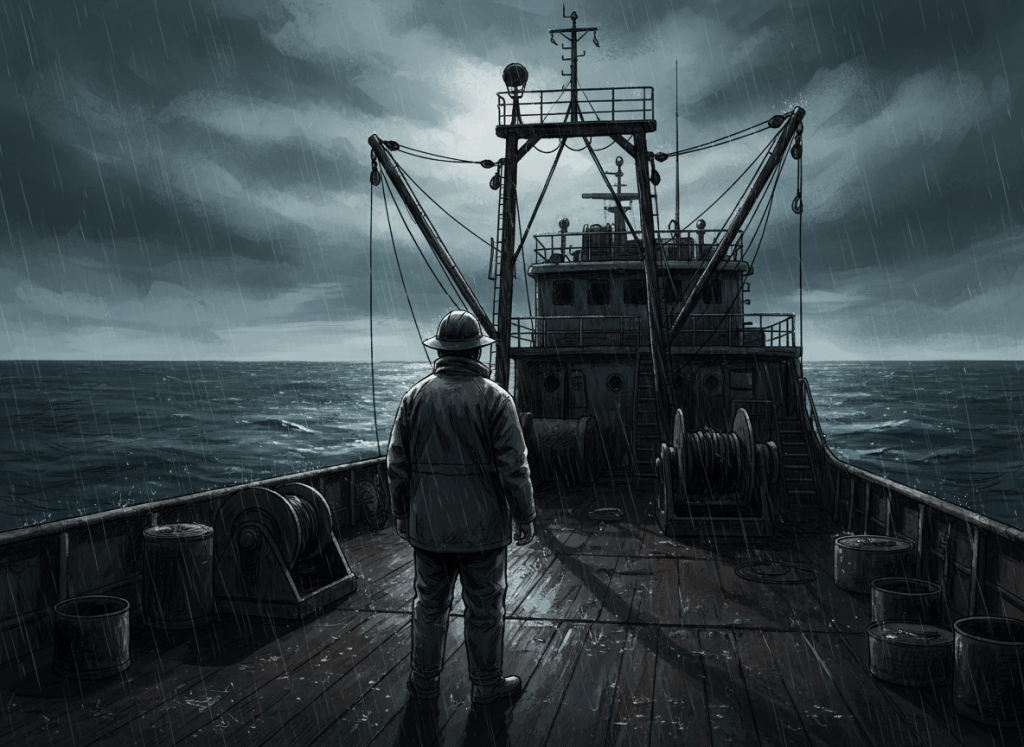
The federal government calls them observers. In practice, they are one unarmed person with a clipboard, a tablet, and a mandate, dropped onto a commercial fishing vessel for days or weeks at a time. They count every fish, record every discarded catch, and document anything that smells like a violation of the Magnuson Stevens Act. They share cramped bunks with the crew they may later help prosecute. Their presence can shave thousands of dollars off a haul if what they write down does not match what the captain wants to land.
Observers, at sea monitors, and catch monitors are the federal government’s eyes and ears on the water. They supply the data NOAA Fisheries uses to set catch limits, justify management decisions, and defend them in court. According to NOAA’s own materials on observer safety and harassment, they do all this while facing a steady risk of verbal abuse, intimidation, and worse. NOAA has highlighted a North Pacific case where harassment of an observer led to a Notice of Violation and Assessment of tens of thousands of dollars against a vessel. That incident made it into an enforcement action. Many others, as NOAA sponsored research has shown, never make it into any official record at all.
Peer reviewed work in journals such as Frontiers in Marine Science, along with NOAA funded studies on the Alaska maritime workplace, has described systematic underreporting of harassment and obstruction of observers. The pattern is not subtle. One worker, often the youngest and least powerful person on board, lives and works in close quarters with the very people whose behavior they are supposed to document. Federal policy historically told them that if something happens, they should report it through channels designed for office parks and research labs instead of rolling decks and hostile wheelhouses.
What H.R. 2406 Actually Does, Behind The Branding
Enter H.R. 2406, the National Oceanic and Atmospheric Administration Sexual Harassment and Assault Prevention Improvements Act of 2025. The title reads like a committee staffer tried to squeeze every relevant noun into one line. The substance, laid out in House Report 119-761 and in the bill text on GovInfo, is more focused.
The bill, introduced by Representative Suzanne Bonamici with bipartisan cosponsors including Representatives Maria Salazar, Jared Huffman, and Brian Fitzpatrick, starts with a simple admission that took Congress far too long to articulate. NOAA’s existing sexual harassment and assault policies did not explicitly protect the people the agency sends onto boats to enforce federal fisheries law. H.R. 2406 expands those policies to cover observers, at sea monitors, catch monitors, and staff of the regional fishery management councils.
The bill also creates a restricted reporting option so that observers and other covered personnel can make confidential disclosures without automatically triggering a full investigation. That kind of option already exists in other federal contexts. Here, it is treated as a novel improvement for people who have been filing incident reports from the middle of the ocean for years.
H.R. 2406 requires NOAA to refer vessel related incidents of sexual harassment and assault to the Coast Guard, along with the names of the individuals involved, the vessel, and the time and location of the incident. It directs the agency to strip out older “forcible” qualifiers in policy language so that non stranger sexual assaults and a wider range of coercive conduct clearly fall within the rules. It expands the annual report to Congress so that lawmakers stop receiving glossy aggregate counts and instead see case synopses, information on disciplinary actions, and breakdowns across observer categories.
One more provision speaks volumes about how literally Congress expects NOAA to take all this. The bill prohibits individuals with certain sexual offense convictions from joining the NOAA Corps. The fact that this needed to be spelled out in legislative text tells its own quiet story about gaps the system had tolerated.
According to House Report 119-761, the Natural Resources Committee reported the bill favorably on August 20, 2026, with bipartisan support and no meaningful opposition. For a Congress that can turn a routine reauthorization into a multi year culture war, that level of consensus is its own data point.
How A “Success Story” Managed To Leave Observers Exposed
The backstory, documented in GAO reports and NOAA’s own studies, will not reassure anyone who thought federal workplace protections were already universal. In 2021, the Government Accountability Office released GAO 21 560 on NOAA’s sexual harassment and assault prevention efforts. The report concluded that NOAA had made “substantial progress” on prevention and response. In Washington, that phrase functions as both praise and warning. It begs the question of what conditions looked like before the progress and what still sat outside the frame.
NOAA’s public facing materials on observer safety acknowledge that harassment incidents have been significantly underreported. Its summary of a new study on harassment in the Alaska maritime workplace describes observers who did not come forward at all or waited until long after returning from deployments. A paper in Frontiers in Marine Science details harassment and obstruction of observers in multiple fisheries, reinforcing the same pattern. Observers described behavior that would violate any modern harassment policy. The problem was that the policy did not clearly reach them.
The gap was not abstract. The North Pacific Observer Program has highlighted specific enforcement actions, including a Notice of Violation and Assessment of about fifty five thousand dollars against a vessel following harassment of an observer. That case, plastered on NOAA’s own website as an example of seriousness, stands out precisely because it is an exception. The agency’s own research says the incident iceberg is larger than the visible tip.
Yet for years, as observers lived and worked in this environment, NOAA’s sexual harassment policies focused on employees and settings that looked much more like traditional offices. Observers contracted through providers, at sea monitors, and some council staff sat in a gray zone that could leave them without the same protections or clear reporting paths. According to the committee report and bill text, H.R. 2406 is meant to close that gap. The timeline raises an obvious question. If the problem is so plain now that both parties agreed to plug it, why did everyone tolerate the hole for so long.
Why Observer Safety Is Not Just A Human Resources Issue
Fisheries observers illustrate a basic truth about federal oversight. The government often relies on a single individual to stand in for the public interest in places that are hard to reach and easy to ignore. Under the Magnuson Stevens Act, observer coverage helps set catch limits, trigger enforcement, and defend management decisions in court. The accuracy of those data feeds depends on observers who feel safe enough to record what they actually see and report it without fear that the next deployment will become punishment.
NOAA’s own messaging about observer harassment admits that underreporting and lack of confidential reporting options have distorted the picture. Before H.R. 2406, whole categories of people who were central to fisheries management sat outside the strongest protections. That is not just a workplace policy oversight. It is a structural flaw in the way the government manages the nation’s fisheries.
The bill will not repair every weak joint in that structure. H.R. 2406 does not rewrite deployment practices that place a lone observer on vessels for weeks at a time. It does not change vessel culture or the basic power imbalance between an observer whose contract depends on successful deployments and a captain whose income depends on how much catch gets recorded. It does not guarantee that every retaliation risk disappears just because reporting options have better labels.
What the bill does, according to the committee report and supporting documents from sponsors such as Representative Huffman, is drag observer safety and harassment out of the gray zone where it has sat for too long. It pulls observers, at sea monitors, catch monitors, and council staff clearly into NOAA’s harassment and assault framework, insists on Coast Guard notification when incidents happen on vessels, and forces more detailed information into Congress’s hands.
For a rare bipartisan effort in a polarized Congress, the most damning part is how modest it is. None of this should be innovative. Confidential reporting, clear coverage of contract like workers, basic screening of Corps officers, and transparent case reporting are the floor of any credible harassment regime. In this sector, that floor took years of reports, studies, and one too many horror stories at sea before lawmakers finally bothered to pour the concrete.
H.R. 2406 is the kind of bipartisan accomplishment that rarely makes news because it fixes something that should never have been broken. The Chuck Edwards censure recommendation — also cleared by a bipartisan Ethics Committee that same August — is another rare instance of the institution applying its own rules with consistency. That case involves a different congressional power structure, but the same underlying question: what it takes to make federal workplace protections mean something for people who lack the power to enforce them on their own.
- Built to Prevent Another Studebaker, Saved From Its Own Studebaker Moment by a $91 Billion Check
- The $1.6 Million Ghost Transit Company: How Federal Grant Money Paid for Services That Never Existed
- Six Agencies Let DOGE Into the Building and Kept GAO on the Porch
- CMS Found $2.2 Billion in Unauthorized Obamacare Enrollments. So Who Did It?
- CBO Tests a One-Point Interest-Rate Increase. The Federal Debt Hits 222% of GDP.

