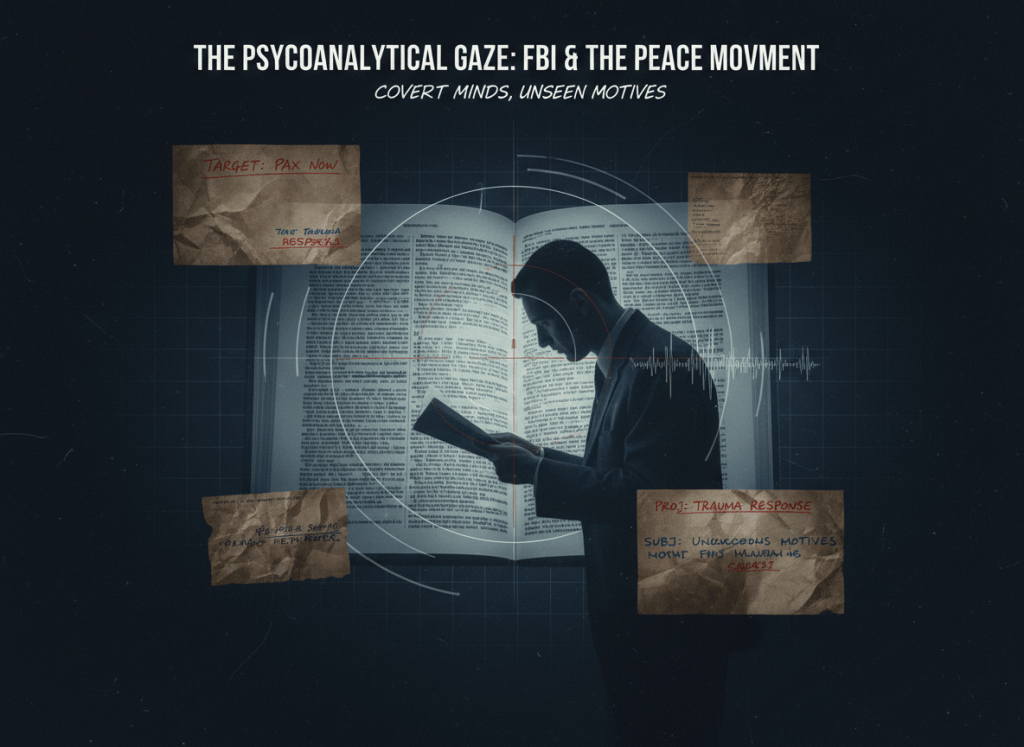
The Curiosity of the “Double Agent” Intellectual
In the summer of 1962, the world was a powder keg. As an investigative archivist sifting through the yellowing, salt-and-peppered pages of declassified Bureau dossiers, one can almost feel the static of the early sixties as a world vibrating with the threat of nuclear annihilation.
In July of that year, Moscow hosted the “World Congress for General Disarmament and Peace,” an event the FBI viewed through a lens of deep suspicion. To J. Edgar Hoover’s Bureau, the Congress was a front for Communist infiltration; and to the Soviet authorities, it was a grand stage for propaganda.
Yet, tucked away in the inter-office memos and reports from legal attachés is the story of an intellectual middle ground that both superpowers found dangerous. At the center was Erich Fromm, a man whose “independent position” made him a paradox of the Cold War.
Fromm was a man the FBI watched with relentless scrutiny, even as sensitive informants in Mexico reported that the Communist Party was reprimanding its members for contacting him, labeling the psychoanalyst an “anticommunist.” These files reveal a forgotten struggle: the attempt to maintain an independent conscience when every dissent is categorized as treason.
Takeaway 1: Dissent Was a Two-Way Street in Moscow
Scanning the November 1965 memos and the earlier reports from 1962, it becomes clear that the Western delegates weren’t the “puppets” the FBI feared. Figures like Erich Fromm, Lord Bertrand Russell, and Canon L. John Collins, the latter of whom was actually threatened with expulsion from the British Labor Party for his attendance, refused to follow the Soviet script. Along with Senator Wayne Morse and his wife, this group issued a “separate statement” for the official record that aggressively criticized both the U.S. and the U.S.S.R.
The Bureau’s investigative files acknowledge this friction. Memos describe these individuals not as agents of a foreign power, but under a distinct, nuanced classification: “peace advocates on the American scene.” They utilized the Moscow platform to denounce the military-industrial strategies of both sides, insisting that true advocacy required criticizing one’s own government as much as the enemy’s.
“It called on peace advocates to maintain their independence by criticizing their own governments as well as foreign ones.”
Takeaway 2: The Disarmament “Deadlock” Was a Technical Choice
The declassified records from the 1962 Congress contain a biting analysis of why peace remained elusive.
The Western delegates’ “separate statement” dissected the disarmament negotiations not as a failure of diplomacy, but as a deliberate “deadlock” maintained through technicalities.
The peace advocates saw through the tactical stalling of both superpowers:
- The United States: The statement accused Washington of “stalling disarmament” by making it conditional on a “previous setting up of an impossibly strict system of inspection.” This was a condition the U.S. knew would be inherently unacceptable to the Kremlin.
- The Soviet Union: Conversely, the delegates described the U.S.S.R. as “obstructive” because it insisted that all inspections be postponed until after the disarmament process had already been initiated.
The archives reveal a cynical reality: both sides used these mutually exclusive technical demands to maintain the military status quo while publicly performing a desire for peace.
Takeaway 3: The FBI’s Ideological Paradox (The “Anticommunist” Social-Democrat)
The FBI’s surveillance of Erich Fromm exposes a glaring irony in Cold War intelligence.
Bureau reports from a sensitive informant on June 29, 1962, reveal a struggle to categorize Fromm’s political identity. The informant noted that while Fromm was “somewhat influenced” by his psychoanalytic background, he was influenced “more so” by his social-democrat viewpoint.
The Bureau was well aware that Fromm was a member of the National Committee of the Socialist Party-Social Democratic Federation (SP-SDF). The ultimate irony, buried in a 1955 report from a Mexican informant, was that the Communist Party had officially reprimanded its members for associating with Fromm, explicitly labeling him an “anticommunist.”
Despite knowing the Communists distrusted and avoided him, the FBI continued its massive surveillance, unable to compute an “independent position” that sat outside the binary of the Cold War.
Takeaway 4: The Policy of “Limited Risks” and the Berlin Thesis
One of the primary reasons for the Bureau’s fixation on Fromm was his advocacy for a departure from established U.S. foreign policy, specifically his “Berlin Thesis.” In these writings, Fromm called for a “new approach” by the United States based entirely on the objective of “no war over Berlin.”
To the FBI, this was subversive. Fromm and his colleagues urged both superpowers to abandon brinkmanship in favor of “limited risks.” They argued that taking a unilateral, limited risk for the sake of disarmament was a rational alternative to the unlimited risk of a nuclear exchange.”
The statement denounced nuclear tests and urged both sides of the Cold War to take ‘limited risks’ through unilateral actions toward disarmament.” The Bureau viewed this specific policy departure not as a humanitarian plea, but as a reason to monitor Fromm’s “ideological influence,” as it bucked the standard government line on the defense of West Berlin.
Takeaway 5: Dissent as a “Who’s Who” of 1960s Culture
The declassified files read like a registry of mid-century intellectual life.
To gather intelligence on these figures, the Bureau often employed “suitable pretexts.” For instance, one memo describes a Special Agent calling the offices of Liberation magazine on April 21, 1965, using the pretext of being a student preparing a term paper to gather information on their personnel and contributors.
The surveillance extended across organizations like SANE, the American Friends Service Committee (AFSC), and the War Resisters League. The files reveal an incredible list of names monitored for their “ideological influence”:
- Writers: Saul Bellow, Arthur Miller, James Baldwin, Ray Bradbury, and Lawrence Ferlinghetti.
- Scientists & Physicians: Dr. Benjamin Spock, Dr. Linus Pauling, and Albert Szent-Gyorgyi.
- Public Intellectuals & Activists: Norman Thomas, Michael Harrington, Lewis Mumford, and Reverend Stephen Fritchman.
These weren’t just names on a list. The FBI tracked the “bulk distribution” of their circulars. When figures signed a “Declaration of Conscience,” they were taking a massive personal risk.
A “Note” in the files warns that signing such documents was viewed by the government as a potential violation of the Universal Military Training and Service Act, carrying a penalty of up to five years’ imprisonment.
The Legacy of the Independent Conscience
The 1962 Moscow Congress served as a prelude to the 1965 March on Washington for Peace in Vietnam. These files document a clear arc in the “Call to Mobilize the Conscience of America.“
By 1965, the Bureau was tracking the “bulk distribution” of march circulars by the Communist Party to fuel a “Communist infiltration” narrative, even as the march’s sponsors were the very same independent social-democrats the Communists had previously denounced.
The declassified “peace files” tell the story of a struggle for an independent position in a polarized world. As we look back at the efforts of Fromm, Russell, and Thomas, the archival record leaves us with a haunting question for the modern era:
In a world of increasing polarization, is it still possible—or perhaps more necessary than ever—to maintain a conscience that refuses to align with either side of a conflict?
References:
- SEC Flagged OTC Link’s Access-Control Problem in 2016. It Was Still There in 2023.
- VA Pricing Problems Spread Beyond Drugs, With 11 of 12 Medical-Supply Proposals Flagged
- The Postal Service and Its Watchdog Cannot Agree on Whether They Spoke in 2024
- The Pentagon’s Own Gas Station Is Losing Money on Every Gallon
- The $215 Million Quantum Race That Took Washington a Decade to Build

