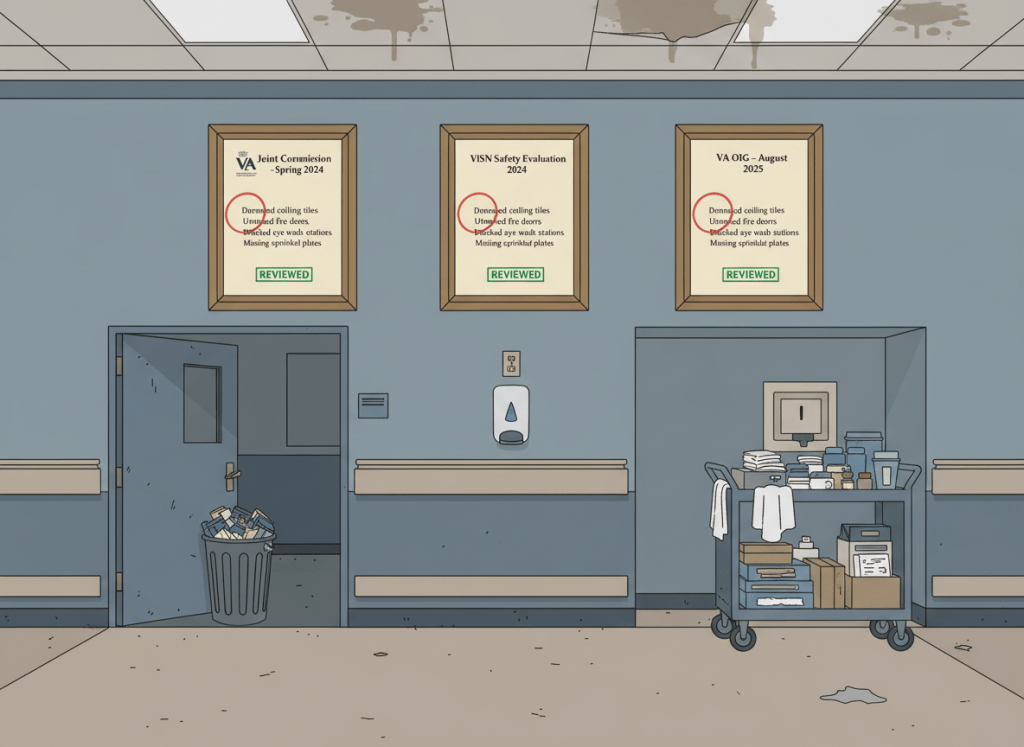
The VA Office of Inspector General spent four days in August 2025 walking the halls of the VA New Jersey Healthcare System, and what it found reads less like a discovery than a rerun. Untested fire doors. Exposed wiring. Expired hand sanitizer. Missing sprinkler head plates. Every one of these had already been flagged, by two other auditors, in two prior years. The OIG simply confirmed that nobody had done anything about it (VA OIG, Report 25-00242-195, Sept. 25, 2026).
A Facility With Three Report Cards and One Grade
The Joint Commission inspected East Orange and Lyons in the spring of 2024 and found damaged ceiling tiles, emergency pull cords wrapped uselessly around handrails, and a hand sanitizer dispenser bolted directly above an electrical outlet, an arrangement that National Fire Protection Association code exists specifically to prevent. Weeks later, the Veterans Integrated Service Network’s own annual safety evaluation found the same wiring problems, the same missing sprinkler plates, the same neglected eye wash stations. Then in August 2025, sixteen months and one more VISN evaluation later, OIG inspectors arrived and cataloged the identical list. Bugs in light fixtures. An eye wash station blocked by trash cans. Another behind a locked door. A blanket warmer with a broken thermometer, so nobody could confirm it wasn’t running hot enough to injure a patient.
The most damning line in the entire report is not a violation; it’s an explanation. Facility leaders told the OIG that when a Joint Commission finding came in, they assigned a “champion” to fix that specific item, track it for a few months, and close it out. Nobody then checked whether the same defect existed two floors up, or in the other building, or in the room next door. The system was built to close tickets, not to fix conditions. That is not an oversight. That is a workflow, and it is the reason three separate inspections over two years kept finding the same broken country.
The Clock That Stopped in 2018
Buried in the fire safety section is a detail that deserves more alarm than it got. Components of East Orange’s sprinkler system were last fully tested in 2018. Federal fire code requires that testing every three years. Nobody inside the facility caught the seven year lapse. It took an outside inspector, flipping through maintenance logs during a routine three year cycle visit, to notice that the system meant to put out fires in a building full of bedridden patients hadn’t been checked since the first Trump administration.
The facility’s written response is a masterclass in bureaucratic redemption arc, promising a “comprehensive action plan,” an assessment of all six hundred fire doors, “interim life safety measures,” and monthly reporting up a new committee chain. All of this is true and all of it is also what gets written every time an inspector shows up with a clipboard. The test is not the pledge; it’s whether the OIG’s next visit, on its own three year cycle, finds anything different.
Nobody Told the Family
The report’s second major thread involves adverse events, VHA’s term for incidents that harm or nearly harm a patient. In the twelve months before the inspection, the facility recorded a delayed diagnosis, a serious injury, and a death, each the kind of event that VHA policy requires be formally disclosed to the patient or their family. The facility disclosed none of them. Risk managers told OIG inspectors they had “varying interpretations” of which adverse events actually triggered the disclosure requirement, an admission that a policy meant to protect patients had quietly become optional at the point of use.
Separately, patient safety staff had let twenty nine corrective actions from prior root cause analyses go overdue, and executive leadership said they had no idea. The chief of quality had been on the job for fourteen days when the OIG walked in and told her about a backlog that had been accumulating on someone else’s watch for months.
The Corrective Action Plan Is Also a Genre
None of this is new to VA, and none of it is unique to New Jersey. The pattern here, an inspection generates a promise, the promise generates a committee, the committee generates a monthly report, and the underlying condition waits patiently to be rediscovered by the next auditor, is close to the operating system of federal accountability itself. VA New Jersey’s leadership turned over almost entirely in the year before the inspection, a new director, a new chief of engineering, a new quality chief, each inheriting a facility mid collapse and each producing, on cue, a fresh action plan with a fresh target date of March or December 2027.
Reading eleven recommendations and eleven corresponding concurrences, each attached to a specific committee that will “monitor” compliance until some threshold of ninety percent is reached for six consecutive months, one starts to suspect that the compliance theater has become more sophisticated than the compliance itself. The VISN director concurred in one paragraph. The facility director concurred in one paragraph. Both thanked the OIG for the opportunity.
The veterans using that emergency department, the ones navigating a locked interior route or an outdoor ramp to reach it, are unlikely to be reassured by a committee’s monitoring cadence. They would probably just like the doors to close.

