Introducing The Man Behind the Mirth
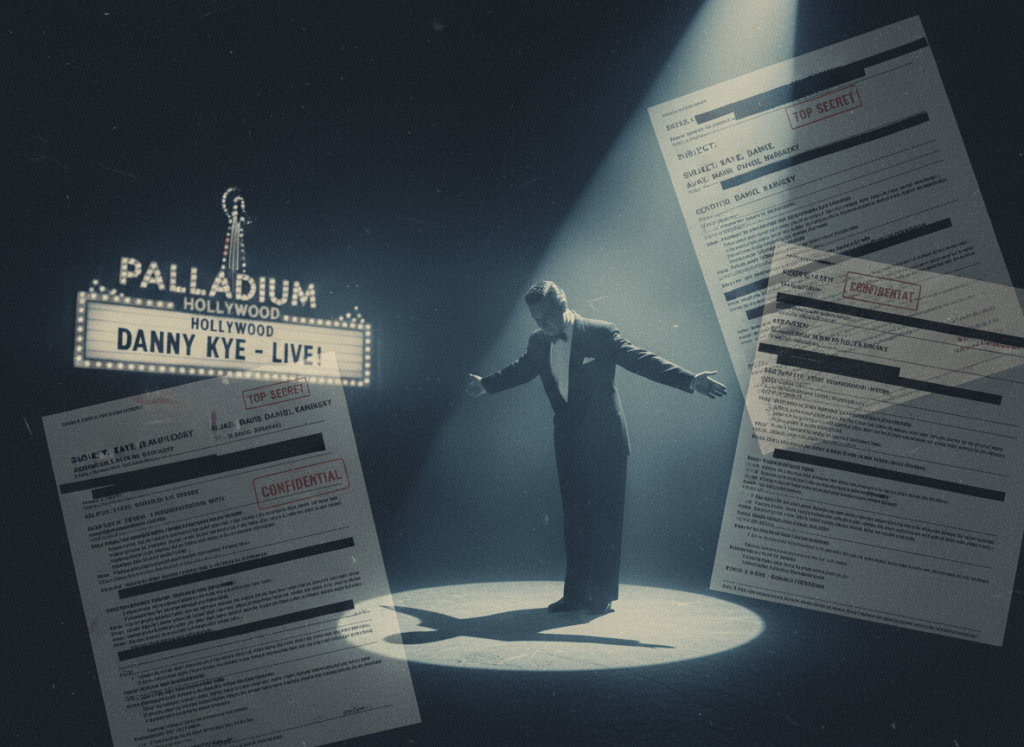
To the mid-century American public, Danny Kaye was the kinetic “vessel of nonsense,” a beloved comedian whose tongue-twisting lyrics and rubber-faced antics made him a household fixture. But while the man born David Kaminsky was busy filming Up In Arms or earning $200 a week headlining for Sam H. Harris at the Alvin Theatre, J. Edgar Hoover’s FBI was looking past the greasepaint.
Behind the laughter lies a declassified paper trail that includes a collection of memos, teletypes, and surveillance reports that paint a startlingly different picture.
Why would the federal government expend such immense resources on a man famous for “vaudeville acts”?
As it turns out, the Bureau was deeply suspicious of the performer, narrowing their lens on him for everything from high-level espionage to “pulling a fast one” on the military draft.
The “Technical” Spy: When the FBI Feared the Funny Man
In the fall of 1946, the Bureau’s lens shifted from Kaye’s fitness for service to his potential as a threat to national security. The flashpoint was a Baltimore FBI office teletype dated October 13, 1946.
It contained a list of individuals under scrutiny for espionage, but Kaye stood out for one chilling reason: he was the only person on that list for whom the Bureau already held “pertinent information.”
The Bureau wasn’t concerned with Kaye’s timing; they were worried about his “technical questions.” Agents scrutinized his interactions with a redacted associate to determine if Kaye had expressed an “unusual interest” in sensitive subjects or if he had “made notes” during conversations. The fear was a literal “information transfer” disguised by the comedian’s public persona. To break the case, the FBI didn’t just watch Kaye…they pressured his inner circle.
The Director of the FBI ordered that this individual be ‘closely interrogated’ regarding their interactions with the actor. While Kaye’s role as treasurer for the Independent Citizens Committee of the Arts, Sciences and Professions (ICCASP) and his political rallies provided the Bureau with “context,” the inquiry ultimately hit a wall. Memos eventually noted that despite his activism, there was “no record of Communist Party membership” for Kaye at the time.
The Five-Show Surveillance: Testing the “Vaudeville Act”
If the espionage charges were high-concept, the 1944 Selective Service investigation was pure Broadway drama. The trouble started in the neon-lit booths of Lindy’s Restaurant in New York, a legendary haunt where “common gossip” suggested Kaye had successfully “pulled a fast one” on induction officials to secure a 4-F classification.
The military’s response was as surreal as a Kaye musical number. A Lieutenant Colonel attached to the National Headquarters of Selective Service was dispatched to watch Kaye’s vaudeville act five times. His mission was as precise as it was absurd: to determine if the symptoms Kaye exhibited during his physical exam, which had just resulted in a 4-F rejection, were merely a “first-rate act” being recycled for the doctors.
This highlights the unique peril of being a professional performer. That is, when your entire career is built on simulating reality, the government struggles to believe you’re telling the truth, even when you’re on a medical examination table.
Bureaucratic Pettiness: The Local Board’s Grudge
The conflict between David Kaminsky and the bureaucratic labyrinth of Local Board 229 in Brooklyn was a war of attrition. While higher military authorities eventually accepted his medical status, the local board held a distinct grudge. They voted unanimously (4-0) to deny Kaye permission to travel overseas with the USO to entertain troops, essentially grounding the star out of spite.
The board’s assessment was biting and reflected their firm belief that Kaye was “malingering,” a term that became the centerpiece of their resistance. They were so unconvinced of his sincerity that they officially recorded a stinging rebuke regarding his value to the war effort. The board stated that Kaye’s performance would not benefit the “morale of the armed forces.”
The situation became so contentious that the Director of Selective Service himself, Lewis B. Hershey, had to intervene. Hershey actually appealed the local board’s decision on Kaye’s behalf, arguing that the War Department should not be deprived of the performer’s unique talents.
The Medical Mystery: From “1A” to “4-F”
The files reveal a flip-flopping medical history that fueled the government’s suspicions of foul play. In early 1943, Kaye was classified as “1A”, or fit for service. By December 1, 1943, he was reclassified as “4-F,” a transition that the FBI scrutinized for “fraudulent rejection.”
The reported ailments were documented with clinical precision:
- Musculo-skeletal Issues: A history of backaches (“clinically N.D.”) and a specific fracture of the coccyx from a fall four years prior.
- Tuberculosis Contact: Kaye’s mother had died of the disease, and X-rays showed an “old fibrotic tubercular lesion” in his lung.
- Nervous Symptoms: A pulse that fluctuated wildly between 90 and 120.
Kaye was even held for a mandatory three-day “Medical Holdover” at Fort Jay on Governor’s Island to verify these findings. The local board remained skeptical until the very end, even after a joint examination by Dr. Simon Moore of Brooklyn State Hospital.
It was Kaye’s personal physician, Dr. Janet Rioch, who provided the most biting defense against the Bureau’s favorite accusation. Dr. Rioch stated that careful observation left her “convinced that there is no problem here of malingering.”
The Case That Closed Itself
The Bureau’s obsession didn’t die easily. It simply morphed from the 1944 draft-dodging case into the 1946 espionage hunt, a cycle of continuous government harassment.
Ultimately, however, the mountain of surveillance resulted in a legal molehill. The facts were eventually presented to the Assistant U.S. Attorney, who brought the curtain down on the drama.
Assistant U.S. Attorney Vincent Quinn declined prosecution on the grounds that there was “no evidence to indicate any criminal violation of law.”
The file was finally marked “CLOSED.”
Danny Kaye remained a free man, his “vaudeville act” having survived one of the most intense backstage reviews in FBI history.
Yet, the Kaye files leave us with a haunting question:
In an era of heightened anxiety, do we ever truly “know” the public figures we admire, or are we simply watching the act the government allows us to see?
- Federal Register Watch: September 25, 2026
- Deja Vu on the Clinch River: TVA’s New Nuclear Bet Looks a Lot Like Its Last One
- SEC Flagged OTC Link’s Access-Control Problem in 2016. It Was Still There in 2023.
- VA Pricing Problems Spread Beyond Drugs, With 11 of 12 Medical-Supply Proposals Flagged
- The Postal Service and Its Watchdog Cannot Agree on Whether They Spoke in 2024

