• Forty Reports, Zero Referrals: The LSC Inspector General’s Quiet Six Months

    Forty Reports, Zero Cases

    In the six months that ended March 31, 2026, the Legal Services Corporation Office of Inspector General opened 20 investigative cases, closed 29, and issued 40 investigative reports. That is a brisk clip for a small oversight office.

    The subject matter was not arcane. According to the semiannual report, investigators worked allegations of theft and misuse of funds, impermissible attorneys fees, time and attendance fraud, and travel fraud. These are not abstract compliance categories. They are the sort of allegations that, in other programs, often migrate from administrative files into criminal case management systems.

    The same document then presents the required statistical table of criminal enforcement activity. Persons referred to the Department of Justice for criminal prosecution: zero. Persons referred to state or local prosecuting authorities: zero. Arrests: zero. Indictments: zero. Convictions: zero. Forty reports. Zero referrals.

    The report does not attempt to reconcile those two sets of numbers. It simply prints them on adjacent pages and moves on.

    Small Watchdog, Large Checkbook

    The Inspector General Act of 1978, codified at 5 U.S.C. App., requires every federal Inspector General to send Congress a semiannual report that lists what the office did and what came of it. That includes a line for cases sent to prosecutors and the resulting prosecutions and convictions.

    The Legal Services Corporation Inspector General oversees a nationwide network of legal aid grantees that distribute hundreds of millions of federal dollars each year. Complaints arrive through the hotline. Investigators open cases. Auditors review financial statements and internal controls.

    The outcomes, from recoveries to referrals, are supposed to appear in the semiannual report in a way that lets Congress trace the line from misconduct identified to action taken. In this reporting period, that line stops abruptly at the threshold of criminal enforcement.

    A Busy Season on Paper

    The October 1, 2025 through March 31, 2026 semiannual report, posted on Oversight.gov, describes a reasonably active investigative period by the standards of a small grant oversight shop. The office opened 20 new investigations and closed 29, which signals that it arrived in October with a backlog and worked it down. Investigators issued 40 final reports.

    The report describes investigations into misappropriation of Legal Services Corporation funds, attorneys claiming fees they were not entitled to claim, employees falsifying time records, and staff submitting fraudulent travel expenses. These are the standard vices of a far flung grantee network, but they are also the same broad categories that have generated criminal charges in other grant programs when the facts supported it.

    On the audit side, the office reviewed 21 grantee financial statement audits and conducted 10 quality control reviews of the independent public accounting firms that audit Legal Services Corporation grantees. One marquee product dominates the dollar figures.

    A performance audit of Legal Aid of Nebraska, identified as Report AU 26 01, found $642,782 in questioned costs and produced 28 recommendations. The findings covered weaknesses in timekeeping controls, gaps in procurement documentation, and problems in travel expense management.

    During the period, the Inspector General reported two recovery actions that totaled $164,237. An additional $137,341 in previously unsupported Legal Services Corporation funded expenditures was brought into compliance after the office intervened.

    Two matters were referred back to Legal Services Corporation management, not to prosecutors, involving a combined $39,384 in questioned costs. The office also reported closure of one lingering recommendation from its earlier audit of Legal Services Corporation disaster grants.

    The report also notes that grantees are required under Program Letter 25 3 to report cyber incidents that affect Legal Services Corporation data to the Inspector General hotline. The tables for this period do not identify any cyber related referrals to prosecutors, a detail that becomes conspicuous only after one reads what follows.

    All That Fraud, None of the Handcuffs

    The referral table is where the narrative stumbles. Under the Inspector General Act, semiannual reports must list matters referred to prosecutorial authorities and their outcomes. For this six month window, the Legal Services Corporation Inspector General reports zero persons referred to the Department of Justice, zero persons referred to state or local prosecutors, zero arrests, zero indictments, and zero convictions. No separate line lists cyber related referrals. On its face, none occurred.

    By itself, a zero referral count in a half year is not an indictment of an oversight office. Administrative investigations are not criminal case files. Inspectors General routinely substantiate conduct that supports civil recovery, administrative discipline, or corrective action without ever presenting it to a grand jury. Not every false time sheet earns a criminal charge, and not every misused travel card is worth a prosecutor’s attention. United States Attorneys and state prosecutors have wide latitude to decline marginal or low dollar fraud cases.

    Context cuts in the other direction. The prior reporting period, April 1 through September 30, 2025, shows a more familiar pattern. The semiannual report for that span, also posted on Oversight.gov, lists two referrals to the Department of Justice, one referral to a state authority, and one conviction. The period before that, October 1, 2024 through March 31, 2025, recorded one Justice Department referral, one state referral, one arrest, one indictment, and one conviction, as reflected in the semiannual report for March 2025. The six months from April through September 2024 also posted a zero line in the referral column. The result is a pattern that alternates between modest criminal activity and none at all.

    There are several possible explanations for a zero that coincides with 40 investigative reports about theft, fraud, and fee abuse. The conduct may not have met the intent requirement or dollar thresholds that prosecutors look for. The office may have sent cases for consultation that never ripened into formal referrals. Investigators may have focused their energy on getting money back quickly instead of building criminal packages. Or the facts may be messier in ways the four line summary table does not capture.

    The report itself offers no theory. It simply confirms that, during a period of documented misuse of federal grant funds, no one found themselves the subject of a charging decision.

    Independence Without Impact

    Buried in the statistical tables is another figure that merits attention. Inspectors General are required to report any attempts by the entities they oversee to interfere with their independence. For the October 1, 2025 through March 31, 2026 period, the Legal Services Corporation Inspector General reports the expected entry. Attempts by the establishment to interfere with OIG independence: none. In an ordinary budget year, that would register as harmless boilerplate.

    This was not an ordinary year. The White House budget proposal for fiscal year 2026, set out in the budget appendix, again proposed eliminating the Legal Services Corporation and providing only enough money for what it called an orderly closeout. Congressional appropriators were openly debating whether to cut the agency roughly in half or to shut it down outright. Our coverage of the LSC’s FY2025 audit — conducted while the administration was trying to eliminate the agency — is here: The Auditors Said Fine. The Administration Said Gone. Congress Said Neither.

    Inside that context, the Inspector General opened cases, closed cases, issued reports, recovered $164,237, brought another $137,341 into compliance, and sent zero subjects to prosecutors, all without documented interference from an agency leadership fighting for institutional survival. That is what formal independence looks like on paper.

    Whether it produced the level of deterrence Congress thought it was buying is a harder question.

    An Awkward Number to Explain

    The Legal Services Corporation Inspector General spent six months doing what inspectors general say they do. The office investigated complaints. It audited grantees. It pressed for better controls. It recovered money. It issued 40 written products that describe theft, fraud, fee abuse, and other familiar forms of grant misbehavior.

    Then it reported zero criminal referrals, which could mean the facts did not justify criminal charges, or that prosecutors declined to invest scarce resources, or that something else happened in the space between the field work and the charging decision. The public record does not clarify that gap.

    What the semiannual report does say is simple. Forty investigative reports were issued. Twenty nine cases were closed. Two recoveries were made. No subjects were referred to the Justice Department. No subjects were referred to state or local prosecutors. No arrests, indictments, or convictions resulted from the period’s work.

    That zero sits at the end of a table that otherwise conveys a portrait of an office in motion. In oversight circles, an unexplained zero rarely feels like the most reassuring number in the room.

    For more on the limits of federal oversight, see The Inspectors General Say They Returned $17 for Every $1 Spent — our examination of what the federal IG community’s headline $65.6 billion return figure actually contains — and Five Billion Dollars for the Bureau of Prisons, and a Watchdog on a Diet, on Congress assigning a new $5 billion oversight mandate to a watchdog whose budget didn’t move.
    Fediverse reactions
  • The Auditors Said Fine. The Administration Said Gone. Congress Said Neither.

    The line item the White House tried to erase

    The Trump administrations fiscal year 2026 budget request did not nibble at the Legal Services Corporation. It tried to erase it.

    In the budget appendix, the White House proposed to eliminate the Legal Services Corporation (LSC) outright and set aside 21 million dollars for what it called an “orderly closeout.” A fifty year old grant maker that underwrites civil legal aid for low income Americans would receive enough money to shut itself down. LSC had requested 2.132 billion dollars. The administration answered with 21 million and a farewell.

    That fight moved quickly from tables to press releases. The LSC warned, in a blunt statement, that the plan would end federal funding for civil legal aid for millions of low income Americans. Advocates mobilized. Appropriators counted votes. And into this argument walked CliftonLarsonAllen LLP, the outside firm hired by LSCs Office of Inspector General to audit the corporations fiscal year 2025 financial statements.

    On June 9, 2026, CLA issued its Independent Auditors Report. The opinion was unmodified. On paper, the books were fine, with one exception that critics of the elimination plan did not rush to cite and supporters did not need to.

    An agency built to move money, not wield power

    The Legal Services Corporation Act of 1974 created LSC as a federally funded nonprofit, not a regulatory agency. It does not prosecute cases, issue rules, or send investigators into courtrooms. It does not litigate on its own behalf. LSC receives federal appropriations and distributes them to a nationwide network of independent legal aid organizations that represent low income clients in civil matters, including housing evictions, domestic violence proceedings, veterans benefits disputes, consumer fraud cases, and immigration problems.

    It has no enforcement stick. Its entire institutional purpose is to move federal dollars from the Treasury to lawyers who handle cases that the private market will not take at a price low income clients can pay. In fiscal year 2025, LSC operated under an appropriation of roughly 560 million dollars. That sum did not buy a new bureaucracy. It bought time from lawyers who otherwise could not afford to keep their doors open for tenants, survivors, and veterans who show up without counsel.

    Elimination on paper, survival in markup

    The administration’s fiscal year 2026 proposal was not a haircut, which the LSC said plainly in its own response. The 21 million dollar line item was described as funding for closeout activities only. No new grants, no ongoing operations, just the administrative costs of winding down a national legal aid infrastructure. On the other side of the ledger sat LSCs 2.132 billion dollar request, which reflected rising demand and inflation, and which assumed continued existence.

    Congress declined to accept the premise that LSC should close its doors. The House Appropriations Committee initially marked the corporation at 300 million dollars, a cut of roughly 46 percent from the prior year enacted level. That figure drew bipartisan pushback from members who know exactly which clinics in their districts would go dark. After negotiations, the House passed 540 million dollars for LSC in a bipartisan vote that explicitly rejected elimination. The Senate Appropriations Committee recommended 566 million dollars. The Senate ultimately approved a 540 million dollar level that matched the House.

    The enacted fiscal year 2026 appropriation overrode the administration’s proposal but did not approach LSCs request. The corporation received 540 million dollars, which is 519 million dollars more than the White House wanted to spend and 1.592 billion dollars less than the agency said it needed.

    The LSC is not dead, but it is not fully funded. It operates in the gap between an administration that has tried to write it out of the budget and a Congress that keeps deciding, in bipartisan votes, that civil legal aid remains a line item worth defending. The audit landed in the middle of that gap.

    A clean opinion with a catch

    The fiscal year 2025 audit, recorded in the OIG release and listed on Oversight.gov, followed the standard script. The LSC Office of Inspector General contracted with CliftonLarsonAllen LLP, a national accounting and advisory firm that markets itself as CLA, to perform the work in accordance with Government Auditing Standards. On June 23, 2026, the OIG transmitted the completed package to LSC leadership, complete with the boilerplate assurance that the auditors were independent in fact and appearance.

    CLA issued three reports. The Independent Auditors Report on the financial statements gave LSC the prize every agency wants to wave at appropriators, an unmodified opinion that the statements present fairly, in all material respects, the corporation’s financial position and results of operations in conformity with U.S. Generally Accepted Accounting Principles (GAAP).

    The Independent Auditors Report on Internal Control over Financial Reporting identified a material weakness.

    The Independent Auditors Report on Compliance and Other Matters reported no instances of noncompliance that had to be disclosed.

    The weakness sits in Note 9 to the financial statements, titled Correction of Prior Period Error. During fiscal year 2025, LSC management identified an error in how the corporation had been classifying investment income earned on funds derived from federal appropriations.

    Historically, that income had been reported as net assets with donor restrictions. After reviewing applicable case law and accounting guidance, management concluded that it should have been reported as net assets without donor restrictions and restated the fiscal year 2024 statements.

    The restatement moved $7,806,766 in beginning net assets and $9,170,582 in investment income between the two columns. Total net assets did not change. Total investment income did not change. This was a classification error, not a missing dollar.

    The material weakness arises because the internal controls that were supposed to prevent or detect that kind of misclassification did not work well enough to catch it in the normal course of business. Management found it, corrected it, and disclosed it. CLA agreed that the correction was appropriate and kept the main opinion unmodified.

    Under Government Auditing Standards, however, a material weakness means there is a reasonable possibility that a material misstatement of the financial statements could occur and not be prevented or detected on a timely basis. For an agency that spends each spring justifying its existence to appropriators, that is not a flattering footnote.

    Weak controls in an agency on the bubble

    The chronology is not subtle. LSC management identified and corrected the classification error in fiscal year 2025. That is the same fiscal year in which the administration proposed to eliminate the corporation and Congress debated whether to cut it by nearly half or by one hundred percent. The audit does not suggest that political pressure caused the error in the prior year. It cannot. This was a financial statement audit, not a culture study.

    What the audit establishes is narrower and more uncomfortable. During a period of sustained institutional threat, LSCs internal controls were not strong enough to catch a prior year classification error without targeted management review. That is what a material weakness means in this context. The auditors found the books corrected. They also found that they should not have needed correcting in the first place. The Office of Inspector General put both facts in the same public document instead of letting the clean opinion swallow the control finding.

    The report does not wade into the reasons. Government Auditing Standards do not ask auditors to diagnose whether vacancies, frozen systems projects, or repeated elimination threats erode financial oversight. The letters stick to what is provable. The controls did not prevent or detect the error in a timely way. Management remediated the numbers. The underlying control environment will improve or it will not. That choice will show up in next years report.

    Neat books, messy politics

    The Legal Services Corporation passed its fiscal year 2025 audit. After a correction, CliftonLarsonAllen said the financial statements fairly present reality. The administration still wants the agency off the federal books. Congress funded it at 540 million dollars, which is 519 million dollars more than the White House proposed and 1.592 billion dollars less than LSC requested. The material weakness in internal control will be remediated or it will recur and trigger another finding next year.

    The fiscal year 2027 appropriations cycle will almost certainly open with another proposal to eliminate LSC, packaged in new budget language but familiar in substance. CLA or a peer firm will return. The OIG will issue another transmittal memo. Unmodified opinions and control findings will continue to travel together in thick PDFs that only specialists read.

    Elsewhere in the system, far from the footnotes and the markup tables, actual lawyers will or will not walk into housing court, family court, and veterans benefits hearings beside clients who have nowhere else to turn. If the zeros finally win, the missing lawyers will explain more than any audit ever could. For now, the audit is fine. The rest is politics. Those are not the same thing.

    For related coverage on the limits of federal oversight, see Forty Reports, Zero Referrals — on the LSC OIG’s six-month period that produced 40 investigative reports on theft and fraud and zero criminal referrals — and The Inspectors General Say They Returned $17 for Every $1 Spent, our examination of what the federal IG community’s headline return-on-investment figure actually measures.

    Fediverse reactions
  • Hundreds of Separated CBP Contractors Still Have System Access, OIG Audit Finds

    A contractor leaves U.S. Customs and Border Protection with a password and access to a database full of biometric information, border patrol reports, and personally identifiable information. Because of a systemic process failure, that contractor can still log in months later. And CBP didn’t catch it — a federal audit did.

    Fifteen percent of contractors who separated from CBP retained active access to the agency’s computer systems after leaving, according to a Department of Homeland Security Office of Inspector General audit released September 4, 2026. Among federal employees who transferred to new positions within CBP, 17 percent kept access they no longer needed.

    The most alarming finding: 86 percent of the transferred employees with unneeded access came from CBP’s most sensitive offices — the Office of Intelligence, U.S. Border Patrol, Office of Field Operations, and Office of Air and Marine Operations — meaning they retained access to systems containing “highly sensitive systems containing national security and personally identifiable information.”

    The audit, titled “CBP’s IT Access Control Deficiencies Introduced Critical Risk to IT Systems and Sensitive Information” (OIG-26-28), reveals a cascading failure in CBP’s account management process where supervisors and contracting officers fail to properly document separations and transfers, leaving hundreds of people with passwords to systems they should no longer be able to access.

    This is one of three pieces covering the same OIG audit. The other two examine a seven-year-old privileged account vulnerability that gave all 76,000 CBP network users administrative access, and a 2023 security directive that went unenforced for three years because no compliance mechanism was ever built.

    How the System is Supposed to Work

    CBP’s established process for account disablement after an employee or contractor leaves is straightforward: A supervisor or contracting officer should create a separation notification record in the Employee Separation System or Contractor Tracking System once they’re aware of the separation. That system then automatically notifies CBP’s centralized Access Management System (AMS), which disables the account on the separation effective date.

    DHS policy requires accounts be disabled within 3 days of separation.

    For transferred employees, the process is similar. The departing supervisor creates a transfer record, and the AMS automatically removes the employee’s old system access on the transfer date, while preserving access needed for their new position.

    On paper, it works. In practice, it collapses under the weight of CBP’s size and bureaucratic friction.

    Where the Process Breaks Down

    The audit examined separations and transfers that occurred in fiscal years 2023 and 2024. The findings show systematic non-compliance at nearly every step.

    For separated employees: Supervisors didn’t create separation notifications in a timely manner. The OIG sampled 365 employees who separated in FY 2023-2024 and found 72 (20 percent) had accounts that were not disabled promptly after they left. Among contractors, the problem was worse: 1,208 of 8,013 identified contractors (15 percent) had accounts not disabled in a timely manner.

    For separated contractors specifically: The data reveals a stunning breakdown. Of 1,208 contractor separations, 623 (52 percent) had separation records created more than 30 days after the contractor had already left CBP.

    Think about that timeline: A contractor walks out the door on day one. The supervisor doesn’t create a separation record. Days pass. Weeks pass. Thirty days later — well after the contractor should have been disabled — the separation record finally gets created. In the intervening month, that person could have been accessing databases from anywhere in the world.

    For transferred employees: Of 3,697 identified employee transfers, 615 (17 percent) retained unneeded access after moving to new positions. When supervisors entered transfer records late — after the employee had already transferred — the AMS didn’t automatically remove the old system access. The employees retained unnecessary access, likely without supervisor awareness.

    The OIG report notes that CBP configured its systems to remove existing access on the transfer date but not after. Why? To avoid inadvertently removing any newly granted access needed for the transferred employee’s new position. The result: Employees who transfer keep their old access indefinitely.

    Why CBP’s Backup Plan Doesn’t Work

    When the primary process failed, CBP relied on “backup controls” to eventually catch the problem: account inactivity. If an account wasn’t used for a certain period, the system would eventually disable it.

    This is not adequate. The DHS requirement is 3 days. Account inactivity can take weeks or months.

    “Although these backup controls helped reduce the risk of separated personnel retaining unnecessary access, they did not allow CBP to disable the accounts within 3 days of an employee’s separation, as required,” the OIG found.

    CBP also relied on data from the National Finance Center to identify separated employees. This creates a lag — payroll data isn’t real-time — meaning accounts could remain active longer than policy allows.

    The National Security Angle

    Of the 615 transferred employees who retained unneeded access, 531 (86 percent) came from CBP’s most sensitive offices.

    The significance of this cannot be overstated. These are not administrative workers losing access to email or shared drives. These are personnel from the Office of Intelligence, Border Patrol, Office of Field Operations, and Office of Air and Marine Operations retaining access to systems with “national security and personally identifiable information.”

    Transferred employees with access to information without a need-to-know and legitimate business purpose weaken operational security and integrity of the programs and systems, the OIG noted. Such access “could result in using the access for improper purposes.”

    This raises personnel security questions: Is CBP conducting counterintelligence reviews to determine why someone transferred and whether they retained access? Are there cases where an employee transferred after disciplinary action or under suspicious circumstances and retained sensitive access?

    The OIG audit doesn’t address this question. It’s one worth investigating further.

    The June 2025 Breach Question

    In June 2025, multiple DHS components, including CBP, experienced a cybersecurity incident that allowed hackers to steal CBP employee data. The OIG report mentions this incident as context for why CBP needs strong access controls — attackers regularly target CBP systems.

    The audit does not state whether the June 2025 breach involved separated or transferred personnel accounts. But given that CBP had hundreds of accounts that should have been disabled but weren’t, it’s a logical question: Did hackers use a former contractor’s credentials to gain access?

    Bureaucracy Times submitted that question to CBP. The agency has not responded.

    CBP’s Response and Timeline

    CBP concurred with all 12 OIG recommendations related to this finding. The agency’s planned corrective actions include:

    • Updating supervisor training by August 31, 2026
    • Implementing a new “Submit” tab on separation forms that automatically emails supervisors with reminders and direct links to the Employee Separation System (also by August 31)
    • Issuing formal notification memorandums to contracting officer representatives (by August 31)
    • Developing a process to periodically review contractor separations for compliance (by August 31)
    • Evaluating and formalizing the process for managing access when CBP personnel transfer internally (by August 31)
    • Implementing controls to monitor and review transferred personnel’s access (by August 31)

    All of these were due by August 31, 2026. Whether CBP met those deadlines has not been confirmed. This article will be updated as new information becomes available. But the core problem — that CBP is attempting to manage account security through human process compliance rather than automated enforcement — remains unaddressed.

    The Real Issue: Process, Not Technology

    CBP’s explanation for the failure places blame on “human error and challenges associated with monitoring account access changes over time.” But this framing misses the point.

    The problem isn’t that supervisors are careless. The problem is that CBP built a system that depends on thousands of supervisors remembering to file paperwork within 3 days of separation, across an organization with 67,000 personnel, 4,500 facilities nationwide, and constantly shifting staffing.

    A modern access management system should detect separations from HR records automatically. A supervisor forgetting to file a form shouldn’t be able to delay account disablement. These are solvable technical problems, not inherent human failures.

    Instead, CBP has implemented “backup controls” and relies on account inactivity as a de facto enforcement mechanism. This is reactive security, not proactive security.

    The OIG recommendation to “update supervisor training” may help marginally, but it doesn’t address the structural problem: CBP’s access management process is fundamentally broken at the design level.

    What’s at Stake

    CBP protects America’s borders and manages biometric data on millions of people. The agency processes travel documents, law enforcement information, and intelligence. Contractors working for CBP — software developers, IT managers, security consultants — have access to some of the most sensitive information in the federal government.

    If CBP can’t reliably remove their access when they leave, the agency can’t reliably protect that information.

    The OIG audit found this problem in September 2026. CBP is promising fixes by August 2026. If the timeline holds and the fixes work, accounts should be disabled more reliably going forward.

    But accounts that should have been disabled in 2023 and 2024 — the subject of this audit — remain within CBP’s systems today. CBP has not said whether it has gone back and cleaned up those historical accounts, or what it found when it reviewed the access logs.

    Those are questions worth asking.


    References and Links

    Full OIG Report (OIG-26-28): CBP’s IT Access Control Deficiencies Introduced Critical Risk to IT Systems and Sensitive Information — Released September 4, 2026 by the DHS Office of Inspector General

    DHS OIG Homepage: www.oig.dhs.gov

    Relevant DHS Policy (referenced in audit):

    • DHS 4300A: Information Technology System Security Program, Sensitive Systems (v. 13.4, December 2024)
    • NIST SP 800-53, Revision 5: Security and Privacy Controls for Information Systems and Organizations

    CBP Policy Directives (referenced in audit):

    • CBP Directive 51715-006: Separation and Reassignment Directive for CBP Employees (August 2023)
    • CBP Directive 1210-007B: Tracking of Contractor Employees (August 2023)
    • CBP Identity Credential and Access Management Directive (IPL-2022-05-0253, May 2023)

    Editor’s Notes

    — CBP was contacted for additional details on the June 2025 cybersecurity incident and whether separated/transferred personnel accounts were involved. The agency has not responded as of September 9, 2026.

    — The report notes that “CBP provided timely responses to our requests for information and did not delay or deny access to information we requested” during the audit. This OIG notation is standard language confirming agency cooperation.

    — All 12 recommendations in the audit were concurred with by CBP, meaning the agency agreed with the findings and committed to corrective action.

    Fediverse reactions
  • The VA Knows How to Help Pregnant Veterans. It Isn’t Doing It Consistently.

    VA Maternity Care Coordination Delivers The Easy Parts And Drops The Rest

    The premise sounds almost elegant. The Veterans Health Administration assigns a dedicated maternity care coordinator to each pregnant veteran. That coordinator is supposed to translate VA coverage into real care. Help schedule prenatal and postpartum visits. Connect veterans to community providers when VA facilities do not offer maternity services. Untangle billing in a system originally built for male patients and acute care, not pregnancy.

    The program exists because VA finally acknowledged what veterans and frontline staff already knew. Pregnancy inside a large, fragmented federal health system is a moment when complexity can hurt people if no one is minding the gaps.

    So the Office of Inspector General pulled fiscal year 2025 data to see how that promise is playing out in practice. The findings follow a familiar VA pattern. The structured, front end tasks are mostly done. The work that happens after delivery, where coordination actually earns its name, is where the program starts to fray.

    Where the Prenatal Numbers Hold Up

    Credit belongs where it is due. The OIG review, Review of VHA Maternity Care Coordination and Women Veterans’ Experience (Report No. 24-00818-208, August 10, 2026), found that VA providers largely met prenatal referral requirements. Seventy seven percent of veterans in the sample made it to a first community prenatal appointment in the first trimester. For a program that routes most maternity care to community providers, that is not a trivial accomplishment. It means the intake forms are completed, the consults are placed, the Community Care Network plumbing is working often enough to get most pregnant veterans into care when it matters most for fetal development and maternal risk assessment. Maternity care coordinators are doing the early paperwork and phone calls that the design demands. Where the rules are clear and the timeline is short, the system behaves.

    That matters for another reason. It establishes that the maternity care coordination program is not a caricature of VA failure. It is a partial success in the early phase of pregnancy. The coordinators exist. The referrals are flowing. The first trimester access metric is something many large private systems would be happy to claim.

    The OIG did not find systemic refusal to engage with pregnant veterans or wholesale breakdown of the front end processes. Instead, it found something both more mundane and more telling. Once the baby is born and the simple checklist items run out, the system loses interest.

    The Postpartum Drop-Off

    The postpartum phase is where the compliance picture deteriorates. The OIG reports that facilities were not yet in compliance with postpartum care coordination requirements, and it does not soften the point. Unlike the prenatal side, the report does not put a tidy percentage on postpartum coordination performance. That in itself is a clue.

    Postpartum coordination is inherently less tidy. It involves multiple follow up contacts, depression and safety screenings, contraception counseling, primary care scheduling, and handoff back into the broader VA system that will manage chronic conditions long after the baby shower balloons have deflated. It is work that stretches over months and cuts across services that still treat maternity as an exception, not a core line of business.

    The billing finding is more concrete and far less flattering. In roughly one in four records reviewed, OIG staff found documentation of billing issues related to maternity care. That is not a stray coding error. It is a pattern. Community care billing has been a persistent weak point across VA programs, and maternity services are no exception.

    In a June 27, 2024 national review of perceived barriers in coordinating maternity care, about 80 percent of maternity care coordinators surveyed told the OIG that billing processes were the top area that needed improvement. Two years and a fresh FY 2025 data pull later, the 2026 maternity coordination review confirms that billing trouble remains baked into the experience for too many pregnant and postpartum veterans.

    The clinical follow through is not much better. The report found that veterans were not consistently completing postpartum primary care visits within three months of delivery. That is not a small administrative miss. Those visits are where postpartum depression screening should happen. Where contraception options are revisited and chronic conditions like hypertension, diabetes, and PTSD are reassessed after pregnancy.

    When those visits fall off the schedule, the whole pitch of maternity care coordination looks thinner. The prenatal phase gets documented and counted. The messy reality of postpartum health, which rarely fits into a neat six week follow up, slides back into the same gaps that prompted VA to create maternity coordinators in the first place.

    A Structural Problem, Not an Isolated One

    None of this occurs in a vacuum. Community care billing problems are endemic across VA programs, not unique to maternity. The VA OIG has spent years documenting slow or failed resolution of community care claims. The postpartum coordination gap fits a broader pattern as well.

    Across service lines, VA has trouble maintaining intensive coordination once the acute episode is over and the veteran is supposed to flow smoothly back into routine care. For women veterans in particular, that handoff occurs inside an institution that is still catching up to its own demographic reality. VA likes to point to its expansion of women veterans clinics and services, and there is real progress there, documented in VA materials and in external reporting. Yet the infrastructure that supports those services, particularly billing and care coordination, often looks like it was bolted on in a hurry.

    In September 2023, VA extended maternity care coordinator availability to one year after delivery, an acknowledgment covered in contemporaneous reporting that postpartum needs do not vanish after the traditional six week check. The FY 2025 coordination review suggests that the requirements attached to that extended availability have not yet caught up with the ambition.

    The policy recognizes a year long postpartum reality. The execution still reaches only some veterans, some of the time. The result is a familiar VA split screen. On one side, a well worded policy statement. On the other, incomplete documentation, missed primary care follow up, and unresolved community care billing that lands in veterans mailboxes.

    Closed Recommendations, Open Questions

    The OIG did not leave its findings in abstract terms. It issued four recommendations to the Under Secretary for Health. All four have been closed as implemented. The recommendations called on VA to review postpartum coordination compliance and fix deficiencies, evaluate how facilities identify and resolve community care billing problems, improve scheduling of postpartum primary care visits, and close documentation gaps in coordination records. On paper, that is a clean result. The department agreed with every recommendation and reported specific corrective actions, which convinced the OIG to close the items.

    Closure, however, is an administrative milestone, not a victory lap. OIG recommendations come off the list when VA shows it has put a policy, process, or training in place, not when veterans lives measurably improve.

    The real test will come in the next review cycle, when inspectors can ask a simpler question. Did postpartum coordination rates rise? Are fewer maternity care records littered with billing disputes? Are more veterans keeping postpartum primary care visits within three months of delivery? Until those numbers move, the existence of closed recommendations mostly proves that VA knows where the problems are.

    The Map Is Not the Territory

    Maternity care is not a side project for a modern veterans health system. The number of women veterans continues to grow, and VA itself has framed maternity care coordination as proof that it can adapt. The department touts its maternity benefits on its own womenshealth.va.gov site. It promotes the Community Care Network as a flexible way to connect veterans to non VA providers when VA cannot provide a service directly.

    The FY 2025 OIG review is a cold measure of how that rhetoric holds up against the record. Early referrals work reasonably well. The harder, quieter labor of postpartum coordination and billing cleanup still falters.

    One in four maternity care records with documented billing issues does not describe a theoretical risk. It describes veterans receiving inaccurate bills or facing potential collections for care that should have been covered. That is not a harmless paperwork glitch. It is a pregnant or postpartum veteran who should be tracking blood pressure or sleep, instead tracking appeal deadlines and resubmitted claims.

    VA created the maternity care coordination program because it understood that unmanaged complexity can do real harm at a vulnerable moment. The OIG has now provided a clear map of where that complexity still wins.

    For more on VA institutional performance, see Paying for Nothing — on how the VA spent $11.2 million on a Veterans Crisis Line backup contractor that never answered a call — and Drug Companies Told the VA What Their Best Customers Pay. Two-Thirds of Them Lied. — on how pharmaceutical pricing disclosures for VA federal supply contracts fare under OIG review.

  • Drug Companies Told the VA What Their Best Customers Pay. Two-Thirds of Them Lied.

    When Veterans Become Test Cases For Drug Pricing Honesty

    The Department of Veterans Affairs runs the largest integrated health care system in the country. It buys enormous volumes of drugs through the VA Federal Supply Schedule, a program that was supposed to solve a simple problem: if manufacturers tell the government what they charge their best commercial customers, the government will not get fleeced.

    The contract paperwork calls this a Commercial Sales Practices disclosure. The theory is that the VA should get a price at least as good as the most favored commercial customer identified in that disclosure, consistent with the pricing rules in 38 U.S.C. § 8126.

    In practice, the VA Office of Inspector General keeps finding problems. In its latest summary of pre-award reviews of pharmaceutical proposals for fiscal year 2025, the OIG reports that 11 of 16 manufacturers submitted proposals with deficiencies in those required disclosures, covering contracts with an estimated value of about $21 billion and 1,043 offered items.1 That is just under 69 percent. You do not need a graduate seminar in procurement policy to understand what that ratio means. You just have to be able to count.

    How The VA Drug Pricing Gate Is Supposed To Work

    The VA National Acquisition Center in Hines, Illinois, runs the pharmaceutical side of the Federal Supply Schedule program under a delegation from the General Services Administration.2 Drug companies that want in on that steady government demand submit proposals that include a Commercial Sales Practices disclosure.

    On paper, it is straightforward. The manufacturer identifies its most favored commercial customer, lists the prices and discounts that customer receives, and explains any deviations from standard commercial pricing that might matter when the VA negotiates its own rates.

    The OIG does not rubber stamp those claims. For selected high value proposals, it conducts what the agency calls a pre-award review. Investigators compare the disclosure against underlying sales data, rebates, and price concessions to see whether the manufacturer described its commercial pricing accurately and completely before the contract is awarded.1

    The point is simple: the VA should not pay more than commercial customers pay for the same drug, especially when Congress has already told manufacturers in statute that prices for the VA and certain other agencies are capped at no more than a fixed percentage of the nonfederal average manufacturer price.

    For fiscal year 2025, the OIG summary covers 16 pharmaceutical proposals with a combined estimated value of about $21 billion, offering 1,043 line items into the Federal Supply Schedule.1 These are not discount contracts for aspirin at the corner store. These are large volume, multi year deals that set the baseline for what the government pays and what manufacturers earn on veterans health care.

    What Fiscal Year 2025 Actually Found

    The headline number is astounding: 11 out of 16 proposals had disclosure deficiencies, as the OIG defines them. That category includes errors, omissions, or inaccuracies in the commercial sales practices data that manufacturers are required by contract to provide truthfully and completely.1

    In seven of those 16 proposals, the OIG went further and made explicit pricing recommendations that helped contracting officers obtain about $24.7 million in savings before the contracts were awarded. That figure is not a theoretical projection, but one that reflects savings that VA contracting staff actually realized after the reviews.

    The names of the manufacturers do not appear in the public record. Individual pre-award reports are sealed because they contain commercially sensitive pricing information that federal law protects from public release.1 So the taxpayers who funded the drugs, and the veterans who will take them, see only the aggregate scorecard. They get the failure rate and the total savings, but not which company left what out of its disclosure, or how hard the government had to push to fix it.

    What that aggregate view does show is a pattern over time. The 2025 summary does not appear in isolation. In fiscal year 2023, the OIG reviewed 17 proposals and recommended approximately $120.6 million in savings for VA contracting officers.3

    In fiscal year 2024, it reviewed 14 proposals and estimated about 54.9 million dollars in potential savings, of which the VA sustained $36.8 million after negotiations.4 The $24.7 million in 2025 is realized savings, not just a recommendation.

    Whether that lower figure reflects cleaner initial proposals, a shift in which proposals the OIG chose to review, or less aggressive follow through by contracting officers is a question the public summary raises by implication and then leaves on the table.

    Why Deficiencies Are The Point, Not A Glitch

    The federal pricing rules for covered drugs exist because of a basic information gap. Drug manufacturers know exactly what they charge their best customers and what quiet concessions they make to close big commercial deals. The government generally does not, unless manufacturers are required to disclose it as a condition of doing business. Under the Veterans Health Care Act and its implementing contracts, that disclosure is not optional etiquette. It is a binding promise.

    Getting it wrong can carry real penalties. If a manufacturer obscures or misstates its commercial pricing, the government can seek price adjustments, refunds, or more severe remedies. In some cases, that pattern of conduct turns into False Claims Act exposure. That is not a hypothetical risk. The Justice Department has used that statute against pharmaceutical companies that overcharged the VA by failing to live up to their pricing obligations.

    Sanofi Pasteur, for example, agreed to pay $19.8 million to resolve allegations that it overcharged the department for certain vaccines by misreporting its pricing under the relevant federal program.5

    The OIG pre-award review program exists to keep more of those problems from maturing into retroactive enforcement cases years later. Seen that way, 11 out of 16 proposals requiring correction is not proof that the process failed. It is proof that the process is catching something real every time it is used. It is also a reminder that without this gatekeeping, those same deficiencies could have gone straight into long term contracts with no one the wiser until a whistleblower or analyst stumbled over the gap.

    What The Screen Misses By Design

    The pre-award reviews have one unavoidable limitation, in that the OIG does not review every pharmaceutical proposal that comes through the Federal Supply Schedule door. For fiscal year 2025, it examined 16. The broader VA FSS pharmaceutical portfolio is bigger than that, and the OIG is candid that it selects high risk, high value targets rather than running a universal check.1

    The individual pre-award reports remain confidential. The public does not see which manufacturers needed corrections or which contracting officers accepted, modified, or ignored OIG pricing recommendations. The $24.7 million in savings for 2025 is a documented floor, the confirmed amount that VA obtained after the reviews. How much was recommended but not sustained, as in 2024 when $54.9 million in potential savings yielded $36.8 million in actual reductions, is not broken out for 2025 in the public record.4

    What the record does say is simple enough. The VA is the largest buyer of prescription drugs in the federal system. The OIG reviews only a fraction of the proposals, and roughly two thirds of those examined contain problems in mandatory pricing disclosures. The screen catches something. It does not catch everything.

    Why Veterans Should Care Who Gets The Best Price

    Veterans health care spending is not an abstraction on a chart. The VA pharmaceutical budget comes from public money and buys medicines for people who served in uniform. When a manufacturer submits an inaccurate Commercial Sales Practices disclosure on a contract worth hundreds of millions or billions of dollars, and the OIG flags it before award, that is oversight doing its job.

    When about 69 percent of the proposals the OIG reviews contain deficiencies, year after year, that is the oversight system sending a message. The pre-award review program itself is relatively small compared with the volume of contracts it could examine. The path to catching more overcharging before it happens is not complicated. It involves more reviews, more often, with the same unglamorous insistence on accurate data.

    The harder question is how to get accurate disclosures from the start. The summary reports, properly, stay out of that policy fight. They just present the numbers and leave the rest to the people who decide how much risk they are willing to run with other peoples medicine.

    For more on VA oversight and institutional accountability, see Paying for Nothing — on how the VA paid $11.2 million for Veterans Crisis Line backup services never delivered — and The VA Knows How to Help Pregnant Veterans. It Isn’t Doing It Consistently. — on where the maternity care coordination program holds up and where it frays.

  • Truth Social’s Bots Keep Banning Us for Being a Bot

    There are certain moments in journalism when the facts arrange themselves so neatly that commentary becomes almost unnecessary.

    This is one of them.

    Truth Social has, for the second time in a matter of days, informed Bureaucracy Times that its bot-mitigation system mistakenly identified our account as a bot and banned it.

    For the second time, we have been reinstated.

    We would therefore like to announce that we have once again been officially recognized as human.

    The Bot That Cried Bot

    The sequence began when Truth Social suspended the Bureaucracy Times account. We appealed. Truth Social subsequently restored the account and explained that the suspension had been an error.

    “Your account was inadvertently banned due to a bug in our bot mitigation system that mistakenly identified your account as a bot.”

    Truth Social Ban Appeals

    Fair enough. Software makes mistakes. Automated moderation systems make mistakes. Somewhere inside Truth Social’s machinery, something apparently looked at an independent journalism account posting links to stories about federal bureaucracy and concluded that no actual human being would voluntarily spend this much time doing that.

    We can understand the confusion.

    So we returned to Truth Social and did what journalists generally do when something peculiar happens: we reported what happened.

    We posted Truth Social’s explanation, noted—with perhaps an inadvisable amount of amusement—that its bot detector had mistaken us for a bot, and asked whether anyone else had experienced the same problem.

    At 11:52 a.m. on September 7, we posted Truth Social’s explanation. At 11:53 a.m., the account was banned again.

    Apparently, discussing the bot that thought we were a bot did not improve our standing with the bot.

    Humanity, Recertified

    We appealed the second ban.

    On September 8, Truth Social’s Ban Appeals team responded:

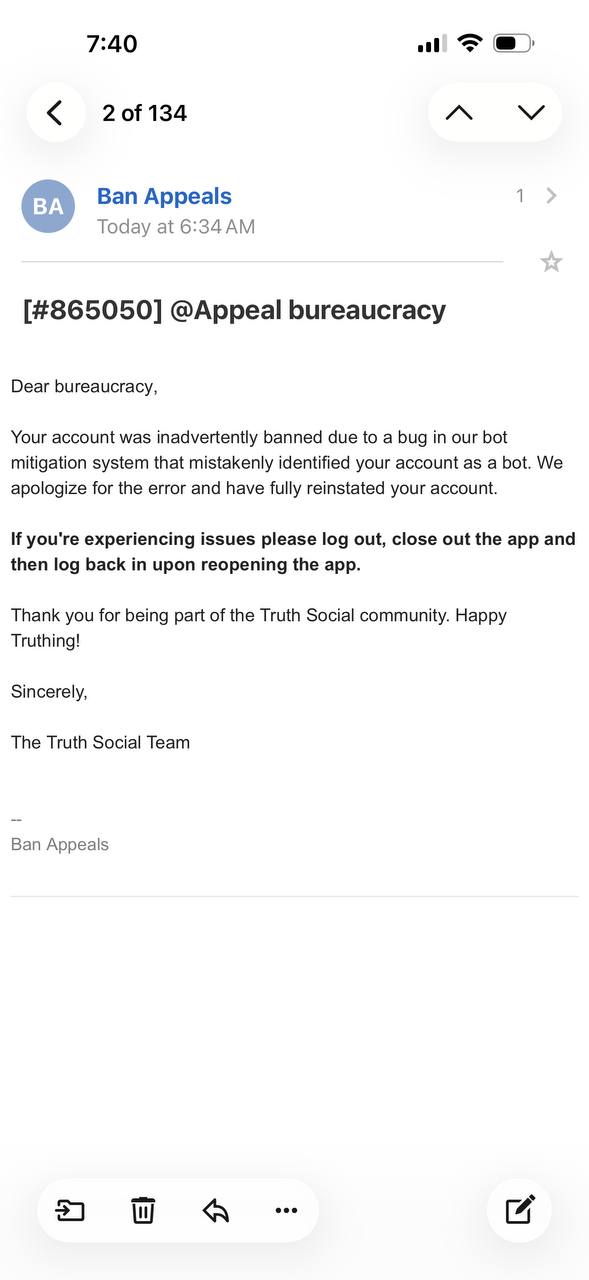
    “Your account was inadvertently banned due to a bug in our bot mitigation system that mistakenly identified your account as a bot. We apologize for the error and have fully reinstated your account.”

    Truth Social Ban Appeals, Sept. 8, 2026
    Screenshot of Truth Social email reinstating the Bureaucracy Times account for the second time.
    The second reinstatement email received from Truth Social’s Ban Appeals team on September 8, 2026.

    If that sounds familiar, it should.

    Truth Social has now twice told us that its bot-mitigation system mistook us for a bot. It has twice restored the account. And the messages explaining those reinstatements are sufficiently similar and formulaic to raise another rather obvious question: how much of this process involves a human being?

    We do not know.

    And that distinction matters. The messages themselves do not establish whether a human moderator reviewed either appeal, whether an automated appeals system reversed an automated enforcement decision, or whether some combination of human and automated review occurred.

    So we will not claim that a bot handled our appeals merely because the responses look remarkably robotic.

    We will, however, admire the irony.

    A Perfectly Bureaucratic Loop

    At this point, the known sequence is wonderfully circular.

    • Truth Social’s bot-mitigation system identifies Bureaucracy Times as a bot.
    • Bureaucracy Times appeals.
    • Truth Social says its bot-mitigation system was wrong.
    • Bureaucracy Times reports that Truth Social’s bot-mitigation system was wrong.
    • Truth Social’s bot-mitigation system apparently identifies Bureaucracy Times as a bot again.
    • Bureaucracy Times appeals again.
    • Truth Social again says its bot-mitigation system was wrong.

    This is, in its own peculiar way, the purest expression of the bureaucracy we cover: a system creates a problem, another part of the system corrects the problem, and then the system recreates the original problem almost immediately.

    The only thing missing is a form requiring us to certify under penalty of perjury that we possess a pulse.

    The Question Truth Social Has Not Answered

    Beneath the comedy is a legitimate platform-accountability question.

    When an account appeals an automated enforcement action on Truth Social, does a human moderator review that appeal? Can a successfully appealed account be flagged so that the same automated system does not immediately repeat the same mistake? And when Truth Social tells a user that a “bug” caused a false bot identification, is that determination made by a person, another automated system, or both?

    Those questions became considerably more interesting after the same failure happened twice.

    We intend to ask them.

    In the meantime, Bureaucracy Times is back on Truth Social. Again.

    We eagerly await our third certification of humanity.

    Editor’s note: This is the third report in an ongoing series. Read the first report: ‘Truth Social Banned a Federal Accountability Outlet. It Won’t Say Why.’ (https://bureaucracy.news/2026/09/04/truth-social-banned-a-federal-accountability-outlet-it-wont-say-why/) and the second: ‘Truth Social Said Its Bot Detector Mistakenly Banned Us. We Posted Their Explanation. It Banned Us Again.’ (https://bureaucracy.news/2026/09/07/truth-social-said-its-bot-detector-mistakenly-banned-us-we-posted-their-explanation-it-banned-us-again/)

  • A Court Struck Down the $100,000 H-1B Fee. DHS Came Back With $103,265.

    After the Proclamation Falls, the Rulemaking Rises

    In September 2025, the Trump administration tried a shortcut. By presidential proclamation, it slapped a $100,000 payment requirement on cap-subject H-1B petitions, skipped notice-and-comment, and skipped a traditional cost justification. DHS and USCIS treated the proclamation as enough authority and began collecting the money.

    In June 2026, a federal judge in the First Circuit said no, ruling the proclamation-based fee unlawful and cutting off the revenue stream, as reported by the Associated Press.

    Seven weeks later, on August 25, 2026, the same policy goal reappeared in a more conventional outfit. DHS published a notice of proposed rulemaking in the Federal Register proposing a $103,265 fee on the same cap-subject H-1B petitions, now with a cost study, a docket number (USCIS-2026-0298), and a 30-day comment period that closes September 24, 2026.

    DHS estimates roughly $8.8 billion in annual revenue from the fee. The administration has learned from the loss. Whether the proposal survives its own litigation cycle is another matter.

    The proposed fee sits in the Federal Register as the innocuously titled “Fee for Certain H-1B Petitions,” 91 FR 54817, RIN 1615-AD20. The USCIS bulletin announcing it uses calmer language than the political rollout that preceded the 2025 proclamation, but the basic architecture is the same: a six-figure price tag aimed squarely at the capped segment of the H-1B market.

    This time, however, it arrives with the procedural trappings that courts expect. There is a published methodology. There is a public docket. There is at least a gesture at economic analysis. It looks less like a campaign press release and more like a revenue regulation.

    What the Proposed Fee Covers and Who Pays It

    DHS is explicit about the scope. The proposed $103,265 fee applies to cap-subject H-1B petitions, meaning the filings an employer submits when it wants one of the 65,000 regular cap numbers or one of the 20,000 advanced degree set-asides. It does not touch cap-exempt petitions filed by institutions of higher education, nonprofit research organizations, or governmental research organizations, which keep their current fee structure. The new amount would be due at filing, in practice from the petitioner, and would stack on top of the existing menu of charges.

    Those existing costs are already familiar to anyone who files H-1Bs for a living. There is the I-129 base fee. There is the ACWIA training fee, which runs up to $1,500 depending on employer size. There is the $500 fraud prevention and detection fee. There is the asylum program fee that USCIS added in its broader fee rule. For employers who need predictability, there is premium processing.

    DHS treats the new $103,265 figure as just one more line item in this stack, but the arithmetic looks different in the real world. A company sponsoring a worker under the proposal would face a government filing cost that clears $105,000 before attorney fees. That is not a filing fee in any normal sense. It is an entry tariff.

    The Legal Backstory

    The reason this policy is coming back as a proposed rule instead of another proclamation is simple: the first attempt collided with separation of powers.

    On September 19, 2025, President Trump issued a proclamation titled “Restriction on Entry of Certain Nonimmigrant Workers,” which included a $100,000 payment requirement tied to specific H-1B petitions. That document did not run through the Administrative Procedure Act, and it did not pretend to be a fee rule. DHS treated it as binding anyway and began collections.

    Litigation followed almost immediately. As AP reported, a federal judge in June 2026 struck down the proclamation-based fee as an overreach of executive authority and blocked its enforcement. DHS did not concede.

    In coverage from Bloomberg Law, the agency defended the payment as something less than a tax and urged the First Circuit to let collections continue while the appeal played out. The court declined to restore the fee.

    At that point, the administration had two choices: ride out the appellate process or route the policy through the machinery that Congress actually assigned to fee setting. It chose the second.

    The proposed rule in 91 FR 54817 includes a calculated amount of $103,264.57, rounded to $103,265, a cost study, and a public docket. It rests on USCIS fee authority rather than on a generalized presidential power over entry. That makes it procedurally more durable than the 2025 experiment, though not insulated from challenge.

    The potential attack lines are not exotic. Commenters will have questions about the cost model, the choice of payers, and the alignment with the agency’s statutory mandate to recover costs rather than generate free-standing revenue streams. Any eventual lawsuit will frame those questions as Administrative Procedure Act problems and ask a court to decide whether the agency crossed the line from fee setting into policy making that lacks a firm statutory hook.

    For now, DHS is busy papering the record that the proclamation never had.

    What $8.8 Billion Buys

    DHS estimates that the proposed fee would generate about $8.8 billion per year, with roughly $74.9 billion projected over ten years, as reported by Fortune. In the proposed rule, the agency frames this as cost recovery across DHS and other parts of the immigration machinery.

    The math is straightforward on paper: take projected total recoverable costs, divide by the projected volume of cap-subject H-1B petitions that would owe the fee, and call the result a cost-based amount.

    What the documents do not do is spell out in granular detail which programs and operations would live off this revenue or how it interacts with the rest of the USCIS fee schedule. Historically, USCIS has operated on a budget in the $4 billion to $5 billion range, funded almost entirely by filing fees.

    Against that backdrop, $8.8 billion per year from one fee on one subset of one visa category looks less like a user charge and more like a policy tool in search of legal justification.

    The Exemption That Matters

    The most structural choice in the proposal is the cap exemption. Universities, nonprofit research institutions, and governmental research entities are carved out. The fee lands instead on for-profit petitioners that need cap numbers: technology companies, consulting shops, staffing firms, financial institutions, and the rest of the private sector that relies on capped H-1Bs. That design does not happen by accident.

    For years Congress and DHS have used H-1B surcharges on for-profit employers to subsidize training and other programs, while preserving easier pathways for academic and nonprofit employers. The proposed $103,265 fee keeps that asymmetry and pulls it to an extreme.

    Academic and nonprofit hiring channels stay under the old fee logic. Cap-subject corporate sponsorship moves into a different economic universe. Whether one sees that as a labor market correction or as a selective barrier depends on policy priors, but the functional outcome is the same: for-profit demand for capped H-1Bs is the chosen revenue base.

    What Happens Next

    The comment period on the proposed rule runs through September 24, 2026. DHS will then sift through submissions, prepare responses, and decide whether to adjust the proposal before issuing a final rule with an effective date.

    At that point, the fight would shift from the White House and DHS press shops to the Administrative Procedure Act framework that governs challenges to federal regulations.

    Unlike the 2025 proclamation, a final rule would arrive with a cost study, a paper trail, and a comment record. That makes it more defensible in court but not untouchable. The H-1B program has drawn lawsuits from employers, workers, and restrictionist groups for years.

    If DHS finalizes a six-figure fee on cap-subject petitions, it will add one more high-stakes test of how far agencies can push revenue strategies under the label of cost recovery.

  • Truth Social Said Its Bot Detector Mistakenly Banned Us. We Posted Their Explanation. It Banned Us Again.

    Editor’s note: This article is a follow-up to Bureaucracy Times’ earlier report, “Truth Social Banned a Federal Accountability Outlet. It Won’t Say Why.” It documents a second ban and reinstatement dispute involving the same account.

    Truth Social Reinstated Bureaucracy Times, Then Banned It Again One Minute After a “Beep Boop” Post

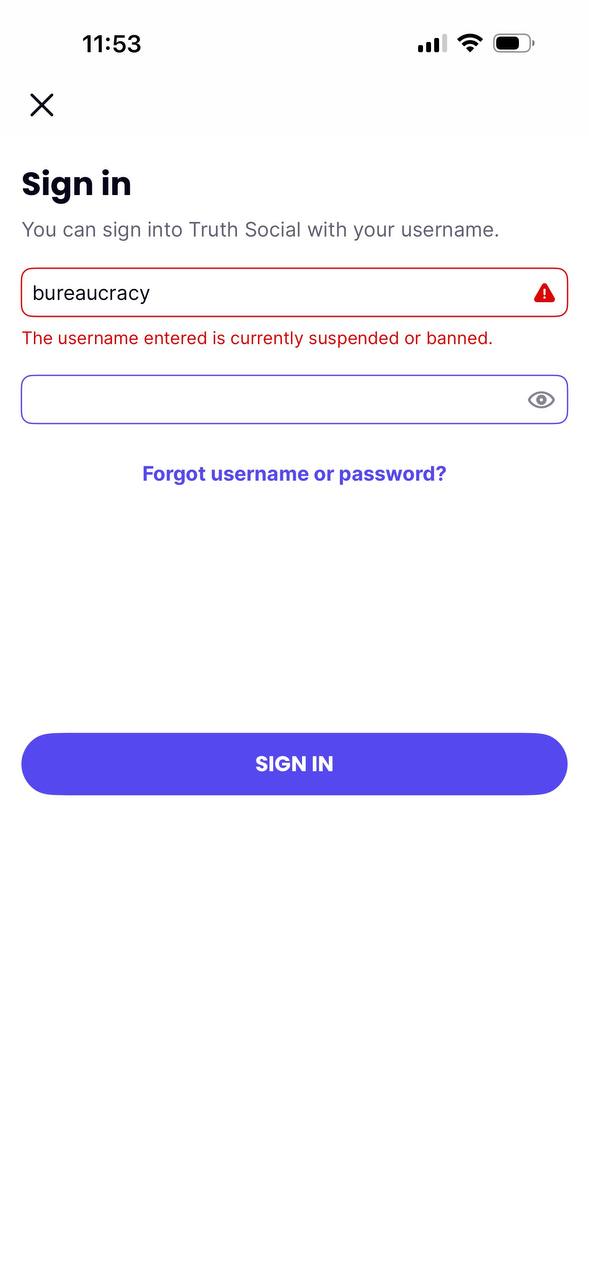
    At 11:52 a.m. on September 7, 2026, Bureaucracy Times posted a wry update on Truth Social about having just been cleared as a non-bot. At 11:53 a.m., the outlet was banned again.

    The post that preceded the second ban quoted Truth Social’s own explanation for an earlier suspension, which blamed a “bug in our bot mitigation system.” It ended with a deadpan sign-off: “Beep boop.”

    One minute later, Bureaucracy Times received a second ban email. The message was word-for-word identical to the original suspension notice that Truth Social staff later attributed to an automated error.

    The first ban: no rule cited, then a bot bug

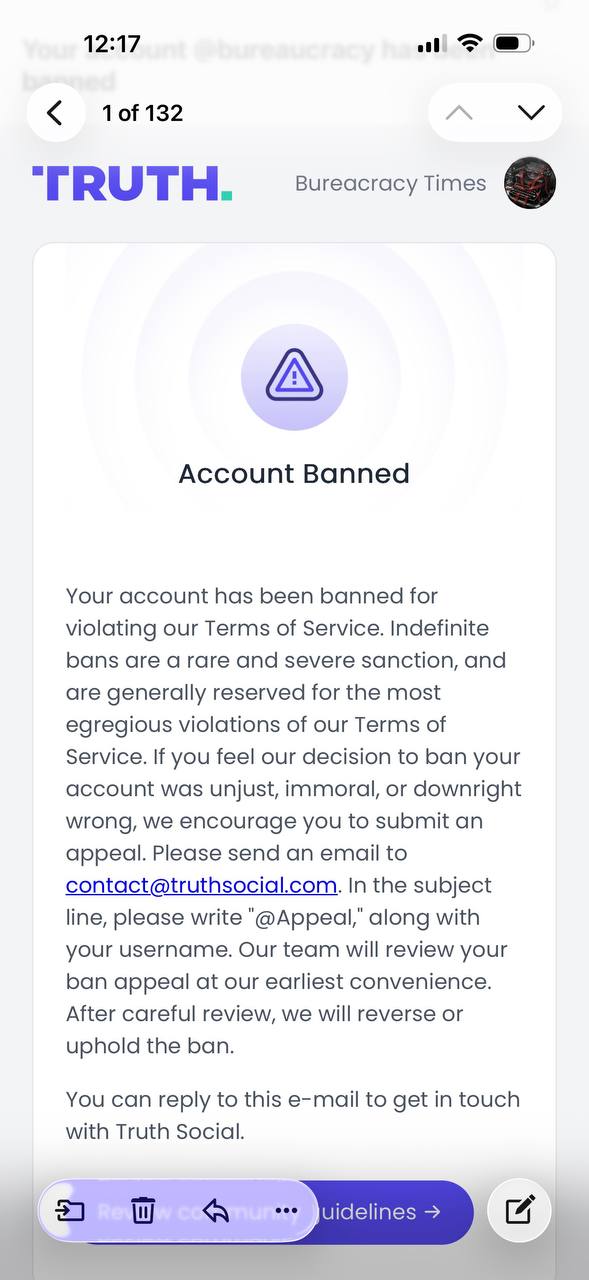
    Truth Social first banned the outlet’s account, @bureaucracy, on September 4, 2026. The suspension notice cited a violation of the platform’s Terms of Service and described the action as being “reserved for the most egregious violations,” but did not identify any specific rule, post, or flagged content. The outlet received no warning.

    Bureaucracy Times appealed that decision via email to contact@truthsocial.com. As detailed in the earlier report, we did not receive an explanation at the time beyond the generic Terms of Service language. Truth Social subsequently declined to specify which policy had allegedly been violated.

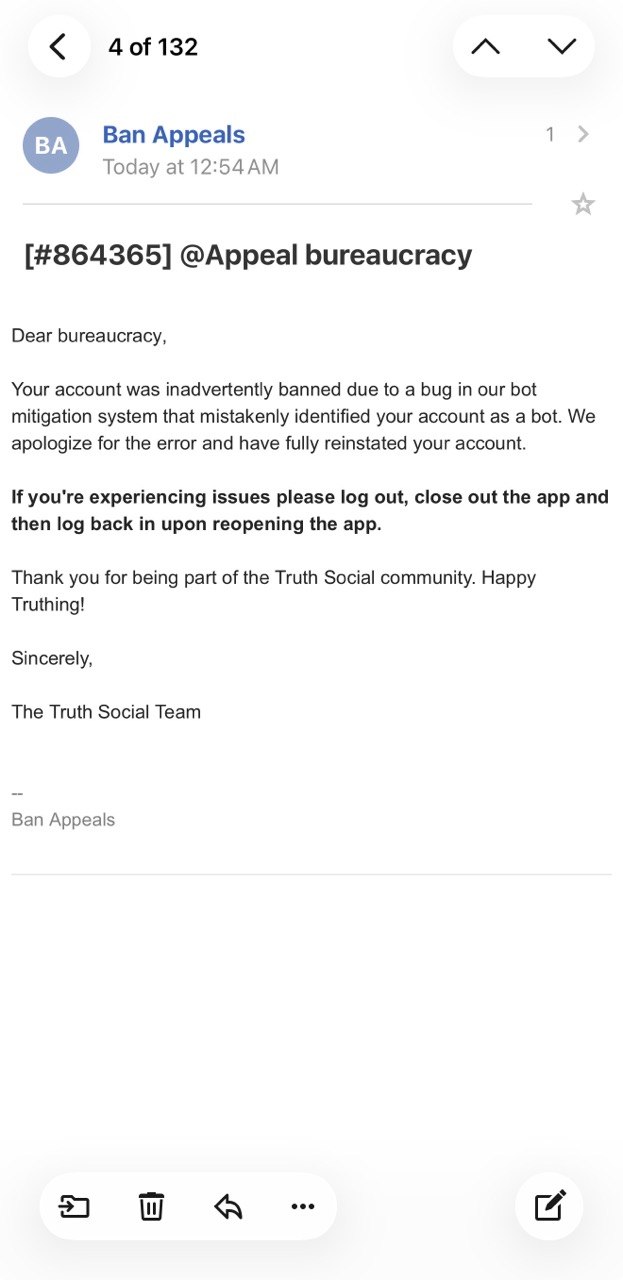
    Screenshot of Truth Social email informing Bureaucracy Times that its account was reinstated
    Overnight on September 7, 2026, Truth Social emailed Bureaucracy Times (ticket #864365) saying the account had been “inadvertently banned due to a bug in our bot mitigation system” and was now fully reinstated.

    That changed in the early hours of September 7, when Truth Social’s “Ban Appeals” team sent a new message, ticket #864365, reversing the decision. “Your account was inadvertently banned due to a bug in our bot mitigation system that mistakenly identified your account as a bot,” the email read. “We apologize for the error and have fully reinstated your account.”

    On the strength of that explanation, Bureaucracy Times’ account was restored. For a few morning hours, at least, the case appeared closed.

    The “beep boop” post that preceded the second ban

    After the reinstatement, Bureaucracy Times resumed posting. At approximately 11:52 a.m. on September 7, we published a post summarizing Truth Social’s bot explanation and inviting others who had been mistakenly flagged as bots to get in touch.

    The post read in full:

    “Truth Social has lifted the ban on Bureaucracy.news.

    The explanation?

    ‘Your account was inadvertently banned due to a bug in our bot mitigation system that mistakenly identified your account as a bot.’

    So, good news: I wasn’t banned for journalism.

    I was banned for apparently doing journalism with the cold, mechanical efficiency of a machine.

    Beep boop.

    Truth Social apologized and fully reinstated the account. I appreciate both.

    But now I’m curious: Has anyone else on Truth Social been banned after being mistakenly identified as a bot?

    If so, I’d like to hear from you.

    Apparently, we machines need to stick together.”

    Less than a minute later, the outlet’s account was no longer accessible.

    The second ban: one minute later, same email

    According to timestamped records reviewed by Bureaucracy Times, Truth Social sent a second ban email at 11:53 a.m., approximately one minute after the “beep boop” post went live.

    Screenshot of Truth Social login screen showing the @bureaucracy account suspended at 11:53 a.m.
    A login attempt at 11:53 a.m. on September 7 shows the @bureaucracy account suspended, with a red error message on the username field.

    The outlet’s login screen displayed a red error on the username field confirming that the account had been suspended as of 11:53 a.m. That timing leaves little room for human review: one minute is generally not enough time for a person to receive a post, evaluate it, and manually draft and send a suspension email.

    Bureaucracy Times cannot definitively determine whether the second ban was triggered by an automated system or a manual action. However, the one-minute interval strongly suggests some level of automated response to the account’s activity.

    Screenshot of Truth Social email notifying Bureaucracy Times of a second ban
    The second ban email sent at 11:53 a.m. on September 7 repeats the same Terms of Service language used in the first ban notice, with no mention of a bot bug or automated error.

    The content of the second ban email is notable. It is, according to a comparison by Bureaucracy Times, word-for-word identical to the first suspension message received on September 4. The language again cites a Terms of Service violation reserved for “the most egregious violations,” without identifying any specific rule, post, or flagged content.

    In other words, the email explaining the second ban looks exactly like the one that Truth Social later attributed to an automated “bot mitigation” bug.

    Automation, irony, and unanswered questions

    The timing and wording raise several questions Truth Social has not yet answered. If the first ban was, as the platform wrote, “inadvertently” triggered by a bug in its bot mitigation tools, what caused a second, identical ban to follow one minute after a post quoting that explanation?

    If a similar bug fired again, it would suggest that the underlying automated system remains prone to sweeping up non-bot accounts. If, instead, the second ban reflects a manual moderation decision, Truth Social has again cited “egregious” Terms of Service violations without specifying which rule the outlet allegedly broke.

    Either way, the optics are unusual: Bureaucracy Times was initially banned without a stated rule violation, later told it had merely been mistaken for a bot, and then banned again almost immediately after reporting that it had been mistaken for a bot. The headline writes itself, but the policies behind it remain opaque.

    As of publication, Truth Social has not responded to Bureaucracy Times’ questions about the second ban or whether it was again related to automated bot detection. No updated explanation has been offered beyond the recycled Terms of Service language in the 11:53 a.m. email.

    What happens next

    Bureaucracy Times is preparing a new appeal in response to the second ban and is seeking clarification from Truth Social about whether the action was automated, manual, or some combination of the two. The outlet has also renewed its request for a specific citation to any Terms of Service provision the platform believes was violated.

    This article will be updated if Truth Social provides an explanation that goes beyond the form letter language now attached to both suspensions. Until then, Bureaucracy Times remains — at least in Truth Social’s system — part of the platform’s ongoing struggle to distinguish between bots and the humans who write about them.

  • Trump Signs Pro-Rancher Executive Orders. The Timing Is the Story.

    On September 4, 2026, President Trump signed two executive orders and the USDA announced six additional administrative actions under its Ranchers First Initiative — all framed as the culmination of a historic commitment to America’s cattle producers. The substance of many of these actions is real. The timing, however, is harder to square with the headline.

    One day earlier, a 90-day window opened in which the administration’s plan to import up to 300,000 metric tons of foreign beef would begin taking effect. That plan, which sent cattle futures lower and drew swift backlash from ranchers, Republican lawmakers, and agricultural groups, is conspicuously absent from the USDA press release announcing yesterday’s actions.

    The Herd Problem Is Real

    The policy context the administration cites is accurate. The U.S. cattle herd stood at 86.2 million head as of January 1, 2026 — the smallest inventory recorded since 1951, according to USDA’s National Agricultural Statistics Service. Ground beef averaged $6.89 per pound in July 2026, with beef and veal CPI up roughly 9.4% year-over-year. The squeeze on consumers and the structural challenges facing producers are documented and severe.

    The administration did not create this problem. Herd liquidation driven by drought, high input costs, and decades of market consolidation predates this presidency. The question is not whether the problem is real — it is — but whether the solutions announced September 4 address its root causes, and whether some of them cut against the very producers they claim to protect.

    What Is New, and What Isn’t

    The press release blends genuinely new executive actions with repackaged announcements from prior months. The 2025 USDA Beef Plan, the Ranchers First Initiative, and several programs listed — including the BRAND endorsement for Livestock Risk Protection, the SPUR Guaranteed Loan Program, and the Harvest to Hallways initiative — were announced before September 4. Their inclusion in yesterday’s release as part of a cumulative list of administration accomplishments is standard political communications practice. It is also worth noting when evaluating the scale of any single day’s action.

    The genuinely new items include:

    • Direction to the Secretary of the Interior to begin ESA delisting or downlisting reviews for gray wolves and Mexican wolves
    • Direction to USDA to review authorities for mandatory country of origin labeling (COOL) for beef
    • Direction to prioritize and increase staffing for Packers and Stockyards Act enforcement
    • Expansion of Cooperative Interstate Shipment and Talmadge-Aiken programs for state-inspected meat
    • Enrollment of nearly 1 million new acres in Grasslands Conservation Reserve Program
    • Expansion of USDA’s remote and instrument-enhanced beef grading programs

    The Import Question in the Room

    The executive orders announced September 4 do not mention the administration’s separate August 2026 proclamation to allow expanded beef imports beginning September 1. That action — designed to lower consumer beef prices — drew immediate criticism from ranchers and Republican lawmakers in farm states who argued it would undercut domestic producers already dealing with record-low herd sizes and high operating costs.

    Fox News reported September 3 that Republican lawmakers were warning the White House the import plan was “hurting his base.” Axios characterized the plan as landing “hard in cattle country,” citing falling cattle futures on the announcement. The AP noted ranchers and some Republicans were already balking before the orders were signed.

    The September 4 executive orders — emphasizing predator control, country of origin labeling, and packer competition enforcement — address concerns that domestic ranchers have raised for years. They were signed the day after the import window opened. Whether that sequence reflects careful policy coordination or political damage control is a question the press release does not address.

    Packers and Stockyards: A Long-Deferred Problem

    The executive order directing USDA to prioritize Packers and Stockyards Act enforcement and increase staffing addresses one of the most persistent structural complaints in the cattle industry. Four firms — JBS, Tyson, Cargill, and National Beef — control roughly 85% of U.S. beef processing capacity. That concentration has been documented by USDA’s Economic Research Service, litigated in federal court, and debated in Congress for decades.

    In November 2025, Trump accused foreign-owned meat packers of price manipulation and called for investigation. In April 2025, Senator Grassley introduced bipartisan legislation to strengthen P&S Act enforcement. Yesterday’s executive order does not change the statute — it directs prioritization, increased staffing, and a report to the president within one year. Whether that translates to meaningful enforcement against packers with significant legal and lobbying resources remains to be seen.

    The DOJ Deputy Assistant Attorney General addressed R-CALF USA in 2026 on market concentration in beef processing. The enforcement posture has been announced. The results are pending.

    Country of Origin Labeling: Still Voluntary

    The executive order on country of origin labeling directs USDA to review its authorities for mandatory COOL and produce regulatory and legislative recommendations. It does not impose mandatory labeling. The Product of USA label — which the administration launched as a voluntary standard — remains voluntary.

    Mandatory country of origin labeling for beef was repealed by Congress in 2015 following a WTO ruling that found it discriminated against Canadian and Mexican cattle. Reinstating it would likely require new legislation and could trigger trade disputes. The executive order acknowledges this complexity by directing consultation with the U.S. Trade Representative. That is the appropriate process. It is also a process that could take years and produce no mandatory rule.

    What to Watch

    The actions announced September 4 are not without merit. Expanding small processor capacity, increasing grazing access, modernizing grading technology, and pressing for competitive markets in beef packing are legitimate policy goals with real stakeholder support. The ESA wolf delisting review addresses a genuine and longstanding conflict between ranchers and federal wildlife management.

    But the framing, as in saying the “most pro-rancher administration in history,” invites scrutiny of the full picture, including an import plan that opened the same week, a labeling reform that remains advisory, and a packer enforcement directive that sets a deadline for a report rather than a result.

    The cattle herd is at a 75-year low. Ground beef is nearly seven dollars a pound. The administration’s diagnosis is correct. Whether September 4’s prescriptions match the severity of that diagnosis, or whether they are calibrated more precisely to the political moment, is the question ranchers, and voters in farm states, will be watching.


    Sources: USDA NASS Cattle Inventory Report (Jan. 30, 2026); USDA ERS Livestock, Dairy and Poultry Outlook (May–June 2026); BLS Consumer Price Index (July 2026); White House Fact Sheet (Aug. 2026); AP (Aug. 21, 2026); Axios (Sept. 3, 2026); Fox News (Sept. 3, 2026); Roll Call (Aug. 21, 2026); DOJ Remarks at R-CALF USA 2026; USDA Packers and Stockyards Division enforcement records.

    Fediverse reactions
  • The Leviathan’s Paperwork Problem: How the VA Quietly Shortchanged Veterans and Called It Due Process

    Closed Means Nothing If the Work Was Never Done

    Here is the sentence that should be carved above the entrance to every regional VA office in America: the claim status “closed” is defined as “the claim is complete with no further action possible.” That is the government’s own definition, straight from VBA Manual 21-4.

    Now consider that the Office of Inspector General just spent thirteen months proving that VBA staff closed thousands of these supposedly complete, no-further-action-possible claims while the actual required action, the one affecting a veteran’s monthly paycheck, had never happened at all.

    Somewhere a bureaucrat defined “closed” and somewhere else an entirely different bureaucrat closed a case that was, by any honest reading, wide open. This is the kind of contradiction that would get you fired from a lemonade stand. At the VA, it just gets you a “concur” stamp and a target completion date sometime next year.

    A Third of Cases, A Thousand Ways to Fail a Veteran

    The report in question, released last week and quietly filed under a review number nobody will remember, examines how the Veterans Benefits Administration handles “adverse actions,” the bureaucratic euphemism for cutting a disabled veteran’s monthly check. Under 38 C.F.R. Section 3.103, before VA can reduce or terminate a veteran’s disability compensation, it has to notify them, give them sixty five days to respond with evidence, and offer a hearing.

    This is not some newfangled progressive innovation. It is basic due process, the kind of thing that has been settled law in this country since well before most of the claims processors involved were born.

    The OIG sampled 229 cases out of an estimated pool of 27,100 and found errors in roughly a third of them, projecting that about 9,300 cases involved at least one mistake (see the report’s Appendix C for the full statistical gymnastics, margin of error and all). Break down the error types and you get a portrait of an agency that treats due process as optional homework.

    About 4,000 cases involved insufficient notice to the veteran, meaning VA moved to cut a check before telling the person whose money it was. Nearly 2,900 involved uncorrected “codesheets,” the internal ledgers that track a veteran’s disability history, left inaccurate after the fact. Another 2,900 had botched effective dates, sometimes off by a month in either direction (see Example 2 in the report, where a claims processor miscounted sixty days and cost a veteran an extra month of benefits they were never entitled to, an overpayment of roughly $300 that will eventually have to be clawed back from someone who did nothing wrong).

    Then there is Example 3, which deserves its own museum exhibit. A veteran’s lung cancer rating was proposed for reduction from 100 percent to 30 percent. The due process letter went out. The veteran did not respond. So far, bureaucratically unremarkable. Then a different claims processor, working an entirely separate benefit for the same veteran, canceled the “end product” tracking the reduction, which under VA’s own system definitions automatically closed the case as complete.

    The reduction that was supposed to happen never did. VA overpaid the veteran about $43,000 over sixteen months, at a running rate of $2,700 a month, and nobody noticed until the OIG went looking. This is not fraud. Nobody here is a villain twirling a mustache. It is simply a records system so brittle that one employee’s unrelated paperwork can silently erase another employee’s entire adjudication, and an agency with no automated way to notice when that happens.

    If this sounds familiar, it should. Federal courts have spent decades wrestling with agencies that treat procedural notice requirements as a formality to be checked off rather than a substantive right to be honored. The Supreme Court’s own due process jurisprudence in the benefits context traces back to Mathews v. Eldridge, which set the very balancing test the VA is nominally supposed to be applying here. And this is far from the VA’s first rodeo with the OIG on exactly this theme.

    Earlier reviews have flagged similar breakdowns in how VBA tracks pending claims through its “end product” workload system, a structure originally built to measure employee productivity rather than to safeguard veterans’ rights, which may explain why it is so good at counting closed cases and so bad at noticing which ones should not have been closed.

    They Knew in 2024. They Made a Video.

    What makes this report more than a dry compliance exercise is the timeline buried in its own pages. In March 2024, over two years before this report’s publication, a senior quality reviewer at VBA’s Compensation Service flagged on an internal call that an “alarming number” of adverse action claims were being closed without final decisions. The recommended fix was to remind new staff to finish their paperwork.

    Nobody followed up.

    The OIG then found the exact same problem persisting through September 2025, in nine of twenty sampled cases, a 45 percent failure rate that is arguably worse than the original estimate. This is bureaucracy’s favorite trick: identify the problem, hold a call about the problem, and mistake the call for the fix.

    Meanwhile, VBA officials proudly told the OIG team about a new training initiative called “Minute Videos,” rolled out in December 2025 with more planned for March 2026. The OIG actually watched them. The December batch had nothing to do with adverse actions. The March batch addressed the topic but, in the OIG’s own words, did not address the deficiencies identified in this review or the actions recommended to mitigate them.

    Somewhere in a windowless conference room, someone approved a training video series that fails to train anyone on the thing it needed to train them on, and that someone almost certainly got a positive performance review for shipping content on schedule.

    VA’s own fix for the letter generating problem, meanwhile, has a “tentative delivery timeline” stretching from a 2023 start date to early 2027, a four year odyssey to standardize a form letter.

    For context, the Government Accountability Office has spent years documenting how federal agencies routinely blow through their own modernization timelines, sometimes by a decade or more, for systems far more complex than a rating decision letter.

    The Bare Minimum, Arriving Four Years Late

    The dollar figures here, at least $16.9 million in improper payments and nearly $1 million a month in ongoing overpayments and underpayments, are almost beside the point, though Congress will fixate on them because dollar figures are legible in a way that human suffering is not.

    The real story is that a veteran who lost a leg or a lung in service to this country can have their monthly check quietly reduced, restored, reduced again, or simply left in bureaucratic limbo because two different employees in two different systems never talked to each other, and no software exists to flag the contradiction.

    VA concurred with every finding. VA agreed to every recommendation. VA has, as of this writing, resolved 184 of the 191 specific errors the OIG identified, which sounds impressive until you remember those 191 are drawn from a sample that represents thousands more the agency has not yet found.

    The recommendations themselves (standardized letters, an extra layer of signoff, an automated tracking report) are not radical. They are the bare minimum any competent organization would have built a decade ago. That the largest disability benefits system in the country is only now getting around to it, under OIG pressure, with completion dates stretching into 2027, tells you less about incompetence than about priorities.

    Building a system that reliably protects a veteran’s paycheck has simply never been urgent enough. It took an audit to make it urgent for exactly as long as this news cycle lasts.

    Fediverse reactions