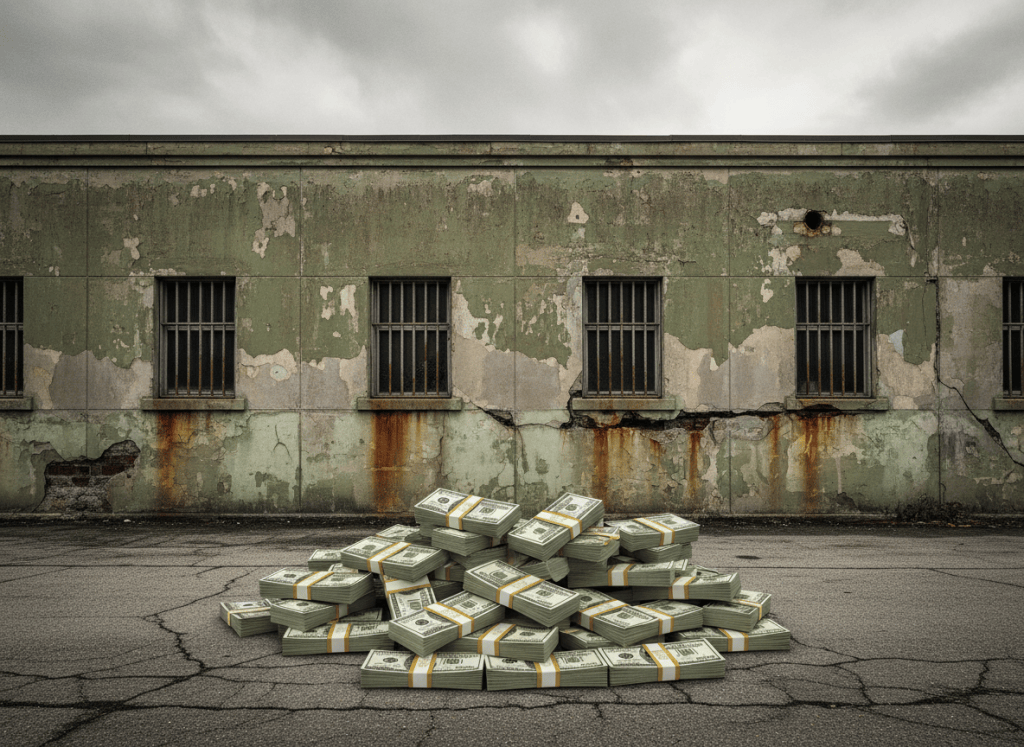
Every so often Congress does something almost touching in its honesty. Buried in the reconciliation act it passed last July, the same 800-plus page monument to legislative multitasking that reshaped Medicaid, tax brackets, and the national debt ceiling in a single afternoon, lawmakers also found room to hand the Federal Bureau of Prisons five billion dollars. They then, in the very next breath, ordered their own watchdog to make sure the Bureau did not blow it.
That watchdog, the Department of Justice’s Office of Inspector General, announced in April that it was standing up a new oversight effort to track how BOP spends the money. Its first product is a public dashboard, the kind of thing that looks reassuring right up until you notice how much of the actual accounting still has to be taken on faith. The rest of the story lives in the fine print: a Senate committee report that reads less like appropriations boilerplate and more like a parent handing a teenager the car keys along with a very specific list of rules about curfew.
The Fine Print of a Windfall
Section 100056 of Public Law 119-21 is admirably specific for a document buried in a bill mostly concerned with tax brackets and Medicaid work requirements. It appropriates five billion dollars to BOP, available through fiscal year 2029, and it splits the money with the precision of a divorce settlement: not less than three billion for hiring and training new employees, not more than two billion for maintenance and repairs. Congress, in other words, built its own priorities into the statute rather than trusting the Bureau to sort it out.
That specificity is not decoration. It is a tacit admission of where BOP has been failing for years. The correctional officer shortage has been a fixture of oversight reporting since before the pandemic, and the Senate Appropriations Committee’s own report accompanying the bill spends paragraphs on “augmentation,” the practice of pulling teachers, psychologists, and other non-custodial staff into cellblocks to cover shifts. The Committee has been complaining about this since 2017. Nine years is a long time to keep writing the same sentence into a report and expecting a different result.
The maintenance side is no less telling. BOP’s own facilities director told a Senate Judiciary hearing in 2024 that the repair backlog had grown to roughly three billion dollars, a figure driven by roofs that, in her memorable phrasing, keep crumbling. Two billion dollars against a three billion dollar backlog is progress, arguably, though it is also an admission that the hole is deeper than the shovel.
A Base Budget That Refuses to Move
Here is the detail that ought to embarrass everyone involved. While Congress was carving out five billion dollars in emergency supplemental funding, it also passed BOP’s ordinary fiscal year 2026 budget in that same Senate report, and that budget did not move an inch. Salaries and Expenses: $8,392,588,000, identical to the year before. Buildings and Facilities: $179,762,000, also identical. The entire burst of new money for staffing and repairs is arriving through a one time, off cycle appropriation that expires in 2029, while the underlying, permanent budget line for facility maintenance remains smaller than a single semiconductor plant’s monthly grocery bill.
This is not how a healthy institution gets funded. It is how you patch a hole in the hull without ever addressing why the ship keeps taking on water. When the five billion dollars runs out, whatever the Bureau has built or hired will need to be sustained on a base budget that, as of this writing, Congress has shown no interest in growing. The supplemental is not a fix. It is a loan against a problem nobody has committed to solving permanently.
The Watchdog Gets a List of Chores, Not a Raise
The Committee did not simply hand BOP the money and walk away, to its credit. Section 100056 comes with an explicit oversight mandate: BOP must deliver a spend plan to the Inspector General and the relevant committees within 120 days of enactment, broken out by fiscal year, and the OIG must then assess whether the money is going where it is supposed to, flag risks, and report back, in one document or several, as it sees fit. That deadline landed around the first of November. Whether BOP hit it is, as of this writing, an open question, and one worth a formal records request rather than a press release.
What makes the arrangement almost darkly comic is the OIG’s own budget. The same report that ordered this new layer of scrutiny also notes that the Inspector General’s office has fielded more than 27,000 complaints about BOP misconduct over the past three years, that roughly 57 percent of all OIG investigations already concern the Bureau, and that the office’s total appropriation for the coming year is a flat $139,000,000, not one dollar more than last year. Congress has, in effect, assigned its watchdog a second job and declined to adjust the salary. If the review is thin, if it takes longer than anyone would like, the reason will not be a mystery.
A Track Record That Argues for Skepticism
None of this occurs in a vacuum, and BOP has not exactly earned the benefit of the doubt. A GAO report from last year found the Bureau had implemented only 33 of 87 recommendations from restrictive housing reviews conducted back in 2014 and 2016, a full decade of foot dragging on its own watchdog’s advice. A separate GAO report, issued just weeks before this piece went to press, is already circling the same five billion dollar appropriation, which suggests the Government Accountability Office does not share the confidence implied by a shiny new dashboard either.
Meanwhile, the infrastructure money is not flowing into an oversight vacuum so much as a politically charged one. BOP’s own fiscal year 2027 budget documents request another $152,000,000 to plan the reactivation of USP Alcatraz as a working prison, a proposal that generates headlines far more easily than it generates cell capacity, while simultaneously rescinding $400,000,000 in prior year construction balances, most of it from the long contested Letcher County, Kentucky project. Money is being pulled from one embattled site and pushed toward a defunct national landmark, all while the base maintenance budget sits frozen and the emergency supplemental is supposed to cover the difference.
The Inspector General’s dashboard is a start. It is not, on its own, an answer to the question Congress ought to be asking itself: why does an agency with a documented decade of ignored recommendations, a stagnant base budget, and a watchdog running on last year’s allowance keep getting bailed out with emergency cash instead of a permanent fix. Five billion dollars buys a great deal of goodwill. It does not, on the evidence so far, buy a plan.
This is the first in an ongoing series tracking BOP’s implementation of Public Law 119-21. A records request regarding the Bureau’s spend plan submission is pending; a follow up will run when it is resolved.
 Bureaucracy Times