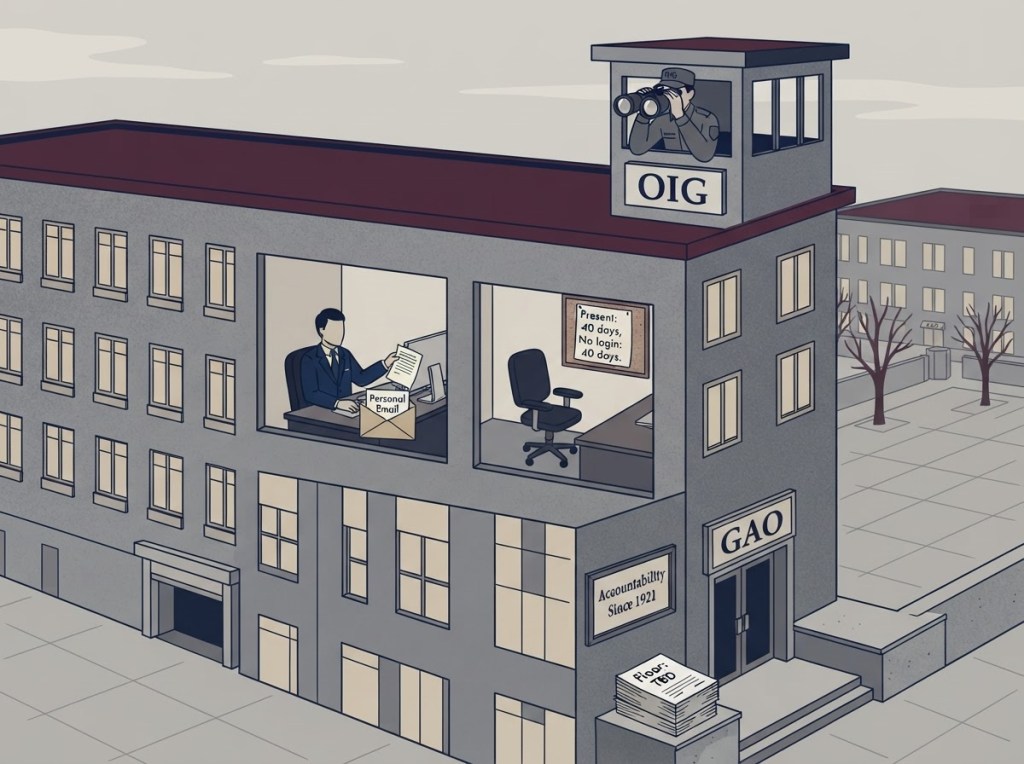
The congressional watchdog’s own Inspector General reports sensitive-information mishandling, employee timekeeping investigations, undocumented technology decisions, and procurement weaknesses while pressing for greater financial independence.
The Government Accountability Office has spent more than a century examining how federal agencies spend taxpayer dollars, manage public resources, and account for their decisions. Congress relies on the agency to expose administrative weaknesses, identify waste, and recommend corrective action throughout the federal government.
But the congressional watchdog is itself a federal institution, with employees, contracts, technology systems, and management decisions that require independent scrutiny.
Its latest Inspector General report offers a revealing examination of that responsibility.
In the Fall 2026 Semiannual Report to Congress, OIG-27-1SP, covering April 1 through September 30, the GAO Office of Inspector General documented employee misconduct investigations, deficiencies in technology modernization oversight, procurement control weaknesses, and ten outstanding audit and evaluation recommendations.
The report also renewed Inspector General L. Nancy Birnbaum’s request for stronger budget protections for her office, an issue that has appeared repeatedly in the OIG’s reporting as GAO prepares for a transition in its top leadership.
Taken together, the findings raise a fundamental institutional question: How does the federal government’s principal congressional watchdog ensure that the standards of accountability it applies to other agencies are enforced within its own organization?
The report does not establish widespread corruption at GAO. Nor does it accuse the agency’s leadership of obstructing its Inspector General. In fact, the OIG explicitly reported no attempts by GAO to interfere with its independence or delay access to information during the reporting period.
The concern is more nuanced. GAO’s own oversight office has identified weaknesses in internal administration while seeking additional assurances that its ability to examine those weaknesses will remain protected under future leadership.
Independence Already Protected by Law, but Questions Remain
Congress established GAO’s statutory Office of Inspector General through the Government Accountability Office Act of 2008.
Under 31 U.S.C. § 705, the Inspector General conducts audits and investigations involving GAO’s programs and operations and must keep both the Comptroller General and Congress informed about serious problems, abuses, and deficiencies.
The law provides several explicit independence protections. The Comptroller General cannot prohibit the Inspector General from carrying out statutory duties. The Inspector General has broad access to agency records, authority over OIG personnel, and a statutory reporting relationship with Congress.
The law also requires the Comptroller General to include the Inspector General’s annual budget request in GAO’s budget without change.
Nevertheless, Birnbaum is seeking an additional financial safeguard. In her fall 2026 message to Congress, she renewed a request for a fiscal year 2027 budget floor intended to strengthen the office’s independence and ensure continued oversight.
The request is not new. GAO OIG’s fall 2025 and spring 2026 semiannual reports also described the effort to establish a budget floor comparable to protections available elsewhere in the federal Inspector General community.
The latest report connects the concern to a leadership transition. Birnbaum explained that the office will operate under a new Comptroller General for the first time and cannot assume that the institutional support provided by the previous Comptroller General will continue.
The distinction is important. The Inspector General is not alleging that current leadership has withheld access to records, interfered with investigations, or improperly altered the office’s budget request.
Rather, the office is seeking a more durable financial arrangement that would not depend on the priorities of successive agency leaders.
The report does not specify the proposed minimum funding amount or explain precisely how the requested budget floor would operate alongside existing statutory protections. Those details remain important questions for Congress and the OIG.
GAO’s broader fiscal year 2027 budget request sought $860 million in appropriations and $910 million in total budget authority, including offsetting receipts. That provides context for the agency’s overall financial scale, but it does not establish the resources specifically available to the Inspector General.
The institutional issue is whether existing protections are sufficient to preserve meaningful investigative and audit capacity as leadership, staffing priorities, and budget conditions change.
Sensitive Information and Employee Timekeeping Under Investigation
During the six-month reporting period, the OIG opened seven GAO-related investigations and closed nine. Fifteen remained open as of September 30.
One unresolved investigation involved allegations that a senior government employee had mishandled sensitive information and falsified time records. Investigators found that the employee sent numerous documents containing sensitive information to a personal email account without password protection.
The OIG also identified at least 40 separate days on which the employee claimed to be working but did not log in to GAO’s network.
The Inspector General issued a report of investigation to GAO on September 16, 2026. The case remained open pending the agency’s response at the end of the reporting period.
The public summary does not identify the employee, describe the precise nature of the sensitive information, or establish whether an unauthorized person accessed the documents. It also does not disclose a final disciplinary determination.
Those limitations matter. Sending sensitive government documents to an inadequately protected personal account is a documented information-handling concern, but the report does not establish a classified-information compromise or confirmed external data breach.
Likewise, the absence of network logins is not, by itself, a complete accounting of work performed.
A separate investigation identified 48 days on which another GAO employee claimed to be working without logging in to the agency network. In that case, GAO suspended the employee for 60 days. The OIG closed its investigation on September 22.
Other cases examined allegations involving contractor favoritism, improper vendor payments, misuse of government resources, and onboarding disclosures. Several were closed without substantiating the underlying allegations.
The distinction between investigated allegations and established findings is essential. Independent oversight must be capable of identifying misconduct, but it must also recognize when evidence does not support an accusation.
A Million-Dollar Technology Plan and an Undocumented Decision
In 2021, GAO paid approximately $1 million to develop a five-year modernization plan encompassing initiatives projected to cost about $29 million.
Less than 18 months later, the agency changed direction, adopting an ongoing modernization strategy rather than continuing to use the original plan as its governing approach.
Changing a technology strategy is not inherently improper. Agencies must adapt to evolving security requirements, operational demands, and technological developments.
The problem identified by the Inspector General was that GAO did not adequately document why it made the change. According to the OIG’s August 2026 audit, subsequent agency leaders were unaware of the rationale for the decision.
The Inspector General also found that GAO did not maintain initiative-level cost information in a manner that allowed total modernization expenditures to be reported easily.
Those findings do not establish that the projected $29 million was lost or improperly spent. They identify weaknesses in decision documentation and financial transparency.
For an agency that regularly evaluates technology modernization efforts throughout government, the distinction is consequential. Without adequate records, future leadership may be unable to reconstruct why a major investment strategy changed. Without accessible cost information, management and congressional overseers may struggle to assess the resources devoted to the effort.
GAO accepted the OIG’s recommendations and established a Technology and Data Governance Board. The agency planned additional improvements to decision documentation by December 2026, with further cost-tracking arrangements expected in early 2027.
Those commitments provide measurable opportunities for subsequent oversight. Until the OIG verifies implementation, however, planned corrective action should not be mistaken for completed reform.
Procurement Controls and Contract Administration
The Inspector General also identified deficiencies in GAO’s acquisition management practices.
A September 2026 audit examined a facility maintenance contracting arrangement involving labor rates adjusted under a collective bargaining agreement.
The OIG found that GAO had not made the necessary contract modifications to reflect adjusted rates before payments were approved. The adjusted labor rates were approximately $94,000 higher than the previously negotiated rates.
The finding concerns contract administration and payment controls. It should not be characterized as an established $94,000 fraud loss.
The audit also identified opportunities to strengthen subcontracting guidance, invoice reviews, and procurement procedures involving General Services Administration schedules.
GAO agreed to corrective measures, including stronger invoice review procedures, contract modifications, and additional procurement guidance. Two acquisition-related recommendations were closed in September. Other actions remained outstanding at the end of the reporting period.
The findings underscore a recurring principle of government financial management: identifying a deficiency, agreeing to correct it, and demonstrating that the correction has been completed are three separate stages of accountability.
Hotline Complaints and the Work of Internal Oversight
During the reporting period, the OIG processed 76 substantive complaints. An additional 122 complaints were classified as non-substantive because they lacked sufficient information or an appropriate basis for investigation or referral.
Seven substantive complaints became GAO-related investigations. Others were referred to GAO offices, the OIG’s audit and evaluation function, or appropriate outside agencies.
The report also disclosed 1,768 repeat submissions excluded from the complaint totals.
According to the OIG, two complainants submitted sufficiently large volumes of repeated email complaints concerning non-GAO matters that their activity disrupted the office’s workflow. The OIG notified the complainants and blocked their email addresses.
The report provides an operational explanation for that decision. It does not establish that legitimate complaints were suppressed.
The episode nevertheless illustrates the administrative burden associated with maintaining a public complaint mechanism while distinguishing allegations within the office’s jurisdiction from those belonging elsewhere.
The OIG also announced a future transparency improvement. Beginning with the reporting period ending March 31, 2027, it plans to provide more substantive information concerning certain referrals to GAO for which it requests an agency response.
That change could help the public better understand how internally referred concerns are handled.
Ten Recommendations Awaiting Completion
At the end of September, ten recommendations from three recent OIG audit and evaluation reports remained open. Four concerned hiring practices, two addressed technology modernization oversight, and four involved acquisition management.
The hiring evaluation identified unreliable data and inconsistent methods used to measure how long GAO takes to recruit employees. GAO’s hiring timeliness goal was approximately 20 days longer than the executive branch’s 80-day benchmark. The OIG also found that some hiring calculations excluded employees or relied on inaccurate dates.
GAO outlined corrective actions with estimated completion dates extending through April 2027.
Other outstanding recommendations addressed the documentation of major technology decisions, modernization cost tracking, contract labor-rate controls, and procurement guidance.
The OIG generally expects agency responses to recommendations within 60 days and monitors implementation until sufficient evidence demonstrates that corrective action has addressed the underlying problem.
The outstanding recommendations do not establish that GAO refused to cooperate. They show that the agency’s response to identified weaknesses was still underway at the reporting cutoff.
More Reviews Are Underway
The OIG was examining engagement staffing and schedules, the Center for Audit Excellence’s recovery of service costs, employee official time used for union-related activities, and the timeliness of releasing excess funds from selected contracts.
Another audit was assessing whether GAO had purchased access-control equipment unsuitable for its intended purpose.
The OIG was also reviewing the agency’s handling of employees and contracts during a lapse in appropriations at the beginning of fiscal year 2026.
These were ongoing reviews, not completed findings. Their inclusion in the report does not establish wrongdoing. Their eventual conclusions could nevertheless offer additional evidence about the effectiveness of GAO’s administrative and financial controls.
Accountability Begins at Home
The Government Accountability Office occupies a distinctive position in the federal oversight system. It serves Congress by examining the operations, spending, and performance of agencies throughout government. Its findings influence legislation, administrative reform, and the allocation of public resources.
That mission makes independent examination of GAO’s own operations especially important.
The fall 2026 Inspector General report documents weaknesses in internal controls, employee conduct investigations, and corrective actions that remained unfinished. It also records areas in which GAO cooperated with investigators, accepted recommendations, and took action.
The evidence does not support treating the institution as uniformly dysfunctional. Nor does it justify dismissing the identified problems simply because GAO’s broader mission is to improve government accountability.
Both conclusions would miss the significance of the report.
The Inspector General’s request for stronger budget protections adds another dimension. Existing law already provides meaningful independence safeguards, and the OIG reported no interference during the period examined. Yet its repeated request for a budget floor suggests that the office believes further financial assurance is necessary to sustain effective oversight through leadership transitions.
Whether Congress agrees, and what additional protections it might provide, remain unresolved questions.
The broader standard is less complicated. An agency charged with holding the federal government accountable must be willing to subject its own decisions, expenditures, and conduct to the same scrutiny.
GAO’s Inspector General exists to ensure that examination takes place.
The continuing challenge is making certain that the office has the independence, resources, and institutional protections necessary to carry out that responsibility, regardless of who occupies the Comptroller General’s office.
Source note: Principal source: GAO Office of Inspector General, Fall 2026 Semiannual Report to Congress, OIG-27-1SP, covering April 1–September 30, 2026. Additional sources: 31 U.S.C. § 705; GAO OIG semiannual reports OIG-26-1SP and OIG-26-2SP; OIG audits OIG-26-1, OIG-26-2, and OIG-26-3; and GAO’s fiscal year 2027 budget request, GAO-26-900720.

