International operation dismantled Gootloader infrastructure after years of infections, including attacks involving U.S. defense organizations.
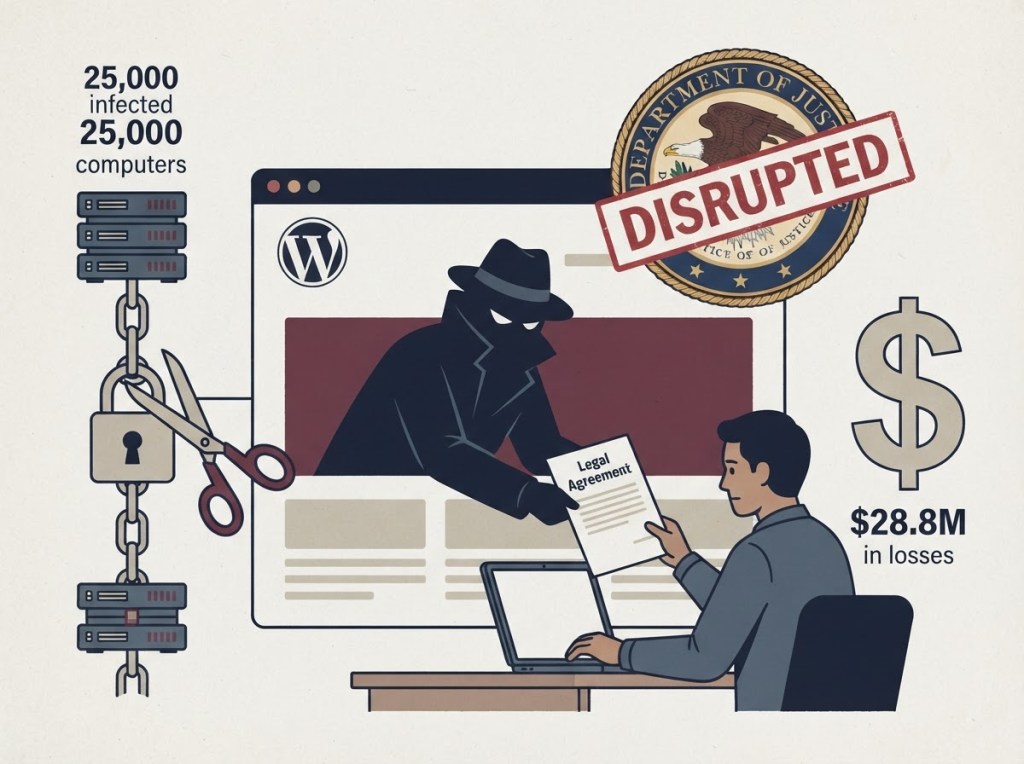
The Justice Department announced November 12 that an international cybercrime operation disrupted a malware network responsible for infecting at least 25,000 computers worldwide, exploiting compromised WordPress websites and facilitating ransomware attacks that caused approximately $28.8 million in identified U.S. losses.
The operation targeted Gootloader, malicious software used by cybercriminals to gain access to computer systems and sell that access to ransomware operators. According to the Justice Department, investigators removed malware from more than 100 servers, including compromised WordPress sites, and seized U.S. domain names used to distribute and control the malware.
Since 2018, Gootloader has been linked to ransomware attacks involving at least 44 U.S. victims. Federal investigators also identified attacks involving the Department of War and the defense industrial base, underscoring the national security implications of an operation that began, in many instances, with compromised websites.
When a Website Becomes a Delivery System
Gootloader relied partly on a deceptively simple technique. Criminals compromised legitimate websites, including those running WordPress, and used them to distribute malicious downloads disguised as ordinary documents.
According to Europol, fake legal documents were among the materials used to lure unsuspecting visitors. Once downloaded and executed, the malware could provide attackers with access to infected computers, creating opportunities for additional attacks.
The operators then sold access to compromised systems to other cybercriminals, including ransomware groups. In effect, Gootloader helped supply the initial access that other criminals needed to conduct more destructive attacks.
The distinction matters for WordPress publishers and website administrators. The investigation does not establish that WordPress installations generally were compromised or that every site using the platform was vulnerable. Rather, attackers exploited individual websites and used their apparent legitimacy to deceive visitors.
An International Takedown
The disruption formed part of Operation Endgame, an international law enforcement initiative targeting the infrastructure that supports ransomware and other cybercrime.
Europol reported that the broader operation against Gootloader and two additional malware families, CastleRAT and StealC, involved action against 235 servers and 257 domains. For Gootloader specifically, authorities reported taking down 14 servers and 218 domains and remediating 681 infected websites.
The broader investigation also identified approximately 6.4 million stolen victim credentials across the targeted criminal infrastructure, although that figure should not be attributed exclusively to Gootloader.
The Gootloader investigation involved the FBI, the Defense Criminal Investigative Service, Army Criminal Investigation Division, and international law enforcement partners. The nonprofit Shadowserver Foundation assisted with identifying infected systems, notifying victims, and coordinating remediation.
Disruption Is Not Elimination
The operation represents a substantial interruption of criminal infrastructure, but it does not establish that every Gootloader infection has been eliminated or that the ransomware operators who purchased access to compromised computers have been apprehended.
For website administrators, the case reinforces the importance of maintaining updated software, securing administrative credentials, enabling multifactor authentication, and monitoring for unauthorized changes. Europol specifically urged WordPress users to strengthen account security and patch vulnerabilities.
The larger lesson extends beyond any single publishing platform. A legitimate website can become part of a criminal distribution network without its visitors realizing that the content they are downloading has been manipulated.
Federal investigators have now disrupted a significant portion of that network. The continuing challenge is preventing compromised websites from becoming the next entry point.
Sources: U.S. Department of Justice, November 12, 2026; Europol, November 12, 2026; Netherlands Police, November 12, 2026.

