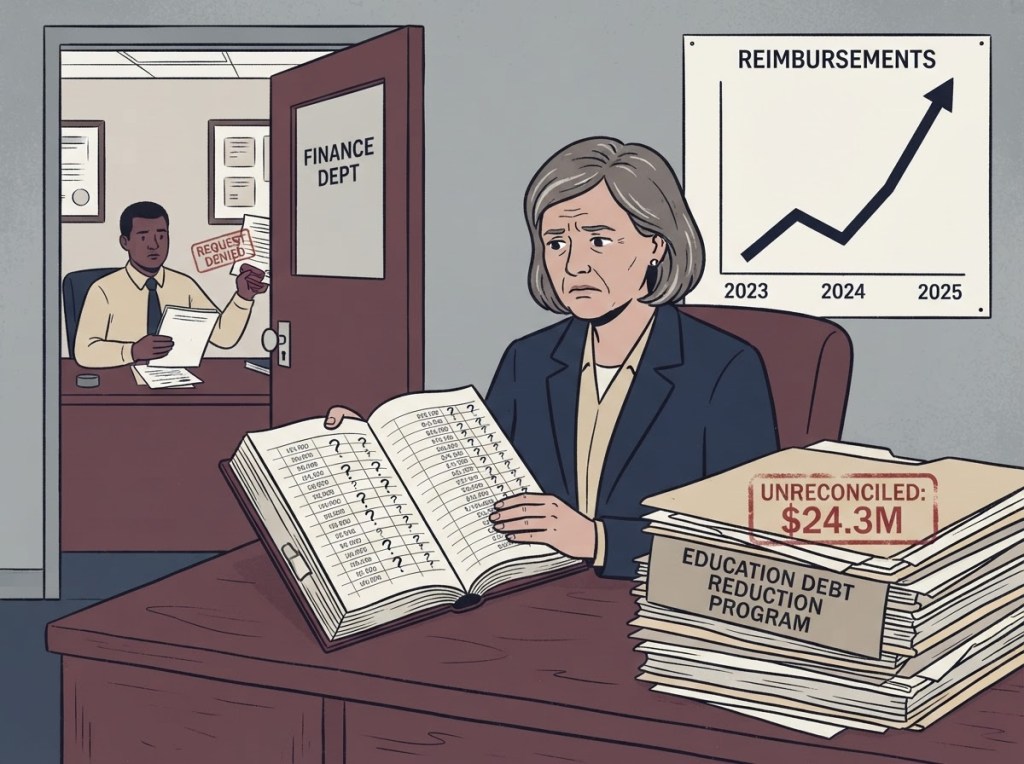
Watchdog finds financial tracking failures, unsupported reimbursements, and an ineligible employee who remained in the program after officials acknowledged the error.
The Department of Veterans Affairs could not fully reconcile $24.3 million in funds associated with a student loan repayment program for healthcare employees, according to a November 12 audit that also identified improper reimbursements, incomplete eligibility documentation, and weaknesses in verifying whether employees fulfilled their service obligations.
The VA Office of Inspector General’s audit, Report 25-03991-177, examined the Veterans Health Administration’s Education Debt Reduction Program, which helps recruit and retain healthcare professionals in positions that are difficult to fill. The program reimbursed approximately $445 million in qualifying education debt for about 15,000 employees from fiscal years 2023 through 2025.
The inspector general found that VA generally administered the program effectively and that most sampled participants were eligible. But the audit also exposed a financial accountability problem that developed after the agency began transferring money to medical facilities before employees completed the service periods required to receive reimbursement.
More than 1,900 financial records could not be reconciled, leaving program administrators unable to fully determine how previously distributed funds had been spent, retained, or returned.
The $24.3 million figure does not represent a finding that the money was stolen or lost. It represents funds for which the agency could not adequately reconcile its financial records. That distinction is important, but so is the underlying problem. A federal agency distributing hundreds of millions of dollars in employee incentives should be able to establish where its funds are and whether they have been used for their authorized purposes.
A growing program with significant financial commitments
Established in 2002, the Education Debt Reduction Program provides financial assistance to qualifying VA healthcare employees who incur education debt while preparing for clinical occupations. Congress expanded the available benefit through the VA MISSION Act of 2018, allowing eligible employees to receive up to $40,000 annually for five years, with a maximum tax-free reimbursement of $200,000.
The incentive is intended to help VA compete for healthcare professionals and reduce staffing shortages. Unlike general student loan forgiveness programs, reimbursements depend on an employee’s qualifying position, approved education debt, completed service, and compliance with program requirements.
The program has grown considerably.
VA financial records reviewed by the inspector general show reimbursements increasing from approximately $114 million in fiscal year 2023 to $136 million in 2024 and $195 million in 2025. That represents an increase of approximately 71 percent over two years.
As of February 2026, VHA had also committed approximately $1.2 billion in maximum potential reimbursements for current participants. That figure represents the maximum amount the agency could eventually pay under existing agreements, not money already disbursed.
These commitments underscore the importance of effective financial controls. The program is not a minor administrative benefit, but a substantial federal workforce investment whose success depends on accurate eligibility determinations, reliable records, and accountable spending.
How $24.3 million became difficult to reconcile
The audit traced the principal financial weakness to an accelerated funding process introduced in fiscal year 2023.
Under the process, VA began transferring program funds to medical facilities before participating employees completed their required service periods. Facilities could then hold the funds until employees qualified for reimbursement.
The arrangement could help facilities make timely payments, but it also created additional accounting responsibilities.
Employees might leave their positions before completing their service obligations, repay less qualifying debt than originally anticipated, or otherwise become eligible for reimbursement amounts below their initial awards. In those circumstances, unused funds were supposed to be identified and returned or appropriately reallocated.
The inspector general found that the financial tracking procedures did not consistently account for those outcomes.
For fiscal years 2023 through 2025, program records identified approximately $25.1 million in unused funds at the local level, offset by approximately $800,000 in excess returns. The resulting net unreconciled balance was $24.3 million across 1,918 records.
The annual net amounts were approximately $12.9 million for fiscal year 2023, $5.9 million for 2024, and $5.5 million for 2025.
Separately, a VHA Office of Finance supervisor provided information indicating that approximately $19.7 million from those fiscal years remained at medical facilities. That figure reflected a different accounting perspective and should not be added to the $24.3 million.
The report described several sources of discrepancies, including facilities retaining funds, returning amounts greater than those originally allocated for individual participants, and reimbursing employees from other funding sources.
The agency also struggled to trace returned funds to individual participants because facilities sometimes consolidated multiple returns into a single transfer.
Consequently, neither the central program office nor VHA finance officials could fully account for the disposition of all program funds.
One particularly revealing finding concerned the flow of financial information within the agency itself.
According to the inspector general, the associate director of Education Loan Repayment Services requested a report from VHA’s Office of Finance to help track and reconcile program funds. The request was denied.
The audit did not establish why the request was denied. It did, however, identify an unresolved division of responsibilities between the program office and financial management officials.
The report observed that Education Loan Repayment Services was expected to reconcile program records annually, although that responsibility was not clearly defined at the program-office level.
In other words, the office expected to help account for the money reportedly could not obtain the financial report it believed was necessary to do so.
Eligibility errors and questioned reimbursements
The inspector general also examined whether VA correctly approved employees for the program and maintained the documentation needed to support reimbursements.
Of 109 employee records sampled, 95 applications were processed in accordance with program procedures. The remaining 14 contained errors involving eligibility determinations, loan approvals, or required documentation.
The OIG identified $160,403 in questioned costs, consisting of $96,861 in reimbursements lacking adequate supporting documentation and $63,542 paid to an employee who was ineligible for the program.
Questioned costs are not necessarily fraudulent expenditures. They include payments for which the agency cannot provide required documentation or that otherwise fail to satisfy applicable requirements.
The $96,861 involved an employee whose required documentation could not be produced. Program officials maintained that an attestation concerning the employee’s medical school start date was sufficient, but the inspector general disagreed.
The second case presented a more direct eligibility problem.
An employee whose occupation was coded as staff pharmacist actually served in an administrative position that did not qualify for the education reimbursement benefit.
Program officials acknowledged the error in January 2026, according to the audit. By that point, the employee had received $63,542 in reimbursements that the inspector general classified as improper payments.
What happened afterward raises a separate question about management accountability.
In March 2026, an Education Loan Repayment Services official told auditors that the program would honor the reimbursement offer to retain the employee and take no further action. The employee remained active in the program as of June.
The report does not establish whether VA had legal authority to continue the agreement despite the eligibility determination, nor does it document a subsequent recovery of the improper payments.
The decision warrants explanation because an agency’s interest in retaining an employee does not, by itself, establish authority to disregard statutory or regulatory eligibility requirements.
The audit also identified ten employees initially approved for reimbursements involving education loans that did not qualify them for their positions. VA officials indicated that four awards would be corrected, while one former employee’s documentation remained unresolved. For five others, the OIG found that adjustments were unnecessary because reimbursements had not exceeded the value of eligible loans.
Missing records prevented verification of service obligations
Eligibility at the application stage is only part of the program’s oversight responsibility.
Before receiving annual reimbursement, employees must demonstrate that they made qualifying loan payments, completed the required service period, and maintained acceptable performance.
The inspector general found proof of lender payments for all sampled employees. However, records for 36 of the 109 employees lacked one or more documents necessary to independently verify compliance with service, performance, or conduct requirements.
Twenty-one of those employees had submitted self-declaration questionnaires addressing matters such as unpaid leave and performance issues.
The audit did not conclude that the 36 employees failed to fulfill their obligations. Rather, it found that VA’s procedures did not require the central program office or field coordinators to maintain the documentation necessary for independent verification.
That is an important difference, but it is not a trivial one.
A reimbursement program built around service commitments requires more than assurances that those commitments were satisfied. It requires records demonstrating compliance, particularly when payments can reach tens of thousands of dollars annually.
Without those records, the agency risks reimbursing employees who may not have satisfied the conditions of their agreements.
A familiar weakness in VA incentive oversight
The new audit follows several earlier inspector general examinations of VA employee incentive programs.
In May 2024, the VA OIG reported that the department had improperly awarded $10.8 million in critical skill incentives to central office senior executives.
A June 2025 audit identified oversight weaknesses involving recruitment, relocation, and retention incentives for VHA positions. A January 2026 supplemental review examined service obligations associated with those incentives.
The programs involve different authorities and eligibility requirements, and the earlier findings should not be treated as evidence of violations in the Education Debt Reduction Program.
Taken together, however, the reports illustrate a recurring management challenge: VA has struggled in multiple incentive programs to ensure that eligibility decisions, supporting records, and financial controls are sufficiently reliable.
The latest findings also arrive amid substantial organizational changes.
During 2026, VA began consolidating VHA’s regional management structure and realigning financial oversight responsibilities. A February memorandum transferred authority over VA budget and financial management functions to the assistant secretary for management and chief financial officer.
Such changes may provide opportunities to clarify accountability. They also make it essential to establish which officials are responsible for resolving existing financial discrepancies and preventing new ones.
The inspector general evaluated the program against federal internal control principles, including requirements concerning reliable information and ongoing monitoring. The audit cited Office of Management and Budget Circular A-123 and the Government Accountability Office’s Standards for Internal Control in the Federal Government.
The problems identified were therefore not simply failures to follow internal preferences. They involved financial management practices intended to safeguard federal resources.
VA agrees to corrective action
VA concurred with both recommendations in the audit.
In an October 15, 2026 response signed by Acting Under Secretary for Health John Figueroa, VHA said it had reviewed the program’s application and reimbursement procedures and begun implementing improvements.
Those measures include a standardized calculation tool for applicants with consolidated loans, enhanced software requirements for documenting performance and conduct, and additional verification of leave usage.
VA also reported that it was developing functionality to ensure reimbursements remain tied to originally approved loans when employees change lenders.
The department set March 2027 as its target for completing the documentation and eligibility improvements.
On the financial side, VA agreed that Workforce Management and Consulting would coordinate with financial officials to determine responsibility for annual reconciliations and establish controls providing visibility into funds from initial distribution through reimbursement and closeout.
The target completion date for that work is December 2026.
Those commitments are significant, but the audit does not establish that the $24.3 million in discrepancies has been resolved.
The inspector general said it would continue monitoring corrective actions and close the recommendations only after VA provides sufficient evidence that the improvements have been completed.
The remaining accountability question
The Education Debt Reduction Program serves a legitimate workforce purpose. VA needs qualified healthcare professionals, and education debt assistance can help attract and retain employees who provide care to veterans.
The inspector general’s findings do not undermine that objective. Indeed, the audit found that most sampled applications were processed correctly and that participants were generally eligible.
But the program’s value does not eliminate the need for financial accountability.
The audit leaves several consequential questions unanswered, including how much of the $24.3 million has since been reconciled, why the program office’s request for financial reporting was denied, and what authority supported continued participation by an employee whose position did not qualify for reimbursement.
VA has acknowledged the need for stronger controls and committed to correcting them. Whether those changes produce reliable accounting and enforceable eligibility standards remains to be seen.
For a program that distributed $445 million over three fiscal years and carries up to $1.2 billion in potential commitments, reconciling the money is not an optional administrative exercise.
It is a basic responsibility of managing public funds.
Source note: This article is based principally on the Department of Veterans Affairs Office of Inspector General’s November 12, 2026, Audit of VHA’s Education Debt Reduction Program, Report 25-03991-177, including VA’s October 15 management response. Statutory and oversight context includes 38 U.S.C. §§ 7681–7683, the VA MISSION Act of 2018, OMB Circular A-123, and GAO’s Standards for Internal Control in the Federal Government.

