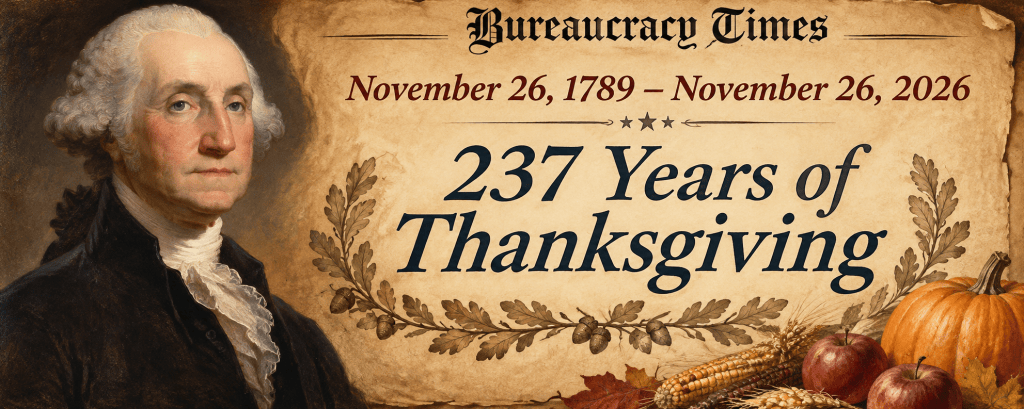
On the 237th anniversary of the first national Thanksgiving under the United States Constitution, we revisit the words of our first president and the historical significance of his appeal for gratitude, national unity and good government.
By the President of the United States of America.
A Proclamation.
Whereas it is the duty of all Nations to acknowledge the providence of Almighty God, to obey his will, to be grateful for his benefits, and humbly to implore his protection and favor—and Whereas both Houses of Congress have by their joint Committee requested me to recommend to the People of the United States a day of public thanksgiving and prayer to be observed by acknowledging with grateful hearts the many signal favors of Almighty God especially by affording them an opportunity peaceably to establish a form of government for their safety and happiness.
Now therefore I do recommend and assign Thursday the 26th day of November next to be devoted by the People of these States to the service of that great and glorious Being who is the beneficent Author of all the good that was, that is, or that will be—That we may then all unite in rendering unto him our sincere and humble thanks—for his kind care and protection of the People of this Country previous to their becoming a Nation—for the signal and manifold mercies, and the favorable interpositions of his providence, which we experienced in the course and conclusion of the late war—for the great degree of tranquillity, union, and plenty, which we have since enjoyed—for the peaceable and rational manner in which we have been enabled to establish Constitutions of Government for our safety and happiness, and particularly the national One now lately instituted—for the civil and religious liberty with which we are blessed, and the means we have of acquiring and diffusing useful knowledge—and in general for all the great and various favors which he hath been pleased to confer upon us.
And also that we may then unite in most humbly offering our prayers and supplications to the great Lord and Ruler of Nations, and beseech him to pardon our national and other transgressions—to enable us all, whether in public or private stations, to perform our several and relative duties properly and punctually—to render our national government a blessing to all the People, by constantly being a Government of wise, just, and constitutional laws, discreetly and faithfully executed and obeyed—to protect and guide all Sovereigns and Nations (especially such as have shewn kindness to us) and to bless them with good government, peace, and concord—to promote the knowledge and practice of true religion and virtue, and the increase of science among them and us—and generally to grant unto all Mankind such a degree of temporal prosperity as he alone knows to be best.
Given under my hand at the City of New York the third day of October in the year of our Lord 1789.
George Washington
Source: National Archives, Thanksgiving Proclamation of October 3, 1789.
A Thanksgiving 237 Years in the Making
Thursday, November 26, 2026, marks a remarkable coincidence of the American calendar. Exactly 237 years ago, on Thursday, November 26, 1789, Americans observed the first national day of thanksgiving proclaimed by a president operating under the United States Constitution.
The nation commemorating its 250th anniversary of independence this year was, at the time of Washington’s proclamation, barely acquainted with its new government. The Constitution had taken effect earlier that year. Washington had been inaugurated on April 30 in New York City, which then served as the seat of the federal government. The institutions that Americans recognize today were still taking shape, their authorities being defined and their responsibilities assigned.
The survival of the American experiment was by no means assured. Independence had been secured, but the work of establishing a durable republic had only begun.
It was in this environment that the first president called upon the American people to give thanks.
A Request from the First Congress
Washington’s proclamation did not originate solely within the executive branch. On September 28, 1789, the First Federal Congress adopted a resolution requesting that the president recommend a national day of thanksgiving.
Five days later, Washington issued his proclamation.
The timing is noteworthy. Just three days before Congress adopted its Thanksgiving resolution, it had approved twelve proposed amendments to the Constitution for submission to the states. Ten of those amendments would eventually be ratified as the Bill of Rights on December 15, 1791.
The foundational principles of the republic were still being debated, articulated and refined when Washington asked Americans to reflect upon their good fortune in having established a government for their collective safety and happiness.
Washington did not establish a permanent federal holiday, nor did his proclamation compel religious observance. It was a presidential recommendation issued at the request of Congress, inviting the people of the newly constituted republic to participate in a common occasion of gratitude and reflection.
Gratitude and the Responsibilities of Government
Read in its entirety, Washington’s proclamation is considerably more than an invitation to give thanks. It is also a statement about the responsibilities accompanying the establishment of a constitutional republic.
Washington expressed gratitude for independence, the conclusion of the Revolutionary War, the establishment of civil government, religious and civil liberty, and the opportunity to acquire and disseminate knowledge.
But the proclamation did not stop at celebrating those accomplishments.
Its concluding paragraph acknowledged national transgressions and called upon Americans in both public and private life to discharge their responsibilities properly. Washington envisioned a national government whose benefit to its people would depend upon the wisdom and justice of its laws, their constitutional foundation, and the fidelity with which they were administered.
That distinction is significant. The proclamation did not suggest that establishing a government was, by itself, sufficient cause for enduring confidence. It expressed an aspiration for how that government would conduct itself.
While the document also reflects the religious language prevalent in the founding era, Washington framed his appeal explicitly in terms of divine providence, while identifying civil and religious liberty among the blessings enjoyed by the American people.
Nor was Washington’s expression of goodwill confined to the United States. His proclamation extended its prayers to other nations, particularly those that had assisted the American cause, and expressed a desire for peace, concord, scientific advancement and prosperity throughout humanity.
From Washington to Lincoln
Although Washington established an important presidential precedent, the Thanksgiving holiday familiar to Americans today did not emerge immediately.
National and state observances continued at varying intervals over the following decades. There was no permanent federal Thanksgiving date, and presidential proclamations did not initially establish an uninterrupted annual tradition.
That changed during one of the most difficult periods in American history.
On October 3, 1863, exactly 74 years after Washington issued his proclamation, President Abraham Lincoln issued his own Thanksgiving Day Proclamation.
The circumstances could scarcely have been more different. Washington had spoken to a nation emerging from a war for independence. Lincoln addressed a nation in the midst of a civil war that threatened its continued existence.
Lincoln’s proclamation acknowledged the suffering inflicted by the conflict, entreated Americans to remember those who had lost loved ones and appealed for the restoration of national unity. He designated the final Thursday of November for the observance.
The annual presidential Thanksgiving tradition became firmly established thereafter.
When Congress Settled the Calendar
Even the familiar placement of Thanksgiving on the fourth Thursday of November is a comparatively recent development.
In 1939, President Franklin D. Roosevelt moved the observance one week earlier than its customary date, hoping to extend the Christmas shopping season and support an economy still recovering from the Great Depression.
The decision produced considerable disagreement among the states. Americans found themselves observing Thanksgiving on different dates depending upon where they lived.
Congress eventually intervened.
In October 1941, the House of Representatives approved a resolution establishing the last Thursday of November as a legal holiday. The Senate amended the measure to designate the fourth Thursday instead, accommodating those years in which November contains five Thursdays.
President Roosevelt signed the legislation on December 26, 1941. The congressional resolution provided the statutory foundation for the federal holiday Americans observe today.
The fourth Thursday of November remains codified as Thanksgiving Day under 5 U.S.C. § 6103.
Two Thursdays, 237 Years Apart
The United States of November 26, 2026, bears little physical resemblance to the republic of November 26, 1789.
The federal government has expanded from a handful of departments into an extraordinarily complex collection of institutions, agencies and administrative organizations. The country has endured wars, economic crises, constitutional disputes and profound social transformations. The promises of liberty articulated in the founding era were not universally realized in Washington’s lifetime, and their extension to millions of Americans required generations of struggle, constitutional amendment and legislative action.
Yet the proclamation issued by the first president remains accessible in the historical records of the nation he helped establish.
Its significance extends beyond the origins of an annual holiday. It preserves an early presidential articulation of the relationship between gratitude and civic responsibility, between constitutional government and its administration, and between the welfare of the nation and the obligations of those entrusted with its public affairs.
Today, 237 years to the day after Americans first observed Thanksgiving under their new Constitution, Washington’s words provide a historical opportunity to reflect not only upon what the nation has inherited, but also upon the responsibilities that accompany that inheritance.
Editor’s Note
As I read through Washington’s Thanksgiving Proclamation again, I had a National Treasure moment where, after reading a portion of the Declaration of Independence, Nicolas Cage sadly says, ”People don’t talk like that anymore.”
And we don’t.
Americans seldom speak of liberty and freedom the way we once did. It is almost like a forgotten language or a waning skill…like cursive. When we speak of freedom today, we often frame it as freedom from something with which we disagree, be it speech, political ideology, religious belief, or even the laws by which we are governed.
Yet many of those who came to the New World sought refuge from religious persecution, intolerance, and censorship. The principles upon which our republic was founded were intended to protect our right to disagree, not to insulate us from disagreement. Liberty loses much of its meaning when its protections extend only to those whose opinions we find agreeable.
There also seems to be a rather romanticized understanding of our nation’s founding, particularly among younger generations, in which the Founding Fathers stood united in thought and purpose. History tells a considerably different story. They disagreed, sometimes bitterly, and not everyone in the colonies favored independence from Great Britain. The very idea of an American republic was born amid fierce debate, uncertainty, and competing visions of what that republic ought to be.
To misunderstand the conditions that preceded our independence is to obscure the very reasons we sought it.
What strikes me about Washington’s proclamation is that, alongside his expressions of gratitude, he acknowledged our obligations as citizens. He spoke of the proper discharge of our public and private duties, of wise and just laws, and of the need to acknowledge our national transgressions. His patriotism did not require an assertion of national perfection.
I don’t know what the future holds for America. It could be great or terrible, and that depends largely upon us. When we lose sight of the principles of liberty and freedom upon which our nation was founded, it is only a matter of time before we lose the very things those principles were meant to preserve.
Even so, I am thankful to be an American. I’m thankful for the freedom to establish an independent publication and pursue the truth as best I can. I’m thankful that I can investigate the affairs of our government, question its decisions, and criticize its shortcomings without fear of reprisal. And I’m thankful for you, my dear readers, whose curiosity and willingness to question give purpose to the work we do here.
May we never take these freedoms for granted.
I hope you all have a happy and safe Thanksgiving.

