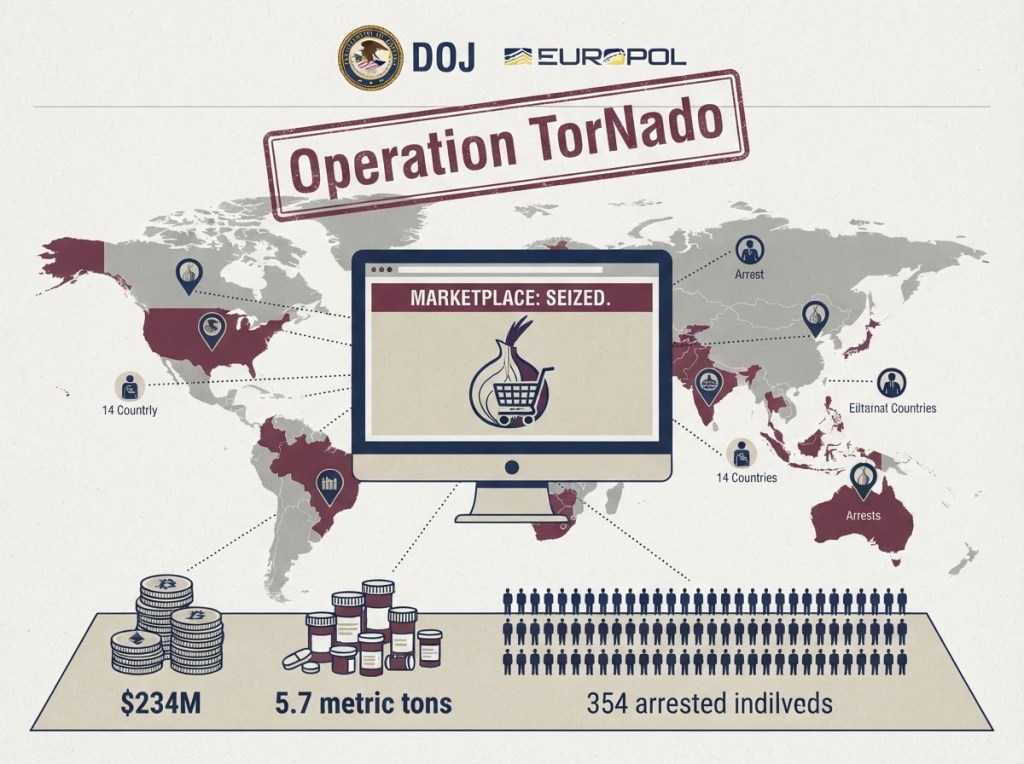
An international crackdown spanning 14 countries exposes how investigators used dismantled darknet marketplaces to track suspected traffickers, counterfeit prescription pills, and cryptocurrency proceeds.
An international law enforcement operation targeting drug trafficking through anonymous online marketplaces has resulted in 354 arrests worldwide, the seizure of more than $234 million in cash and cryptocurrency, and the confiscation of approximately 5.7 metric tons of illicit drugs, according to the U.S. Department of Justice.
Announced November 12, Operation TorNado represents the largest coordinated enforcement action undertaken by the Joint Criminal Opioid and Darknet Enforcement initiative, or JCODE, since its establishment in 2018.
The operation, conducted between May 2025 and October 2026, involved law enforcement authorities from 14 countries, including the United States, several European nations, Australia, and New Zealand. Of the 354 arrests, 132 occurred in the United States and 222 overseas.
Authorities also reported seizing 209 firearms and 38 pill presses, equipment frequently associated with the manufacture of counterfeit pharmaceutical tablets.
The results demonstrate the expanding reach of international investigations into online narcotics trafficking. They also raise an important distinction between dismantling individual criminal enterprises and permanently disrupting the digital marketplaces that enable them.
From Seized Websites to Identified Suspects
Unlike traditional narcotics investigations centered on physical distribution networks, Operation TorNado relied heavily on intelligence obtained through previous law enforcement actions against darknet marketplaces.
These marketplaces, accessible through anonymity-focused networks, have facilitated the sale of illegal drugs, counterfeit pharmaceuticals, and other illicit products. Transactions frequently involve cryptocurrency, while shipments move through conventional postal and commercial delivery systems.
According to DOJ, investigators exploited information obtained from previously dismantled marketplaces, including Archetyp, Bohemia, Nemesis, Kingdom, and Tor2Door, to identify suspected vendors and buyers.
The resulting investigations connected online vendor accounts to real individuals, allowing authorities to pursue arrests, financial seizures, and criminal prosecutions across multiple jurisdictions.
The operation involved the FBI, Drug Enforcement Administration, Homeland Security Investigations, Internal Revenue Service Criminal Investigation, U.S. Postal Inspection Service, and numerous other agencies working alongside Europol and international partners.
The breadth of that cooperation illustrates a central feature of modern darknet investigations. Although criminal transactions may originate behind layers of digital anonymity, the physical movement of drugs, financial transactions, and accumulated marketplace records can provide investigators with opportunities to identify participants.
Counterfeit Pills and Fatal Overdoses
Among the cases highlighted by DOJ is the prosecution of two brothers arrested in Florida who allegedly operated a darknet vendor account known as BarbaraWhite.
Federal prosecutors allege that Stanislav and Vladislav Chernyshov distributed counterfeit oxycodone tablets containing nitazenes, a class of synthetic opioids that can equal or exceed the potency of fentanyl.
Investigators reportedly connected the operation to more than 1,000 parcels shipped across 49 states. Authorities also identified multiple fatal and nonfatal overdoses among recipients of the products.
The brothers face federal conspiracy charges in the Eastern District of Virginia and, if convicted, could each receive up to 20 years in prison.
In another case, Alexander Green of North Carolina allegedly operated a darknet drug trafficking organization under the name STARLABS, distributing fentanyl and other controlled substances through the DrugHub marketplace.
According to DOJ, the organization has been linked to two overdose deaths in Ohio. Investigators seized counterfeit pharmaceutical pills containing fentanyl and other suspected narcotics during the June 2026 enforcement action.
Green faces federal drug distribution charges in the Southern District of Ohio.
These prosecutions illustrate how darknet narcotics trafficking extends beyond anonymous online transactions. Counterfeit prescription medications can reach consumers who may not know the substances contained in the pills they receive.
The allegations remain subject to adjudication, and the defendants are presumed innocent unless proven guilty.
Following the Money
The reported seizure of more than $234 million in cash and virtual currencies represents another significant component of Operation TorNado.
Cryptocurrency can facilitate transactions between buyers and sellers who never meet, but its use does not necessarily prevent investigators from tracing financial activity or connecting transactions to identifiable individuals.
IRS Criminal Investigation and other financial enforcement agencies participated in the operation, underscoring the importance of financial intelligence in investigations that cross national borders.
However, the reported seizure total should not be confused with a final forfeiture judgment or money permanently recovered by the government. Asset seizures can remain subject to judicial proceedings, ownership claims, and other legal requirements.
Similarly, the 354 arrests announced by authorities do not represent 354 convictions.
DOJ has not provided a comprehensive public breakdown of how much of the approximately 5.7 metric tons of seized drugs consisted specifically of fentanyl, as opposed to methamphetamine, heroin, cocaine, MDMA, and other substances included in the operation.
Those distinctions matter when evaluating the results of an enforcement action of this size.
A Growing International Campaign
Operation TorNado follows Operation RapTor, announced in 2025, which resulted in 270 arrests, more than $200 million in seized assets, and over two metric tons of confiscated drugs.
The newly announced operation exceeds those reported totals, although the investigations covered different periods and should not be interpreted as a direct year-over-year measurement of enforcement effectiveness.
Europol’s November 12 announcement independently confirms the international scope of Operation TorNado and describes the continuing use of intelligence obtained from earlier marketplace takedowns.
The Justice Department has also published a collection of related federal court documents, providing additional information about individual prosecutions and the allegations underlying several cases.
Some investigations remain ongoing, and authorities have indicated that additional efforts to identify individuals behind darknet accounts are continuing.
Arrests Are Measurable. Lasting Disruption Is Harder to Establish.
The scale of Operation TorNado demonstrates that darknet marketplaces are not beyond the reach of conventional law enforcement, particularly when digital investigations are combined with financial tracing, postal inspections, and international cooperation.
Yet the operation’s long-term effect on illicit online drug markets remains less certain.
Marketplace seizures and vendor arrests can interrupt established trafficking networks, but they do not necessarily eliminate demand, prevent replacement platforms from emerging, or establish a sustained reduction in the availability of illegal drugs.
Those outcomes require evidence extending beyond the immediate results of an enforcement announcement.
For now, Operation TorNado represents a substantial international enforcement effort with hundreds of arrests, significant asset seizures, and numerous criminal prosecutions.
Whether those results translate into a lasting reduction in darknet narcotics trafficking is a question that will require continued scrutiny long after the arrests have been counted.

