The Extraordinary Event That Never Got Explained
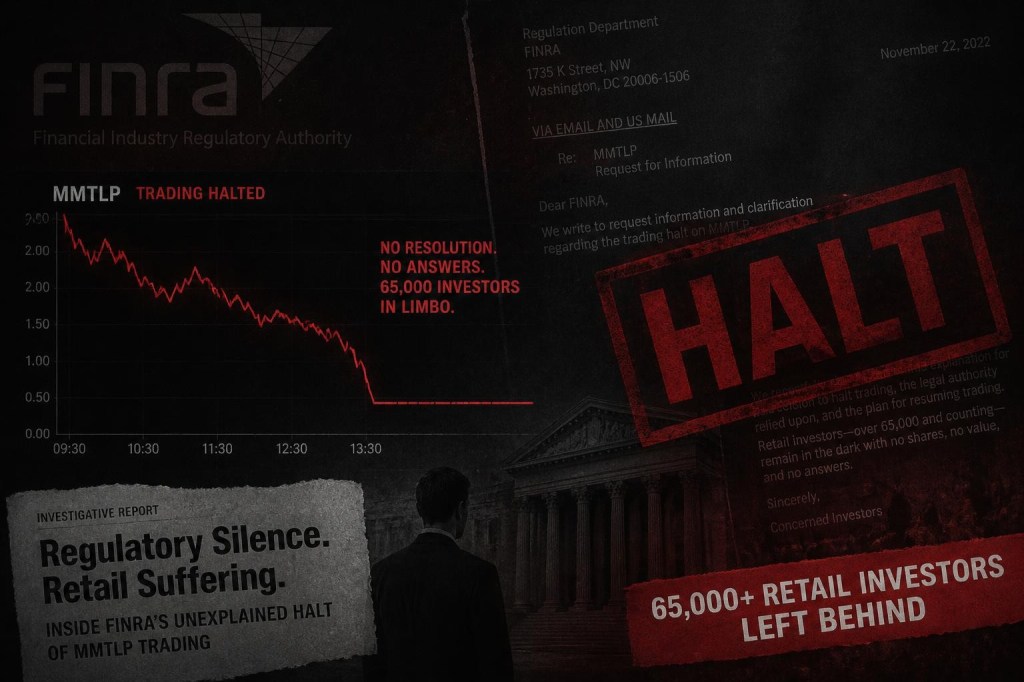
On the morning of December 9, 2022, trading in one of the more obscure corners of the U.S. equity markets stopped and never resumed. FINRA, the private self-regulatory body that oversees broker-dealers and many over-the-counter securities, issued a U3 halt on MMTLP, the OTC ticker for Meta Materials Inc.’s Series A Preferred Stock. The code signaled an “extraordinary event.” In practical terms, it meant the stock was frozen. There would be no reopening auction, no final day of speculative mania, and, crucially for thousands of retail investors, no last chance to exit.
U3 halts are rare in the over-the-counter market, reserved for situations in which regulators believe continued trading could produce disorderly conditions or serious settlement failures. When the halt hit, investors expected two more trading days before their preferred shares were canceled as part of a planned corporate action. Instead, they watched their screens go dark, then learned that the symbol would never reappear. The security was effectively terminated in mid-sentence.
More than three years later, there is still no public, granular explanation of what the “extraordinary event” actually was. What exists instead is a patchwork: a self-regulator asserting broad authority with minimal disclosure, an ongoing but unresolved SEC investigation, a set of serious but contested investor allegations, and tens of thousands of shareholders holding illiquid interests in a private company with no public market. The case has become a stress test for how much opacity the American regulatory architecture will tolerate when retail investors are the ones left holding the bag.
From Torchlight to MMTLP to Next Bridge
To understand why this halt matters, it helps to follow the corporate trail. MMTLP was not a traditional operating company. It was the OTC symbol assigned to Meta Materials’ Series A Preferred Stock, a spin-off vehicle born when Torchlight Energy Resources, an oil and gas company, merged with Meta Materials, a Canadian tech firm, in 2021. Torchlight investors received preferred shares representing an interest in Torchlight’s legacy oil and gas assets, which were to be separated into a new entity.
That new entity eventually became Next Bridge Hydrocarbons, Inc. By late 2022, the path appeared straightforward on paper. MMTLP shares would be canceled on December 14, 2022, and holders of record would receive one share of Next Bridge common stock for every MMTLP share they held. The preferred shares functioned as a bridge from the old Torchlight assets into the new private company.
In practice, MMTLP had turned into something else entirely. As the distribution date approached, the preferred shares evolved into a speculative meme-like OTC play. Social media channels amplified bullish narratives. Retail trading surged. Short sellers saw an opportunity on the other side. By late 2022, MMTLP was heavily traded and heavily shorted, according to public data on short interest and fails-to-deliver. The convergence of a complex corporate action and a highly volatile retail-driven market is precisely the sort of scenario that tests the limits of regulatory systems.
A Halt with Powerful Discretion and Limited Disclosure
FINRA’s stated authority for the halt sits in Rule 6440, which allows the organization to suspend trading in OTC equity securities under a range of circumstances, including when an extraordinary event has had or may have a material effect on the market or could cause major disruption or uncertainty in the settlement process. The rule gives FINRA wide discretion. It does not require the organization to publicly identify the specific triggering event, nor to publish detailed contemporaneous reasoning.
On December 9, 2022, FINRA issued Uniform Practice Advisory #35-22, announcing a U3 halt in MMTLP. The notice referenced “extraordinary events” related to the security, but did not describe them. What investors saw was a short advisory, a permanent halt, and a fast-approaching corporate action that would cancel their tradable shares within days. What they did not see, and still have not seen, is a public account of what information or risks justified the nuclear option of freezing trading until cancellation.
The 41-Day Coding Error and the Enforcement Gap
In the months that followed, one fact emerged that fueled deeper questions. FINRA acknowledged that a systems coding error had incorrectly classified MMTLP as a non-SEC-reporting security, causing it to be listed on FINRA’s OTC Threshold Securities List for approximately 41 days. The organization disclosed this in a public FAQ, describing it as an error in how the security was coded within its systems.
The threshold list designation matters because it is supposed to trigger regulatory consequences. Under SEC Regulation SHO and FINRA Rule 4320, securities appearing on the threshold list are subject to “close-out” requirements designed to address persistent failures to deliver shares. If a stock remains on the list, market participants with unsettled short positions are required to buy shares to close those positions within a prescribed time frame.
Investors and several members of Congress asked a simple but pointed question: if MMTLP was on the threshold list for 41 days, even erroneously, why did that not result in documented enforcement activity or visible forced buy-ins to resolve any outstanding fails-to-deliver? FINRA’s public FAQ acknowledged the incorrect listing and described it as a mistake, but did not provide an answer that critics considered complete on the enforcement issue. The organization has said, in response to congressional inquiries, that its review did not find evidence of significant naked short selling at the end of MMTLP trading, a conclusion that directly challenges one of the central claims of the most vocal investors.
Shareholders Stranded in a Private Company
The practical outcome for investors is not disputed. Court filings and company disclosures indicate that roughly 65,000 shareholders held long positions in MMTLP at the time of the halt. On December 14, 2022, the distribution went ahead. Meta Materials distributed 165,472,241 shares of Next Bridge Hydrocarbons common stock to former MMTLP holders on a one-to-one basis.
Next Bridge is a private company focused on oil and gas assets. As of the company’s May 2026 prospectus filing, its stock is not listed on any public exchange and is not eligible for electronic transfer through the Depository Trust Company. There is no conventional public market where shareholders can simply log into a brokerage account and sell. Instead, they hold paper-like positions in a thin, opaque universe of potential private transfers, company-led liquidity initiatives, or the speculative hope of a future listing.
For many retail investors who approached MMTLP as a tradable meme stock, the shift from a volatile OTC symbol to an illiquid private equity position was jarring. Whether or not that outcome was avoidable, the process that delivered it — an abrupt permanent halt with limited public explanation — has become the focal point of their anger.
Allegations, Press Conferences, and an Unanswered Letter
Out of that anger, a loose movement coalesced under the hashtag #MMTLParmy and later through groups such as American Made Action. Their core allegation is straightforward but unproven: they contend that the U3 halt was effectively orchestrated to shield short sellers and broker-dealers from having to buy back shares ahead of the corporate action, which would have required them to deliver Next Bridge stock they allegedly did not have.
These investors argue that an enormous level of synthetic or “naked” short interest built up in MMTLP and that the combination of the threshold list anomaly and the abrupt halt prevented a normal reconciliation of supply and demand. They point to anecdotal reports of difficulty obtaining physical share certificates and to the absence of a public, audited share count as circumstantial support. These contentions remain allegations. They have not been validated by regulators or courts, and they are directly contested by FINRA’s own finding that it uncovered no evidence of significant naked short selling in MMTLP at the end of trading.
The campaign nonetheless gained political traction. On January 12, 2026, investors and advocates held a press conference outside SEC headquarters demanding greater transparency around the halt. Separately, 74 members of Congress, led by Representative Ralph Norman of South Carolina, sent a detailed letter to SEC Chair Gary Gensler and to FINRA. The lawmakers’ questions echoed investor concerns: why did MMTLP sit on the threshold list for 41 days without visible enforcement action, why was no audited share count ever released, and what precisely was the extraordinary event that justified a permanent halt days before a known corporate cutoff?
FINRA’s Data, the SEC’s Charges, and an Open Investigation
FINRA responded publicly through an FAQ and, more specifically, in a January 31, 2024 letter responding to Representative Norman. In those materials, FINRA provided additional data on short interest and fails-to-deliver in MMTLP. The organization reiterated that, based on its review, it did not find evidence of significant naked short selling at the end of trading. It also maintained that the halt was necessary to prevent disruption in the settlement of the corporate action that would cancel MMTLP and distribute Next Bridge shares.
What FINRA has not done is publicly spell out, in granular, chronological terms, what information it received, how it assessed settlement risk, and which specific conditions met the threshold of an “extraordinary event” under Rule 6440. The gap between the broad authority the rule grants and the limited explanation offered is not a matter of market rumor. It is a structural accountability question: how far can a self-regulator go in halting trading permanently while disclosing only the bare minimum required by its own rules?
Meanwhile, the SEC has drawn a line between the corporate saga that created MMTLP and the unresolved questions surrounding the halt. In June 2024, the Commission filed charges against Meta Materials and its former CEOs, John Brda and Georgios Palikaras, alleging market manipulation and fraud in connection with a $137.5 million at-the-market offering. According to the SEC, that misconduct occurred on the front end of the story — in how Meta Materials raised capital and communicated with the market — not in the halt itself.
In the same breath, however, the SEC disclosed that a separate investigation into “subsequent events related to Meta Materials” remained ongoing. That phrase is widely understood to include the MMTLP halt and its aftermath. As of the last public update in June 2024, that investigation had not produced any public enforcement action or formal findings about the halt. The existence of an open investigation is not proof that rules were broken. It does, however, mean that the agency is still actively reviewing the very questions investors and lawmakers have been raising.
A Self-Regulatory Blind Spot
At the center of the MMTLP controversy is a feature of the U.S. market structure that usually stays offstage. FINRA is not a federal agency. It is a private self-regulatory organization, authorized by Congress and overseen by the SEC, with the power to write and enforce rules for broker-dealers and many OTC securities. Unlike the SEC, FINRA is not subject to the Freedom of Information Act. Its internal emails, memos, and meeting notes about the MMTLP halt are not available via standard public records requests.
The SEC, for its part, is subject to FOIA but can invoke law enforcement exemptions, including Exemption 7, to withhold records related to ongoing investigations. In the MMTLP case, that means the two entities with the most direct insight into what happened in December 2022 are either not covered by FOIA or have legal grounds to decline disclosure while their inquiries remain open. Congressional oversight can demand answers, but short of a formal hearing or subpoena process, that leverage has so far produced letters and partial responses rather than full transparency.
The result is a regulatory blind spot that does not require any conspiracy to operate. A self-regulator, acting under a broadly worded rule, can impose a permanent trading halt on a security in the middle of a contentious corporate action. The specific rationale can remain largely undisclosed to the public. The federal overseer can continue to investigate without revealing its working theories or factual findings. Investors, and even lawmakers, can be left to infer intent and causality from fragments of data and carefully worded statements.
Four Years On, the Question Remains
As of mid-2026, that blind spot has not closed. The SEC’s investigation related to MMTLP remains open, with no public enforcement action specifically addressing the halt. Next Bridge continues to file with the SEC and has undertaken efforts to respond to shareholder concerns, including a 2026 special dividend of common stock intended, in part, to address perceived allocation and ownership issues.
Litigation has produced more heat than light. Multiple lawsuits have been filed and largely dismissed, including Targgart v. Next Bridge Hydrocarbons, which was thrown out at the district court level and is now on appeal to the Fifth Circuit. The dismissals have not resolved factual disputes about trading mechanics or regulatory decision-making; they have primarily reflected legal hurdles in holding issuers, regulators, or intermediaries liable under existing statutes.
Congressional pressure has yielded attention but not yet a comprehensive public accounting. The letter from 74 lawmakers prompted formal replies and some additional data disclosures, but no regulator has published the kind of detailed timeline that would show exactly how and why the U3 decision was made. FINRA stands by its conclusion that it did not detect significant naked short selling at the end of MMTLP trading. Investor groups stand by their allegation that the halt functioned as a bailout for short positions. Between those positions lies a void of shared facts.
What is clear is that investors who held MMTLP on December 9, 2022 are now involuntary long-term shareholders in a private oil and gas company, waiting either for a path to liquidity or for regulators to explain the decision that cut off their last days of trading. Whether future SEC actions, court rulings, or congressional inquiries will fill in the missing pieces remains uncertain.
For now, the question at the heart of the MMTLP saga is stark and unresolved: when FINRA called an “extraordinary event” in December 2022, what, exactly, did it see that the public still has not?

