The Memo Said Remove. The Asylum Officer Stayed.
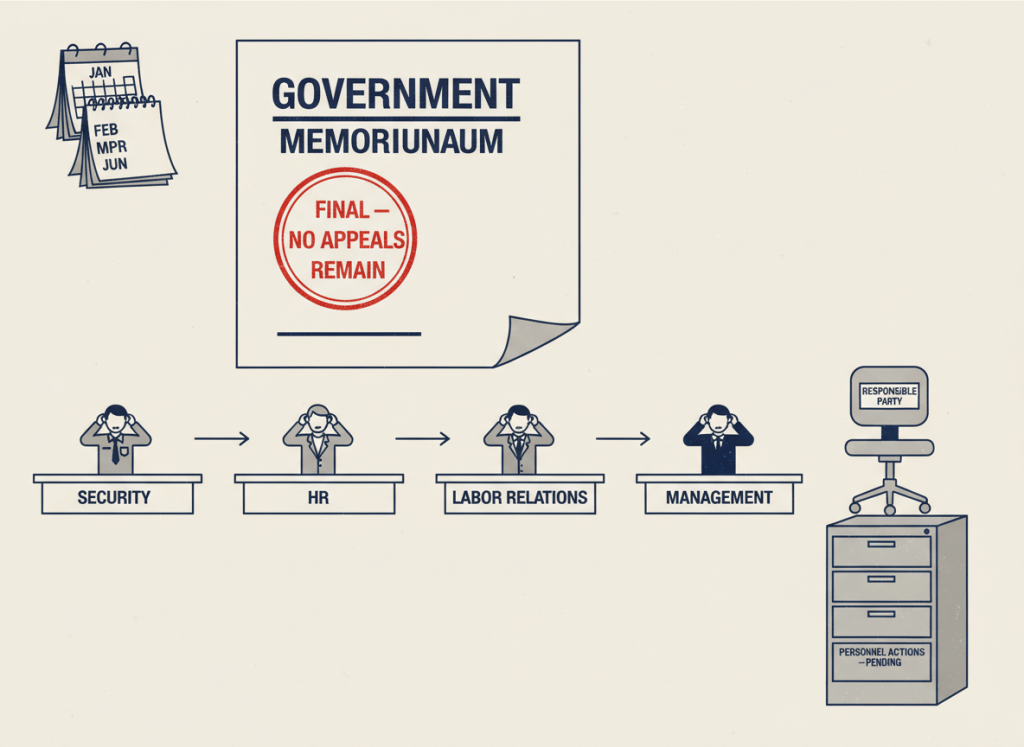
In March 2025, the DHS Security Appeals Board did what it exists to do. It upheld the denial of a USCIS employee’s security clearance and eligibility to hold a sensitive position, the second such denial since the employee was hired in 2015. The Personnel Security Division then sent the employee’s supervisor a memorandum stating that the decision was final, that no appeals remained, and that the employee must be removed from the sensitive position. As of June 2025, the DHS Office of Inspector General confirmed, the employee was still working in the same job, as an asylum officer.
That is one case among fourteen in OIG-26-31, published September 23, 2026, and it is the one that explains the rest. The audit examined the roughly 15,684 USCIS employees, 78 percent of the workforce, who hold Special-Sensitive or Critical-Sensitive positions, a group that includes the officers who decide who may live, work, and seek refuge in the United States. As of April 30, 2025, OIG found 14 employees whose clearances or eligibility had been denied or revoked and who still held national security positions. Ten stayed an average of about seven years after being found ineligible, one for more than twelve. One employee in the Fraud Detection and National Security Directorate, the unit that coordinates with the intelligence community, stayed about seventeen months while awaiting an appeal decision. One stayed more than eleven years until they passed away, and two worked roughly four years in Critical-Sensitive positions before being favorably adjudicated.
A Rulebook With No Last Page
Nobody slipped through unnoticed. The process that denied these employees was thorough to the point of ceremony. As OIG describes it, a proposal letter goes out, the employee gets 30 days to respond, a Notice of Determination follows, then a Notice of Review from the USCIS Chief Security Officer, then a three-member board of Senior Executive Service officers. What the procedure lacks is an ending. According to OIG, DHS policy never says who decides an employee’s continued employment or reassignment once appeals are exhausted, whether a revocation bars someone from a national security position during appeal, or how quickly anyone must act after a final decision.
Into that silence stepped a 2020 USCIS document, the Supervisor’s Guide to Actions on an Employee’s Eligibility to Hold a Sensitive Position and Security Clearance, which lets employees under appeal perform “only non-sensitive duties.” OIG found USCIS treated that as sufficient even after appeals ended. That does not square with OPM guidance or with 5 C.F.R. 1400.201, under which sensitivity is designated for a position and not for a menu of its duties. One USCIS official explained the practical result by saying an ineligible employee may still be working in a public trust position “at the discretion of their leadership.” OIG’s conclusion is blunt. Supervisors have no authority to keep such an employee in a sensitive position once all appellate rights are exhausted.
Everyone Concurs, Nobody Agrees
USCIS’s management response, signed by a DHS financial management official, calls the draft report “significantly flawed” and “misleading.” It argues that OIG changed the audit’s scope a year in without revising its criteria, applied current guidance to events that predate it, and misunderstood the role of a personnel security office, which it says adjudicates eligibility but does not decide personnel actions. Those belong to management and labor relations, which may reassign or remove an employee only once a determination is final.
Some of this deserves a fair hearing. Eight of the 14 had their clearances denied or revoked before SEAD-4 took effect on June 8, 2017, and USCIS says the rules then gave it little power to remove someone from a sensitive position where a clearance was not a condition of employment. It also says the employees kept in place were barred from classified information and sensitive duties, and that 48 employees have been removed or reassigned since SEAD-4, with 52 more leaving during review or appeal. OIG replies that USCIS never documented that the non-sensitive assignments happened. The 48 and 52 are USCIS’s own numbers, which the report does not verify.
That defense covers eight of fourteen. It does not obviously cover an asylum officer whose final denial came in 2025, and the published response does not address that case. Nor does it resolve the ownership problem. Security says removal belongs to management. OIG says DHS policy never assigns it to anyone. And after a memo saying the decision was final, the employee was still in the same position three months later.
The Fix Is Smaller Than the Finding
The audit’s second finding describes the front door. USCIS had 18 employees in national security positions with no suitability decision on file after an average of two years on the job. Five were recording errors. For the other 13, background investigations that surfaced marriage fraud, tax evasion, and potential money laundering had been complete for a year or more with no decision. One employee hired in October 2023 was flagged for immigration fraud, confirmed by FDNS in May 2024, suspended in February 2026, and resigned in March 2026. Another, hired in April 2022, was still under review in June 2026. The delay carries a mechanical cost, since once probation ends an agency generally loses the ability to separate someone on suitability grounds alone.
All four recommendations drew a “concur.” Read the commitments closely, though. Recommendation 1 asks USCIS to reevaluate employees denied or revoked before and after SEAD-4. USCIS says OIG clarified at the exit conference that it meant the 14 cited employees, and it promises documentation of adjudicated background investigations and enrollment in continuous vetting. Recommendation 2 asks USCIS to review the 27 suitability exceptions to make sure each decision remains valid. USCIS promises to confirm continuous vetting enrollment, while OIG says it will close the recommendation only when USCIS confirms it reviewed each exception and found it still valid. Those are different jobs. The first two commitments come due September 30, 2026. The timeframe rules in Recommendations 3 and 4 are promised for August and September 2027, and DHS notes it does not set its own adjudication timelines because the Executive Agents do.
USCIS can describe every rung of the ladder leading to a denial, down to the number of days allowed for a reply. It cannot yet say who is responsible for climbing down. Until someone is named, a memo saying remove is just a memo.

