Sixty-Three Percent
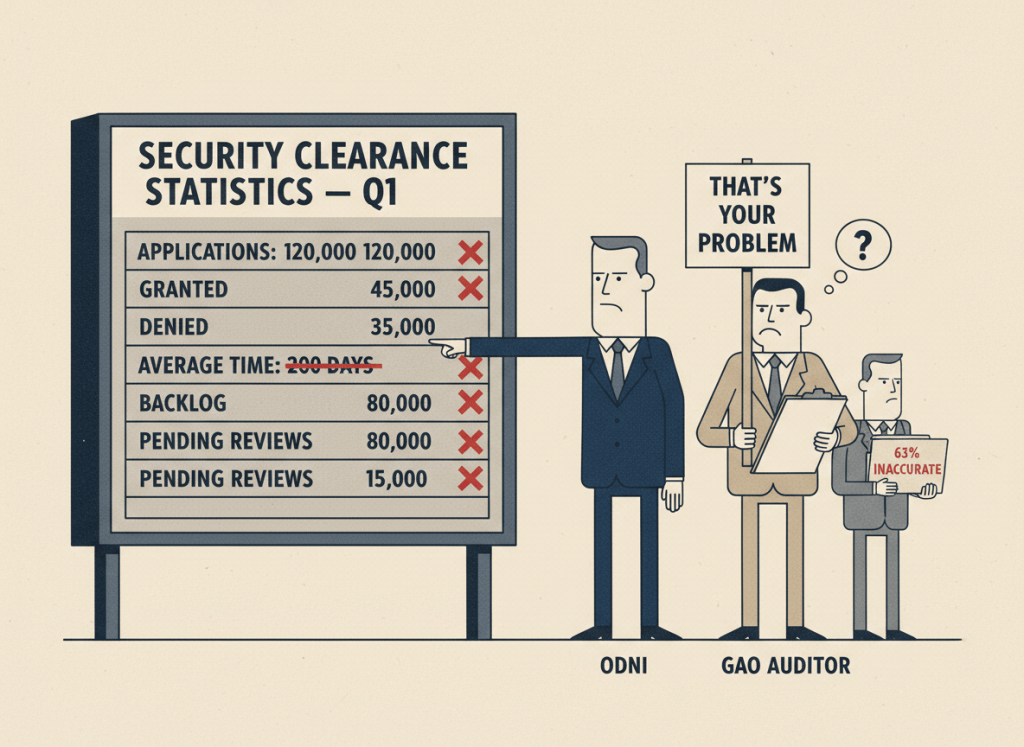
Every quarter, more than 100 agencies send the Office of the Director of National Intelligence numbers describing how they vet people for security clearances, and every quarter ODNI uses those numbers to judge whether the system works. Last December the Government Accountability Office checked a sample. Of 305 statistics from seven agencies for a single quarter, 63 percent were inaccurate or incomplete. Thirty-four of the inaccurate ones were off by 100 percent or more.
The examples do not require a statistician. The National Geospatial-Intelligence Agency reported adjudicating 839 Top Secret clearances for contractors, and its own case records showed 142. Treasury reported starting 51 Top Secret investigations for government personnel, and its records showed six. The General Services Administration reported two clearances awaiting adjudication when its records showed 34. Treasury submitted no reciprocity data at all for the quarter, because, its officials said, its systems have trouble tracking it.
In fairness, the sample was not built to represent every agency. But the seven agencies GAO picked are collectively responsible for reporting on more than 90 percent of the people who hold a clearance, and the problems turned up at all seven.
ODNI watches one number more closely than the rest, which is how long a clearance takes. GAO found 36 of the 42 timeliness statistics it examined were inaccurate. Thirty of those traced to a single error at the Defense Counterintelligence and Security Agency, which processes about 95 percent of the government’s background investigations. ODNI’s guidance told agencies to set aside the slowest 10 percent of cases and average the rest. DCSA instead set aside the slowest 10 percent separately for each phase, using four different sets of cases, and began doing so in fiscal 2020.
The result was that times were systematically understated. It touched the timeliness measurement of 95 percent of the clearances completed across government, and it put ODNI in the position of telling the Defense Department it had met a contractor timeliness goal it had not. GAO’s report says ODNI did not correct for the error when it built its quarterly reports, and that the flawed figures also flowed into the public quarterly updates on Trusted Workforce 2.0, the government’s clearance reform, from 2020 through 2024. DCSA agreed with GAO and fixed its method beginning in fiscal 2025. ODNI says new metrics covering every case will keep the problem from recurring, which is a fair point and also an admission that the old ones needed fixing.
An outside auditor found this, four years in.
Nobody Owns the Spreadsheet
GAO traced the trouble to three gaps. ODNI has no process for testing the reliability of the data it collects. It has issued no guidance telling agencies how to check their own. And it never defined what the senior data official at each agency, a post its 2018 memo requires, is supposed to do. Officials from most of the agencies GAO selected could not say who their own senior data official was. ODNI’s officials said they do not know either. Officials from most of those agencies also said ODNI had never given them feedback on their data.
ODNI did not say whether it agreed with GAO’s four recommendations, but it did have objections. It asked that GAO drop the reference to data reliability principles because, it said, those are designed for auditors and ODNI lacks the infrastructure or expertise to audit. It said it has no traditional enforcement powers and that ensuring agencies follow its data guidance would be difficult and resource intensive. GAO answered that any agency collecting data can adapt those principles, that the Director as Security Executive Agent has authority to issue guidelines to agency heads, and softened the word “ensure” to “monitor” to meet the resource point. The office charged with overseeing the clearance system has told its auditor that verifying the data is an auditor’s job.
It is also not the first time anyone has said so. GAO’s report lists earlier warnings, from the State Department’s inspector general in 2021, the intelligence community’s inspector general in 2023, GAO’s own January 2024 report and its 2025 High-Risk update. In the January 2024 reciprocity report, GAO found ODNI’s reciprocity data inconsistent and incomplete and recommended that ODNI follow best practices for evaluating it. ODNI told GAO in September 2024 that it already employed best practices, though GAO noted it described none. In December 2025, ODNI officials told GAO they were working on it but had not yet done so.
What Reciprocity Looks Like From the Waiting Room
Reciprocity is the rule that if one agency has cleared you, the next one should take its word. The January 2024 report found it works less well than advertised. Twenty-eight of 31 agencies surveyed said their IT systems at times lacked information needed to make the call, some agencies distrusted other agencies’ clearance processes, and contractors said they were not told when a determination was delayed.
ODNI’s answers to those findings are the most revealing in the file. It told GAO that no communication between agencies is needed for reciprocity, yet 30 of the 31 agencies surveyed said they communicate with each other regularly, and GAO recorded ODNI officials giving conflicting accounts on the point at different times. It called facilitating access to secure facilities for the checks untenable, and it called keeping contractors informed of delays not feasible because of the volume of cases, though two agencies told GAO they already send updates. GAO disagreed on each count. As of December 2025, ODNI officials said they were working on implementing every one of these recommendations and had not finished any. One of them, the plan to make clearance IT systems complete enough for reciprocity, carries GAO’s priority designation, as does the December recommendation for a process to test ODNI’s own data.
A Dashboard That Flattered the System
The stakes are not academic. GAO testified in February that the Trusted Workforce 2.0 finish line has slid from the end of fiscal 2026 to the end of fiscal 2028, and that at least 46 percent of the milestones tied to the Pentagon’s new background investigation system have been pushed out since April 2025. In the second quarter of fiscal 2025, agencies averaged 206 days to complete the fastest 90 percent of initial Top Secret clearances, 92 days beyond the 114-day goal, and GAO says those averages have trended longer since fiscal 2022. That testimony carries a footnote noting that more than 60 percent of the ODNI data GAO reviewed were inaccurate or incomplete.
That raises a question GAO does not answer. The old calculation understated times through fiscal 2024 and was corrected in fiscal 2025, so the trend line crosses the moment the method changed. How much of the lengthening is real and how much is the correction showing through is not something the public record currently lets anyone say. It is a question, not a finding.
ODNI owes Congress its own accounting of these recommendations in late January. A government that cannot say how long a clearance takes cannot say whether the fix for clearance delays is working, and ODNI’s stated position is that checking is for auditors. GAO is an auditor. It checked.

