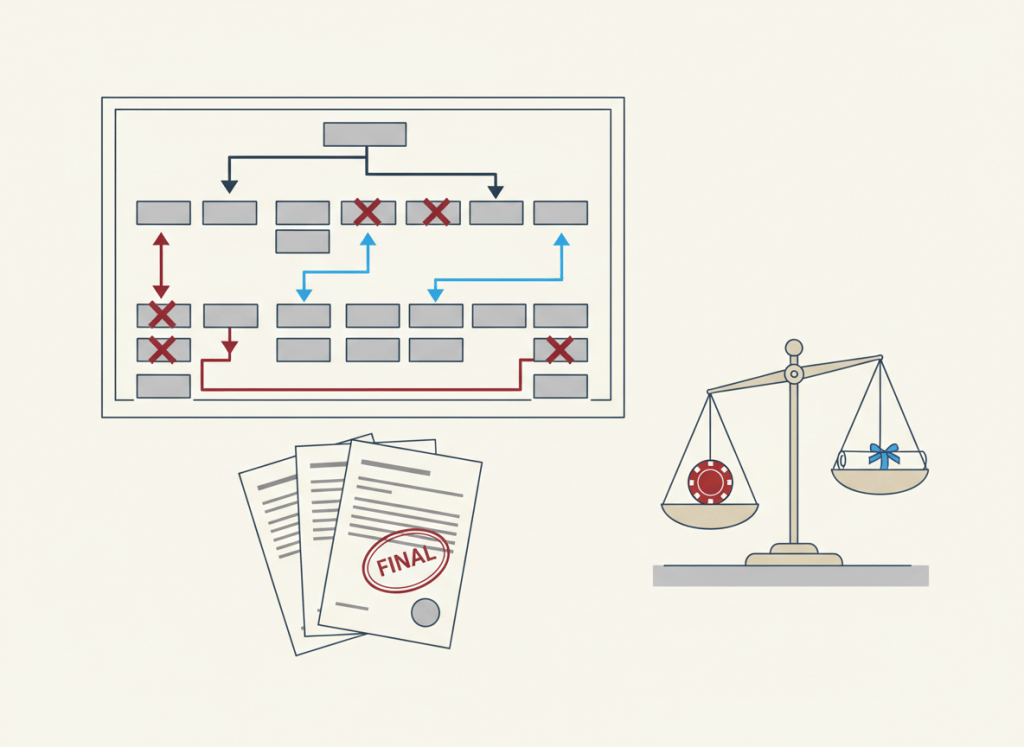
The Office of Personnel Management and the Office of Management and Budget published three linked final rules on federal personnel policy in a single day. One speeds up promotions by eliminating a longstanding time-in-grade requirement, one rewrites how agencies can use administrative leave during layoffs and buyout programs, and one overhauls how senior career employees are rated.
It is a coordinated rewrite of who moves up, who goes on leave, and who gets rated poorly across the federal workforce.
- Office of Personnel Management / Office of Management and Budget — OPM and OMB issued three final rules on federal personnel policy, published together. One eliminates the “time-in-grade” rule, which has generally required a year of service in a position one grade lower before an employee can be promoted into a competitive General Schedule job at GS-6 or above; agencies can now promote faster, so long as the employee still meets occupational qualification standards. A second rewrites the rules on administrative leave, spelling out when agencies can pay staff not to work during a reduction-in-force notice period or a deferred-resignation program, and when an agency can refuse to let someone take back a resignation already submitted under one of those programs. A third replaces the appraisal system for senior-level and scientific or professional employees with one modeled on Senior Executive Service reviews, and lifts a prior ban on using standardized rating distributions, meaning senior career staff can now be scored against each other rather than solely on individual merit. Three final rules this closely tied to promotion speed, leave during layoffs, and performance ratings landing in the same issue points to a single coordinated push to reshape how career employees move through the federal workforce, rather than three unrelated updates that happened to land together.
- Commodity Futures Trading Commission — The CFTC issued two related rules on the legal definition of a “swap.” One is an interim final rule, meaning it takes effect immediately without the advance public comment period an ordinary rule requires, codifying the Commission’s position that casino-style gambling products, including sportsbook wagers and casino games, fall outside the swap definition and therefore outside CFTC jurisdiction. The other is an ordinary proposed rule, open for comment until November 18, 2026, that would explicitly bring “event contracts” tied to sports, politics, culture, and weather into the swap definition, placing them under CFTC oversight rather than state gambling law. Pairing a rule that takes effect immediately with one that invites months of public comment, on opposite sides of the same jurisdictional line, is worth watching given the live fight between federal regulators and states over whether prediction-market and sports-event contracts are financial products or wagers.
- Federal Communications Commission — The FCC announced that OMB approved the information-collection requirements tied to its Upper C-Band order, the rulemaking clearing satellite operators out of the 3.98–4.2 GHz band to free spectrum for next-generation wireless use. In a companion notice issued the same day, the Wireless Telecommunications Bureau opened comment on a preliminary cost catalog estimating how much incumbent satellite and earth-station operators will be reimbursed for relocating out of the band. That cost catalog is the detail that actually determines how many billions of dollars change hands and on what schedule, so the comment period is where affected companies will contest specific figures before they are locked in.
- Environmental Protection Agency — EPA proposed updating its delegation of New Source Performance Standards and hazardous-air-pollutant enforcement authority to the Northwest Clean Air Agency in Washington State, after the local agency asked to take over enforcement of newer federal standards for new pollution sources. A delegation like this hands day-to-day permitting and enforcement to a state or local agency instead of EPA regional staff, which can speed up permitting decisions but also means the practical application of a federal standard now depends on how the delegated local agency chooses to enforce it, with EPA keeping oversight rather than a direct role.
- Consumer Product Safety Commission — CPSC issued an interpretive rule concluding that “flammable liquid fuels,” a phrase used in the Portable Fuel Container Safety Act of 2020, does not cover fuel additives meant only to improve engine performance, clean engine components, or otherwise treat fuel rather than serve as the fuel itself. Interpretive rules are a shortcut: agencies use them to explain how they read an existing statute without going through the notice-and-comment process a new substantive rule would require, so this determination narrows what the 2020 safety law covers without the public first getting a chance to weigh in on where that line should sit.
Bureaucracy Times reviewed all 146 documents published in the October 19, 2026 Federal Register. We excluded routine advisory-committee meeting notices, fee-schedule adjustments, Paperwork Reduction Act information-collection notices, antidumping and countervailing-duty administrative reviews, airworthiness directives, hazardous-materials special-permit actions, routine safety and security zone notices, and Self-Regulatory Organization rule-change filings, none of which cleared our threshold for institutional or anomaly significance today.

