Category: Regulatory Watch & Oversight

  • The $215 Million Quantum Race That Took Washington a Decade to Build

    The Quantum Genesis Files, Part One

    DOE wants a fault-tolerant quantum computer by 2028. The competition announced this week is only the newest piece of a federal research, benchmarking and industry partnership effort years in the making.

    The Department of Energy wants someone to build a quantum computer that actually works.

    Not merely one with an impressive number of qubits attached to its name. Not another experimental machine capable of demonstrating that quantum computing remains theoretically fascinating. DOE wants a fault-tolerant computer capable of performing useful scientific work, and it wants the first generation of that machine demonstrated by 2028.

    On September 17, DOE announced the Quantum Genesis Q Competition, offering up to $215 million in planned funding to private companies capable of reaching a series of increasingly difficult milestones.

    The headline number is substantial. The history behind it is considerably larger.

    The competition is the latest step in an effort DOE has been developing for more than a decade, moving gradually from asking whether quantum computers could be useful for federal science to preparing an independent government apparatus capable of determining whether industry has finally built one.

    From Physical Qubits to Useful Ones

    Quantum computing has suffered from an inconvenient problem for anyone trying to explain its progress. Qubit counts sound impressive without necessarily telling anyone how useful a machine is.

    Physical qubits are notoriously susceptible to errors. Environmental interference, imperfect controls and the delicate nature of quantum states can corrupt calculations long before a useful computation is completed.

    A logical qubit attempts to solve that problem by encoding quantum information across physical qubits using error correction. The objective is not simply to possess more qubits. It is to possess qubits reliable enough to keep calculating.

    DOE’s new competition therefore targets machines with at least 100 logical qubits capable of performing hundreds of millions of fault-tolerant operations.

    Companies reaching that threshold will be eligible to share a $100 million incentive pool. DOE has established another $50 million pool for competitors reaching 150 logical qubits and another $50 million for systems reaching 200.

    Before any of that happens, Phase I offers individual competitors up to $1.5 million for earlier milestones.

    There is, however, an important budgetary asterisk.

    The $215 million is planned funding, not $215 million already sitting in an account waiting to be distributed. DOE says only $2.5 million comes from fiscal year 2026 funding. The remainder is dependent upon future congressional appropriations.

    Applications are due October 19.

    DOE Did Not Arrive Here Overnight

    To understand why DOE thinks a machine like this might exist by 2028, it helps to travel back to Bethesda, Maryland, in February 2015.

    DOE’s Advanced Scientific Computing Research program convened a Workshop on Quantum Computing for Science.

    The question then was much more fundamental.

    Could quantum computing technologies eventually address computational problems relevant to DOE’s scientific and energy missions?

    The resulting report examined quantum simulation, physical sciences, applied mathematics, linear algebra, graph theory and machine learning. More importantly, it identified how much research still stood between quantum computing as an intriguing technology and quantum computing as a useful scientific instrument.

    That distinction has driven much of what followed.

    DOE convened a Quantum Testbeds Stakeholder Workshop in 2017. It subsequently funded quantum testbeds, application research and the Accelerated Research in Quantum Computing program. In 2023, another Basic Research Needs workshop in Quantum Computing and Networking examined problems including algorithms, benchmarking, verification and error resilience.

    The vocabulary evolved as the machines did.

    Eventually the question was no longer whether quantum computing might matter.

    It became how the government would know when it did.

    The Blueprint

    That evolution culminated this year in DOE’s Blueprint for DOE Quantum Supercomputing.

    The Blueprint was developed by DOE laboratories with what the Department describes as significant contributions from academia and industry. It establishes a strategy for developing fault-tolerant quantum computers capable of solving scientific problems beyond the reach of even the most powerful conventional supercomputers.

    DOE calls that threshold scientific utility.

    That phrase is important because it changes the measurement of success.

    A machine does not become scientifically important merely because a manufacturer announces another qubit record. DOE’s target is useful computation.

    The Blueprint calls for initial scientifically relevant quantum-computing capabilities by 2028, followed by larger production-scale systems in the 2030s.

    DOE then formally launched Quantum Genesis in June, organizing the initiative around three components.

    One is the Q Competition now underway.

    Another is a planned National Quantum Supercomputing User Facility intended to give American scientists access to advanced quantum systems and integrate those machines with DOE’s conventional high-performance computing infrastructure.

    The third is research into scientific applications that could actually make use of the machines.

    In other words, DOE is not envisioning quantum computers replacing its supercomputers.

    It wants them working together.

    Trust, but Verify the Qubits

    There is another part of this week’s announcement that received considerably less attention than the $215 million headline.

    DOE simultaneously announced a Quantum High-Performance Computing Validation and Verification Testbed Lab Call.

    The Department plans to provide another $45 million to its National Laboratories to establish tools for independently evaluating the machines entered in the competition.

    Of that amount, $14 million is FY2026 funding. The remainder, like most of the Q Competition funding, depends upon future appropriations.

    The validation program is supposed to examine virtually the entire quantum computing stack, including physical hardware, quantum gates, logical architectures, algorithms, scientific applications and classical control systems.

    That means DOE is doing something considerably more interesting than offering prizes for impressive specifications.

    It is building the referee at the same time it organizes the race.

    Competitors will have to demonstrate their machines to government evaluators rather than simply provide their own performance claims. DOE wants verification of logical error rates, gate performance, computational depth and scientific workflows.

    The arrangement represents the culmination of another thread running through DOE’s quantum research.

    Government researchers have spent years developing benchmarks, testbeds and performance-assessment techniques precisely because competing quantum architectures can be extraordinarily difficult to compare.

    DOE now intends to apply that expertise to machines competing for federal money.

    A Computer Looking for a Scientific Problem

    The Department has already identified the general territory where it expects quantum computing to matter.

    Chemistry is one obvious candidate. Molecules themselves obey quantum mechanics, making sufficiently complex molecular systems extraordinarily difficult to simulate using conventional computers.

    Materials science presents similar opportunities.

    DOE also identifies plasma physics, high-energy physics, nuclear physics and applied mathematics among the potential beneficiaries.

    But the Department is trying to avoid building an exotic machine and only afterward asking scientists what they might do with it.

    Quantum Genesis instead calls for scientific applications to develop alongside the hardware. National Laboratories, universities and industry partners are supposed to identify problems that can eventually become demonstrations of scientific utility.

    That is an important departure from treating quantum computing primarily as a hardware competition.

    The machine and the scientific mission are supposed to meet somewhere in the middle.

    The Starting Gun Is Not the Beginning

    Seen in isolation, the September 17 announcement looks like a new $215 million federal technology competition.

    Seen against the documentary history, it looks more like the moment DOE decided that more than a decade of research had advanced far enough to start demanding results.

    In 2015, DOE was assessing whether quantum computing could meaningfully serve its scientific mission.

    By 2017, it was studying testbeds and methods for comparing technologies.

    By 2023, benchmarking, verification and error resilience had become explicit research priorities.

    The 2026 Blueprint established scientifically useful fault-tolerant computing as the objective and 2028 as the initial deployment target.

    Now money is attached to the milestones.

    Even the money, however, requires some perspective.

    Quantum Genesis does not begin with this week’s $215 million announcement. DOE explicitly says the initiative builds upon longstanding federal investments in quantum information science, including the National Quantum Information Science Research Centers created under the National Quantum Initiative.

    Those investments, along with programs elsewhere in the federal government, have helped build the laboratories, researchers, partnerships, technologies and companies that now make a competition like Quantum Genesis possible.

    That raises a different accounting question.

    When companies line up to compete for DOE’s $215 million, how much federal support will already be standing behind them?

    That is where the quantum race gets considerably more interesting.

    Sources: DOE, Quantum Genesis Q Competition announcement (September 17, 2026); DOE, Quantum Genesis initiative launch (June 2026); DOE, Blueprint for DOE Quantum Supercomputing; DOE ASCR, Workshop on Quantum Computing for Science (February 2015).
    Fediverse Reactions
  • Federal Register Watch: September 17, 2026

    EPA moved to unwind its own legal basis for regulating power-plant greenhouse gases, finalizing a repeal of its 2024 carbon standards for electric generating units while, on the same day, proposing to rescind the underlying 2015 findings that justified regulating those emissions at all.

    • EPA proposes rescinding the 2015 findings behind power-plant climate rules. EPA proposed rescinding the 2015 findings that greenhouse gases from fossil-fuel power plants endanger public health, the legal foundation beneath a decade of federal climate regulation for the sector. The agency offers three separate arguments for reversing itself, including that Congress never clearly authorized EPA to regulate power plants over climate change under the “major questions doctrine,” and that eliminating the entire U.S. power sector’s emissions would have only a negligible effect on global temperatures. Because this is a proposed rule rather than a final one, it opens debate instead of closing it: comments are due November 2 and a virtual public hearing is set for October 1, giving utilities, states, and advocacy groups a real chance to contest the reasoning before it can take legal effect. Read the proposal.
    • EPA finalizes repeal of most of the 2024 Carbon Pollution Standards. In a companion action published the same day, EPA finalized the repeal of most of its 2024 Carbon Pollution Standards, including emission guidelines for existing coal- and gas-fired power plants and carbon-capture requirements the agency itself adopted only two years earlier. Unlike the proposal above, this one is already final, meaning it takes legal effect without any further public comment. Pairing a final repeal with a still-pending proposal to erase the legal findings underneath it is an unusual sequence, since it leaves EPA’s authority to write any future power-plant rule resting on a foundation the agency has separately proposed to tear down. Read the final rule.
    • FDIC calls a merger-policy board meeting on unusually short notice. The FDIC gave notice of a board meeting held with less than seven days’ advance warning, short of the one week of public notice its Sunshine Act procedures normally require, to take up two proposed rules on bank merger transactions and “state bank parity” plus a vote to rescind an existing supervisory guidance document. Federal open-meeting law expects an agency to state why a shortened notice period was necessary, and this notice offers no reason, which matters because that explanation is the only real check on how much warning the public and affected banks get before a board acts on merger policy. Read the notice.
    • FDA denies exemption for AI radiology software, despite a title that reads the other way. FDA denied a device maker’s petition to exempt certain AI-based radiology software, including cancer-detection and triage tools, from the premarket notification process that normally requires FDA clearance before a device can be sold. The agency found that relying on the company’s prior clearances and a proposed post-market monitoring plan wasn’t enough to show that skipping that clearance review would leave patients just as safe. It’s worth flagging because the document’s own title, “Exemption From Premarket Notification,” names the type of request under review rather than its outcome; read quickly, it can look like FDA loosened oversight of AI diagnostic tools when the agency in fact declined to. Read the notice.
    • Commerce renews export ban on Aeroflot, citing an active violation. The Commerce Department’s Bureau of Industry and Security renewed its temporary denial of export privileges against Russia’s PJSC Aeroflot, citing evidence the airline kept operating U.S.-regulated aircraft components in violation of the denial order Commerce had renewed just last September. A temporary denial order cuts a company off from anything subject to U.S. export rules, and a finding that Aeroflot defied the prior renewal, rather than the agency simply extending it as a precaution, signals that the restriction isn’t achieving compliance and that Commerce is now treating the airline as an active violator rather than a monitored risk. Read the order.

    This edition draws on the Federal Register’s full docket of 72 documents published on September 17, 2026. Set aside as routine: airworthiness directives, OMB/PRA information-collection notices, Coast Guard drawbridge and safety-zone notices, SEC self-regulatory-organization filings, FERC combined filings and blanket-authorization notices, cultural-property exhibition determinations, Postal Service product notices, and other standard administrative filings that didn’t trip an institutional-significance or anomaly signal.

    Fediverse Reactions
  • SEC Moves to Tear Up the Federal Rulebook for Shareholder Proposals

    WASHINGTON — The Securities and Exchange Commission proposed Wednesday to eliminate one of the federal government’s longstanding mechanisms governing how shareholders get proposals before their fellow investors — potentially shifting much of that fight back to the states and individual corporations.

    The SEC proposed rescinding Exchange Act Rule 14a-8, the federal rule governing shareholder proposals included in companies’ proxy materials.

    If adopted, the change would not merely tweak eligibility thresholds or adjust paperwork. It would remove Rule 14a-8 altogether.

    The Referee Leaves the Room

    In its announcement of the proposal, the SEC says the rule exceeds the scope of the Commission’s statutory authority and intrudes into an area traditionally governed by state corporate law. The agency also argues that some of the original policy justifications for the rule have either failed to materialize or become less persuasive over time.

    Under the proposal, questions about the role of shareholder proposals would instead largely be determined by state law and companies’ own governing documents.

    That is a substantial jurisdictional shift disguised in the familiar beige wrapping of federal rulemaking.

    Rule 14a-8 currently establishes a federal framework through which qualifying shareholders can submit proposals for inclusion in a company’s proxy materials, subject to numerous procedural requirements and grounds for exclusion. The system has consequently made the SEC an important referee in disputes between corporations and shareholders over what belongs on the ballot.

    The Commission is now proposing to send much of that argument elsewhere.

    Atkins, Briefly, in Plain English

    SEC Chairman Paul Atkins described the proposal as part of an effort to keep federal securities regulation from improperly encroaching upon state corporate law while modernizing rules to account for changes in markets and technology.

    The SEC also proposed amendments to Rule 14a-4(c), which governs circumstances in which companies may exercise discretionary authority over proxy votes. According to the Commission, those changes would provide companies greater flexibility while giving shareholders greater control over proposals subject to discretionary voting.

    While They Had the Hood Open

    And Rule 14a-8 was not the only piece of proxy plumbing placed on the workbench Wednesday.

    In a separate proposal, the Commission moved to modernize additional portions of the proxy solicitation process. Among other things, the SEC proposes eliminating the requirement that companies deliver annual reports to security holders, eliminating certain delivery deadlines for documents incorporated by reference into proxy statements, eliminating Notices of Exempt Solicitation, and shortening the minimum broker search period from 20 business days to five.

    Simplification, or Just a Change of Address?

    Taken together, the proposals suggest something larger than regulatory housekeeping.

    The Commission is reconsidering how much of corporate shareholder governance should be administered through federal proxy rules in the first place, while simultaneously stripping away some procedural requirements built for a decidedly less digital era.

    Whether that produces a simpler system or merely relocates the complexity remains to be seen.

    State corporate law is not uniform, corporate governing documents vary, and removing a national SEC framework could produce considerably different shareholder-proposal environments depending upon where a company is incorporated and what its governing documents permit.

    For now, nothing changes.

    These are proposed rules, and the SEC will accept public comments for 60 days following publication of the proposals in the Federal Register.

    But the proposal is worth watching closely. Washington occasionally simplifies a regulatory system by simplifying it.

    Other times, it simply moves the paperwork somewhere else.

  • Truth Social Banned a Federal Accountability Outlet. It Won’t Say Why.

    Editor’s note: This article reports on an action taken against Bureaucracy Times’ own Truth Social account. It is written in the third person for consistency with our editorial style. The appeal referenced below was submitted by the editor on September 4, 2026.

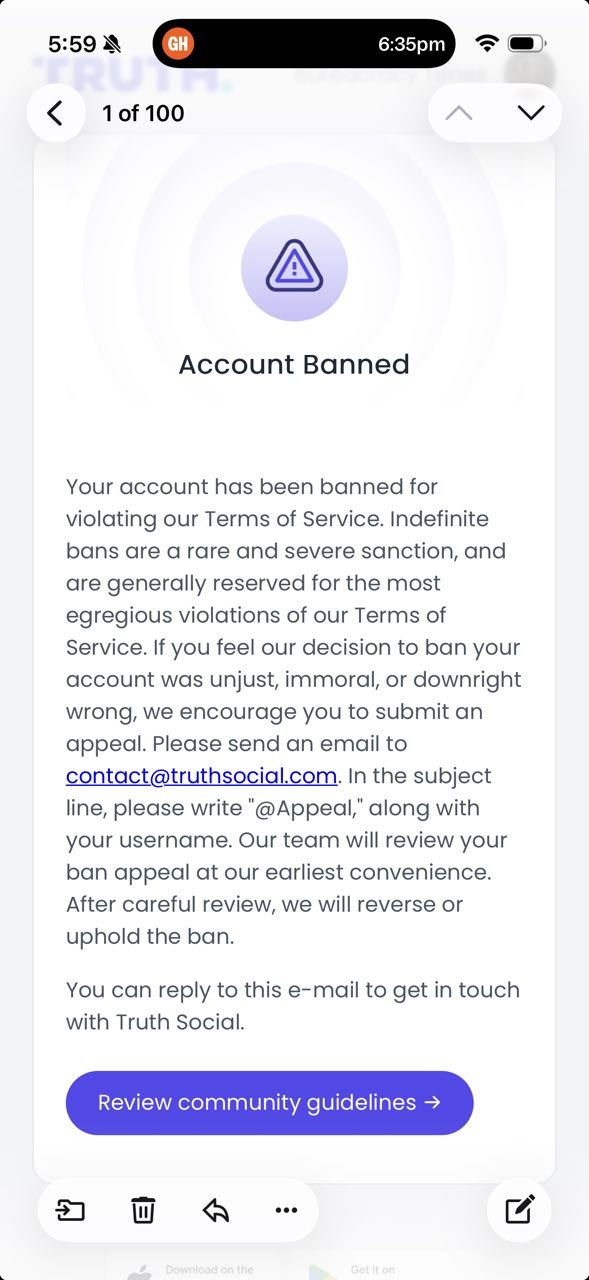
    Bureaucracy Times was banned from Truth Social on September 4, 2026. The notification cited a violation of the platform’s Terms of Service. No specific rule was identified. No content was flagged. No warning was issued.

    Bureaucracy Times covers federal agency accountability, government oversight, regulatory failures, and congressional conduct. The ban is indefinite.

    Truth Social account banned notification
    The notification Bureaucracy Times received from Truth Social on September 4, 2026.
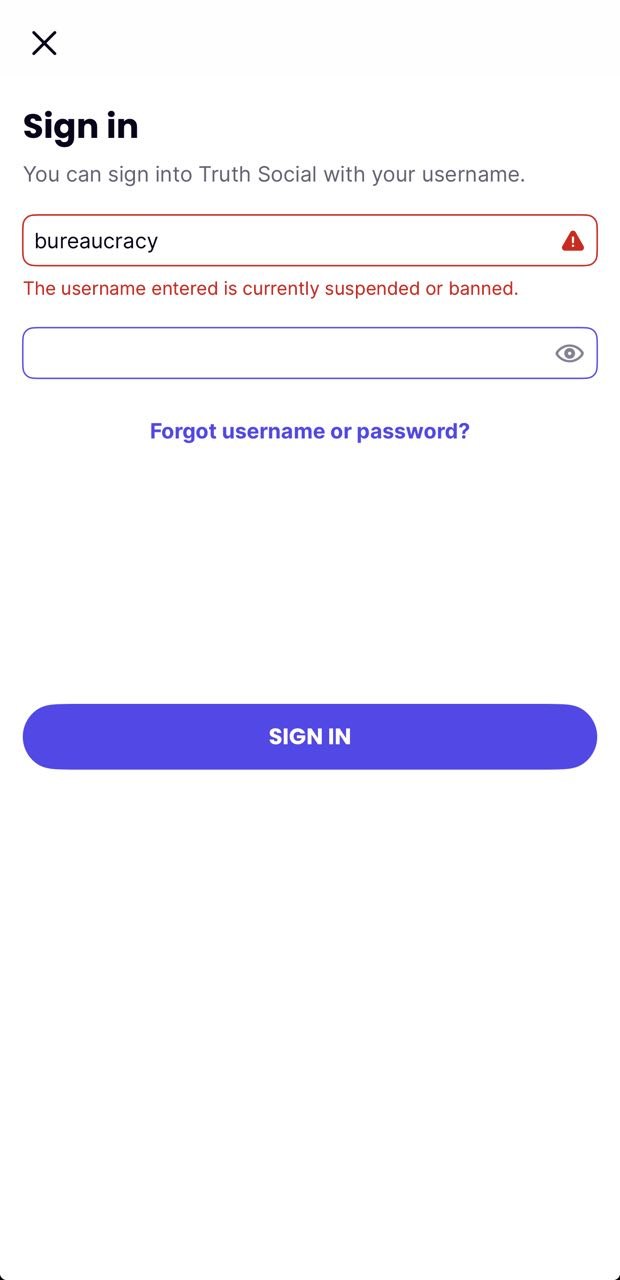
    Truth Social app login screen showing account banned or suspended error
    Attempting to log in to the Truth Social app on September 4, 2026, after receiving the ban notification. The app displays a red error on the username field, offering no further explanation.

    What the Notification Said

    The ban message stated that the account had been banned indefinitely for “violating Terms of Service” and that the violation was “generally reserved for the most egregious violations.” It directed the account to contact@truthsocial.com with a subject line of “@Appeal” followed by the account username.

    The account handle — @bureaucracy — is a common English word. Whether the simplicity or genericness of the handle factored into any complaint or automated flag is unknown. Truth Social’s guidelines identify “username squatting” as a reportable offense, but that category applies to accounts impersonating others, not to a publication operating under its own editorial identity.

    That is the entirety of the explanation provided.

    What the Guidelines Actually Say

    Truth Social’s Community Guidelines open with a commitment to free speech principles:

    “In no instance will TRUTH Social determine what content will be removed or filtered, or whose account will be eliminated, on the basis of the point of view shared within the content at issue. TRUTH Social’s policies are, to use a popular concept in First Amendment law, viewpoint-neutral and fully inclusive.”

    The guidelines list eleven categories of reportable content — illegal activity, fraud, nudity, violence, child sexual abuse material, prostitution, counterfeit goods, privacy violations, illegal sales, intellectual property infringement, and doxxing — and four categories of reportable account behavior: spam/bots, username squatting, impersonation, and intellectual property violations.

    Bureaucracy Times publishes investigative reporting on federal agencies, regulatory failures, congressional oversight, and government accountability. Its content is sourced from public records, GAO reports, Inspector General findings, FOIA requests, and official government documents.

    None of the fifteen enumerated violation categories apply.

    The Accountability Gap

    Truth Social was founded by President Donald Trump following his suspension from Twitter in January 2021. The platform has consistently marketed itself as a free speech alternative to what it characterizes as ideologically biased Big Tech moderation.

    The guidelines promise viewpoint neutrality. The enforcement is a black box.

    There is no published appeals process beyond a single email address. There is no timeline for response. There is no mechanism to identify which content triggered the ban, which rule was applied, or who made the decision. The notification itself acknowledges none of this. It simply states a violation occurred and offers an email address.

    This is the same accountability gap Bureaucracy Times covers when federal agencies deny FOIA requests without explanation, when regulatory bodies issue enforcement actions without citing specific violations, or when government offices respond to oversight inquiries with form letters and indefinite timelines.

    The irony is structural, not incidental.

    What Happens Next

    Bureaucracy Times submitted an appeal to Truth Social on September 4, 2026, via email to contact@truthsocial.com with the subject line required by the platform. We will report on any response received, including the timeline, the substance of any explanation, and whether the ban is reversed.

    We are also documenting this incident as a case study in platform moderation opacity, the same kind of opacity we cover in the institutions this publication was built to hold accountable.

    If Truth Social responds, we will update this article. If it does not, that will be the story.

    Update, September 7, 2026: Truth Social responded to the appeal and reinstated the @bureaucracy account, stating, “Your account was inadvertently banned due to a bug in our bot mitigation system that mistakenly identified your account as a bot. We apologize for the error and have fully reinstated your account.”

    This explanation identifies a technical mechanism for the ban but does not clarify why a government accountability outlet was flagged as a bot, nor why the original notification cited a Terms of Service violation rather than a technical error.

  • Cox Media Group Was Selling a Lie, and the FTC’s Price Tag Was $930,000

    Active Listening, Passive Accountability: Cox Sold A Phantom Surveillance Machine

    Cox Media Group spent years telling advertisers that its ad tech could listen to people through their phones and smart devices in real time. The Federal Trade Commission just confirmed the truth, and it is not the nightmare people expected. The terrifying surveillance state did not materialize. Instead, one of the largest media companies in the United States apparently charged clients for an eavesdropping machine that did not work as advertised (FTC press release, Aug. 27, 2026). They did not just lie about you. They lied about lying on you.

    The product that promised to hear you breathe

    The centerpiece of this small civic tragedy is a product with the sort of tech conference name that should set off fire alarms: Active Listening. According to pitch materials obtained and published by 404 Media, Cox Media Group, through a web of related entities, told advertisers that Active Listening was an AI powered service that used the microphones on smartphones, smart TVs, and smart speakers to harvest what people said in their homes. The pitch deck promised to “capture real time intent data by listening to our conversations” and to use that data to target ads across digital platforms.

    The deck name dropped Google, Amazon, and Facebook as partners, which instantly raised eyebrows among people who have read an engineering document in their lives. Active Listening, according to the marketing promises, would know when you talked about a new car or a vacation and would help advertisers ambush you with relevant ads on major platforms. Cox sold this as a competitive advantage, the secret sauce that supposedly made its campaigns smarter than the poor souls buying regular ad inventory (404 Media).

    The three company magic trick

    The FTC enforcement action involves three entities: CMG Media Corporation, which does business as Cox Media Group, a major broadcaster and digital publisher. MindSift LLC, described in the complaint as a data and technology firm. And 1010 Digital Works LLC, a company that helped develop and promote Active Listening (FTC complaint). Together they offered advertisers a kind of turnkey wiretap fantasy.

    On paper, CMG handled the sales pitch, MindSift delivered the alleged AI analysis, and 1010 Digital Works supplied the technical wizardry. In reality, according to the FTC, the supposed listening capability was either false or unsubstantiated. The complaint says the companies told customers their service collected and used real time conversational data, when in fact they could not do what they claimed (FTC complaint).

    Security researchers and reporters smelled trouble early. Ars Technica examined the claims in late 2023 and pointed out that no major mobile platform would quietly allow a random ad partner to run a background microphone dragnet across millions of devices (Ars Technica). The word “impossible” was used with unusual restraint. The better word might have been “ridiculous.”

    From leaked slides to federal orders

    The unravelling started when 404 Media published the Active Listening pitch deck, giving the public an unvarnished look at the claims Cox and its partners were making behind closed doors. Gizmodo followed with its own examination of the materials and highlighted just how explicitly the slides promised microphone level access to private conversations for ad targeting (Gizmodo).

    Once those claims hit daylight, the alleged “partners” did not exactly rush to embrace them. Google removed CMG from its Partners Program after the story spread, and Meta reportedly reviewed its relationship with the company (Gizmodo). Senator Marsha Blackburn sent letters in September 2024 to CMG and the platforms that had been invoked in the pitch materials, seeking clarification about what exactly this service did and how (Blackburn letter).

    Under pressure, CMG issued a public statement in September 2024 asserting that Active Listening had been discontinued and insisting that it did not actually listen to private conversations in the way critics feared (CMG response). The company tried to downplay the idea that it was running a live audio surveillance operation, while somehow not conceding that its pitch deck had veered into science fiction.

    The FTC filed its formal complaint on May 21, 2026, and on August 27, 2026, it finalized orders with CMG, MindSift, and 1010 Digital Works, finding that the companies deceived customers about Active Listening’s capabilities (FTC press release). Regulators did not find a vast illegal wiretap plot. They found an ad product that bragged about criminal level access to people’s devices and could not back it up.

    The fine that would not pay for the coffee

    The money involved is almost insultingly small. CMG will pay $880,000. MindSift and 1010 Digital Works will each pay $25,000. The grand total for an AI branded service that allegedly promised live monitoring of household conversations clocks in at $930,000 (FTC press release).

    To grasp the scale, remember that CMG’s parent company, Cox Enterprises, has reported revenue in the tens of billions of dollars in recent years. Against that backdrop, $880,000 looks less like a punishment and more like an invoice for a slightly overpriced consulting engagement. No executive is cancelling a golf trip over this.

    The timeline does not exactly scream urgency. The pitch deck surfaced in late 2023. Google cut CMG loose from its Partners Program soon after. Senator Blackburn raised public questions in September 2024. CMG said the product was discontinued that same month. The FTC did not file its complaint until May 2026, and only finalized the orders in August 2026 (FTC case page). Eighteen months of regulatory process for a fine that amounts to parking ticket money in corporate terms.

    The two sided risk: surveillance or snake oil

    Why does any of this matter, if the microphones were not actually siphoning up your late night rants about car insurance and vacation plans

    Because either version of this story is bad. If Active Listening had worked as advertised, it would look a lot like illegal surveillance. A private media company and its vendors would have been running continuous audio capture through consumer devices in order to sell more ads. The only relief in the FTC’s findings is that this horror show did not come true, at least not here.

    But if the product did not work, then advertisers were paying real money for imaginary data. That is fraud, not merely overenthusiastic marketing. Ad buyers were told they could reach audiences based on intimate, spoken conversations, when in fact the companies could not substantiate that claim. Consumers still lose in this scenario, because a market that rewards outlandish surveillance stories pushes every competitor to gesture at the same dystopian magic, whether they have it or not.

    The FTC’s orders do more than collect a modest check. They impose 20 year prohibitions on future misrepresentations about data collection, surveillance, and AI capabilities for all three companies (FTC press release). The length of that leash says something quiet and grim. Regulators clearly expect that someone will try a version of this trick again.

    For the public, the Cox case settles one narrow question. Your phone was probably not part of a Cox run, AI powered live tap for ad targeting, despite the rumors. What the case does not settle is more troubling. It shows how easily a large, well connected media company can spin a story about total surveillance, use the credibility of big tech brands as set dressing, and sell that fantasy to clients until reporters, platforms, a senator, and finally the FTC call their bluff. The lesson is not that we are safe. The lesson is that when someone tells you they can hear everything you say, the only rational response is to demand proof, and then check who is cashing the checks.


    Fediverse Reactions
  • The Loneliest Job in Federal Oversight: Congress Finally Moves on NOAA Observer Harassment

    Congress Discovers NOAA Observers Are Human After All

    Alone On The Boat With Everyone Pretending Nothing Is Wrong

    The federal government calls them observers. In practice, they are one unarmed person with a clipboard, a tablet, and a mandate, dropped onto a commercial fishing vessel for days or weeks at a time. They count every fish, record every discarded catch, and document anything that smells like a violation of the Magnuson Stevens Act. They share cramped bunks with the crew they may later help prosecute. Their presence can shave thousands of dollars off a haul if what they write down does not match what the captain wants to land.

    Observers, at sea monitors, and catch monitors are the federal government’s eyes and ears on the water. They supply the data NOAA Fisheries uses to set catch limits, justify management decisions, and defend them in court. According to NOAA’s own materials on observer safety and harassment, they do all this while facing a steady risk of verbal abuse, intimidation, and worse. NOAA has highlighted a North Pacific case where harassment of an observer led to a Notice of Violation and Assessment of tens of thousands of dollars against a vessel. That incident made it into an enforcement action. Many others, as NOAA sponsored research has shown, never make it into any official record at all.

    Peer reviewed work in journals such as Frontiers in Marine Science, along with NOAA funded studies on the Alaska maritime workplace, has described systematic underreporting of harassment and obstruction of observers. The pattern is not subtle. One worker, often the youngest and least powerful person on board, lives and works in close quarters with the very people whose behavior they are supposed to document. Federal policy historically told them that if something happens, they should report it through channels designed for office parks and research labs instead of rolling decks and hostile wheelhouses.

    What H.R. 2406 Actually Does, Behind The Branding

    Enter H.R. 2406, the National Oceanic and Atmospheric Administration Sexual Harassment and Assault Prevention Improvements Act of 2025. The title reads like a committee staffer tried to squeeze every relevant noun into one line. The substance, laid out in House Report 119-761 and in the bill text on GovInfo, is more focused.

    The bill, introduced by Representative Suzanne Bonamici with bipartisan cosponsors including Representatives Maria Salazar, Jared Huffman, and Brian Fitzpatrick, starts with a simple admission that took Congress far too long to articulate. NOAA’s existing sexual harassment and assault policies did not explicitly protect the people the agency sends onto boats to enforce federal fisheries law. H.R. 2406 expands those policies to cover observers, at sea monitors, catch monitors, and staff of the regional fishery management councils.

    The bill also creates a restricted reporting option so that observers and other covered personnel can make confidential disclosures without automatically triggering a full investigation. That kind of option already exists in other federal contexts. Here, it is treated as a novel improvement for people who have been filing incident reports from the middle of the ocean for years.

    H.R. 2406 requires NOAA to refer vessel related incidents of sexual harassment and assault to the Coast Guard, along with the names of the individuals involved, the vessel, and the time and location of the incident. It directs the agency to strip out older “forcible” qualifiers in policy language so that non stranger sexual assaults and a wider range of coercive conduct clearly fall within the rules. It expands the annual report to Congress so that lawmakers stop receiving glossy aggregate counts and instead see case synopses, information on disciplinary actions, and breakdowns across observer categories.

    One more provision speaks volumes about how literally Congress expects NOAA to take all this. The bill prohibits individuals with certain sexual offense convictions from joining the NOAA Corps. The fact that this needed to be spelled out in legislative text tells its own quiet story about gaps the system had tolerated.

    According to House Report 119-761, the Natural Resources Committee reported the bill favorably on August 20, 2026, with bipartisan support and no meaningful opposition. For a Congress that can turn a routine reauthorization into a multi year culture war, that level of consensus is its own data point.

    How A “Success Story” Managed To Leave Observers Exposed

    The backstory, documented in GAO reports and NOAA’s own studies, will not reassure anyone who thought federal workplace protections were already universal. In 2021, the Government Accountability Office released GAO 21 560 on NOAA’s sexual harassment and assault prevention efforts. The report concluded that NOAA had made “substantial progress” on prevention and response. In Washington, that phrase functions as both praise and warning. It begs the question of what conditions looked like before the progress and what still sat outside the frame.

    NOAA’s public facing materials on observer safety acknowledge that harassment incidents have been significantly underreported. Its summary of a new study on harassment in the Alaska maritime workplace describes observers who did not come forward at all or waited until long after returning from deployments. A paper in Frontiers in Marine Science details harassment and obstruction of observers in multiple fisheries, reinforcing the same pattern. Observers described behavior that would violate any modern harassment policy. The problem was that the policy did not clearly reach them.

    The gap was not abstract. The North Pacific Observer Program has highlighted specific enforcement actions, including a Notice of Violation and Assessment of about fifty five thousand dollars against a vessel following harassment of an observer. That case, plastered on NOAA’s own website as an example of seriousness, stands out precisely because it is an exception. The agency’s own research says the incident iceberg is larger than the visible tip.

    Yet for years, as observers lived and worked in this environment, NOAA’s sexual harassment policies focused on employees and settings that looked much more like traditional offices. Observers contracted through providers, at sea monitors, and some council staff sat in a gray zone that could leave them without the same protections or clear reporting paths. According to the committee report and bill text, H.R. 2406 is meant to close that gap. The timeline raises an obvious question. If the problem is so plain now that both parties agreed to plug it, why did everyone tolerate the hole for so long.

    Why Observer Safety Is Not Just A Human Resources Issue

    Fisheries observers illustrate a basic truth about federal oversight. The government often relies on a single individual to stand in for the public interest in places that are hard to reach and easy to ignore. Under the Magnuson Stevens Act, observer coverage helps set catch limits, trigger enforcement, and defend management decisions in court. The accuracy of those data feeds depends on observers who feel safe enough to record what they actually see and report it without fear that the next deployment will become punishment.

    NOAA’s own messaging about observer harassment admits that underreporting and lack of confidential reporting options have distorted the picture. Before H.R. 2406, whole categories of people who were central to fisheries management sat outside the strongest protections. That is not just a workplace policy oversight. It is a structural flaw in the way the government manages the nation’s fisheries.

    The bill will not repair every weak joint in that structure. H.R. 2406 does not rewrite deployment practices that place a lone observer on vessels for weeks at a time. It does not change vessel culture or the basic power imbalance between an observer whose contract depends on successful deployments and a captain whose income depends on how much catch gets recorded. It does not guarantee that every retaliation risk disappears just because reporting options have better labels.

    What the bill does, according to the committee report and supporting documents from sponsors such as Representative Huffman, is drag observer safety and harassment out of the gray zone where it has sat for too long. It pulls observers, at sea monitors, catch monitors, and council staff clearly into NOAA’s harassment and assault framework, insists on Coast Guard notification when incidents happen on vessels, and forces more detailed information into Congress’s hands.

    For a rare bipartisan effort in a polarized Congress, the most damning part is how modest it is. None of this should be innovative. Confidential reporting, clear coverage of contract like workers, basic screening of Corps officers, and transparent case reporting are the floor of any credible harassment regime. In this sector, that floor took years of reports, studies, and one too many horror stories at sea before lawmakers finally bothered to pour the concrete.

    H.R. 2406 is the kind of bipartisan accomplishment that rarely makes news because it fixes something that should never have been broken. The Chuck Edwards censure recommendation — also cleared by a bipartisan Ethics Committee that same August — is another rare instance of the institution applying its own rules with consistency. That case involves a different congressional power structure, but the same underlying question: what it takes to make federal workplace protections mean something for people who lack the power to enforce them on their own.


  • The SEC’s Most Brazen Impostor: How “WealthTutor” Forged Its Way Into Your Portfolio

    Three Names, One Scam: How WealthTutor Played Adviser Dress Up While Regulators Napped

    You have read the press release. Some plucky staff in gray suits finally noticed that a company calling itself WealthTutor Corp was about as real as a late night trading bot on Telegram. The irony is not that the firm lied. Of course it lied. The irony is that it lied in public, on government forms, on a government website, for months, while the same government now congratulates itself for spotting the forgery it had been hosting.

    The Form ADV That Lived in Fantasy Land

    The Securities and Exchange Commission complaint against Ichcoin Tech Corp, later renamed WealthTutor Corp, reads like a parody of the agency’s own disclosure system. According to the civil complaint and the matching litigation release, the firm filed a Form ADV that claimed it was a registered investment adviser when it was not even close to eligible.

    They did not stop at lying about status. The form listed a CRD number that belonged to an entirely unrelated individual, phone numbers that rang into the void, and a principal office address that the company did not actually occupy. In other words, the very fields the public is told to trust as objective, verifiable data turned out to be performance art.

    The fake registration still shows its ghost in the SEC’s own investment adviser database. The adviserinfo page for firm number 323744 is right there on IAPD, with the status marked as withdrawn. It reads less like a regulator’s proud archive and more like a crime scene left intact for tourism.

    From Indicator Global to Ichcoin to WealthTutor

    Corporate shape shifting is not a new trick, but Ichcoin Tech Corp turned it into something close to performance art. The SEC describes the company as having been known at various points as Indicator Global Inc, Ichcoin Tech Corp, and finally WealthTutor Corp. Three corporate identities, one scheme, and a trail of paperwork that should have lit up every system that claims to monitor registration risk.

    This was not some back alley operation hiding in the shadows. The company used its evolving set of names to present itself as a sophisticated technology driven adviser. They did what every fraudster with a Canva account now does. Glossy website. Sleek branding. And in this case, the pièce de résistance, a forged SEC registration certificate proudly displayed online. The complaint spells it out. WealthTutor’s operators posted a counterfeit certificate to convince investors the SEC had blessed their act.

    The App That Was Really a Funnel

    The company did not just lie on paper. It built a trading fantasy for your phone. According to the SEC, Ichcoin Tech Corp rolled out a phony mobile trading application. Investors believed they were watching real positions and real balances. Behind the interface, the app was not routing trades. It was routing cash. Money in, nothing out, except to the people running the scheme.

    At least three investors fell for it. One lost nearly two million dollars. Think about the kind of trust it takes to move that much money into a brand new app from a little known firm with a churning name history. Then remember that the investor could look up the firm on a government website and see what looked like a real registration. The trust did not come out of nowhere. It was manufactured, with a generous assist from the illusion of regulatory vetting.

    Red Flags in the Wild, Silence in the Temple

    While officialdom slept, the people it loves to lecture were already sounding alarms. In December 2024, the Washington State Department of Financial Institutions quietly dropped an alert about alleged crypto related scams incorporating in the state. Among the usual menagerie of shell companies and blockchain flavored hallucinations sat Ichcoin Tech Corp. State regulators saw enough smoke to warn the public long before the SEC took federal action.

    Go lower down the hierarchy and the picture gets more damning. Users on Reddit’s r/CryptoScams were posting victim reports tied to the scheme as early as June 2024. Screenshots of fake app balances. Stories of withdrawal delays that turned into black holes. The usual pattern of online fraud, narrated in real time by the people living it. No subpoena necessary. No forensic data pull. Just a browser and a search bar.

    Yet according to the federal docket, the SEC did not file its case in the Northern District of New York until August 27, 2026, in SEC v. Ichcoin Tech Corp, now known as WealthTutor Corp, Case No. 1:2026cv01648. The litigation release followed a day later. By then, the money was long gone and the only thing left to protect was the narrative.

    The System That Believes Its Own Forms

    This case matters less for its cast of characters and more for what it reveals about the machinery around them. The SEC did not just get fooled by a clever fraud. It built the stage set. The Form ADV, with its air of bureaucratic precision, became a prop. The adviserinfo database, marketed as a safe public gateway to adviser credentials, became an unwitting recommendation engine. A forged certificate uploaded to a website completed the Holy Trinity of official looking fiction.

    Everyone is told to check registrations, verify CRD numbers, and read public filings. In this case, doing all that due diligence would have walked a careful investor straight into the trap. The official data did not counter the scam. It amplified it. When the same agency later announces that it has sprung into action to protect investors, it leaves out the awkward part where its own systems served as character witnesses for the defendant.

    What You Are Supposed to Forget

    None of this absolves WealthTutor or whatever name its operators are using this quarter. They built a phony trading app, forged credentials, and siphoned cash from at least three investors, including one seven figure victim. That belongs in court and, ideally, in prison. But if you stop the story there, you have accepted the comforting version. Rogue actors, vigilant regulators, problem solved.

    Look again at the timeline. Retail investors on a subreddit spotted smoke in mid 2024. A state regulator flagged the corporate shell in December 2024. The SEC’s own database showed suspicious registration details paired with unreachable phone numbers and a borrowed CRD number. A counterfeit SEC certificate sat in plain sight on the firm’s website. The federal enforcement machine caught up in late 2026, after the damage.

    The lesson is not that you should distrust every press release. You already do. The sharper lesson is that the symbols you are told to trust (registrations, certificates, public filings) are only as honest as the people who feed data into them and the people who are meant to check that data. In the WealthTutor case, the con artists did their part with unusual enthusiasm. The system did not.

    Next time you pull up an adviser record on a government site and feel the warm glow of institutional reassurance, remember Ichcoin Tech Corp. Remember Indicator Global, WealthTutor, and whichever alias comes next. The file may say registered. The certificate may look official. The only thing you can safely assume is that if the story ever collapses, the same people who built the stage will appear at the end to tell you they were heroes all along.


    WealthTutor represents one end of the federal regulatory spectrum “,” an agency so passive it hosted its own fraudsters’ credentials. The other end is worth examining too. Our coverage of the FTC’s breakroom panopticon documents what happens when a regulator overcorrects: a ten-year consent decree, a government-installed monitor paid by the companies he watches, and a forced asset transfer over a 70% share of the office kiosk market. The SEC’s WealthTutor failure and the FTC’s micromarket overreach are two ends of the same broken dial.

    Sources


    Fediverse Reactions