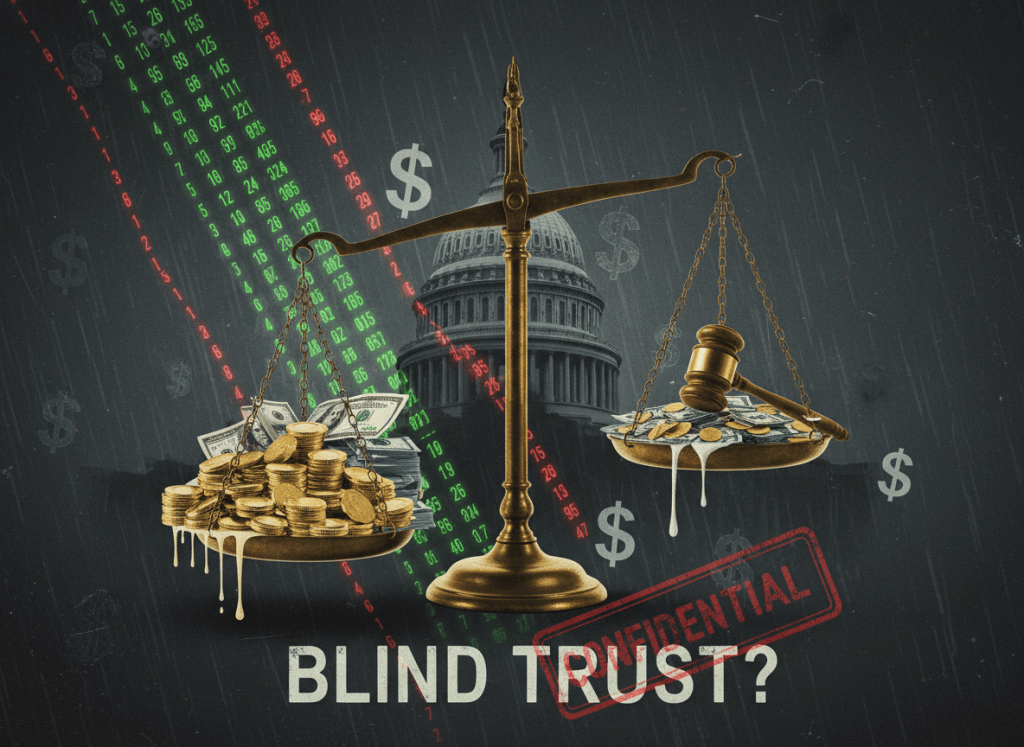
Inside the 2025 Congressional Trading Boom and the Death of Public Trust
Public Service or Private Equity?
While the American public spent 2025 white-knuckling through the “Liberation Day” tariff shocks and the fallout of the longest government shutdown in U.S. history, the inhabitants of Capitol Hill were busy perfecting a different kind of “public service.”
The 2025 Unusual Whales Congressional Trading Report has dropped, and the verdict is in: while your 401(k) was a casualty of policy-induced volatility, your representatives were rotating into safe-haven bunkers and high-alpha tech bets with the timing of a Swiss watch.
The official narrative of the “citizen legislator” is dead. In its place is a sophisticated trading machine where market outperformance is the feature, not the bug. While the plebs grapple with a 10% blanket import tax, Congress has spent the year leveraging their positions to front-run the very “One Big Beautiful Bill” they were supposed to be debating.
The 2025 Performance Scorecard: Beating the Benchmarks
In a year where the S&P 500 (SPY) delivered a +16.8% return, a elite cadre of lawmakers proved that having a seat at the legislative table is the ultimate edge.
While only 32.2% of the 311 backtested portfolios managed to beat the benchmark (a figure that suspiciously mirrors the success rate of professional hedge fund managers), the aggregate data by party reveals a clear winners’ circle.
| Group/Entity | 2025 Return (%) | Relative Alpha vs. SPY (+16.8%) |
|---|---|---|
| S&P 500 (SPY) | 16.8% | 0.0% |
| Republicans | 17.3% | +0.5% |
| Democrats | 14.4% | -2.4% |
| NANC ETF (Dem-aligned) | 20.8% | +4.0% |
| GOP ETF (Rep-aligned) | 18.8% | +2.0% |
The Super-Traders vs. The Danger of Concentration
The top of the leaderboard belongs to the “Super-Traders.” Rep. Warren Davidson secured a staggering +78.8% return by abandoning diversification for concentrated industrial bets on General Electric and GE Vernova.
He was joined by Rep. Donald Norcross, who coasted to a +70.8% gain using a minimalist two-stock strategy.
On the flip side, Rep. Chip Roy provided a masterclass in the “Danger of Concentration,” cratering -59.0% after hitching his wagon to a single energy stock, Atlas Energy Solutions (AESI).
Hedging the House: The Great Rotation to Safety
The 2025 data exposes a sharp ideological schism in how the two parties view the economy they are currently breaking.
In aggregate, members executed a massive tactical retreat, selling $169.6 million in stocks while buying only $125 million, resulting in a $44.6 million net exit from the equity market.
Where did the money go? Straight into the bunkers.
Lawmakers poured $89.5 million into fixed-income vehicles, including $57.4 million in bonds and $32.1 million in municipal securities.
The Tech Split: Even within the Technology sector—the highest volume area—the strategy was a “risk-off” surgical strike:
The Semiconductor Surge: Lawmakers aggressively acquired $17 million in hardware and semiconductor positions, with NVIDIA (NVDA) sucking up $11.2 million in inflows.
The Software Exit: High-valuation software positions saw a heavy divestment of $11.7 million.
Republicans spent the year adopting a “risk-off” posture, dominating the municipal market with 89% of all disclosed purchases. Meanwhile, Democrats maintained a “risk-on” approach through tech accumulation and aggressive options trading ($4.8 million in purchases vs. a measly $555,000 for the GOP).
USONAR: Decoding the Information Channels
To us, the aggregate numbers are just the smoke, while USONAR (Unusual Stock Occurrences: News, Alpha, and Representatives) is the fire.
This tool flags trades that are “statistically improbable,” which means the representative likely knew the news before the press release hit the wire.
Here are some of those statistical improbabilities:
The Semiconductor Architect: Rep. Michael McCaul, the “architect of semiconductor advocacy,” traded $1.1 million in NVIDIA while simultaneously steering the nation’s chip policy.
The Intel Insider: Rep. Tim Moore bought Intel multiple times just before the U.S. government announced a massive stake in the company. The result? A 100% rise and a +43.1% alpha beat on his Super Micro Computer (SMCI) position.
The Tariff Escape: Rep. Susie Lee exited Full House Resorts on March 28, weeks before the “Liberation Day” tariff package rattled the gaming industry, avoiding a -21.3% relative loss.
The Dollar General Play: Rep. Marjorie Taylor Greene snagged Dollar General just before news leaked regarding the closure of the “De Minimis” trade loophole, yielding a +10.7% alpha gain.
Committee “Heat Zones”
Nowhere is the conflict more toxic than in the committee rooms. While Sen. Sheldon Whitehouse (Judiciary/Antitrust) was busy “scrutinizing” Big Tech, he was liquidating $250,000 of his NVIDIA position. Oversight and interest haven’t just collided, they seem to have merged.
The Collapse of Disclosure: 1,200 Violations and Counting
The STOCK Act of 2012 is functionally dead. In 2025, transparency collapsed into a series of “historical dumps”—filings that disclose trades made years prior, effectively hiding market moves until they are irrelevant to the public but profitable for the member.
The Worst Violators of 2025:
Sen. Markwayne Mullin: Disclosed trades on August 13, 2025, that were executed in January 2023, for a whopping 953-day delay.
Rep. Lisa McClain: Flooded the register with 504 late transactions in a single day, some dating back over a year.
Rep. Rich McCormick: Reported 33 trades that had been hidden for 917 days .
When caught, the standard defense is the “clerical error” or the “spreadsheet glitch.” With the $200 fine being routinely waived, the penalty for hiding a multi-million dollar portfolio is less than a D.C. parking ticket.
The Crisis of Legitimacy: Corruption is a Choice
According to a 2025 study from the UCSD Rady School of Management (Alam & Rai), these trading patterns are a poison pill for democracy. The study found that trust in Congress plummets even if the politician loses money on the trade.
The toxic element isn’t the gain, it’s the perceived attempt to use public power for private profit.
To understand the disparity in American justice, look at the case of private citizen Bruce Cameron Conway (Case 3:25-cv-2101-S). For his insider trading, the SEC hit him with a total bill of $241,599.56 (consisting of a $160,936.22 civil penalty, $61,201.95 in disgorgement, and $19,461.39 in interest).
Meanwhile, a member of Congress can hide a trade for 953 days and pay $0.
Corruption in Washington isn’t a lapse in judgment, but a protected perk of the elite.
The Policy Graveyard: Where Reform Goes to Die
While 86% of the public supports a total ban on congressional trading, the ETHICS Act and the TRUST in Congress Act continue to languish in the policy graveyard.
The primary “blocker” is Speaker Mike Johnson, whose refusal to bring these bills to the floor has forced Reps. Anna Paulina Luna and Seth Magaziner into a desperate attempt to bypass his leadership.
The absurdity of the situation was best captured in November, when Rep. Bryan Steil, the Committee Chair overseeing the “Taking Stock of the STOCK Act” hearing, sat at the dais while holding a personal year-to-date return of +64%.
When the fox is the chairman of the henhouse security committee, the chickens shouldn’t expect much.
Conclusion: A Look Back and the Path Forward
As we approach the middle of the year, we look back at Nancy Pelosi, the “Queen of the LEAP” and the undisputed GOAT of the disclosure form.
Remember that time that she pivoted to supporting a trading ban, only after her wealth was secured and her seat was warm?
The 2025 report makes it clear: the STOCK Act is toothless.
And yet, the question remains:
Will Congress finally vote to ban itself from the market, or are we just waiting for the next “historical dump” of secret portfolios to tell us how much they made while we weren’t looking?
- SEC Flagged OTC Link’s Access-Control Problem in 2016. It Was Still There in 2023.
- VA Pricing Problems Spread Beyond Drugs, With 11 of 12 Medical-Supply Proposals Flagged
- The Postal Service and Its Watchdog Cannot Agree on Whether They Spoke in 2024
- The Pentagon’s Own Gas Station Is Losing Money on Every Gallon
- The $215 Million Quantum Race That Took Washington a Decade to Build

