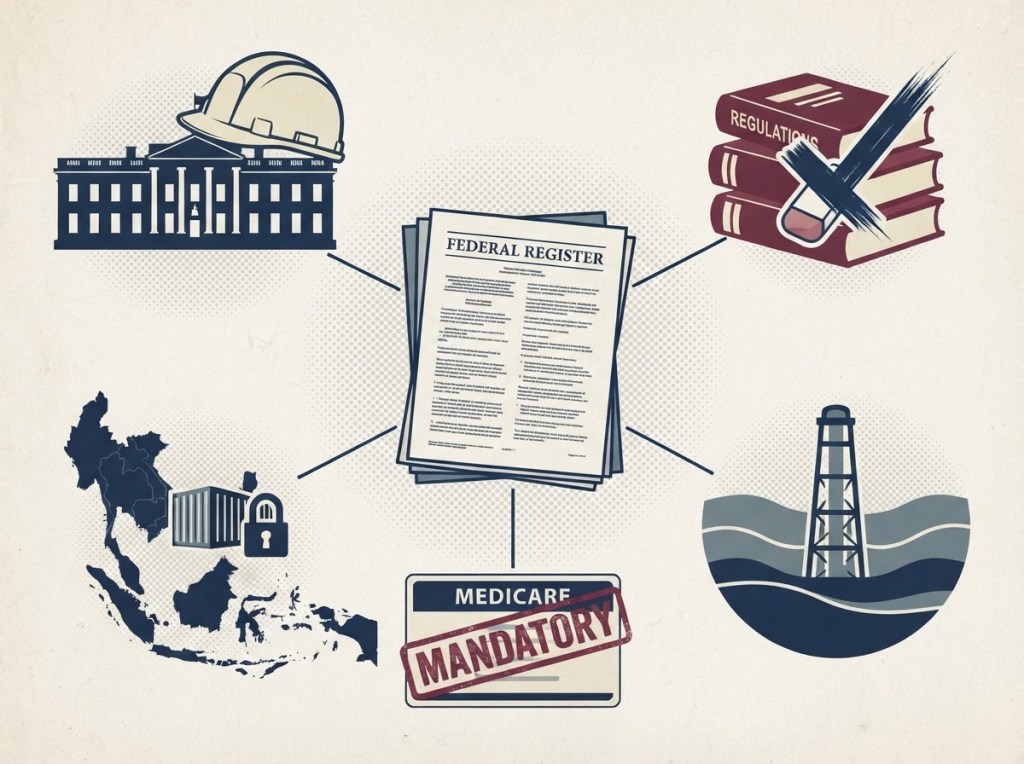
A new executive order tells federal contractors to route congressional information requests through the White House before they respond, asserting executive-privilege control over work the government has increasingly handed to private companies. Elsewhere in Wednesday’s issue, the National Credit Union Administration finalized three deregulatory rules on the same day, each framed separately as routine burden reduction; the Commerce Department added seven companies in Malaysia, Singapore, and Thailand to its export blacklist; the Nuclear Regulatory Commission opened public comment on a proposed new uranium enrichment plant in Tennessee; and the Centers for Medicare & Medicaid Services proposed requiring insurers to join a Medicare Advantage experiment that has so far been voluntary.
Executive Order 14439 does not touch the Freedom of Information Act or restrict what a contractor may eventually tell the public. Its target is narrower, and in practical terms more consequential: communications between contractors and Congress. Under the order, any company working for the federal government that receives a current or future request from a congressional committee about its executive-branch work must notify the White House and the contracting agency, and must follow instructions on withholding material the administration decides is covered by executive privilege. The requirement reaches subcontractors too, with prime contractors made responsible for ensuring compliance down the chain. An agency that finds a contractor out of line is directed to consider contract termination, cancellation, debarment, or suspension, which gives the policy real financial teeth even though the order itself creates no legally enforceable right that anyone could invoke in court.
- An executive order puts White House clearance between federal contractors and Congress. Executive Order 14439 requires companies doing federal contract work to tell the White House before complying with a congressional request for their records or communications, and to withhold information the administration judges privileged; the enforcement tools it lists include ending or barring federal contracts for noncompliance. Because so much government work is now contracted out, the order gives the executive branch a new checkpoint on information that oversight committees have traditionally been able to get directly from companies rather than through the agencies themselves. (Federal Register)
- NCUA finalizes three deregulatory credit union rules in a single issue. The agency cut audit and oversight requirements for federally insured credit unions’ supervisory committees, dropped board-composition and annual-report filing rules for corporate credit unions, and raised the asset threshold that triggers restrictions on overlapping bank-and-credit-union management to $10 billion, a figure unchanged since the threshold was set in the 1990s. Taken individually, each rule is a narrow efficiency fix; three structurally related rollbacks landing from the same regulator on the same day is the kind of clustering worth watching for coordinated agenda-clearing rather than coincidence. All three take effect December 28, 2026, with no public comment period, since each was adopted directly as a final rule.
- Commerce adds seven companies in Malaysia, Singapore, and Thailand to its export blacklist. The Bureau of Industry and Security says the firms acted against U.S. national security or foreign-policy interests. Placement on the Entity List does not freeze assets the way a sanctions listing does, but it requires a special license before any U.S.-origin technology can be exported to the companies named. Firms based in Southeast Asian hubs are a recurring target of this kind of action, typically added on suspicion of re-routing restricted chips or other dual-use electronics toward a country, often China, that U.S. export controls cannot reach directly. (Federal Register)
- NRC opens public comment on a new uranium enrichment plant in Tennessee. The commission’s draft environmental impact statement evaluates Orano Enrichment USA’s bid to build and run a gas-centrifuge enrichment facility on a 624-acre site in Roane County, near Oak Ridge, alongside the alternative of denying the license outright. A draft EIS puts an agency’s environmental analysis on the record before any licensing decision, and the comment window it opens, through January 11, 2027, is the public’s main chance to raise concerns before NRC moves toward a final decision on a plant that would add to the small handful of enrichment facilities operating in the United States, amid a broader federal push to cut reliance on Russian-enriched uranium. (Federal Register)
- CMS proposes making a Medicare Advantage pilot program mandatory. Inside a sprawling annual policy rule covering marketing rules, drug coverage, enrollment, and special-needs plans is a plan to establish a Medicare Advantage model through CMS’s Innovation Center that insurers would be required to join, rather than opting in as they have for most such pilots. Innovation Center models are usually voluntary demonstrations that insurers can decline if they dislike the terms, so converting one into a mandatory program would be a structural change in how much leverage CMS has to test payment or coverage changes on the private plans that now cover most Medicare beneficiaries. As a proposed rule, it is open for public comment before any of it could take effect. (Federal Register)
- CDC extends a quarantine rule it adopted without the usual public comment process. The agency is pushing back the expiration date of an interim final rule first issued in May 2026 that removed lawful permanent residents’ exemption from the regulations implementing CDC’s foreign-quarantine authority under the Public Health Service Act. An interim final rule is a shortcut that lets an agency put a regulation into effect immediately, on a claim of good cause, and work through the comment-and-response process afterward, if at all; extending one rather than converting it to an ordinary final rule leaves the underlying policy in a kind of regulatory holding pattern, in effect indefinitely, without the public record a standard rulemaking would have required up front. (Federal Register)
This edition is drawn from the 72 documents the Federal Register published on November 25, 2026. Beyond the six items above, we screened out and did not cover routine agency information-collection and Paperwork Reduction Act notices, antidumping and countervailing-duty determinations, SEC self-regulatory-organization rule-change filings, routine airworthiness directives and safety-zone rules, routine advisory-committee and Sunshine Act meeting notices, and an OFAC sanctions notice whose public text did not name the designees.

