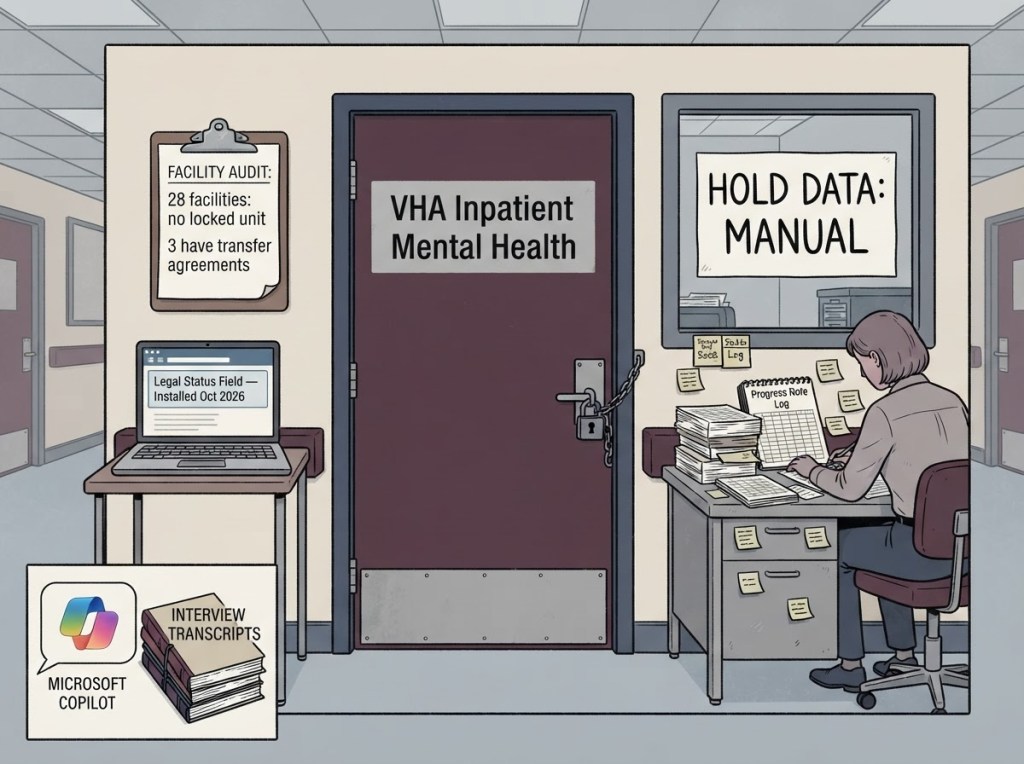
The Veterans Health Administration had no enterprise-wide way to track patients on involuntary mental health holds. A VA OIG national review found most facilities weren’t tracking them at all — and those that did relied on spreadsheets.
The Veterans Health Administration has no enterprise-wide way to identify patients on involuntary mental health holds. That is among the findings of a national review the VA Office of Inspector General released on November 12.
VHA’s National Director of Inpatient Mental Health Services said so directly to the OIG. A hold, by the report’s own description, confines a patient against their will.
Only 48 of the 133 facilities asked said they track hold data at all. That is 36 percent.
The ones that do tend to rely on staff entering information into spreadsheets and logs. Methods varied from facility to facility, drawn from progress notes, orders, admission records and scanned files.
A Count Nobody Was Keeping
The Senate Veterans’ Affairs Committee noticed first. VHA told the OIG that the committee flagged inconsistent data collection on involuntary admissions and asked the Office of Mental Health to improve it.
VHA’s answer is a legal status field in the electronic health record. Programming went out to facilities on June 2, 2026, with installation expected by July 1, and as of August 14 six facilities were still working on it.
VA now says every inpatient mental health unit admitting patients had implemented the required order as of October 5. A dashboard launched October 1.
One caution, flagged as an inference. The report describes the field as a point-in-time metric for patients on locked inpatient units. It does not say whether holds that end in an emergency department, or in a transfer to a community hospital, are counted, and that silence is the reason for the caution.
The fix also landed after the review’s March 2026 end date. The OIG closed the related recommendations because VA completed its actions before publication.
Today the agency has a field, a dashboard and a promise. A reliable count of how many veterans were held before October is another matter.
The Agreements That Exist Mostly in Directives
Twenty-eight of VHA’s 139 facilities have no locked mental health acute inpatient unit. When a patient there needs involuntary admission, someone has to arrange a transfer.
VHA Directive 1160.01, issued in April 2023, requires those facilities to hold agreements with outside agencies or hospitals for exactly that purpose. Three of the 28 reported having one.
Twenty-two of the 28 initiate holds themselves. The rest, the report says, described steps they take through community resources, without the formal agreement the directive requires.
VA’s remedy is a memorandum telling facilities to create the agreements, with regional mental health leads attesting that they did. The target date is April 2027.
Local policy fares better, in the sense that most facilities have some. Twenty facilities, 14 percent, acknowledged having none.
Of the documents the other 119 submitted, about 20 percent were incomplete, unsigned, or both. VHA does not specify what such guidance must contain, and it does not provide for oversight of compliance with it.
Only 43 of 126 respondents said they consulted VA’s Office of General Counsel, which the directive recommends but does not require. Ninety-five percent of facilities with a policy said it aligned with state law.
The OIG did not check.
Closed Is Not the Same as Fixed
On July 30, 2025, VA’s Chief Medical Officer ordered every facility to name a point of contact and an alternate for involuntary commitment, due August 11. When the OIG checked as of April 14, 2026, 79 facilities, or 57 percent, had both. Fifteen had neither.
VA’s response says every legacy regional mental health officer attested that facilities finished the task by September 5, 2025. The OIG closed the recommendation because leaders completed improvement actions before publication.
The report does not explain how an April count with 15 facilities missing both names became a finished task by October. This is an inference, resting on the report’s April figures and the dates in VA’s response, and it may have an ordinary explanation. It is still the gap a reader would want filled.
The recommendations that stayed open are written in the conditional. The OIG asked the Under Secretary for Health to determine whether guidelines should be required to cover holds, to consider requiring District Counsel consultation, and to consider whether hold-specific training should be required.
VA concurred with each. Its responses promise a memorandum, an evaluation of feasibility, and consideration of an assessment of local training needs.
Training is the sharpest example. VHA Directive 1160.06(1) requires inpatient mental health staff to be trained on relevant regulations, but not on hold procedures, and it requires nothing of the emergency department and outpatient staff who often start the process.
Facilities that do train reported covering local policy 73 percent of the time and state law 74 percent. City and county law came in at 61 percent.
The review looked at administrative infrastructure, not patient outcomes, and its data is self-reported and point-in-time. Four earlier OIG reports prompted it, including one finding the incorrect use of Florida’s Baker Act at Gainesville. As of October 19, two hold-related recommendations from the Martinsburg inspection were still open.
The Watchdog Has a Chatbot
Page five of the report discloses that the inspection team used standardized prompts in Microsoft Copilot Chat to review inspection data, including interview transcripts, documents, questionnaire responses and physical observations. The team says it verified the output, edited the report and took responsibility for the content.
It adds, citing OMB Memorandum M-25-21, that the use is not high-impact.
Nextgov reported in September that the same disclosure has appeared in OIG healthcare reports since March 2026. Former Inspector General Michael Missal told the outlet that investigators began using the tool in 2024. The OIG says data entered into it does not leave its secure environment and that people review the output.
The sources do not say which earlier reports were prepared with it.
Nothing in this report suggests patient records were fed to the tool. The review was a facility questionnaire about policies and staffing, and the OIG says it did not examine patient-level outcomes.
The privacy question sits elsewhere in the same building. In June, the OIG reported that VA provides VA GPT and Copilot Chat for work that may involve patient information. Of 135 prompts shared among VHA staff, 79 were clinical, mostly for clinical notes and summaries.
VA had not designated either tool high-impact. Leaders compared them to search engines. VA did give that designation to its Ambient AI Scribe, a documentation tool with similar functions.
The OIG is not alone in its choice of software. The 2025 federal AI inventory lists 102 use cases running some version of Copilot, and the Defense Department sits outside the public inventory.
HIPAA has no AI-specific rule. The existing ones apply: minimum necessary use, business associate agreements with vendors that handle protected health information, and security safeguards. A compliance firm’s summary of remarks by HHS Office for Civil Rights Director Paula Stannard says organizations should not begin using such a tool before an agreement is in place.
VHA’s Notice of Privacy Practices, effective September 30, 2025, does mention AI. It lists AI that supports diagnostics and clinical decision-making under treatment, and software development, including AI, under operations.
It does not mention chat tools used to draft or summarize notes. It does not mention a commercial vendor.
Whether VA is within the law turns on facts the public record does not supply. Does Copilot Chat run inside VA’s own authorized environment? Does a business associate agreement cover it? What are the retention and logging terms for prompts containing patient information? No public document found in this reporting answers any of them.
The same system that spent until 2026 building a field for legal status had, by the OIG’s count, already assembled a library of 135 shared prompts for its chat tools.
A veteran on an involuntary hold does not choose the unit, the clinicians or the paperwork. Nothing in the public record says hold records are going into a chatbot. Nothing in the public record says they are not.


