Charging documents show far less money actually paid, a case announced for the fourth time, and warning signs that stretched back years.
On Oct. 22, the Justice Department announced charges against 15 defendants in Los Angeles. Six were described as medical professionals.
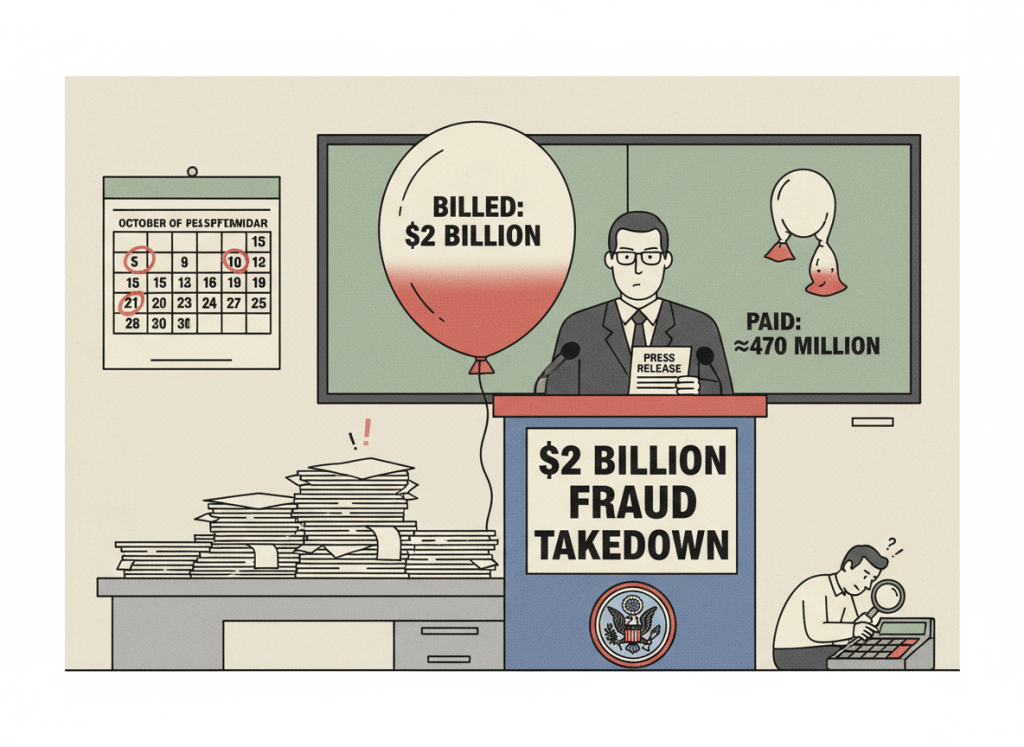
The headline put the loss at “nearly $2 billion.” The body described fraudulent claims billed, which is not the same thing.
The court filings show how big that gap is.
Billed is not paid
The largest case targets a father and son accused of running a sham addiction-treatment network. DOJ says it billed private insurers more than $1.6 billion.
A criminal complaint puts the claims at $1,619,276,243 and the payments at $210,274,793, from about May 2020 to at least May 2026. The release never mentions the paid figure.
The pattern repeats. A surgeon and a chiropractor are accused of billing Medicare $134.96 million for unnecessary artery procedures. The indictment says Medicare paid at least $54.8 million.
A Medi-Cal pharmacy scheme billed about $269 million and was paid about $178.7 million.
Where paid amounts are stated, they total roughly $470 million. The billed amount in those same cases is about $2 billion.
Who paid
The complaint lists Anthem, Aetna, Cigna and UnitedHealthcare as payers. The plans included employer, individual and Affordable Care Act coverage.
The complaint notes that ACA plans carry taxpayer-funded premium tax credits. It alleges patients were enrolled using false residency, income and tribal-status claims.
It does not say how much of the $210 million came from ACA plans.
A case announced again
The pharmacy scheme is not new. Prosecutors charged the pharmacist in the 2024 national takedown, citing $306.5 million billed and $204 million paid. They charged an alleged marketer in 2025, and another defendant in the June 2026 takedown.
The marketer was sentenced to 30 years on Sept. 9 and ordered to pay $178.7 million in restitution. The pharmacist pleaded guilty in August 2024 and was still awaiting sentencing last month.
Now the same scheme counts toward the October total.
Four of the 15 defendants were charged by information, often a sign of a negotiated plea. One of them, Nicholas Moore, has already pleaded guilty. His admitted $199 million sits inside the Youngs’ $1.6 billion.
Who was arrested when
The Youngs’ complaint was filed Oct. 14. Their lawyers say David Young was taken into custody Oct. 13, a day earlier.
DOJ’s release says eight people were arrested “today,” Oct. 22. The main release puts six of those arrests in Los Angeles. The U.S. Attorney’s version says five, with two in Texas and one in Illinois. The Illinois defendant is not named.
Warning signs, years earlier
The filings suggest these cases did not appear overnight.
In the rehab case, the complaint says the Youngs received repeated warnings, including from the state, that patients were enrolled in fraudulent policies. In May 2022, after a state inspection visit, David Young allegedly sent staff paperwork to show inspectors.
In December 2023, an employee emailed him about a Texas resident enrolled in an Oklahoma policy. Billing for that patient allegedly continued until May 2024.
In November 2024, Cigna sent an audit finding. As late as March 2026, Nathan Young allegedly signed papers moving about 13 facilities to a nonprofit.
Aetna sued in November 2023. Its January 2025 court filing said California had “finally” suspended some facilities’ licenses. It listed Rodeo Recovery’s license as revoked Jan. 3, 2025, according to DHCS.
That case later settled. The criminal complaint alleges billing through May 2026.
In the artery case, prosecutors allege the scheme ran from January 2016 to August 2023. ProPublica’s December 2023 analysis ranked surgeon Harold Tabaie second nationally in Medicare atherectomy reimbursement for 2017 to 2021. His total was $24.8 million, behind only a Beverly Hills radiologist.
Tabaie did not respond to ProPublica’s questions. The indictment arrived in October 2026.
DOJ credits “data analytics” for finding him. The defendants allegedly billed under other doctors’ names to dodge exactly that kind of scrutiny.
The pharmacy case may be the starkest. California’s Medicaid agency waived prior authorization for most drugs, retroactive to Jan. 1, 2022, during a pharmacy-system transition. In June 2022 it announced it would begin restoring those checks starting in July.
The alleged scheme ran from May 2022 to April 2023, roughly nine months after reinstatement began. Federal officials have since pointed to California’s “weak systems.”
Hospice fraud follows the same arc. A 2022 state audit flagged LA County. California has had its own moratorium on new hospice licenses since January 2022.
CMS used its enrollment-moratorium authority for hospices for the first time in May 2026. The release gives no dates for the three hospice schemes it describes.
A rebrand, not a new force
DOJ describes the National Fraud Enforcement Division, created April 7, as a new era. It was built largely by moving more than 130 existing career prosecutors. The trial attorney on the pharmacy case has handled it since 2024.
What remains unanswered
Inquiries are being directed to the Justice Department, CMS and California’s Department of Health Care Services. Three questions top the list:
- When did CMS first flag the surgeon’s billing, and when did payments stop?
- When did California first see the pharmacy’s billing, and why was $178.7 million paid after reinstatement began?
- How much of the Youngs’ $210 million came from taxpayer-subsidized ACA plans?
An indictment is an allegation. All defendants are presumed innocent until proven guilty.

