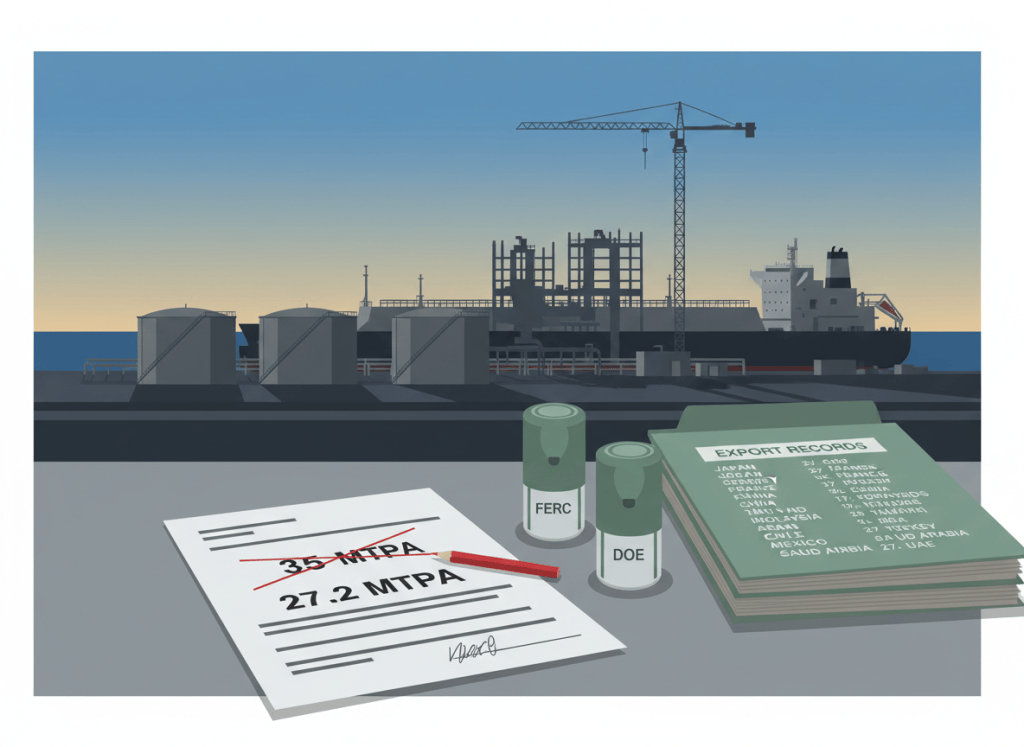
A liquefied natural gas terminal in Louisiana is asking federal regulators for permission to export substantially more natural gas without constructing additional liquefaction facilities. Venture Global says it can get more production out of the equipment it already has. Federal regulators must determine whether the proposed increase satisfies applicable authorization requirements.
Venture Global Plaquemines LNG, LLC, wants to increase its terminal’s authorized peak liquefaction capacity from 27.2 million metric tons per annum (MTPA) to 35 MTPA, an increase of approximately 28.7 percent. The company maintains that the additional capacity can be achieved through operational optimization rather than new construction or material modifications.
The proposal raises a regulatory question: How should federal agencies evaluate a substantial increase in a facility’s authorized output when the company says the physical equipment does not need to change? That question sits squarely within the same regulatory framework that PHMSA is currently proposing to overhaul — the agency’s October 2026 proposed rule would update decades-old LNG safety standards that Congress directed it to modernize years ago.
According to a March 2026 application filed with the Department of Energy, Venture Global attributes the higher capacity estimate to experience gained during construction and commissioning. The company says those experiences allowed it to refine operating assumptions and identify greater potential production under optimal conditions.
That explanation may be technically sound. Whether the associated environmental and operational assumptions remain appropriate is a separate question.
A 467-Billion-Cubic-Foot Question
The proposed increase would raise Plaquemines’ authorized annual export volume to approximately 1,873 billion cubic feet (Bcf) of natural gas, compared with its existing 1,405.33 Bcf authorization for countries without qualifying free trade agreements. The additional 467.67 Bcf represents a roughly one-third increase in non-FTA export authority.
DOE has already granted a corresponding increase for exports to qualifying free trade agreement countries. In July, the department issued Order 3866-C, approving the additional FTA volume. The non-FTA portion requires a separate public-interest determination under Section 3(a) of the Natural Gas Act.
In its October 1, 2026 semiannual progress report, Venture Global confirmed that DOE had not yet acted on the additional non-FTA request. DOE’s October 23 authorization listing identifies earlier approvals but does not establish that the subsequent non-FTA increase has been granted.
That leaves a significant portion of the proposed export increase awaiting a verified federal disposition.
The Terminal Is Still Being Commissioned
Venture Global began producing LNG at Plaquemines in December 2024 and exported its first commissioning cargo on December 26 of that year. The terminal has since shipped substantial volumes of LNG while completing construction and commissioning activities.
The company’s October progress report stated that the project had not yet achieved substantial completion and commissioning of all facilities. On November 1, Venture Global announced that Phase 1 had entered commercial operations on October 31. The first post-commercial-operations cargo departed November 1 and was lifted by Shell under a long-term sales agreement. Phase 2 was still expected to enter commercial operations in mid-2027.
FERC previously extended the deadline for placing all existing project facilities into service to December 31, 2027. Meanwhile, Venture Global is pursuing its additional capacity request in FERC Docket CP26-53-000.
The company is therefore seeking approval for a higher maximum output while portions of the original project remain in commissioning. That overlap is not inherently improper, but it makes the supporting engineering evidence particularly important. Actual operating experience may help validate the revised capacity estimates. Regulators must distinguish sustainable annual production from peak output achievable only under favorable conditions.
What Happens to the Environmental Calculations?
Venture Global says the proposed increase requires neither new facilities nor material changes to existing equipment. But additional production does not necessarily mean unchanged environmental impacts.
A terminal operating at higher annual throughput could consume more fuel, generate additional emissions, require greater supporting resources, or accommodate more LNG vessel movements, even if its physical configuration remains unchanged. Whether those effects occur at Plaquemines, and whether they are already covered by existing approvals, depends on the technical and environmental record.
FERC previously approved an increase from the terminal’s original 24 MTPA authorization to 27.2 MTPA. The latest request would raise the authorized peak capacity to 35 MTPA, approximately 45.8 percent above the original figure.
The company’s position is that refined operational assumptions explain the difference. The corresponding question for regulators is whether the environmental analysis supporting the facility’s earlier approvals remains sufficient at the higher production level.
DOE’s March 27 Federal Register notice acknowledges its responsibility to satisfy applicable environmental review requirements before reaching a final decision on the non-FTA application.
The public DOE docket also contains objections to the proposed increase, including a May 2026 submission from Our Children’s Trust challenging the environmental and legal basis for additional LNG export authority. Those objections represent the organization’s position, not findings of regulatory misconduct.
The Export Records Offer Another Perspective
DOE’s August 2026 natural gas trade statistics show that Plaquemines exported approximately 861.4 Bcf during the first eight months of the year, nearly double its volume during the corresponding period in 2025. That growth is part of a broader national surge: U.S. net natural gas exports jumped 29 percent in the first seven months of 2026, with Plaquemines accounting for more than any other terminal on a year-over-year basis.
An examination by Bureaucracy Times of DOE’s detailed export workbook identified 248 Plaquemines export records from January through August, totaling approximately 861.35 Bcf. The records identify Venture Global Plaquemines LNG, LLC, as the authorization holder and report shipments to 27 destination countries.
DOE’s monthly summary also classifies approximately 53 percent of the terminal’s year-to-date export volume as spot activity. That does not conflict with the workbook’s designation of shipments under long-term export authority. DOE permits shorter-term transactions under qualifying long-term authorizations. Nevertheless, the public workbook does not independently identify which individual shipments account for the reported spot percentage.
The distinction illustrates how public export statistics can establish shipment volumes without fully revealing the underlying commercial arrangements.
Three Requests for Answers
On October 29, Bureaucracy Times submitted separate media inquiries to FERC, DOE, and Venture Global.
FERC was asked to identify the engineering evidence supporting the 35 MTPA proposal, explain the applicable environmental review, and clarify whether actual commissioning data informed its assessment. DOE was asked about the outstanding non-FTA authorization, the public-interest and environmental analyses supporting its review, and the reporting procedures used to classify and verify LNG shipments.
Venture Global was asked to explain its revised production assumptions, projected operational and environmental effects, and commercial-operation schedule. The three recipients were offered until November 4, 2026, at 5 p.m. Eastern to respond. On November 2, Ashley Ingebrigtsen, Strategic Advisor in FERC’s Office of External Affairs, replied that the Commission could not comment on the merits of pending cases and directed Bureaucracy Times to its public docket and eSubscription resources. The reply did not substantively address the engineering or environmental questions. As of November 5, substantive responses from DOE and Venture Global have not been confirmed.
The available records do not establish that either federal agency has failed to perform a required review or that Venture Global has violated its existing authorizations.
They do establish that the company is seeking permission to substantially increase the amount of LNG it can export from an existing facility while that facility is still completing commissioning.
Whether the proposed increase reflects demonstrated production capability, optimistic operating assumptions, or some combination of both is a question the regulatory record should answer. For a project seeking authority to export hundreds of billions of additional cubic feet of natural gas annually, that seems a reasonable amount of paperwork to expect.

