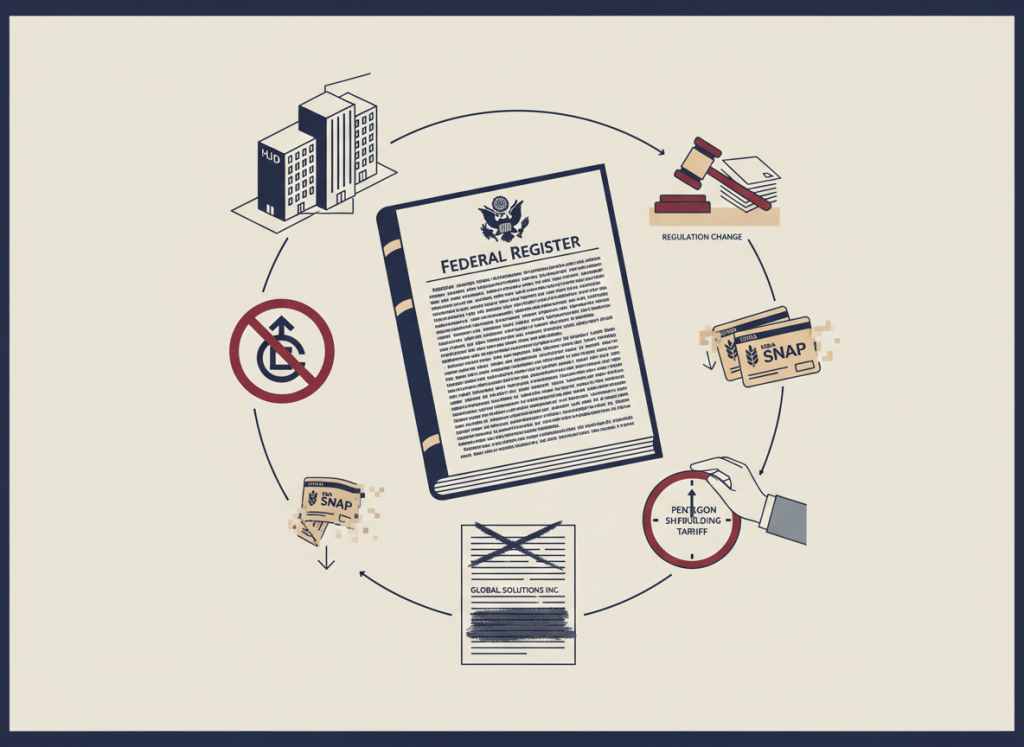
The Department of Housing and Urban Development used today’s Federal Register to disclose that it intends to reorganize its headquarters and field office structure, folding together what it describes as overlapping functions and consolidating administrative work, even while insisting the move will close no offices and relocate no staff. That notice anchors a day that also saw the Treasury Department’s financial-crimes unit move to choke off a major cryptocurrency exchange’s access to the U.S. financial system, and the Agriculture Department advance two separate rules narrowing who qualifies for food assistance.
- HUD discloses plans to reorganize its headquarters and field operations. The department says it wants to remove duplicated functions between Washington and its field offices and make work processes more flexible, using its existing budget and staff rather than new appropriations. Because this is a notice rather than a proposed rule, there is no public comment period attached, which means the public learns about the restructuring only after HUD has already decided to pursue it. The notice is light on specifics about which offices or positions are actually affected, leaving the practical scope of the change largely to be seen. Read the notice.
- CMS proposes to strip back a broad set of Medicare and Medicaid requirements. The Centers for Medicare & Medicaid Services wants to eliminate or loosen regulations it considers outdated or overly burdensome for hospitals, physicians, and other providers, arguing the changes will free up clinical time currently spent on paperwork. Comments are due January 11, 2027, a comment window of roughly 60 days that is standard for a rule of this scope and gives hospital associations, patient advocates, and state Medicaid agencies a real chance to flag unintended consequences before CMS writes a final rule. Read the proposed rule.
- FinCEN moves to cut the crypto exchange MEXC Global off from the U.S. financial system. Treasury’s Financial Crimes Enforcement Network issued an order under the Combating Russian Money Laundering Act finding MEXC Global, along with its subsidiaries and successor entities, to be a financial institution of primary money-laundering concern tied to Russian illicit finance, and prohibiting U.S. financial institutions from transmitting funds involving it. The order takes effect December 10, 2026. This type of special-measure order is rare, issued only a handful of times a year, and functions as a near-total financial blockade of the named entity rather than a fine or a warning. Read the order.
- USDA advances two rules narrowing SNAP eligibility and work requirements on the same day. One proposal would tighten the work requirements able-bodied adults must meet to keep food-assistance benefits beyond three months, implementing changes from this year’s budget law by narrowing the exceptions and making it harder for states to win waivers from the requirement; it also redefines who counts as homeless for SNAP purposes. A second, separate proposal would narrow “categorical eligibility,” the rule that currently lets a household automatically qualify for SNAP if it receives any TANF-funded benefit or service, restricting that automatic qualification to households actually receiving TANF cash assistance. Both carry a comment deadline of December 10, 2026, just 30 days out, half the roughly 60-day window CMS gave above for its rule, and that compressed timeline leaves state agencies and advocacy groups less time to analyze the changes and respond before they can be finalized. Read the work-requirements proposal and the categorical-eligibility proposal.
- The Pentagon quietly removes a company from its list of Chinese military companies. The Deputy Secretary of War (the renamed role atop the Defense Department) ordered one entity struck from the so-called 1260H list, which flags companies believed to operate in the U.S. on behalf of China’s military. The notice does not name the company or explain why it no longer qualifies, though it does preserve the Pentagon’s ability to relist the same entity later on other grounds. Entities are added to this list far more often than they are removed, so a removal with no public explanation is worth watching for what happens next. Read the notice.
- USTR extends a suspended tariff action against China over shipbuilding, again. The U.S. Trade Representative pushed back by two months the effective date of tariff action stemming from a Section 301 investigation into China’s dominance of the maritime, logistics, and shipbuilding sectors, to keep talks with Beijing going instead of letting the tariffs take hold. Oddly, the notice itself is internally inconsistent about exactly when the new suspension runs out, with one part of the filing citing 11:59 p.m. Eastern on January 9, 2027 and another part citing January 10; a discrepancy that small is usually harmless, but it is the kind of drafting error that becomes a real problem if the suspension’s exact end date is ever litigated. Read the notice.
Editorial note: We screened all 108 documents published in the November 10, 2026 Federal Register before selecting the six above. Excluded as routine: dozens of antidumping and countervailing-duty filings on products including polytetramethylene ether glycol and tin mill products; a cluster of National Cooperative Research and Production Act notices covering industry research consortia from the Bytecode Alliance to the Rust Foundation; SEC self-regulatory-organization rule-change filings from exchanges including Cboe BYX, BOX, IEX, and the Texas Stock Exchange; routine FAA airworthiness directives for Airbus, Bombardier, and Leonardo aircraft; Sunshine Act meeting notices and NIH advisory-committee meeting notices; FERC combined notices of filings; and standard agency information-collection and OMB-review notices.

