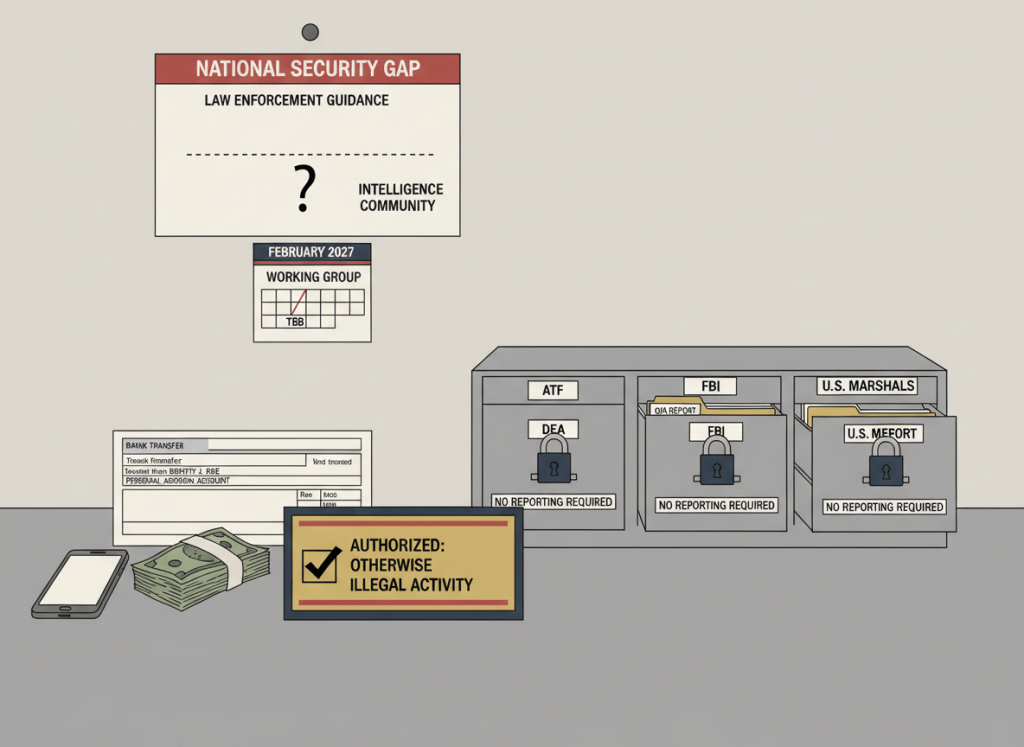
The Justice Department’s inspector general has finished auditing how four federal agencies manage confidential informants, and the headline is soothing. Audit 27-003, published in October 2026, found that the policies of ATF, DEA, the FBI and the U.S. Marshals Service substantially comply with Attorney General guidance.
Keep reading. The same report concedes that the guidance itself has holes in the three places informants are most dangerous: authorized crime, national security cases and money.
A Clean Bill of Health, Printed on Paper
The audit examined documents. OIG reviewed policies, forms, training materials and information systems, and interviewed headquarters officials. It did not test whether agents follow any of it in the field.
That distinction matters. ATF’s written response says that in practice it is fully compliant with the Attorney General’s guidelines and simply failed to put that practice into policy. That is an agency claim, and this audit did not test it.
There is reason for caution. OIG’s earlier audit of ATF, described in congressional testimony, found the agency had not properly implemented practices that matched its written policy. ATF also could not fully reconcile some informant payment records.
Paper compliance is a start. It is not the same thing as compliance.
The Crimes Nobody Adds Up
Informants can be authorized to commit crimes. The jargon is otherwise illegal activity, or OIA, and OIG calls it an extremely powerful tool that demands careful oversight because it can harm people and property.
The FBI must report all of its OIA data to the Department every year. ATF, DEA and the Marshals Service are under no such requirement.
OIG’s conclusion is plain. Without that reporting, the Department lacks consistent and complete oversight of OIA across its law enforcement components.
Those three components are the ones that chase firearms, narcotics and fugitives. Their policies do not fully require weighing the risk of informants handling dangerous commodities such as guns. ATF and Marshals Service policies also do not require written instructions to informants before OIA in all required cases.
OIG warns that the result can be the government actively contributing to criminal enterprises.
Inference: the Department cannot currently say, in aggregate, how often ATF, DEA and Marshals Service informants are authorized to break the law. This rests on OIG’s finding that those components do not report OIA data to the Department, and on the fact that the report publishes no authorization count for any component.
A War Declared, Guidance Not Included
Two executive orders changed the vocabulary of drug enforcement. Executive Order 14157 designated cartels as foreign terrorist organizations. Executive Order 14367, signed December 15, 2025, designated illicit fentanyl and its core precursor chemicals as weapons of mass destruction.
OIG says the orders move narcotics trafficking from a traditional law enforcement setting into a national security one. The Attorney General’s informant guidelines do not apply to foreign intelligence or counterintelligence investigations.
The consequence, per OIG, is stark. ATF, DEA and the Marshals Service have no guidance governing their use of informants in matters covered by the orders.
ATF and DEA personnel told OIG they still use the same strategies as before. OIG says it remains concerned that the guidelines may lack safeguards to protect informants and to share and preserve information within the Intelligence Community. The Deputy Attorney General’s office has commissioned a review of the information-sharing implications.
Inference: one of two things is true. If nothing changed in practice, the national security framing carried little operational weight, which is what one former national security attorney argued after the fentanyl order was signed. If something did change, informants are working in a gap. The audit rests on agency statements and does not resolve which.
The Money Still Has Nowhere Tidy to Go
Informant payments were historically cash. The Attorney General’s informant guidelines do not contemplate electronic payments at all, and the FBI’s guidelines permit them only in extraordinary circumstances, with no added controls.
Components use electronic payments anyway. FBI personnel told OIG that cryptocurrency might be an effective way to pay informants, and the Department has not said what level of risk it will accept.
The Marshals Service has the most concrete problem. Its payments go directly into Deputy U.S. Marshals’ bank accounts, and the deputies withdraw the cash and hand it to informants.
OIG found that this increases operational security risks and does not adequately safeguard against fraud. The guidelines call for advance management approval, two government witnesses, a receipt from the informant and reconciliation. The Marshals Service says it is finalizing a new system with a “Global Financial Wire Transfer Company” and will document controls after approval and implementation. It gives no date.
Then there is the category that keeps coming back. DEA and the Marshals Service pay sources of information who are not classified as informants, so the full guidelines do not apply to them.
OIG’s 2016 audit of DEA found 477 “Limited Use” sources received an estimated $26.8 million, making them some of the agency’s highest paid. That audit counted more than 18,000 active sources and $237 million in payments over its review period.
A decade later, the category still sits outside the full guidelines. DEA’s response says it has considered OIG’s concerns about applying the guidelines to Limited Use sources and will update its policies and risk assessment forms for Criminal Division review. It does not commit to bringing those sources under the guidelines. OIG leaves that decision to the Deputy Attorney General’s office.
What Comes Next
Every component concurred. The Deputy Attorney General’s office says Acting Deputy Attorney General Trent McCotter will convene a working group within 120 days of its October 23 response, which points to late February 2027.
A working group is not a rule, and no deadline is set for updated guidance. ATF targets fiscal 2027 and the FBI early 2027. DEA and the Marshals Service gave no completion dates.
Inquiries were directed to the Department of Justice, DEA, ATF and the Marshals Service. DEA’s media office replied by telling Bureaucracy Times to file a FOIA request, and did not answer the questions. Among the questions still unanswered:
- How many OIA authorizations have ATF, DEA and the Marshals Service approved in the past fiscal year?
- What guidance governs their informants in cartel and fentanyl matters now treated as national security?
- Will the working group bring DEA and Marshals Service Limited Use sources under the full guidelines?

