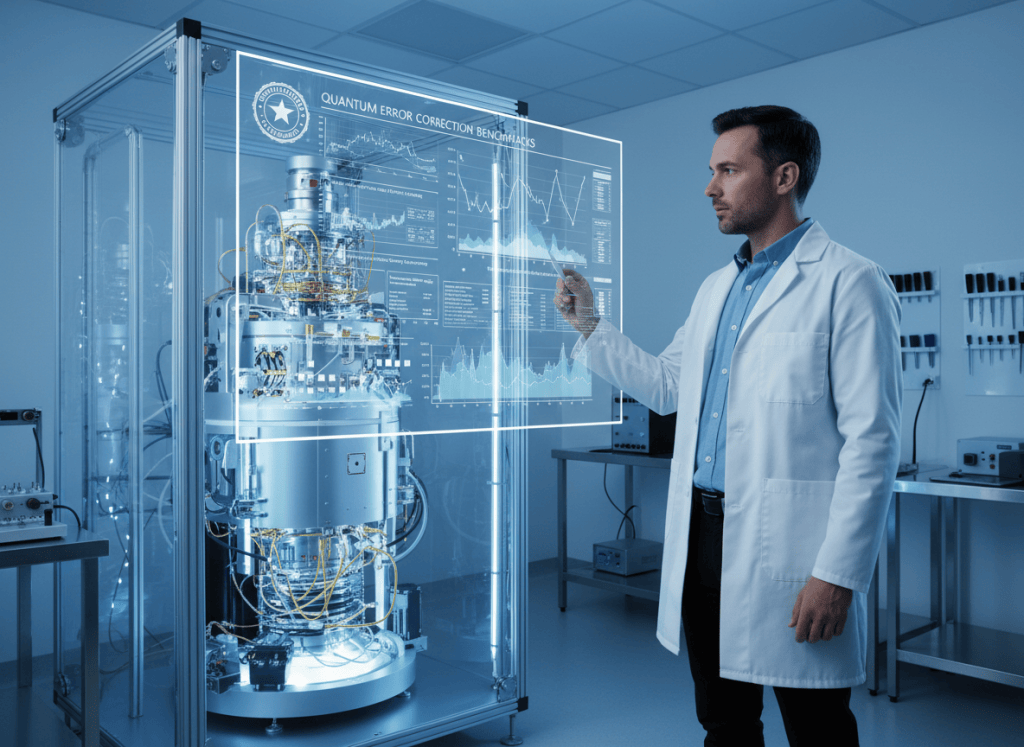
The Quantum Genesis Files, Part Four
Washington has spent years funding quantum computers, testing them and listening to companies explain what their machines can do. Now DOE is building an apparatus to decide when one of them has actually delivered.
Building a fault-tolerant quantum computer is difficult.
Determining that someone has built one may prove surprisingly complicated too.
That problem sits quietly underneath the Department of Energy’s new Quantum Genesis Q Competition.
DOE wants private companies to demonstrate quantum computers with at least 100 logical qubits, hundreds of millions of fault-tolerant operations and scientific applications worthy of the Department’s research mission.
Reach those milestones and substantial federal money becomes available.
But first somebody has to verify the milestones.
That means determining whether logical qubits are really behaving logically, whether error rates are low enough, whether operations can be repeated reliably and whether a supposedly useful scientific computation actually represents something conventional computers cannot reasonably accomplish.
DOE has decided not to leave those judgments entirely to the companies building the machines.
The Department is building referees.
The $45 Million Referee
When DOE announced the Quantum Genesis Q Competition on September 17, the $215 million competition naturally received most of the attention.
Sitting beside it was another announcement.
DOE plans to spend up to $45 million establishing a Quantum High-Performance Computing Validation and Verification Testbed through its National Laboratories.
Fourteen million dollars is available from fiscal year 2026 funding. The remaining planned funding depends upon future congressional appropriations.
Its assignment is remarkably broad.
DOE says the testbed must be capable of characterizing and validating the entire quantum-computing stack.
That includes physical hardware.
Quantum gates.
Logical architectures.
Algorithms and applications.
Classical control systems.
The testbed will support the Q Competition, meaning companies seeking milestone payments will face something more substantial than a review of specifications supplied by their own engineers.
DOE wants independent evidence.
The Department is effectively spending money to answer a question that has followed quantum computing almost from its beginning.
What exactly should count as success?
Qubits Make Terrible Scoreboards
Traditional computers are comparatively easy to describe.
Processor speeds, memory, storage and standardized benchmark tests can provide imperfect but reasonably understandable comparisons.
Quantum computers are another matter.
Two machines can contain similar numbers of physical qubits while having dramatically different capabilities.
One architecture may produce excellent individual gate fidelity while struggling with connectivity.
Another may possess more qubits but suffer from errors that limit useful circuit depth.
A machine may perform impressively on one specialized benchmark and considerably less impressively on another.
Even the same quantum processor can produce different results depending upon calibration, software, circuit compilation and the expertise of the person operating it.
That makes simple qubit counts a particularly poor substitute for useful performance.
The federal government has known this for years.
And some of its laboratories have been trying to solve the measurement problem long before Quantum Genesis existed.
Sandia Has Been Building Yardsticks
At Sandia National Laboratories, the Quantum Performance Laboratory has made quantum-computer assessment its business.
The laboratory develops methods for measuring how quantum hardware actually performs.
Its researchers study failure mechanisms, devise performance metrics, build predictive models and create protocols for testing experimental processors.
They also develop and maintain pyGSTi, an open-source software package used to characterize quantum processors.
Most importantly for Quantum Genesis, Sandia says the laboratory provides quantum-hardware assessment capabilities directly to DOE and the federal government.
That makes Sandia’s work particularly relevant to the new competition.
The Quantum Performance Laboratory has been publishing research on subjects such as randomized benchmarking, gate-set tomography, application-oriented benchmarks and fault-tolerance thresholds for years.
Those terms may sound painfully specialized.
Their purpose is relatively straightforward.
A manufacturer can say a quantum processor performs at a certain level.
Someone else needs a scientifically defensible way to check.
Sandia has spent years developing the ruler.
Oak Ridge Tried Measuring the Machines
Oak Ridge National Laboratory approached the problem from another direction.
Its Quantum Computing User Program has provided researchers access to commercial quantum computers from multiple companies.
That arrangement allowed scientists to do something especially useful.
They could compare machines.
In 2023, Oak Ridge researchers reported what the laboratory described as the first independent comparison of leading quantum computers.
The team examined 24 quantum processors.
They then compared their results against performance figures promoted by vendors including IBM, Rigetti and Quantinuum.
The exercise demonstrated precisely why verification matters.
Most machines performed reasonably close to the vendors’ reported capabilities.
But researchers had difficulty reproducing the highest advertised performance figures consistently.
That did not mean the vendors were lying.
Oak Ridge’s researchers explicitly cautioned against that conclusion.
Manufacturers know their machines extraordinarily well and can optimize their hardware in ways ordinary users may not reproduce.
That distinction may sound minor.
For Quantum Genesis, it is enormous.
DOE is not paying for the performance a manufacturer’s best engineers can coax from a carefully optimized demonstration.
It is trying to determine whether a machine represents a scientifically useful computing capability.
Those are not necessarily the same standard.
DARPA Is Asking an Even Harder Question
The Defense Advanced Research Projects Agency has developed its own verification system.
DARPA’s Quantum Benchmarking Initiative is trying to determine whether any current quantum-computing approach can reach what the agency calls utility-scale operation by 2033.
Its definition is intentionally economic as well as technical.
The computational value of the machine must exceed its cost.
Companies move through three stages.
Stage A asks whether the company has a plausible concept.
Stage B requires a detailed research and development plan, identification of technical risks and prototypes designed to reduce those risks.
Then comes Stage C.
At that point, a government verification-and-validation team determines whether the proposed utility-scale computer can actually be constructed as designed and operated as intended.
DARPA describes the program as independent third-party verification.
That distinction matters.
The agency is not trying to crown the best quantum company.
It says explicitly that the Quantum Benchmarking Initiative is not a competition intended to narrow the industry to a predetermined group of winners.
Multiple approaches could succeed.
One could succeed.
None could succeed.
The job of the government evaluators is to determine which claims survive examination.
Two Federal Finish Lines
DARPA and DOE are therefore examining related questions with different finish lines.
DARPA is asking whether a company can build an industrially useful quantum computer by 2033.
DOE wants scientifically relevant fault-tolerant quantum computing beginning around 2028.
DOE’s target is tied to scientific utility.
DARPA’s is tied to utility at industrial scale.
The distinction creates an interesting federal experiment.
A company could theoretically demonstrate a machine valuable for certain DOE scientific applications before proving that the same technological architecture can become economically useful at industrial scale.
That makes Quantum Genesis something other than a miniature version of DARPA’s program.
The agencies are measuring different stages in the evolution of the technology.
They are also developing independent government expertise rather than accepting industry roadmaps at face value.
The Government Is Learning How to Say No
That may be the least glamorous but most important part of the entire Quantum Genesis story.
Federal quantum policy has spent years asking how government can accelerate the technology.
Fund research.
Create national centers.
Connect companies with laboratories.
Purchase commercial hardware access.
Support domestic manufacturing.
Develop algorithms.
Train scientists.
Those activities help technology move forward.
Verification serves a different purpose.
It gives the government the ability to say no.
No, that qubit count does not demonstrate useful performance.
No, that benchmark does not prove fault tolerance.
No, that scientific calculation does not yet represent meaningful advantage.
No, that roadmap has not sufficiently addressed the engineering risks.
Or eventually, perhaps, yes.
Without an independent ability to make those judgments, a government quantum program risks becoming dependent upon the companies seeking its money to explain whether their own machines deserve it.
DOE appears determined to avoid that arrangement.
From Laboratory Instrument to Federal Infrastructure
The Department’s ambitions extend beyond the current competition.
Its 2026 roadmap envisions quantum processors eventually becoming part of DOE’s broader scientific-computing infrastructure.
That means quantum machines would operate alongside conventional high-performance computers rather than replacing them.
Researchers could move portions of scientific workloads onto quantum processors when those processors offer an advantage.
DOE ultimately envisions a dedicated Quantum Computing User Facility built around that hybrid model.
That changes the stakes of verification.
The Department is not merely evaluating prototypes for a technology prize.
It is potentially deciding what equipment eventually belongs inside the federal scientific-computing enterprise.
DOE already operates some of the most powerful conventional supercomputers in the world.
If quantum processors are going to become another instrument in that infrastructure, the Department needs to know not merely whether they work.
It needs to know when they are useful.
The Bureaucracy Behind the Breakthrough
Quantum computing is often presented through images of exotic hardware, gold-colored cryogenic equipment and promises about calculations that would take conventional supercomputers longer than the age of the universe.
The less photogenic part of the story involves measurement protocols, error models, validation plans, benchmark suites and federal scientists asking manufacturers to run the test again.
That may ultimately matter just as much.
The Quantum Genesis Q Competition is attempting to push private companies toward a fault-tolerant machine.
The new DOE validation testbed will try to determine whether they get there.
Sandia has spent years developing quantum-performance measurements.
Oak Ridge has spent years putting commercial processors in front of independent scientific users.
DARPA has built a staged process for dissecting company roadmaps and eventually verifying complete systems.
Different agencies and laboratories are approaching the problem from different directions.
But they are converging on the same principle.
Extraordinary technological claims require considerably more than extraordinary press releases.
They require somebody with a ruler.
The Race Begins
That brings the first four Quantum Genesis Files full circle.
Part One followed the decade of DOE research that preceded the new $215 million competition.
Part Two followed the federal money that helped construct the broader quantum ecosystem.
Part Three mapped many of the companies and architectures already familiar to federal laboratories and evaluators.
And Part Four arrives at the people responsible for deciding whether any of it actually works.
The next major event is October 19, when applications for the Quantum Genesis Q Competition are due.
Until then, we do not know who will enter.
We do know considerably more about the track on which they will run.
The federal government helped finance portions of the underlying science.
Its laboratories helped test the machines.
Its agencies are supporting manufacturing.
Its researchers developed benchmarks.
Its scientists are building verification tools.
And now DOE has attached money to the finish line.
For a technology famous for existing in multiple states at once, Quantum Genesis has reached at least one surprisingly definite condition.
The government is no longer merely asking whether useful fault-tolerant quantum computing is possible.
It is preparing to measure it.

