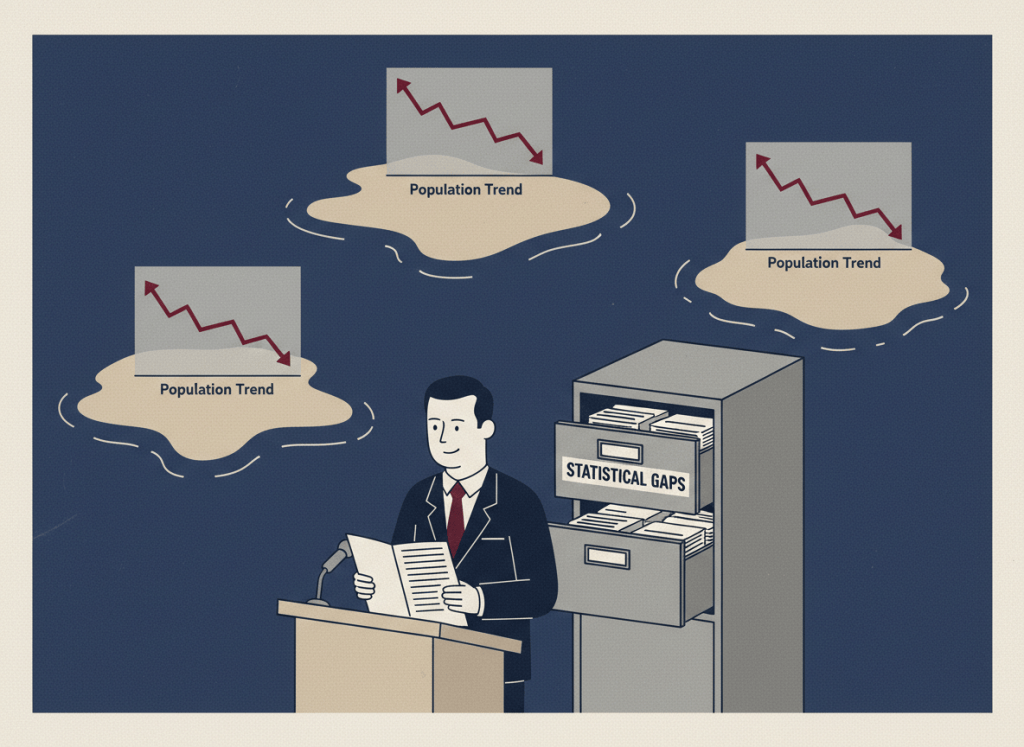
New federal projections forecast population declines of up to 61 percent in four American territories, while a Government Accountability Office recommendation to improve territorial statistical coverage remains open more than two years after its issuance.
WASHINGTON, Nov. 6, 2026 — The federal government has a new forecast for four American territories, and the outlook is not particularly encouraging. By the end of the century, one could lose more than half its population, two others could lose roughly four in ten residents, and a fourth is projected to shrink by nearly one-fifth.
What Washington has not yet demonstrated, at least to the satisfaction of its own congressional watchdog, is that federal agencies have established a coordinated approach to collecting the statistical information needed to understand the territories’ economic and demographic conditions.
The U.S. Census Bureau announced November 5 that its updated International Database projects population declines between 2026 and 2100 of 61 percent in American Samoa, 41 percent in the U.S. Virgin Islands, 38 percent in Guam, and 17 percent in the Commonwealth of the Northern Mariana Islands.
The projections represent the first International Database update for these four territories since 2017. They reflect declining fertility, persistent outmigration, and changing mortality patterns. They are projections, not predictions of inevitable outcomes, and their accuracy will depend in part on how migration and economic conditions develop over the coming decades.
But the new figures arrive against an uncomfortable backdrop.
In May 2024, the Government Accountability Office reported that federal statistical agencies routinely excluded American territories from major data products, potentially limiting the government’s ability to evaluate territorial needs and distribute resources effectively.
GAO recommended that the Office of Management and Budget establish a coordinated, governmentwide approach to addressing those gaps.
More than two years later, that recommendation remains open.
A Shrinking Population and an Incomplete Statistical Picture
The demographic changes are not entirely theoretical.
According to the 2020 Island Areas Censuses, the U.S. Virgin Islands lost more than 18 percent of its population between 2010 and 2020. The Northern Mariana Islands lost more than 12 percent, American Samoa more than 10 percent, and Guam approximately 3.5 percent.
The new projections suggest that substantial population losses could continue throughout the century.
The Census Bureau estimates that American Samoa’s fertility rate declined from 4.0 children per woman in 2000 to 2.1 in 2026. In the Northern Mariana Islands, the rate fell from 3.3 in 2016 to 2.0 in 2026.
Migration adds another challenge.
American Samoa’s estimated net migration rate for 2026 is negative 25.1 people per 1,000 residents. The Northern Mariana Islands have an estimated rate of negative 11.2, followed by the U.S. Virgin Islands at negative 5.4 and Guam at negative 4.8.
In practical terms, more people are leaving these territories than arriving.
The Census Bureau projects that net outmigration will gradually diminish to zero by 2100, an assumption that helps moderate the projected population losses.
That assumption is consequential. If outward migration remains elevated longer than anticipated, actual population declines could differ substantially from the published projections. Conversely, improved economic conditions or changes in migration patterns could produce more favorable outcomes.
The Bureau’s November 5 demographic analysis describes the assumption as a means of maintaining realistic long-term estimates for relatively small populations. The publicly available explanation does not establish how sensitive each territory’s final projection is to alternative migration scenarios.
The International Database methodology describes a cohort-component approach that projects populations by accounting for births, deaths, and migration. The method can incorporate census counts, vital statistics, surveys, and other demographic evidence, but the existence of a general methodology does not by itself demonstrate how alternative long-term migration assumptions would change the published results for each territory. That distinction matters when forecasts extend to 2100.
The Government’s Own Data Problem
The difficulty of planning for population decline becomes more pronounced when the government lacks consistent information about the populations it serves.
GAO’s 2024 investigation found that a majority of statistical products at every federal agency it reviewed excluded at least one U.S. territory.
Among 21 Bureau of Labor Statistics products examined, none included American Samoa or the Northern Mariana Islands. Of 52 statistical products reported by the National Agricultural Statistics Service, only the Census of Agriculture included the territories.
These omissions matter because employment, agricultural production, household characteristics, and economic conditions inform decisions about public programs and investments.
GAO also found that federal agencies generally had not conducted the research necessary to determine the costs, benefits, and feasibility of expanding statistical coverage to the territories.
The report acknowledged that geographic isolation, relatively small populations, legal requirements, and the expense of collecting statistically reliable samples complicate the issue.
Those obstacles are real. But they do not eliminate the consequences of missing information.
GAO concluded that better territorial data could improve federal decisions about allocating resources and evaluating the effectiveness of government investments.
The issue extends beyond the four territories included in the latest Census projections. GAO’s investigation also examined Puerto Rico, which is covered by other federal demographic data programs.
GAO Confirms No Further OMB Update
In a substantive November 12 response to Bureaucracy Times, Latesha Love-Grayer, director in GAO’s Forensic Audits and Investigative Service and the official who led several years of the agency’s Insular Area work, confirmed that GAO had received no further update from OMB on its territorial statistical-data recommendation.
“We have not received an update from OMB,” Love-Grayer wrote. That statement does not establish that OMB has taken no action, but it leaves the oversight agency without new evidence of implementation.
GAO also drew a clear line between creating a committee and fulfilling the recommendation. “The establishment and operation of an interagency committee, without measurable improvements in territorial statistical coverage would not satisfy our criteria for closing our recommendation as implemented,” Love-Grayer wrote. She explained that GAO would need evidence that relevant agencies examined the costs, benefits, and feasibility of including territories in their statistical products and, as appropriate, identified ways to address gaps.
The distinction matters: an interagency process may be a useful starting point, but GAO is looking for substantive assessments and appropriate remedies, not simply an organizational chart.
Territorial GDP Production Remains Paused
Love-Grayer disclosed another complication: Interior’s Office of Insular Affairs has told GAO it is working on new approaches to fund the Bureau of Economic Analysis’s territorial gross domestic product statistics, which remain paused.
BEA previously announced that its GDP work for American Samoa, Guam, the Northern Mariana Islands, and the U.S. Virgin Islands had been paused following an Interior funding decision. A Congressional Research Service account placed the historical annual Interior support for that work at approximately $786,000, a figure that should not be mistaken for the current cost of restarting production.
For jurisdictions facing projected demographic contraction, the absence of regularly updated economic output measures adds another limitation to assessing fiscal capacity and development needs. The pause does not prove that a specific federal investment decision was unsound; it does mean an established source of comparable territorial economic information is unavailable while funding arrangements are reconsidered.
Veterans and Grants: When Missing Data Have Practical Consequences
GAO identified concrete examples of the costs of incomplete territorial coverage. Federal food-assistance allocations to Guam and the U.S. Virgin Islands depend in part on adjustments using poverty and consumer-price information that is not collected in the same way as for states, the agency noted.
The problem is particularly striking for veterans. GAO reported in May 2024 that the Department of Veterans Affairs uses demographic population estimates to inform resource allocation and outreach through fiscal year 2050. One major input is the Census Bureau’s American Community Survey, which excludes territories other than Puerto Rico.
According to Love-Grayer, for at least two territories the federal veteran population estimates were approximately half, or less than half, of the estimates territorial officials considered accurate. GAO recommended that VA assess how known data limitations affect estimates for veterans in the territories and freely associated states; VA agreed.
Those discrepancies do not establish that VA funding was cut by the same proportion, or that particular veterans were denied care. They do raise an immediate planning concern when estimates used for outreach and resource decisions may substantially undercount the population to be served.
GAO also confirmed that its territorial debt work treats population decline and outmigration as risks to debt repayment: fewer working-age residents can mean reduced employment-tax revenue and economic activity. Love-Grayer said GAO is currently updating its 2025 territorial public debt and economic outlook report, although she provided no publication date.
GAO has not, according to Love-Grayer’s brief review of its work, recently evaluated as a standalone question whether agencies systematically incorporate long-term demographic projections into territorial infrastructure, disaster recovery, and other investment decisions. That question remains open for the agencies making those decisions.
A Committee, but an Open Recommendation
In November 2024, OMB reported establishing an interagency Territorial Data Gaps Committee, co-chaired by the Census Bureau and the Department of the Interior’s Office of Insular Affairs.
According to GAO, the committee was intended to assess the feasibility of including territories in existing federal statistical products.
The committee’s creation represented a potential step toward addressing the problem.
It did not, however, resolve GAO’s recommendation.
In the recommendation status accompanying GAO-24-106574, the watchdog reported that, as of mid-February 2026, OMB had not supplied additional information demonstrating implementation progress.
GAO said full implementation would require evidence that federal statistical agencies were consulting territorial governments, examining data needs and collection costs, evaluating feasibility, and identifying appropriate remedies.
The recommendation remains publicly listed as open.
An open recommendation does not necessarily mean an agency has taken no action. It means GAO has not determined that the recommended corrective action has been fully implemented.
That distinction is particularly important here. The public record establishes that OMB formed a committee, but it does not yet establish what the committee has accomplished, whether it has produced substantive deliverables, or whether its work has influenced federal territorial planning.
The Financial Consequences of Population Decline
Demographic contraction presents a different challenge for island governments than it does for many mainland communities.
Territories must maintain essential infrastructure and public services even as their populations and potentially their tax bases shrink.
Power systems, ports, airports, hospitals, roads, and emergency response capabilities cannot necessarily be reduced in direct proportion to population losses.
An aging population may simultaneously increase demand for certain services while reducing the number of working-age residents available to finance and deliver them.
These concerns are not merely speculative. In its 2025 assessment of territorial public debt and economic conditions, GAO examined economic and fiscal vulnerabilities facing U.S. territories, including the consequences of population decline.
The implications for federal investment are substantial.
The U.S. Virgin Islands, for example, has been undertaking extensive federally supported disaster recovery and reconstruction following the devastating 2017 hurricanes.
Major infrastructure investments may remain in service for decades. Their long-term operating costs, maintenance requirements, and expected utilization can depend heavily on future population levels.
Whether the agencies overseeing these investments routinely incorporate demographic projections into their planning remains an important question.
The existence of population decline does not establish that any particular project is wasteful or improperly designed. Nor does the absence of a specific statistical product prove that a funding decision was defective.
It does, however, underscore why reliable, current demographic and economic information matters.
Federal Agencies Asked to Explain Their Planning
Bureaucracy Times initially contacted OMB, the Census Bureau, Interior, and GAO on November 6 concerning the projections and federal territorial planning. GAO supplied its detailed response on November 12, including the clarifications reported above. Love-Grayer also introduced Nagla’a El’ Hodiri, who is leading GAO’s Insular Area work moving forward.
On November 12, Bureaucracy Times sent additional, three-question inquiries to OMB and Interior’s Office of Insular Affairs. OMB was asked for implementation records, the current status and deliverables of the Territorial Data Gaps Committee, and any measurable objectives or deadlines. Interior was asked why funding for BEA’s territorial GDP work was paused, what arrangements might restore it, and how the office is addressing the resulting information gap.
Responses to these new inquiries were requested by November 19 at 5 p.m. Eastern. As of this article’s November 12 update, those responses had not been received. Any subsequent substantive replies will be incorporated into the reporting as appropriate.
Planning for a Future Washington Can Already See
There is an important difference between forecasting population decline and preparing for its consequences.
The Census Bureau has now provided a revised demographic outlook extending nearly three-quarters of a century into the future. The projections suggest that some American territories could face fundamental changes in the size and age composition of their populations.
At the same time, GAO has now confirmed directly that it has received no additional OMB update, that a committee alone would not satisfy its recommendation, and that territorial GDP production remains paused while Interior explores funding options.
Neither finding establishes that Washington has ignored the territories or that existing federal investments are misguided.
Together, however, they raise a legitimate accountability question: How effectively can the federal government plan for the future of its territories when its own watchdog continues to identify unresolved gaps in the information used to understand their present?
The Census Bureau has published the projections. The next question is what the rest of the federal government intends to do with them.

