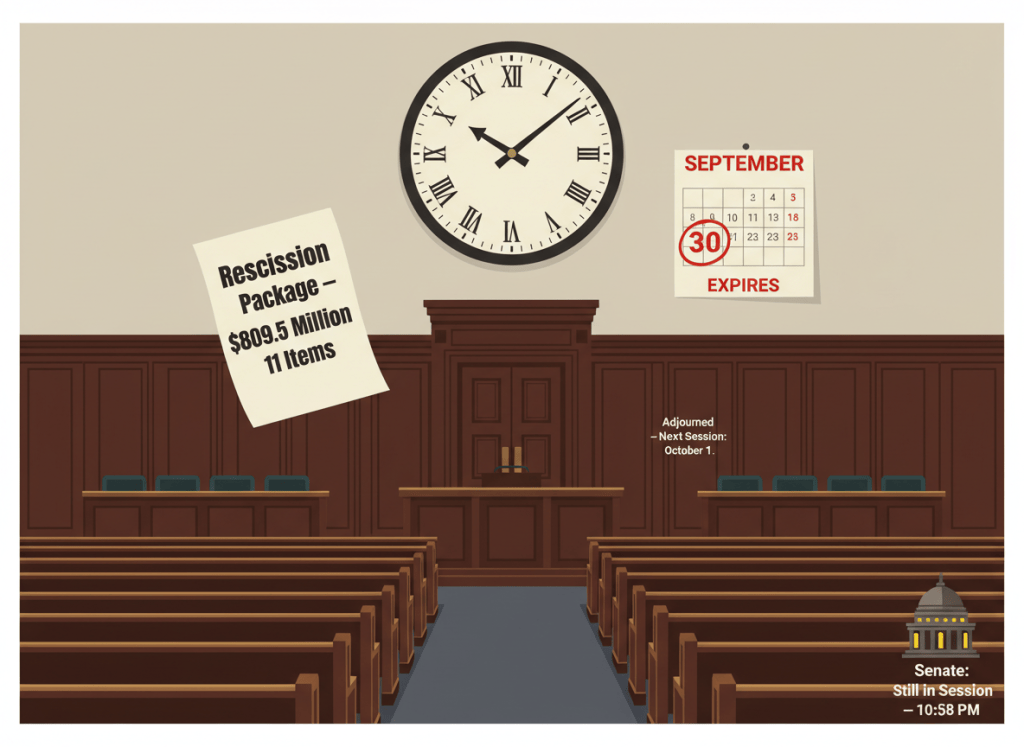
The most consequential item in Monday’s Congressional Record is a piece of mail. The White House’s letter proposing 11 rescissions of budget authority, dated Friday, was logged and referred to committee. The House then convened at noon, adjourned two minutes later, and set its next session for Thursday, October 1. The money in question expires on September 30.
The Arithmetic of Rounding Up
The package totals $809.5 million, which Democrats on the Senate floor kept rounding up to nearly a billion. The largest slice is $567.4 million from HHS refugee and entrant assistance, followed by $69.6 million of a $70.3 million international education line and $56.1 million from HUD housing counseling. It also claws back $15 million from the Justice Department’s Community Relations Service, an office the administration eliminated in late 2025, which makes this the rare rescission that arrives after the funeral.
A Calendar Doing the Work of a Statute
The device is a pocket rescission. The Impoundment Control Act gives Congress 45 days to act on a request, and the administration reads that as permission to sit on the funds until they lapse. The Government Accountability Office concluded in 2018 and again in 2025 that the law does not allow this. The Supreme Court last September let the administration keep withholding roughly $4 billion while litigation continued, but said its order was not a ruling on the merits. Susan Collins, the Republican who chairs Senate Appropriations, called this one unlawful too. Nothing is settled, and the calendar does the rest.
The Senate Stayed Until Nearly Eleven at Night
The Senate spent its evening passing the Protect College Sports Act, 77 to 22, with 50 Republicans and 27 Democrats in favor. A Booker amendment on catastrophic injury insurance for athletes failed 49 to 50. By unanimous consent, senators also passed the House’s penny bill (H.R. 10167), which ends circulating minting and rounds cash sales to the nearest five cents, plus a terrorism risk insurance reauthorization (S. 4395) and a bill (H.R. 997) letting the National Taxpayer Advocate hire its own counsel.
Two inspector general nominations arrived, Mark Priebe for Education and Robert Steinau for NASA, along with Jeffrey Zisk for the Postal Regulatory Commission. Majority Leader Thune filed cloture on the Stop Insider Trading Act, which would restrict stock holdings for members of Congress and their families, then withdrew the underlying motion; the Daily Digest schedules the cloture vote for Wednesday.
Congress spent Monday retiring the penny and studying the price of college football, while eleven appropriations slipped quietly into a folder. It is a fine way to cancel money. Simply schedule the vote for after it is gone.

