Ninety-Two Years of Paying Its Own Way
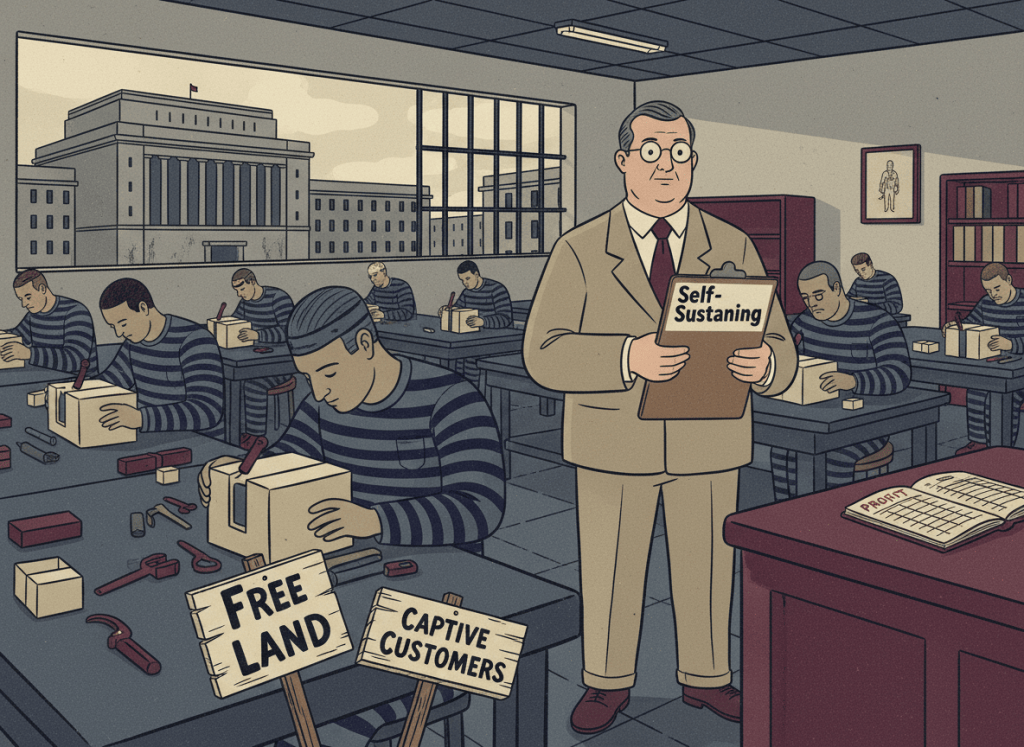
Federal Prison Industries has been “self-sustaining” since 1934. Congress told it to employ inmates and pay its own bills, and it sells under the name UNICOR.
Its latest annual report says it takes no annual appropriation. On the surface, the business is booming, with fiscal 2025 sales of $464.9 million, up 9.7 percent, and net income of $15.0 million, according to the audited financial statements.
Read the statement of operations and the story changes. The corporation lost $37.4 million from operations, and $16.0 million in interest income plus $36.5 million in “other income” turned that into a profit.
Its factories, by FPI’s own segment table, lost $6.5 million after overhead. Clothing and textiles alone lost $19.2 million on $120 million in sales.
Management’s own cover letter explains the slide plainly. Purchases from FPI by the government sector have decreased. That is a striking sentence for a company whose customers are required by law to buy from it first.
The Books That Had to Be Reopened
KPMG gave FPI’s fiscal 2021 statements a clean opinion on November 12, 2021. In fiscal 2023, management discovered a misstatement, and KPMG withdrew that opinion.
The restated 2021 statements were not audited and sent to OMB until December 11, 2025, more than four years after the original, according to the OIG’s restatement audit. KPMG reported three material weaknesses.
One says FPI overstated total revenue by $142 million at the end of fiscal 2021 while adopting a new revenue standard. Another covers revenue booked gross when FPI was really acting as an agent, which cut originally reported 2021 revenue by $49 million.
The fix looked simple. Auditors recommended automating revenue recognition, and FPI did.
The new tool then produced the fiscal 2025 material weakness. Management never assessed the risks the tool created and missed input errors in the fleet and textile calculations.
To be fair, this is the Government Corporation Control Act doing its job. The statute demands the audit, and the audit caught the problem. It just took four years to close the loop.
What Self-Sustaining Leaves Out
The Bureau of Prisons provides the land under FPI’s factories on rent-free leases and shares facilities generally at no cost, according to the notes to the financial statements. FPI is exempt from federal and state income, gross receipts, and property taxes.
It carries no insurance. The BOP may reimburse its losses, and the federal government pays certain personal injury claims directly.
About $30.6 million of its overhead is imputed costs for pensions, retiree health care, and BOP-provided services that other parts of government cover. FPI books them as expenses and offsets them with matching other income.
A corporation with no rent and no tax bill is also sitting on roughly $398 million in cash and Treasury securities. It bought $119.9 million in new Treasury investments in fiscal 2025 alone.
That pile earns the interest income that helps turn an operating loss into a profit. “Self-sustaining” has a lot of help.
Then there are the customers. Federal agencies generally must buy from FPI if its products meet price, quality, and delivery standards, under a mandatory source preference in its statute and the Federal Acquisition Regulation.
Business and labor groups have argued since 1934 that this undercuts the free enterprise system. FPI has answered that the preference keeps the factories running.
Even with that edge, the Department of War accounted for 46 percent of fiscal 2025 sales and DHS for 27 percent. DHS was 18 percent in fiscal 2021.
Fleet sales nearly tripled to $139.9 million, and the report ties customer advances mainly to retrofitting vehicles for DHS. Meanwhile the workforce shrank, from 11,043 inmates a year earlier to 10,494.
Management’s answer to softer government demand is commercial customers. It points to authorities from the First Step Act, a work repatriation program, and a joint-venture program with private firms.
The First Step Act opened new nonfederal markets in 2018, including state prisons and disaster relief. GAO reported in 2020 that a lack of information made it difficult to estimate the dollar value of those markets.
Congress does cap FPI’s central office administrative spending at $2.7 million a year. FPI spent $2.0 million, on a business with $465 million in sales.
A Rehabilitation Claim Without Fresh Receipts
The statutory mission is training and employment. By BOP policy, workers earn between 23 cents and $1.15 an hour, and GAO has noted FPI is not subject to minimum wage provisions.
The statute sets only one floor. At least 15 percent of an inmate’s pay must be reserved for release costs, and every pay rate is otherwise set at the corporation’s own discretion, according to the same summary of federal law.
That is the whole wage policy of a corporation that books $465 million in sales.
The management report says a BOP study “demonstrated” that FPI training contributes substantially to lower recidivism. It does not name the study, and the same paragraph appears nearly word for word in the restated 2021 report.
In 2020, GAO found that BOP had not reviewed FPI’s effect on recidivism in over two decades. BOP later commissioned an outside evaluation and set a recidivism goal for the program.
Independent data is less flattering. A U.S. Sentencing Commission study of federal offenders released in 2010 found FPI participants reoffended at 55.0 percent against 52.0 percent for everyone else.
That gap was not statistically significant once offender characteristics were controlled. Some research GAO reviewed does find reductions from prison work, so the point is not that the program cannot help.
The point is that a mission claim this load-bearing should come with current receipts.
The Guarantee Is the Customer
Every entity in this series hits the implicit guarantee problem through a different door. For UNICOR, the guarantee is not a Treasury backstop. It is a captive customer base written into statute and procurement rules.
That guarantee, plus free land and a tax exemption, props up a corporation whose operations lose money and whose government sales are softening. Its books needed a four-year do-over, and its rehabilitation case rests on a study it will not name.
A private company run this way would be restructured. A government corporation files another report.

