Some institutions learn from their mistakes. Others simply learn to write better memos about them. The Department of Homeland Security’s Office of Inspector General has now inspected the Krome North Service Processing Center in Miami three times since 2023, and each time the findings read like a photocopy of the last, just with the dates changed and a few new appendices explaining why nothing much has improved. The latest report, OIG-26-29, documents an unannounced inspection conducted May 28 to 29, 2025, and covers overcrowding, food safety, use of force, medical neglect, and a facility that appears to be inventing new places to warehouse people faster than it can process the ones it already has. Notably, the report was not released until September 11, 2026, nearly sixteen months after the inspection itself, a delay the OIG attributes to three separate government shutdowns that ate up 123 days of the fiscal year. Apparently the government can furlough its watchdogs even while it keeps running the kennel.
Building 9 and the Art of Improvisational Incarceration
The headline number is simple enough to fit on a bumper sticker: on the first day of the inspection, Krome held 1,102 detainees against a maximum capacity of 882, a full 25 percent over. Six of fourteen intake hold rooms were over their posted limits, one by 56 percent, and inspectors found detainees standing or lying on the floor because there was nowhere else to put them. Krome had also converted two visitation rooms into overflow intake space, which is one way to solve a capacity problem, provided you don’t mind that it violates the standard meant to prevent exactly that.
More striking is the twelve-hour rule. Detention standards cap how long someone can be held in an intake hold room before being processed and moved, precisely because hold rooms are not designed for extended stays. OIG inspectors found intake processing sheets, taped to the outside of hold rooms on May 28, dated May 26. An intake officer confirmed the obvious: people were being held well past the limit, in some cases for days, with a single opportunity to shower or brush their teeth regardless of how long they stayed. Krome’s explanation involved medical screening bottlenecks (no full-time X-ray technician, evidently a luxury) and general staffing shortfalls, which is a candid enough admission that the problem is structural rather than incidental.
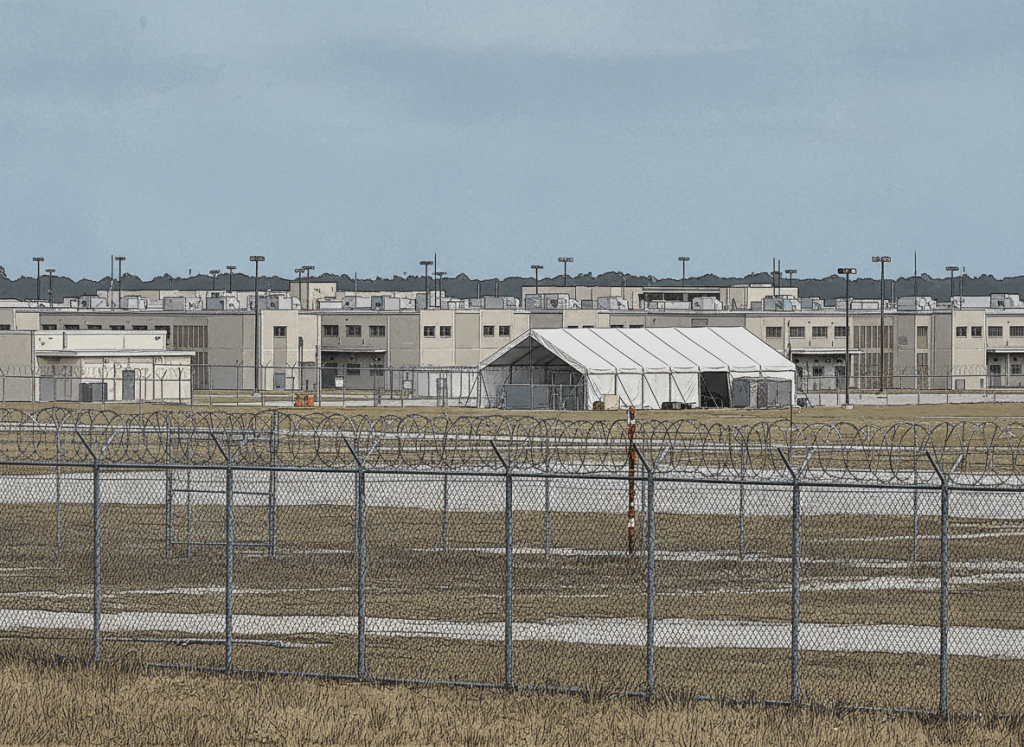
Then there is Building 9, a tent-like structure erected after the prior inspection cycle to serve as overflow housing during the intake crunch. Inspectors found detainees classified at different risk levels (low, medium-low, and high, denoted by wristband color) commingled inside it, which is precisely the scenario the classification system exists to prevent. Some classification forms were incomplete or missing supervisory sign-off entirely. Krome’s given reason, again, was volume: too many people coming and going for staff to finish the paperwork. It is worth noting that a companion report released the same day, OIG-26-22, found even more severe conditions at Florida’s now-shuttered “Alligator Alcatraz” facility, including detainees held in four-by-four-foot outdoor metal enclosures. Whatever is driving Florida’s detention system to improvise structures and shortcuts, it is not confined to one address.
Chicken, Grievances, and Fifteen Vacancies
If the housing findings suggest a facility straining under volume, the food service findings suggest one that has simply stopped paying attention. Inspectors observed raw chicken thawing in three large vats, one with water running continuously over the sides and onto the floor, the other two with chicken submerged, uncovered, and out of its original packaging, sitting in standing water with no temperature control whatsoever. Two freezer gauges read 20 degrees Fahrenheit over the required maximum. A pallet of food marked “Keep Frozen” sat outside in direct sunlight for more than two hours while ambient temperatures ran between 82 and 90 degrees. None of this requires an advanced food safety credential to recognize as a problem; it requires someone walking through the kitchen occasionally.
The medical findings follow a similar shape: real improvement in one narrow area, framed by neglect everywhere else. Sick call wait times dropped from five to seven days down to two or three, thanks to a new sign-up system, which OIG credits fairly. But medical grievances were not being logged or filed, a problem the OIG first flagged back in its 2023 inspection and which persists unchanged. There has been no Continuous Quality Improvement program since the position responsible for running one went unstaffed in April 2024. And the facility’s medical staff had fifteen vacancies at the time of inspection, including a Health Services Administrator position empty since February 2025 (its Assistant has been serving in an “acting” capacity ever since), one dental assistant for the entire detainee population, and eight recently departed nurses. A facility can build all the temporary tents it wants; it cannot conjure medical staff from an org chart with strikethroughs on it.
Use of force fares no better on inspection. Of a five-incident sample drawn from 44 reported incidents over six months, two were flatly non-compliant: pepper spray deployed against a detainee described in Krome’s own after-action review as “offering no resistance,” with no follow-up medical evaluation and incomplete documentation of who was even involved; and a choke hold used during a cell search under circumstances that did not remotely meet the threshold requiring deadly force. Both incidents, notably, were caught and described honestly by Krome’s own internal review process, which raises an uncomfortable question the OIG report does not quite ask directly: if the facility’s own paperwork identifies the violation, why does the violation keep recurring?
Grading Its Own Homework
Appendix B of the report is where the real theater happens. ICE concurred with all nine recommendations, as agencies reliably do, and the OIG’s own scorekeeping tells the real story. Three recommendations (hold room capacity, classification commingling, and SMU recreation equipment) were closed based on evidence ICE supplied, largely photographs and inspection checklists. Six remain open, including the food safety and use-of-force recommendations, because ICE’s paperwork showed intentions and new procedures but not yet the sustained compliance the OIG wants to see documented over time. To its credit, the OIG is not simply rubber-stamping ICE’s self-assessment; it is explicitly withholding closure on the more serious findings pending better proof. That is more scrutiny than many oversight relationships manage. It is also, worth remembering, the third time this particular dance has been performed at this particular address, following near-identical findings in 2023 and again in OIG-24-21 in April 2024, both of which also ended in “concur” and a list of process fixes.
None of this happens in a vacuum, either. Staff-detainee communication showed nearly a quarter of requests to ICE going unanswered past the three-day window, and 17 percent of facility responses marked “complete” contained no actual response at all, a bureaucratic sleight of hand that deserves its own category of dishonesty. Special Management Unit detainees, meanwhile, got an empty fenced lot with no recreational equipment while the general population played basketball and volleyball nearby, a distinction that says a good deal about what “special management” actually means in practice.
Krome did get credit where it was due (the law library, legal materials, and attorney visitation rooms were all found compliant, an improvement from the prior cycle) so it is not as though the facility fails every category. But a facility that can fix its law library and still cannot keep chicken below room temperature, log a medical grievance, or finish a classification form on time is not suffering from a resource problem so much as a priorities problem. The paperwork trail from 2023 through 2026 tells a consistent story: identify the failure, promise the fix, provide a photograph of a checklist, and wait for the next unannounced visit to do it all again.
 Bureaucracy Times