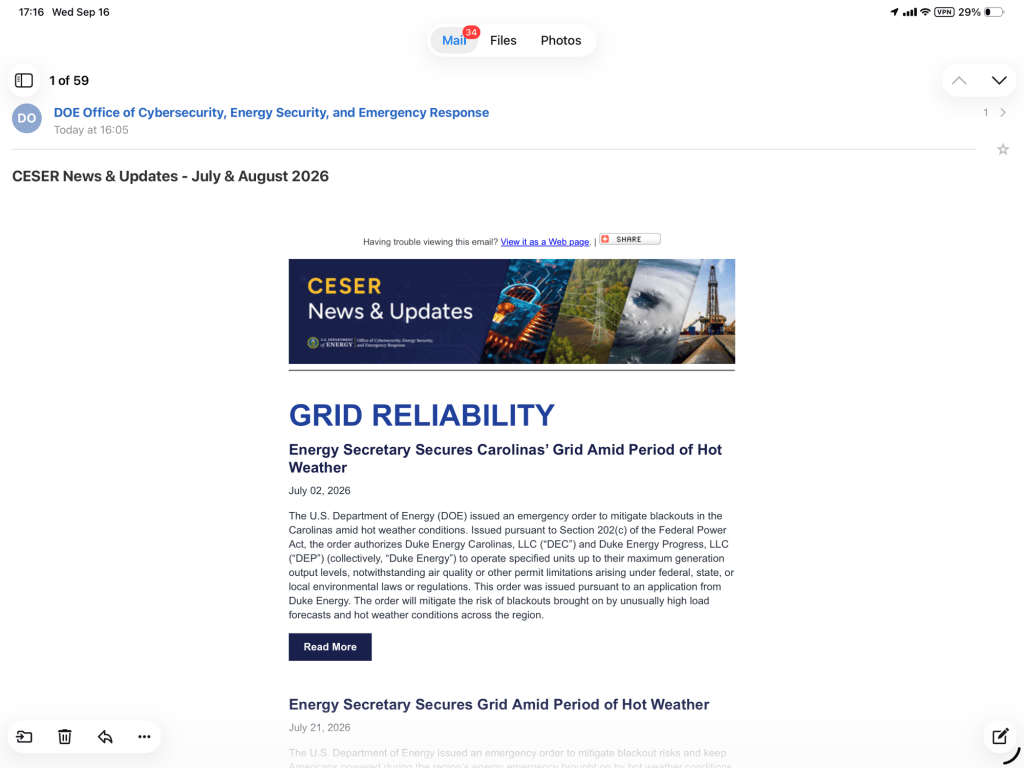
At 4:05 p.m. on September 16, an email arrived from the U.S. Department of Energy’s Office of Cybersecurity, Energy Security, and Emergency Response bearing important news.
July and August happened.
The subject line, “CESER News & Updates – July & August 2026,” was refreshingly honest about the situation. There would be no September news in this September 16 news email. Instead, CESER had assembled a collection of developments stretching all the way back to July 2, presumably after allowing sufficient time for the news to mature.
This might be unremarkable coming from an office devoted to historical preservation. CESER, however, is responsible for cybersecurity, energy security and emergency response, fields in which the phrase “we’ll get back to you next month” generally lacks a certain operational appeal.
The newsletter opened with a collection of grid reliability actions. DOE issued an emergency order for the Carolinas on July 2 amid hot weather. Another followed for the Southwest Power Pool on July 21. There was another on July 26 covering 17 states, followed by August actions involving Guam, Puerto Rico, the Midwest and the Mid-Atlantic.
These are not trivial subjects. Grid emergencies, blackout risks and extreme weather are exactly the sort of matters the public might reasonably associate with timely information.
The cybersecurity section was similarly urgent in subject matter. CESER highlighted Stormbreaker, a testbed developed with Lawrence Livermore National Laboratory to evaluate large language models and agentic artificial intelligence in power systems and operational technology environments. It also pointed readers toward cybersecurity threat guidance, operational technology security, software bills of materials and reports of cyber incidents affecting water and wastewater systems.
All useful material. All arriving in an email on September 16.
The newest dated CESER event in the email was an August 27 appearance by Principal Deputy Director Emily Burdick at a National Governors Association summer meeting. That means even the freshest item in the “News & Updates” package had enjoyed nearly three weeks to contemplate its journey to our inbox.
The newsletter even contains a particularly delightful sentence from an August 5 event at the National Lab of the Rockies. CESER Director Andrew McClure emphasized the office’s guiding principle of providing “timely and actional information to the energy sector.”
We assume “timely” is being used here in the federal sense.
To be fair, there is nothing inherently wrong with a periodic retrospective newsletter. Agencies routinely compile activity over weeks or months, and CESER did not disguise what it was sending. The words “July & August 2026” were right there in the subject line. Nobody promised breaking news.
That may actually make it funnier.
Somewhere in the machinery of the federal government, an office dedicated to responding to rapidly developing threats compiled its July and August news, shepherded it through whatever process was required, and successfully delivered it halfway through September.
The grid remained standing. The email arrived. And Bureaucracy Times can now independently confirm that July and August 2026 successfully occurred.
 Bureaucracy Times