There is a certain genius to a bureaucracy that can build an entire apparatus, complete with memoranda, standard operating procedures, and a coordination group that meets twice annually (on paper), and still lose track of $141 million. The Department of War’s Inspector General released a report on September 10 documenting exactly that: a program built to equip vetted Iraqi forces against ISIS that spent years shuffling paperwork between rotating officers who had, on average, ten days of handoff briefing before assuming responsibility for a multi-year, nine-figure equipment pipeline.
The program is called the Counter-ISIS Train and Equip Fund for Iraq, or CTEF-I, and Congress has appropriated $414.7 million for its equipment component since fiscal year 2022. The findings, delivered with the OIG’s trademark flat affect, describe an institution that built the paperwork and then forgot to watch what happened to it.
Endorsement at the Speed of Bureaucracy
The USCENTCOM Syria-Iraq Train and Equip Cell’s own standard operating procedure, dated May 2020, allows 30 days to endorse an equipment request package once it clears initial submission; officials told auditors the real target, absent complications, is seven days. From October 2021 through May 2025, USCENTCOM missed that window on 53 of 80 packages, or 66 percent of everything submitted, worth $473 million. The average endorsement for those 53 took 131 days. One package, worth $8 million, took 592 days: nearly a year and a half spent bouncing a request back and forth over a missing mission statement and an unidentified vetted officer, a delay that survived two full personnel rotations before anyone resolved it.
The report’s timeline reconstructions read like a workplace comedy with body armor at stake. A package submitted in April 2022 sat untouched for a year because nobody on either side followed up, during which the CJTF-OIR staff assigned to it rotated out twice. When someone finally looked again, the fix required months of back-and-forth over a single missing detail: an officer’s job title.
None of this is because the underlying paperwork was bad. Auditors reviewed all 80 justification letters submitted over the audit period and found every one contained the required justification and capability gap analysis. The problem was never the writing; it was what happened to the writing after it was submitted.
An Institutional Memory That Rotates Out Every Six Months
The report’s central diagnosis is almost sympathetic, in the way autopsies are sympathetic: CJTF-OIR’s Directorate of Military Assistance, the unit actually responsible for tracking equipment through a process that can run more than four years, is staffed entirely by individually deployed service members on six to twelve month rotations. Do the math and a single equipment request can pass through the hands of eight different people before it reaches an Iraqi unit. The handoff between each of them, per the Directorate’s own Director, consisted of ten days of briefing from the outgoing officer.
USCENTCOM’s civilian contractor staff, by contrast, do not rotate and could in theory provide the institutional continuity the military side lacks. Except the OIG found that USCENTCOM’s own SITEC office quietly stopped performing duties its 2020 SOP explicitly assigns it, including maintaining a tracker of procurement status and liaising with procurement commands, and let those responsibilities drift onto the rotating military personnel it was supposed to be backstopping. The one CTEF-I-specific training event that did exist, an annual conference, was not scheduled around rotation dates and was designed to build the next budget request rather than teach anyone how to track equipment already in the pipeline.
The result is a program tracked across at least four separate, non-interoperable systems (a USCENTCOM tracker, the Security Cooperation Information Portal, a Defense Security Cooperation Agency tracker, and a CJTF-OIR demand tracker), each using its own case numbers, with no end-to-end view of where any given shipment actually stands. CJTF-OIR personnel told auditors they did not even have system access to see what equipment was scheduled to arrive in Kuwait; they found out when it showed up.
Where the $141 Million Went
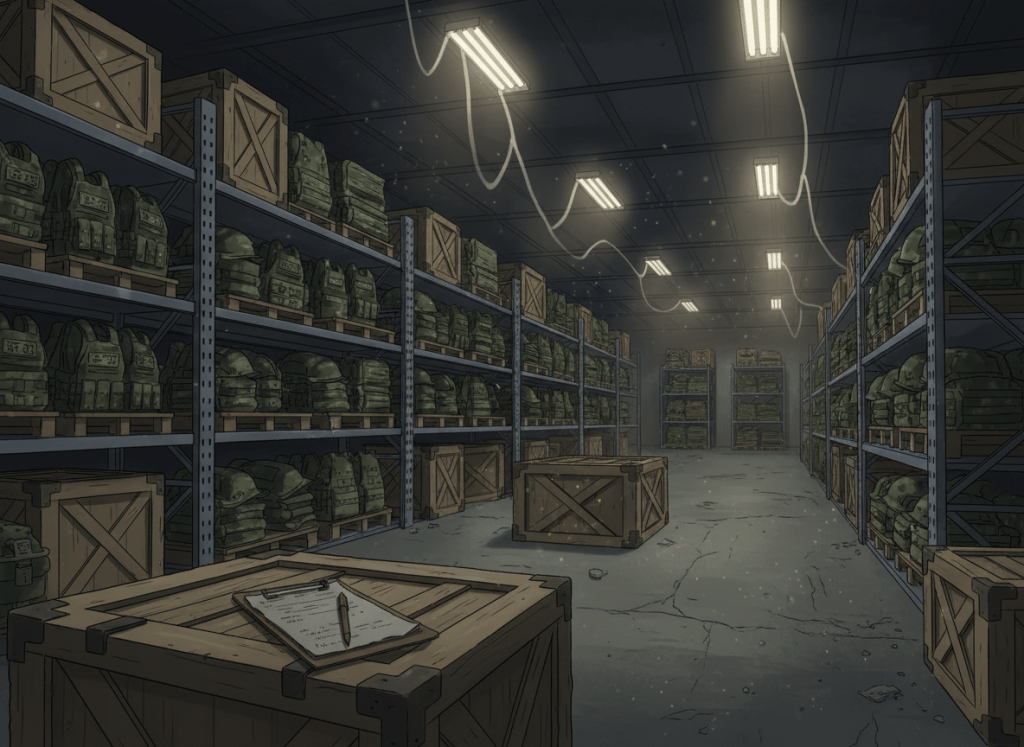
The consequences arrived in three flavors. First, $64 million in equipment sat in Kuwaiti warehouses as of May 2025 awaiting reallocation because the original requirement had lapsed, including body armor and Soviet-style machine guns that have been in storage since 2017. CJTF-OIR trimmed that pile to $19 million by February 2026, an improvement the OIG credits while noting the remainder still needs a plan: reassign it, return it, or dispose of it.
Second, $25 million in fiscal year 2024 equipment funds simply expired on September 30, 2025, unobligated, because the endorsement backlog ate the clock. CJTF-OIR had to raid fiscal year 2025 money to cover the requirements the expired funds were supposed to fund, a shell game the OIG classifies, without euphemism, as waste.
Third, and worst, $52 million worth of equipment across 128 line items was still sitting somewhere in the procurement pipeline as of August 2025, never having shipped to Kuwait, with nobody able to say whether the original requirements were still valid. Eighteen of those line items were endorsed and funded at least five years ago and still have not reached a Partner Force unit. The tracker that surfaced this figure was compiled manually by a separate Army command and had not been updated in six months when investigators found it; it also only goes back to 2019, meaning the true backlog could be larger and simply invisible.
Layered on top of the equipment mess is Finding B, which is almost a separate scandal wearing the same report’s clothes: the policy office responsible for aligning CTEF-I with strategic goals convened zero coordination-group meetings in all of 2025, despite a 2022 memo requiring two per year, and the operational command responsible for quarterly campaign assessments completed exactly two of them between fiscal year 2022 and the third quarter of fiscal year 2025. Both processes were, in the OIG’s careful phrasing, “initiated, but later suspended.” Nobody documented the decision to stop.
Six Recommendations, Two of Which USCENTCOM Would Rather Not Discuss
The OIG issued six recommendations. Four landed as “resolved”: the policy office agreed to restart its coordination group, and CJTF-OIR agreed to sort out the reallocation backlog and the stalled shipments, with an internal deadline of September 30, 2026. The other two, both aimed at USCENTCOM and asking for a comprehensive tracking mechanism and a real standard operating procedure, were met with responses the OIG describes as neither agreeing nor disagreeing, and which “did not address the specifics of the recommendation.” USCENTCOM’s counteroffer was a promise to stop accepting incomplete packages by October 1, 2026, which the OIG points out does nothing about the four years of packages already lost in the machinery. Both recommendations remain open and unresolved, and the OIG has given USCENTCOM 30 days from the report’s release to try again.
At least $71 million of the money involved is, in the OIG’s own accounting language, funds that could still be put to better use. Whether it gets there depends on an institution that has already demonstrated it can build a tracking system, forget to use it, and still call the paperwork complete.
 Bureaucracy Times