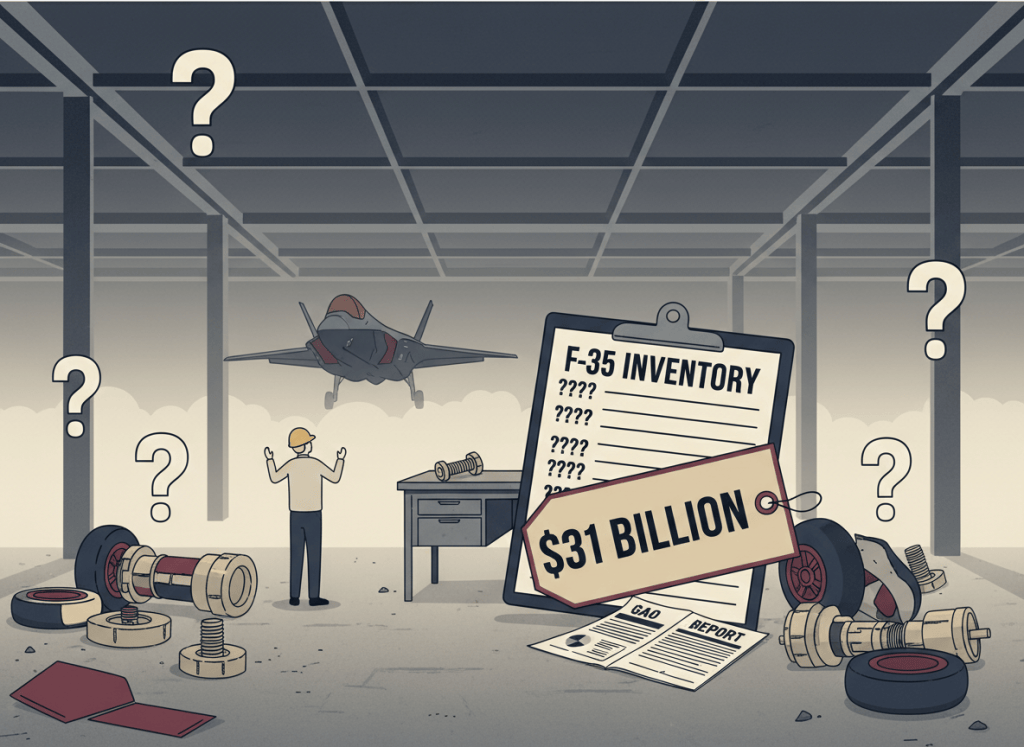
The F-35 is the most expensive weapons program in American history, with a lifetime cost the Pentagon puts above $1.9 trillion. The Defense Department still can’t say with confidence how many of its spare parts exist, where they are, or what they’re worth.
That is the central finding of a Government Accountability Office report dated November 9 (GAO-27-108713). The parts, from engines and tires to bolts and screws, are owned by DOD and shared across a global pool. No one holds a complete record of them.
The number keeps changing
DOD now estimates the program holds about 26 million parts worth roughly $31 billion, spread across more than 700 facilities worldwide. About 30 percent sit at contractor-managed sites. The rest are at government locations such as military installations and Defense Logistics Agency warehouses.
The pool serves the Air Force, Navy and Marine Corps, along with seven partner nations and 12 foreign military sales customers. The F-35 Joint Program Office’s own finance officials told GAO the true totals are likely higher because some parts are excluded or missing.
The estimate has swelled before. In 2019, the DOD inspector general found that the only record of F-35 government property was held by the contractor, which counted 3.45 million pieces worth $2.1 billion.
Seven years later, the count is more than seven times larger. The value is nearly fifteen times higher.
The two figures may not cover the same scope, since the newer one reaches more contractors and government sites. But nothing in GAO’s report reconciles them.
Lost parts, three different tallies
GAO reported in 2023 that one prime contractor lost more than 1 million F-35 parts, valued at over $85 million, between May 2018 and October 2022. About 940,000 of them, worth more than $66 million, had never been reported for adjudication. The new report refers only to “one prime contractor.” Lockheed Martin and Pratt & Whitney are the program’s two primes.
In June 2025, the Defense Contract Management Agency authorized a one-time bulk filing so the contractor could submit all of its outstanding losses. By March 2026, it had submitted about $28 million, reaching back to 2012.
DCMA has so far found the contractor financially liable for roughly $6 million of that. Adjudication is where the money changes hands.
Here is the catch. The F-35 Joint Program Office kept no record of the earlier losses. Officials told GAO they cannot say whether the $28 million includes any of the $85 million GAO flagged.
There is also a third number. The 2019 inspector general report said Lockheed had self-reported $271 million in lost government property, a figure the Pentagon had no way to validate.
The figures cover different periods and methods. GAO also cautions that its $85 million is not the fully burdened cost. Still, three tallies exist, and none ties to another.
Losses at government-run sites are no better tracked. The program office has no complete record of losses reported on DD Form 200 before September 2025. Its stopgap is a spreadsheet of 57 cases.
Seven of those cases lack a unit cost. Twenty-four, worth almost $400,000, were filed more than a year after discovery, against a 30-day requirement.
Officials told GAO they approved inventory adjustments for losses without follow-up, even when forms were incomplete. They also do not analyze losses for trends. GAO says that weakens the office’s ability to detect fraud, waste or theft.
A baseline that doesn’t exist
Under the loss problem sits a bigger one. DOD has no reliable baseline of what it owns, and GAO’s examples show why.
- As of March 2026, about 17,000 parts in repair or maintenance had not been entered into the property system. They were worth about $1.3 billion, and officials said possibly as much as $2.5 billion.
- Only 29 percent of records in a December 2025 contractor data file had serial numbers. Just 43 percent had National Stock Numbers.
- Almost 6 percent of records in that file showed an acquisition cost of a penny or less.
- Contractors send data in quarterly files, so records for the joint spares pool can be more than three months old.
An interface meant to update records in real time is still being built. As of July 2026, the program office was testing a connection to one prime contractor’s system and expected it to go live in September. GAO’s report does not say whether it did.
The other prime had not yet submitted its proposals. The earliest contract awards for that connection were expected in September and October 2026.
Program officials also said efforts to clean up contractor data are sometimes hampered when the primes request contract modifications to provide the missing information. The government may have to renegotiate contracts to get data about its own property.
An inventory built on a disapproved system
The Joint Program Office has spent at least $17 million on physical inventories since fiscal year 2020. GAO found the latest one still did not verify that parts exist or that every part is counted.
For the 2025 inventory, the office used data from a prime contractor whose property management system DCMA had rated “disapproved.” That rating means the system does not comply with contract requirements, in part because the contractor failed to document the relocation of parts or keep auditable records. DOD officials said the risk is high that the contractor’s information is inaccurate.
Some parts cannot be inventoried at all. The primes lack visibility below the subcontractor level, so they do not know where some sub-subcontractor facilities holding F-35 parts are located. Parts in transit or out for repair may not appear in any tracking system.
The plan has also changed. GAO closed a 2022 recommendation in February 2025 after the program office committed to a 100 percent wall-to-wall inventory. Officials now call that infeasible, citing the inability to pause warehouse production and a lack of resources to visit 700-plus facilities.
In March 2026, the Pentagon’s comptroller asked the Defense Contract Audit Agency to help build an auditable baseline. As of June, that agency was in early planning, with a first full inventory targeted for March 2027.
Meanwhile, DOD is moving ahead with its Global Support Solution Reset, which calls for about $13.7 billion in added investment, including to bring the supply of parts up to needed levels. GAO warns DOD may not be able to identify what parts it needs, or show accountability for the ones it buys.
Nobody is clearly in charge
DOD guidance calls for a component property lead and accountable property officers to run property accountability. The F-35 office appointed a lead in 2021. GAO found the lead has not given the officers enough oversight or direction.
The office has not developed F-35-specific procedures or training for those officers. One officer wrote their own procedures. Officials described the six appointments made in 2024 and 2025 as mainly administrative moves to fill required positions.
As of June 2026, the person identified in December 2025 to oversee lost-parts reporting had not been appointed in writing or given specific responsibilities.
Officials also disagree on the basic design of the program. Some DOD officials want a central team of about 40 full-time officers. The program office says it needs about 12, spread across contract locations, and treats the job as an ancillary duty like other DOD components do.
The audit stakes
The F-35 is a major reason DOD has never passed an audit. Auditors have reported a material weakness tied to the program since fiscal year 2019, and DOD has received a disclaimer of opinion in each of the eight fiscal years, 2018 through 2025, that it has undergone a full audit. A 2023 law requires an unqualified opinion by December 31, 2028.
DOD is working on a way to get the parts onto its financial statements. The program office’s chief financial officer plans to use a “deemed cost” method to value parts with missing or erroneous costs. Those procedures are under review by the Pentagon comptroller’s office.
Even then, DOD says it will keep disclosing that it is not making an unreserved assertion on its inventory and property line items. Putting parts on the books is not the same as vouching for the numbers.
What happens next
GAO made four recommendations. They call for procedures to monitor and analyze loss reports, F-35-specific procedures for accountable property officers, specific training for them, and a documented program structure.
DOD concurred with all four. Its written responses offer no completion dates.
On losses, the department says it is taking “decisive, multi-pronged action” built around an inventory baseline that does not yet exist. GAO says the program office has not identified expected completion dates for its procedures and training.
As of August 2026, 26 of the 34 recommendations GAO and the DOD inspector general have made on F-35 financial management remained open. Several of the problems in this report trace back to 2022 and 2023 recommendations that are still unresolved.

