The Scoreboard
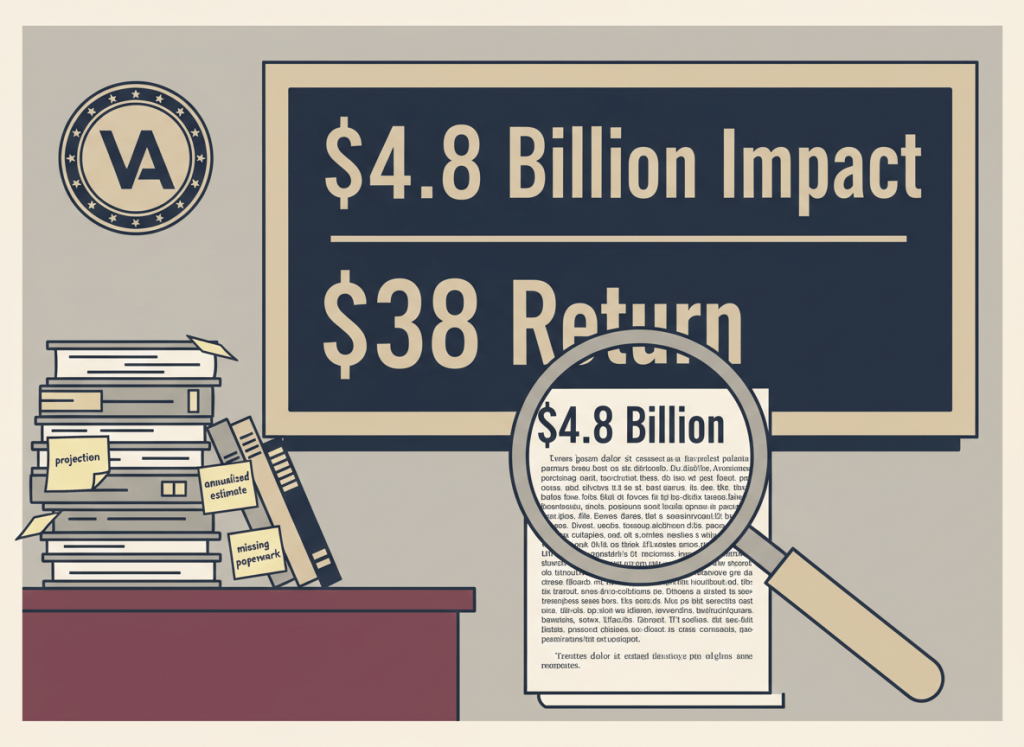
The Department of Veterans Affairs Office of Inspector General does not lack for confidence. Its latest semiannual report to Congress covers April 1 through September 30, 2026, and opens with a scoreboard worth framing.
The numbers: 143 arrests, 86 convictions, 152 reports and other products carrying 392 recommendations, and 22,021 hotline contacts. The headline is nearly $4.8 billion in monetary impact, which the report converts into a return of about $38 for every dollar spent on oversight.
For the full fiscal year, the report claims more than $7 billion and a $28 return.
Those are the OIG’s own figures, and none of them is invented. The question is what kind of dollars they are.
How a Projection Becomes a Dollar
Table 1 breaks the $4.77 billion into categories. Questioned costs account for $3.02 billion, or 63 percent.
Funds that could be put to better use add another $1.14 billion. The line labeled dollar recoveries comes to $2.1 million.
Three reports supply about $3.8 billion of the total, roughly 80 percent.
- The community care eligibility audit contributes $1.74 billion. The OIG estimated VHA could have avoided about $440 million in one quarter, then scaled that to a full year.
- The Louisville medical center review contributes $1.17 billion, all of it unsupported costs, because VA could not produce a business case. That is a documentation finding, not a finding that the money was wasted, as we covered in The Hospital Built on a Document That Never Existed.
- A review of VBA open obligations contributes $895 million, projected from a statistical sample of orders examined between March and May 2025.
None of that makes the work wrong. Questioned costs are a defined audit term, and projections are how auditors size a problem.
It does make “impact” a generous word for a total built from estimates, annualizations, and missing paperwork.
Not every item is a projection. The $11.2 million VA paid for Veterans Crisis Line backup services that were never delivered is a real payment for nothing, and we wrote that one up too. In this scoreboard it is a rounding error.
The ratio also swings with whichever large items land in a given period. The OIG reported a $32 return in Issue 94, $18 in Issue 95, and $38 now.
In Issue 95, about 94 percent of the $2.26 billion came from one category: fines, restitution, and civil judgments. The report’s own footnote says only $340 million of that category was VA’s.
This period’s footnote says $119 million of the $476.6 million in the same category belongs to VA. The category counts amounts payable to all government entities, not just the department.
The Justice Department’s release on the former NFL player Joel Rufus French illustrates the attribution problem. He was sentenced to 196 months for a brace scheme that defrauded Medicare and CHAMPVA of nearly $200 million.
The court ordered $110.75 million in restitution. Neither the release nor the SAR says how much of the loss was VA’s.
The open-recommendations appendix works the same way. It lists $5.03 billion in potential cost savings across 15 reports, and one project accounts for $1.62 billion of it: the Palo Alto ambulatory care center.
That figure is $716.6 million in questioned costs plus $907.8 million in better-use funds, which together equal the project’s entire estimated cost, including the roughly $459 million already spent as of February 2025. VA’s own Palo Alto construction page, updated September 10, 2026, now says the ambulatory care center project “will be canceled.”
Palo Alto and Louisville share a core finding: VA could not produce the business case OMB requires. Together they carry about $2.8 billion in reported dollar figures across two reporting periods.
What the Highlight Reel Skipped
The narrative sections favor arrests, savings, and corrective actions. Several of the period’s more consequential findings get one sentence, a table row, or nothing.
Start with emergency care claims. The SAR gives one sentence to a finding that VHA’s handling of third-party claims conflicted with statute. The underlying advisory memo is blunter.
After a 2022 law set a 180-day filing window for third parties, VHA kept applying a 90-day regulatory limit until October 2025, then adopted a workaround the OIG said still does not fully match the law. VHA’s finance office identified about 78,000 claims, carrying more than $373 million in billed charges, that had been denied for missing the shorter deadline since December 29, 2022.
As of the OIG’s December 2025 interview, those claims had not been reviewed. As of May 7, 2026, the regulation had still not been updated, and the OIG made no recommendations.
Billed charges are not money owed, and the memo does not say veterans were billed. But the SAR gives its readers none of these numbers.
Then there is the Toxic Exposures Fund. VHA and VBA spent about $51.7 billion from it between fiscal years 2022 and 2025, and Congress appropriated about $52.7 billion more for 2026. An August audit found that VBA cannot reconcile spending to actual PACT Act workload, that its cost methodology has no estimates for any of its nine spending categories, and that it went through four chief financial officers in under two years.
The audit found about $371,000 in misapplied expenditures, since corrected. It did not find mass misappropriation, so the finding is an inability to show where the money went, not proof that it went astray.
The audit appears in the SAR’s appendix, not its narrative.
The June review of generative AI is a third example. The OIG found VA GPT and Microsoft 365 Copilot Chat in clinical use without being classified as high-impact tools, and found that VA has no means of measuring how widely they are used.
The SAR says VHA leaders agreed to define permissible clinical uses. It leaves out that the OIG, as FedScoop reported, said leaders’ emphasis on reducing barriers to innovation influenced their oversight decisions.
Finally, the backlog. The OIG ended the period with 573 open recommendations, 163 of them more than a year old and 17 more than five years old.
One of the five-year-old items is a December 2018 recommendation on governance of the VA police program. It sits in Appendix B while the narrative notes a June 2026 police overhaul.
The Disclosure and the Calendar
The Inspector General Act requires the report to disclose any instance in which VA imposes budget constraints meant to limit the OIG, resists oversight, or delays access to information. The report says there were none.
The same report lists the Inspector General’s meetings during the period. Cheryl Mason met OMB Director Russell Vought about OIG budget priorities, and separately met the White House Domestic Policy Council and the White House Fraud Task Force.
The report describes the OIG’s joint fraud initiatives as aligned with the President’s commitment to stop fraud. It also notes that GAO has been interviewing OIG staff for its review of the status of federal inspectors general.
Last period’s engagement list named Congress, the Justice Department, and veterans groups. It did not mention OMB or the White House.
None of that is a finding of interference, and the statutory disclosure is narrow by design. It covers what VA does to the OIG, not what other parts of the executive branch discuss with it.
The inference here is ours. A reader of this report cannot tell whether those meetings shaped the OIG’s priorities, because the disclosure was never built to answer that question. The basis is the report’s own engagement section and its disclosure page.
The context is public. Mason served as a senior adviser to VA Secretary Doug Collins before her appointment, and NOTUS reported staff concerns about independence at several inspector general offices, VA’s among them.
Mason told NOTUS her office has maintained its independence, while noting that she works for the president and is part of VA.
None of this makes the scoreboard false. It makes it a scoreboard: a document written by the team, about the team. The footnotes are where it describes the game.

