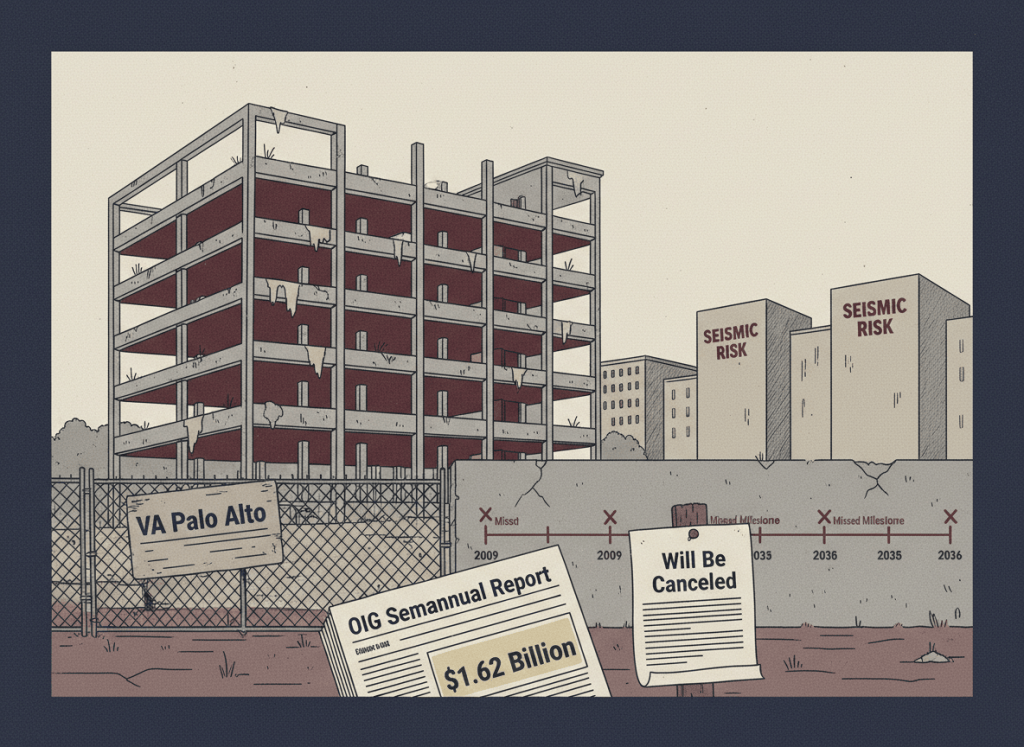
A Seismic Fix That Became a Campus
In its fiscal year 2009 budget request, VA told Congress it needed to replace six seismically deficient buildings at its Palo Alto medical center. Three of them were classified as exceptionally high risk of collapsing in an earthquake. The price was $450.3 million, and the finish line was 2015.
By September 2019, VA had completed ten of the project’s eleven phases. The list is instructive: two parking garages, a polytrauma and blind rehabilitation center, a radiology wing, a recreational therapy building, and a research and veterinary medical unit.
Even the finished phases ran over. The research and veterinary unit, awarded at $95.2 million, cost $117.2 million, and the first parking garage went from $98.8 million to $131.2 million.
The last phase, the ambulatory care center and the remaining demolitions, has never started. VA now says the project cannot finish before 2036, which is 21 years behind schedule and about $1.2 billion over the approved amount.
Congress approved $716.6 million in 2011. About $472.5 million had been appropriated and $458.8 million spent as of February 2025. The inspector general estimated that each year of delay adds about $74 million.
Nobody Approved the Doubling
The VA Office of Inspector General’s September 2025 review found no evidence that VA ever submitted the business case OMB requires, either for the original request or for the 2012 scope increase. OMB declined to help the OIG look for the filings.
The 2012 request raised the authorization from $450.3 million to $716.6 million and expanded the building from 379,100 square feet to more than 600,000.
VA also never brought the project into the acquisition framework it adopted in 2017 for major construction, and it did not use an integrated project team. The OIG found no evidence that critical risks were escalated to the executive who should have decided them.
A $50.4 million change request in 2015 never rose above the regional office. In 2021, a $459.8 million request met a harder fate.
The regional director wrote that he could not submit a request that doubled the cost estimate in a year, and warned that the project would be canceled at that rate. The project manager was told to say the funds were not needed. Within days, he learned he was being replaced.
The OIG could not find records explaining the reassignment or why the request was rejected.
In 2022, work on the ambulatory care center was paused for a different idea. A local university offered up to $250 million in donations in exchange for a 99-year lease on 25 acres of the campus for a cancer center.
VA officials told the OIG the approach had legal problems, and the plan ended in April 2024 when the university could not find a suitable site. For years, VA’s agency capital plans kept reporting the project at $716.6 million.
The Page That Says Canceled
VA concurred with the OIG’s recommendations. It said it would bring the project into its framework once a budget year was identified, and that it would hold a decision event when the documentation was complete.
It gave no dates, and it described the decision as ongoing, to be revisited each year in its Five Year Development Plan.
VA did dispute the missing business case. It gave the OIG a 2008 memo recommending the Secretary approve additional funding, and an unsigned draft memo to OMB that still showed tracked changes. The OIG said neither showed the project’s baseline had reached OMB.
The OIG closed one recommendation, about the capital plan, after VA updated the figure to about $1.6 billion. Recommendations 1 through 3 remain open in the inspector general’s latest semiannual report, which lists $1.62 billion in potential cost savings for the project.
That figure is $716.6 million in questioned costs plus $907.8 million in better-use funds, which together equal the project’s entire estimated cost. We took the number apart in our review of that report.
Then there is VA’s own website, where the Palo Alto construction page, updated September 10, 2026, exactly a year after the OIG report, now says the ambulatory care center project “will be canceled.” It is the only project on the page marked for cancellation.
Earlier versions of the page, as indexed by search engines, described the project as in planning, with construction funding no earlier than 2030. We found no announcement, press release, or notice to Congress about the decision.
What the Cancellation Doesn’t Answer
The same page describes the ambulatory care center project as the demolition of six exceptionally high-risk buildings: 4, 5, 54, and modular buildings MB1, MB2, and MB3. The OIG report counted three among the original six, so the numbers differ and deserve a reconciliation.
The page also lists EHR infrastructure work in all six buildings, and VA’s October 21 funding announcement includes roof repairs for Buildings 4 and 5.
The inference here is ours. If the project is canceled, those buildings stay in service, and neither the page nor the press release says what replaces the seismic fix.
VA may have mitigation plans, and nothing we found says the buildings are unsafe. The basis is VA’s own project descriptions and funding announcement.
The money is also unresolved. The OIG said taxpayers could save about $907.8 million if VA could not justify the project. A web page edit is not the decision event the OIG recommended, and nothing we found shows that event has happened.
Palo Alto is the twin of the Louisville medical center we covered last month in The Hospital Built on a Document That Never Existed. Both reviews found that VA could not produce the business case OMB requires, a year apart.
What began as an earthquake fix became a campus of garages, labs, and clinics. It now ends as one line on a web page.

