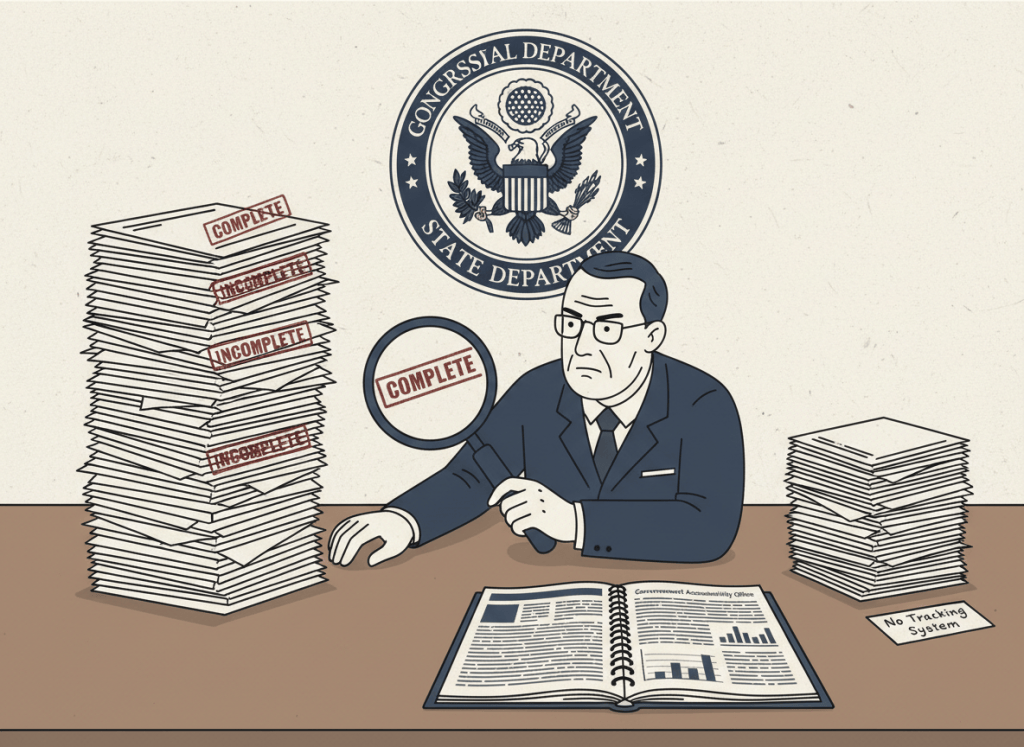
Federal auditors found widespread gaps in congressional notifications involving democracy assistance and other foreign aid. The State Department rejected recommendations to strengthen its reporting procedures.
WASHINGTON, Nov. 9, 2026 — The State Department failed to provide Congress with requested details about the legal restrictions it intended to override in 36 of 37 foreign assistance notifications examined by federal auditors, according to a Government Accountability Office report released Friday.
The GAO report, GAO-27-107900, found that the department’s congressional notification procedures did not consistently incorporate reporting directions established through annual appropriations legislation and accompanying congressional explanatory statements. Auditors also found that State frequently failed to connect its use of exceptional legal authorities to the specific programs those authorities would support.
The findings concern a mechanism known as notwithstanding authority, which allows federal agencies to provide certain foreign assistance despite restrictions that would otherwise prohibit it. Congress has authorized such exceptions to support democracy promotion, human rights, civil society and other foreign policy objectives.
The authority itself is lawful. The question raised by GAO is whether Congress receives enough information to oversee its use.
The State Department disagreed with both recommendations GAO issued to improve the reporting process.
Thirty-Seven Notices, One Complete Explanation
GAO examined 37 congressional notifications involving fiscal years 2023 and 2024 appropriations that cited notwithstanding authorities and were subject to specified reporting criteria.
All 37 identified a relevant legal authority. All 37 also included descriptions of the proposed activities, which GAO counted as justifications for using that authority.
Only one, however, provided the additional details about the underlying statutory restriction that Congress had directed agencies to include through explanatory statements accompanying the appropriations acts.
The distinction is important. Congress did not merely seek notification that the department intended to use an exception. Its explanatory statements called for information identifying the provisions of law being overridden and explaining why the exception was necessary.
Without that information, lawmakers reviewing a notification could know that an exception was being invoked without receiving a sufficiently detailed explanation of which statutory restriction the proposed assistance would overcome.
GAO did not conclude that the 36 notifications represented unlawful expenditures or unauthorized assistance. Its finding concerns the completeness of information supplied for congressional oversight.
But the scale of the omission raises a separate question about the department’s internal controls.
According to GAO, the State Department’s guidance for preparing congressional notifications did not address any of the three reporting criteria examined. Officials from five bureaus said they had not incorporated the additional congressional directions into their procedures.
The auditors also reported that State officials said the department does not track its use of notwithstanding authorities.
For a department responsible for administering foreign assistance subject to numerous statutory restrictions, that leaves an important oversight question: How does State maintain a comprehensive understanding of when, where and why its programs rely on exceptions to those restrictions?
The Missing Connection Between Legal Authority and Spending
GAO identified a second weakness in its examination of 101 State Department congressional notifications citing the democracy assistance notwithstanding authority for fiscal years 2021 through 2024.
Most lacked a clear connection between the legal authority being invoked and the particular programs or activities it was intended to support.
The problem is especially relevant when a notification covers multiple countries, funding accounts or program areas. A reference to notwithstanding authority in an introductory paragraph does not necessarily identify which activities in the accompanying narrative depend on that authority.
GAO found that State’s notification guidance did not direct bureaus to establish those connections.
The resulting ambiguity could complicate congressional efforts to determine which appropriated funds were being used under ordinary statutory authorities and which required exceptions.
USAID’s Reporting Problems Become State’s Responsibility
The audit also examined 101 congressional notifications submitted by the U.S. Agency for International Development.
GAO found inconsistent reporting practices, with approximately one-third of those notifications failing to link the democracy assistance notwithstanding authority to specific program areas or activities.
Auditors identified eight USAID notifications describing democracy-related activities within categories ordinarily classified outside democracy assistance. These included conflict mitigation and stabilization and efforts addressing trafficking in persons.
Those classifications do not, by themselves, demonstrate improper spending. GAO identified activities consistent with democracy assistance definitions even when the activities appeared under other program headings.
The broader issue was the difficulty of determining precisely how the agency intended to apply its legal authority.
That history has become more consequential following the federal government’s reorganization of foreign assistance.
In July 2025, the Secretary of State announced that USAID had ceased implementing foreign assistance. State subsequently assumed certain former USAID functions, including democracy assistance programs.
The department also closed the Bureau of Democracy, Human Rights, and Labor’s Office of Global Programming, which had managed much of that bureau’s democracy assistance portfolio. Responsibility for bilateral and regional assistance shifted to State’s regional bureaus, although the human rights bureau retained some democracy programming responsibilities.
Congress nevertheless appropriated $205 million for the Human Rights and Democracy Fund in each of fiscal years 2025 and 2026.
The department now faces the challenge of administering reorganized foreign assistance responsibilities while maintaining reporting procedures that GAO found deficient in the historical notifications it examined.
The audit does not establish that the same omissions occurred in fiscal year 2026 notifications. It does establish that the congressional reporting framework remains relevant: the explanatory statement accompanying the 2026 appropriations act again directed agencies to identify reliance on extraordinary legal authorities and provide information about their purpose.
State Rejects GAO’s Recommendations
GAO issued two recommendations.
The first called for the State Department’s Bureau of Legislative Affairs to develop guidance addressing congressional reporting criteria for notwithstanding authorities.
The second called for guidance directing notifications to identify the specific programs and activities for which those authorities would be used, when known.
State disagreed with both.
In its response, the department argued that congressional notifications are developed individually, consistent with applicable legal requirements, and that standardized guidance would not be appropriate or necessary.
GAO rejected the suggestion that clearer guidance would prevent individualized review. Auditors explained that reporting instructions could be updated to reflect annual appropriations requirements while preserving flexibility in how individual notifications are prepared.
The disagreement leaves Congress with a practical question: If the existing notification process repeatedly omitted information lawmakers had requested, what assurance does the department offer that its current procedures will produce more complete disclosures?
Congressional Oversight Depends on What Congress Is Told
Notwithstanding authorities serve a legitimate purpose in foreign policy. They allow assistance to proceed in circumstances where Congress has determined that exceptions to ordinary funding restrictions may be appropriate.
Such flexibility can support independent media, human rights organizations, democratic institutions and civil society groups operating under restrictive governments.
But exceptional authority and congressional oversight are not competing concepts. Congress can authorize flexibility while requiring agencies to explain how they intend to exercise it.
GAO’s findings demonstrate the consequences when those explanations are incomplete or difficult to connect to actual programming.
The auditors did not identify a proven scheme to evade congressional restrictions, nor did they determine that the assistance described in the notifications was improper. Their conclusions were narrower and more readily documented: State’s reporting practices did not consistently provide information intended to support congressional oversight.
With foreign assistance responsibilities consolidated within the State Department, those findings now concern more than the notification practices of the past.
They concern whether the department’s current reporting system can give Congress a sufficiently clear account of how federal funds are being administered under exceptional legal authorities.
Congress authorized the exceptions. GAO’s report asks whether Congress is being given the information necessary to oversee their use.
Source: U.S. Government Accountability Office, Democracy Assistance: State Department Should Improve Congressional Notification of Its Use of Certain Legal Authorities, GAO-27-107900, November 6, 2026.

