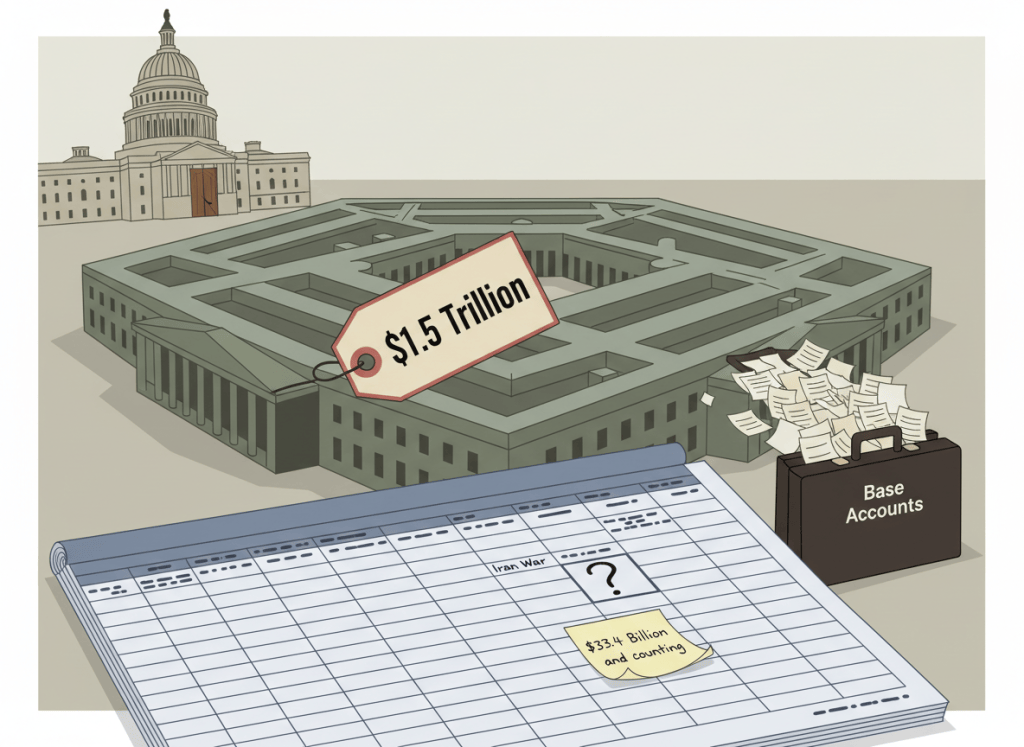
A new inspector general plan says the war is paid from base accounts. One audit is now looking for commitments that could be cancelled and redirected.
The Department of War asked Congress for $1.5 trillion for fiscal year 2027. The request included no money for the war with Iran.
That detail comes from the inspectors general’s new oversight plan for overseas contingency operations. The plan says the request also left out Operation Southern Spear and Operation Southern Guard. For Epic Fury and Southern Spear, the department pays from its base budget.
The request is 42 percent larger than FY2026 funding. It came out in April, weeks after U.S. forces launched Epic Fury on February 28.
A bill without a vote
The White House has not ignored the cost. On June 24, it asked Congress for $87.6 billion in supplemental funding, with $67.1 billion earmarked for the Pentagon.
Congress has not settled it. The House passed a $95 billion package in July on a 216-212 vote. Senate Republican leaders said they preferred a different route.
As of early October, a RealClearPolicy analysis noted that Congress had never passed a dedicated appropriation for the war. The same piece says the executive branch is spending from base accounts originally appropriated for other purposes.
The meter keeps running. The Lead IG’s first quarterly report put the cost at $33.4 billion through June 29, including $22.3 billion in munitions. The Congressional Budget Office, using a broader method, counted $38.1 billion through August 1 and said the war runs $2 billion to $3 billion a month.
The audit hunting for money
The plan lists one audit written specifically for Epic Fury. It examines open FY2026 funding commitments for the war.
Its stated aim is to find stale, invalid or excess commitments. Those could be cancelled and redirected to other unfunded warfighter priorities.
The plan does not say what those priorities are. It does not say how much money is at stake.
Other planned audits cover munitions distribution by U.S. Transportation Command, THAAD interceptor purchases using Defense Industrial Base funds, and damage to U.S. installations in the Middle East.
The plan lists no completed oversight reports on the war.
The inspectors general also say they have not verified the agency data in the plan, apart from their own audits. The cost report carried a similar caution that most agency information was not independently verified. The figures come from the Pentagon itself.
Guantánamo faces the same gap
Southern Guard shows a similar problem. The department was reimbursed by DHS in FY2026.
As of July 8, it had not received a request from DHS to continue in FY2027. The Lead IG is now reviewing whether the mission still meets the threshold for dedicated oversight.
What remains unanswered
Bureaucracy Times is directing inquiries to the Department of War and the DoW Office of Inspector General. Three questions remain open:
- Which base accounts are carrying Epic Fury’s costs now, and what is being delayed to pay for them?
- What has the open-commitments audit found, and where would any freed money go?
- What funds the war in FY2027 if no supplemental passes?

