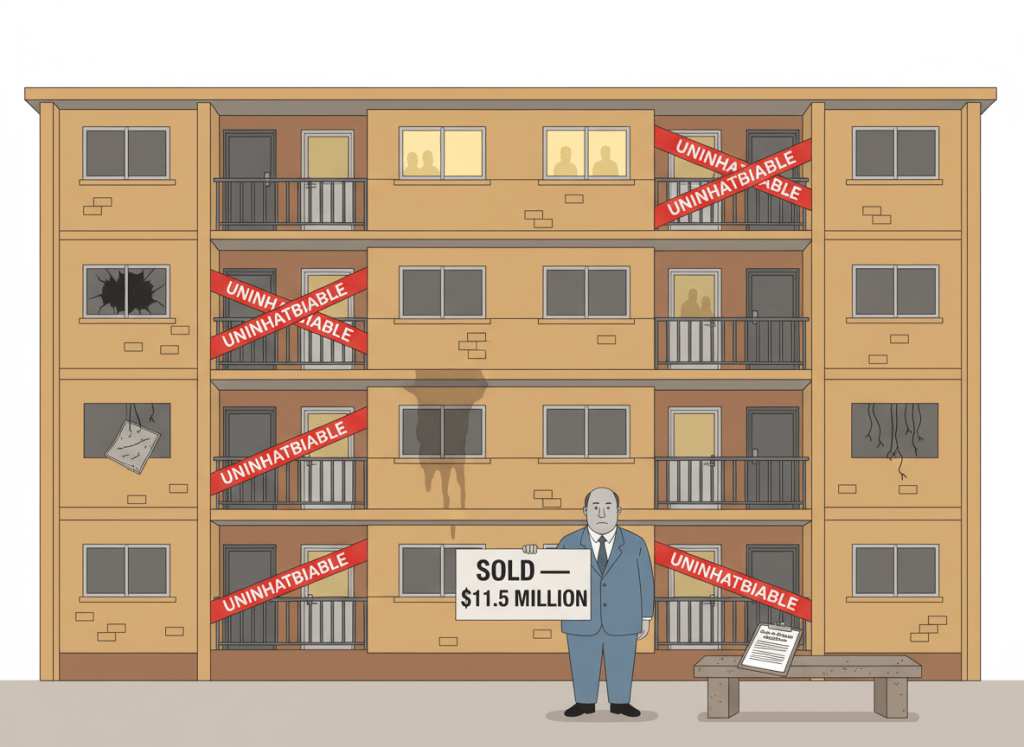
In November 2024, the State Department’s Bureau of Overseas Buildings Operations (OBO) paid $11.5 million for a 16-unit housing complex in Accra, Ghana. Embassy staff told inspectors that they and OBO already knew about the leaking roofs, leaking plumbing, faulty electrical wiring, black mold and air conditioners that needed replacing.
They knew because the Embassy had been leasing 10 of the 16 units. OBO decided that buying the place was in the Department’s interest anyway.
Today, two of the 16 units are occupied. The other 14 have been deemed uninhabitable.
Those are the findings of the State Department Inspector General’s October 2026 inspection of Embassy Accra (ISP-I-27-01). During the inspection, a ceiling in one unit collapsed, nearly hitting the occupant and leaving damp electrical wiring exposed.
Buyer, Be Aware
When OBO tried to use the warranty on the purchase, the seller did not honor it and performed no repairs. The report does not name the seller.
The Inspector General puts the cost of making every unit habitable at $4.7 million and about a year of work. In the meantime, the Embassy would spend roughly $768,000 leasing other residences. The Embassy’s own response says it is spending nearly $800,000 annually to house 16 U.S. direct-hire officers and their families elsewhere.
Add the repairs to the purchase price and the Department is at $16.2 million for 16 units, or about $1 million apiece. That is our arithmetic, not the report’s.
The complex also dominates the report’s money findings. Of the roughly $7.75 million the Inspector General says the Embassy could put to better use, $4.7 million is Brimmo Gardens. The rest is $2.54 million in overdue suspense deposits and $510,630 in unpaid salary and travel advances.
The Inspector General’s remedy is a cost-benefit analysis on whether to repair the complex or abandon it. That analysis comes after the purchase. OBO is also in the process of leasing 76 new housing units for the Embassy by 2028, which the report says may leave the Embassy with enough housing without Brimmo Gardens.
The paper trail is thin but telling. On August 19, 2026, a federal solicitation (19GH1026Q0026) went up seeking building inspectors for a 16-unit compound at 6 Inner Road, Cantonments. The job is to identify needed repairs, rank them by priority and produce a rough cost estimate.
That is about 21 months after the purchase. Our inference, resting only on the solicitation’s wording: either no comprehensive repair assessment existed when the Department bought the complex, or the Department wants a new one. The solicitation does not say which.
Nobody Home at the Front Office
Much of the Inspector General’s explanation for the Embassy’s troubles is a leadership vacuum. The ambassador left in May 2025, and the deputy chief of mission became chargé d’affaires. Section heads then rotated through the acting deputy role.
As of March, the American Foreign Service Association’s ambassador tracker still listed Ghana as vacant, with no nominee. We found no nomination since.
The Inspector General found the Embassy did not maintain certain internal controls. It skipped required annual anti-nepotism reviews. It failed to supervise the Consular Section, including reviews of visa decisions.
The acting deputy from October 2025 through March 2026 was the Consul General’s spouse, and so barred from supervising consular functions. That put all consular oversight on a chargé with little time for it.
None of these problems appeared in the Embassy’s FY 2025 management control statement of assurance, issued in July 2025. The Inspector General’s separate management review of the chargé found no actions or behaviors of serious concern.
The rest of the ledger is not small. Only 2 of 20 reviewed foreign assistance grant files documented monitoring, and 7 of 20 contained the required terrorist financing risk assessment. For many grants, the Inspector General could not tell whether monitoring happened at all, because most of the responsible staff had left.
U.S. citizens waited longer for passports and consular reports of birth abroad than foreign nationals waited for nonimmigrant visas. Managers told inspectors they had prioritized visa demand tied to the 2026 World Cup.
Non-State Department agency staff and temporary visitors were 28 percent of drivers but accounted for more than 61 percent of DriveCam events. A general services employee defrauded at least six colleagues of vehicle insurance and registration fees, then resigned before termination.
The Embassy blames the closure of the USAID mission, which forced the Management Section to decommission 57 leased residences and ship the belongings of 55 staff home. That explains some lapses. It cannot explain Brimmo Gardens, which was bought about six months before the ambassador left and before the USAID mission closed. That is our inference, based on the report’s dates. The report does not say who approved the purchase.
A Success Story, Lightly Edited
The report credits the Embassy with real wins. Several rest on facts that have since moved or that the report leaves out.
On health aid, the report says Ghana rejected a memorandum worth $109 million over five years, citing privacy of health data. Since then, Ghana’s health minister said the government is reviewing a revised U.S. proposal. He said an earlier objection involved a provision that would reportedly exempt covered U.S. pharmaceuticals from Ghana’s Food and Drugs Authority verification.
Chargé Rolf Olson told Ghanaian reporters that 2026 health funding is $53 million and that the memorandum holds it level before declining. One Ghanaian outlet reported that Ghana would have owed $70 million in matching funds and that Washington sought a signature within a week. Olson described months of negotiation. We could not verify the one-week claim.
On debt, the report says an agreement was under negotiation but not finalized. The Embassy said the two countries signed a bilateral debt agreement on May 6, 2026, eight days before the inspection ended. Our inference: the report may describe an earlier point in the fieldwork. It does not say so.
The Embassy also claims credit for Ghana accepting third-country nationals removed from the United States. President Mahama said Ghana would take only West Africans and that 14 had already arrived, with no cap announced. He also described relations as “tightening” amid higher U.S. tariffs and visa restrictions on Ghanaians. The report presents the arrangement without that context.
Finally, the report cites $77 million in Ghanaian arrears paid to U.S. firms. It names no firms. In January 2025, Sen. James Risch put what Ghana owed American companies at about $251 million. The Embassy was still urging progress on those arrears in May.
What the Report Leaves on the Table
The Department concurred with all 16 recommendations, and the Inspector General considers them resolved. Resolved means the Department agreed to do something. It does not mean Brimmo Gardens is fixed.
OBO says the Embassy has asked an architecture and engineering firm to inspect the property and has sought legal advice from OBO, the Justice Department and local counsel about pursuing the seller. Its findings go to OBO leadership “in the coming months.”
Three questions stand out. Who approved buying a complex the Embassy was already leasing and knew was defective, and on what analysis? Who sold it, and has the Department recovered anything under the warranty? Will the cost-benefit analysis be made public?
Inquiries are being directed to the State Department and OBO. This story will be updated with their responses.
Until then, the ledger stands at $11.5 million spent, $4.7 million more to fix, two occupied units, and 14 empty units waiting on a spreadsheet.

