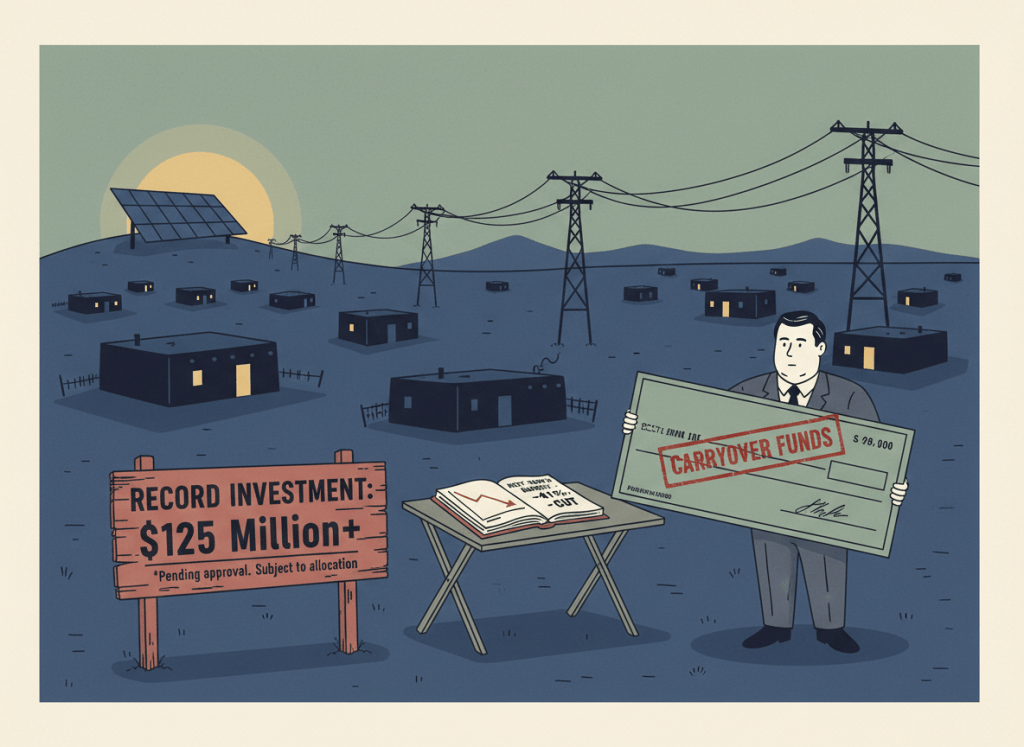
The Department of Energy announced “over $125 million” for 63 tribe-led energy projects on October 22. It called the round the largest single investment in the Office of Indian Energy’s 20-year history.
Deputy Secretary James Danly called it historic. The release is generous with adjectives.
It is thinner on arithmetic, on where the money came from, and on what happens to the program next year.
One caveat comes first. These are selections for negotiation, not awards, and DOE says it can cancel negotiations and rescind a selection for any reason.
The Number That Wasn’t Quite the Number
The release says “over $125 million.” The project list DOE posted alongside it points to something larger.
Each of the 63 entries carries a “Federal Funds Requested” figure. Added up, they total about $137.2 million: roughly $70.1 million for community-scale deployment projects, $24.0 million for predevelopment work, and $43.1 million for large-scale planning.
Total project value, including cost share, comes to about $148.4 million.
“Over $125 million” is technically true of $137 million. It is also a figure that tells a reader nothing about what DOE actually intends to commit.
The likeliest explanation is negotiation.
That is an inference, resting on the list’s own disclaimer that project details are subject to change and on DOE’s statement that selection is not a funding commitment. The reasoning is simple: requested amounts often shrink at the bargaining table.
DOE has not said which number it will stand behind.
A Record Assembled From the Back of the Drawer
The origin of the money matters more than the total.
DOE’s March announcement offered $50 million. The selections page says applications requested about ten times that amount.
DOE did not pick winners from a $50 million pot. It expanded the pot, and Office of Indian Energy Director Eric Mahroum told Tribal Business News that the office used carryover funds to do it.
Carryover is money Congress appropriated earlier that has not yet gone out the door. DOE has not said which fiscal years it came from.
Scale it against the office’s own books. DOE’s FY 2027 budget justification shows Congress enacted $75 million for the office in FY 2026, with $51 million of that for financial assistance, meaning grants.
This single round is between two and a half and nearly three times that annual grant line. It also equals roughly two thirds to three quarters of the more than $190 million the office says it has invested since 2010.
Now read the same budget document forward. The administration’s FY 2027 request is $50.038 million for the whole office, a 33 percent cut.
Financial assistance drops from $51 million to $30 million, a 41 percent cut. Federal staffing drops from 34 positions to 24.
The record, in other words, cannot be repeated on the money the administration is asking for.
That is an inference, drawn from the FY 2027 request table and Mahroum’s carryover statement. If a normal year’s grant line is $30 million, no ordinary year produces $125 million without another stockpile to draw from.
The staffing math is worse. The office’s mid-year update reports 57 active projects.
Add 63 selections headed into negotiation and the office has about 120 projects to manage against a request for 24 federal employees.
That is arithmetic from two DOE documents, and the 24 covers all staff, not just project officers. It is still a lot of projects per person.
One Hundred Fifty Homes
The release says the 13 community-scale projects will bring electric service to 150 tribal homes that currently lack it.
DOE’s own July 2026 strategic plan estimates that 17,000 to 23,000 tribal households still lack power. It lists eliminating that access gap among the office’s priorities.
One hundred fifty homes is less than one percent of either figure.
The release does not say which project delivers them. Only one of the 13 titles describes home electrification: the Navajo Tribal Utility Authority’s “Electrification of Homes on the Navajo Nation Project,” at $7.5 million federal and $10 million total.
It is likely the source of the 150 homes.
That is an inference, resting on the project titles and the release’s wording, and the reasoning is that nothing else in that category is described as residential electrification. If it is right, the cost works out to about $66,700 per home.
The same sentence of the release also promises to convert 500 homes and businesses to natural gas heating. The list’s matching entry is a $6.7 million natural gas distribution expansion for the Seneca Nation.
Heating is useful. It is not electricity access.
The Money Already Promised
This is not the first federal program to promise tribal homes power.
Interior’s Tribal Electrification Program received $150 million from the Inflation Reduction Act.
Its second and final round, $71 million for 13 tribal communities, was announced in September 2024. The Navajo Tribal Utility Authority was among the recipients.
An opinion piece in the Washington Times on October 21 argues that this second-round money has still not been released. Its author reports that Interior’s Indian Affairs office responded by citing efforts to cut bureaucratic waste.
Bureaucracy Times has not independently confirmed the status of those awards.
The same utility now appears on both lists: promised Interior money that may be stalled, and a new DOE selection that is not yet a commitment.
What Remains Unanswered
Inquiries are being directed to DOE and Interior. Three questions lead the list:
- What total federal amount does DOE intend to obligate, given that the project list sums to about $137.2 million against a headline of “over $125 million”?
- Which fiscal years’ carryover funded the expansion, and why was it unobligated?
- Has Interior released the second-round Tribal Electrification Program funds, and how many tribal homes does the federal government now expect to electrify?
The record round makes a fine press release.
Whether it makes a fine power line depends on the negotiations, a budget request pointing the other way, and an office asked to do more with ten fewer people.

