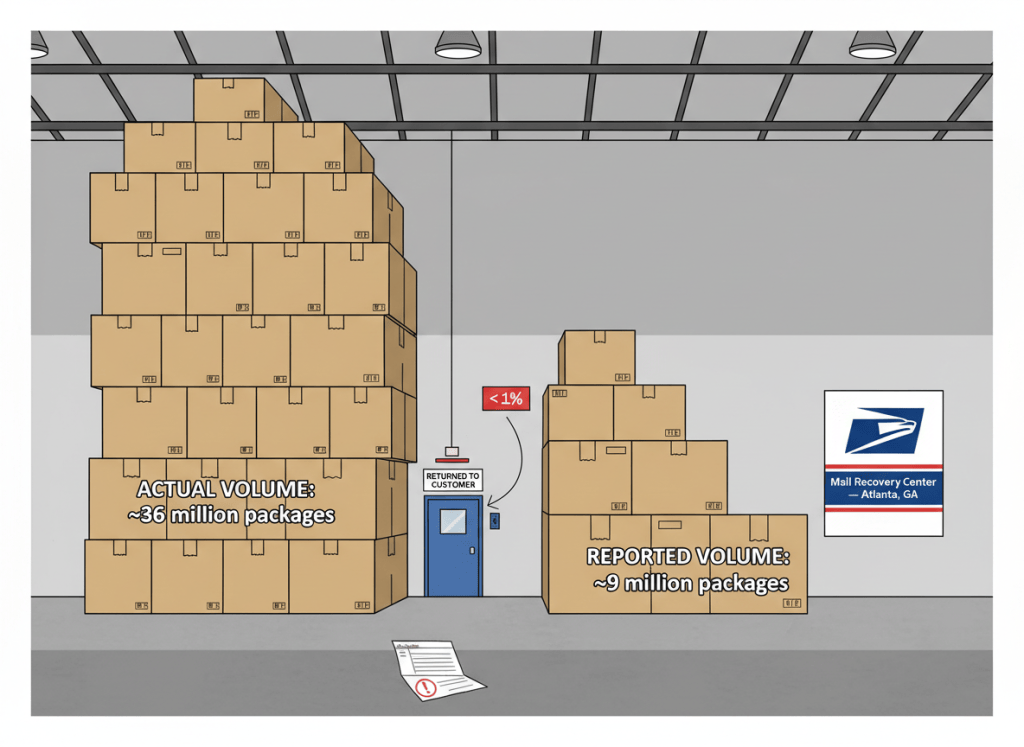
The U.S. Postal Service thought its national lost-package operation was returning roughly four out of every 10 eligible packages to customers.
Its inspector general took another look at the math. Measured against all packages arriving at the Mail Recovery Center, the return rate was less than 1 percent.
That is one of the more striking findings in a new USPS Office of Inspector General audit of the Mail Recovery Center, the Postal Service’s Atlanta-based destination for “dead mail” — packages that cannot be delivered to their intended recipient or returned to the sender.
The audit found that USPS was dramatically underestimating how many packages were entering the operation, using a return-rate calculation that excluded the overwhelming majority of incoming packages and relying on a spreadsheet containing a formula error that had gone undetected since 2016.
All told, the OIG estimates roughly 36 million packages arrived at the Mail Recovery Center between October 2023 and February 2026. USPS operational figures showed only about 9 million.
The 27 million-package math problem
The discrepancy begins with how USPS estimated incoming package volume.
Because every package entering the Mail Recovery Center was not individually scanned, the Postal Service estimated package counts using the weight of incoming containers. The calculation assumed an average package weighed 3.56 pounds.
OIG examined actual scan data and found the average was closer to 0.89 pounds.
That difference is not exactly rounding error. A 200-pound container that would be estimated to contain roughly 56 packages using the Postal Service’s assumption could contain about 225 using the OIG’s observed average.
Applied across the operation, OIG concluded the Mail Recovery Center received approximately 36 million packages during the audit period — about four times the 9 million reflected in the center’s reported volume.
Then came the return rate.
Mail Recovery Center management reported returning about 39 percent of packages to customers. But the denominator used for that calculation included only 607,233 packages the center considered eligible for return, rather than the roughly 36 million packages OIG estimated actually entered the facility.
That excluded about 98 percent of incoming packages from the calculation.
Measured against all incoming packages, OIG calculated the customer return rate at less than 1 percent.
The distinction was not merely academic. According to OIG, Postal Service executives cited return rates in the 30-to-40-percent range believing the figures represented all incoming packages. They did not.
Most packages entering the center were ultimately auctioned, recycled, donated or discarded.
And then there was the spreadsheet
OIG also discovered an error in the Excel spreadsheet used to calculate Mail Recovery Center performance metrics.
The formula double-counted certain successfully returned packages, further inflating the reported performance figure. According to the audit, the error dated to 2016 and remained undetected until inspectors examined the calculations.
USPS management continues to disagree with OIG over how the return rate should be presented. The Postal Service argues the existing metric appropriately measures packages that are actually eligible to be returned. OIG argues an overall return rate is also necessary because senior management had interpreted the narrower measure as describing the entire stream of packages entering the facility.
That recommendation remains unresolved.
A free disposal service for commercial shippers
The audit identified another expensive problem hiding inside the mountain of undeliverable packages.
At high-volume facilities reviewed by OIG, roughly 75 percent of dead-mail packages came from commercial shippers that repeatedly used the Mail Recovery Center by refusing returned packages carrying postage due or otherwise avoiding taking the merchandise back.
In effect, OIG said, the Mail Recovery Center was providing some commercial shippers with a free disposal service.
One fulfillment center outside Los Angeles reportedly refused approximately 250 returned packages every week for three to four years rather than pay the return postage.
OIG estimated USPS lost $109 million in return-postage revenue between October 2023 and February 2026 and calculated that a refusal fee could have generated another $54 million during the period. USPS disputed those monetary calculations, saying it could not replicate OIG’s estimates and arguing that revenue generated from reselling abandoned merchandise should be considered against processing costs. OIG stood by its methodology.
Meanwhile, customers were waiting
The operational problems were visible outside the accounting system.
Missing packages generated approximately 5 million customer complaints in fiscal 2025, more than any other USPS service or product, according to the audit.
OIG found that only 7.6 percent of packages scanned when they arrived at the Mail Recovery Center had previously received the required scan showing they were being sent there. Without that scan, customers — and sometimes postal employees — could not readily determine where a package had gone.
Inspectors also found packages looping repeatedly through the postal network because employees failed to mark them properly. One package reached the Mail Recovery Center five separate times over nearly four months.
As of May, the center also had a four-month backlog of damaged packages awaiting processing. One package mailed from Cleveland on Dec. 19, 2025 — apparently intended as a Christmas shipment — finally reached its customer May 11, 143 days later.
USPS agreed or partially agreed with eight of OIG’s nine recommendations, which include improving package-volume measurements, strengthening required scanning, addressing repeat commercial refusals and improving performance reporting.
The audit ultimately describes something larger than a warehouse struggling with lost Christmas presents. The Postal Service had a national operation handling tens of millions of undeliverable packages, but its own measurement system understated the volume by roughly 27 million packages and produced a success rate senior executives misunderstood.
For an operation devoted to finding things that went missing, the Mail Recovery Center appears to have temporarily misplaced its denominator.

