The Numbers GAO Was Willing to Count
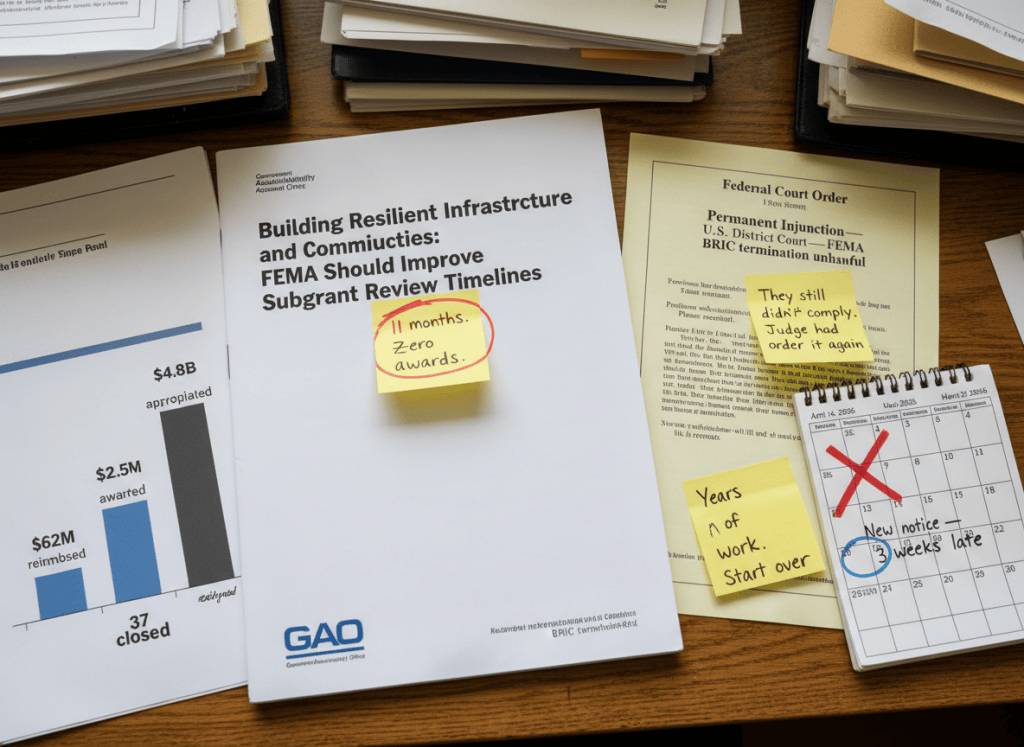
The Government Accountability Office released a report this week on FEMA‘s Building Resilient Infrastructure and Communities program, the agency’s flagship pre disaster mitigation grant, and the numbers it counted are damning enough on their own terms. As of March 2025, FEMA had awarded 1,245 BRIC subgrants worth about $2.5 billion, which sounds respectable until you notice that figure is half of the $4.8 billion Congress actually made available. Of what had been awarded, FEMA had reimbursed $62 million and closed out exactly 37 subgrants. The median time for FEMA to finish reviewing a subapplication and award the money, GAO found, is 7 to 9 months. Another 700 subapplications, tied to roughly $2.2 billion, were sitting in the second of FEMA’s two review stages with no decision made at all.
GAO quotes communities saying, in the mild register that federal audit reports reserve for people who are furious but trying to stay eligible for future funding, that these timeframes “could extend project timelines and increase costs.” The report’s seven recommendations are the standard genre of fix; identify efficiencies in the subapplication review, apply lessons learned to communication, establish performance goals. All reasonable. All aimed at a process problem.
Here is the sentence in the report that is doing more work than it appears to be doing. From April 2025 to March 2026, FEMA awarded no subgrants and obligated no funds. Eleven months, stated as a fact about program administration, sitting inside a report about review timelines.
What Happened Between April and March
That eleven month gap was not FEMA finishing its paperwork slowly. It was FEMA terminating the program.
On April 4, 2025, FEMA formally ended BRIC, cancelling pending applications going back to fiscal year 2020 and moving to redirect the money elsewhere, a move detailed in the federal court’s later ruling on the matter. BRIC is not a discretionary line item FEMA can turn off by memo. It is funded through direct congressional appropriations under the Infrastructure Investment and Jobs Act and set asides from the Disaster Relief Fund under the Stafford Act, which is precisely what a coalition of states argued when they sued that July.
On December 11, 2025, U.S. District Judge Richard Stearns agreed with them, and did not agree gently. He ruled that FEMA’s termination violated the Further Consolidated Appropriations Act of 2024, the constitutional separation of powers, the Appropriations Clause, and the Administrative Procedure Act, and issued a permanent injunction ordering the program restored. FEMA did not restore it. Two months later, the same states had to go back to court and ask a judge to force compliance with his own order, which the Washington state attorney general’s office documented in March 2026, when Judge Stearns issued an enforcement order giving FEMA 21 days to publish a new funding notice. FEMA published it on March 25, 2026, three weeks past the deadline it had already been given twice.
So the eleven months in GAO’s report is not a measurement of bureaucratic friction. It is the interval between an unlawful act and a federal court forcing its reversal, with an extra two months tacked on for the agency’s noncompliance with its own defeat. GAO’s highlights page does not use the words termination, lawsuit, or injunction. It uses the word timeframes.
The plaintiffs were not abstractions. Maryland’s attorney general noted that the termination left more than $80 million in BRIC funding for the state in question, including flood mitigation work for Crisfield and South Baltimore. Arizona’s attorney general listed 25 selected projects worth $9.8 million, among them a $4.6 million infrastructure project in Buckeye. These were not requests still being drafted. They were projects that had cleared FEMA’s review and were waiting on a check, from a government that had already told the public the check was cancelled.
FEMA’s Version of the Same Year
FEMA’s own account of this period, issued as a public notice to states, tribes, and territories, tells a different story than the one a federal judge told. It explains that BRIC “became bogged down in bureaucracy, focused on climate change initiatives, and riddled with inefficiencies” under the previous administration, which is why Secretary Kristi Noem “directed FEMA to conduct a methodical evaluation of the program.” The notice adds that FEMA will resume normal operations “once the lapse in appropriations has ended,” folding the government shutdown into the same sentence as the agency’s own program suspension, as though the two were the same kind of interruption.
Nowhere in FEMA’s telling does a judge find that the agency broke the law. The “methodical evaluation” and the illegal termination occupy the exact same calendar days; FEMA simply gets to narrate them as a virtue rather than a defeat. This is the closest thing this story has to a punchline. A federal court says the government violated the separation of powers to shut down a program Congress funded. The agency responsible calls it stewardship.
Reapply, Please
The 700 subapplications GAO found stalled in review as of March 2025 were caught in that stage precisely when the termination hit. The program that eventually reopened is not, procedurally, the one they applied to. FEMA’s own fact sheet for the restored funding opportunity states plainly that “previous subapplications submitted for the initial Fiscal Year 2024 BRIC funding opportunity will not be reviewed,” and instructs applicants to “review, update, and resubmit in accordance with this new funding opportunity.”
Communities that had already cleared FEMA’s first review stage, in some cases years earlier, were told their applications no longer exist. Whatever work went into a benefit cost analysis, a scope of work, a local match commitment, has to be redone against new evaluation criteria FEMA wrote after Congress had already appropriated the money for the old ones.
None of GAO’s seven recommendations addresses this, because GAO’s mandate is process efficiency, not legality, and by the time its auditors were writing, the termination was already adjudicated elsewhere. What the report actually documents, whether it means to or not, is what happens to an audit’s own numbers when a program spends nearly a year not existing. The 7 to 9 month review time GAO flags as the problem to fix was, for the 700 communities caught in it, the least of their delays. They were not waiting on FEMA to finish reading their file. They were waiting on FEMA to admit the file still counted.
Sources: Government Accountability Office, Building Resilient Infrastructure and Communities: FEMA Should Improve Subgrant Review Timelines (GAO-26-107774, September 2026); Washington v. FEMA, U.S. District Court, Memorandum and Order (December 11, 2025); Washington State Attorney General, Court Order Enforcing BRIC Ruling (March 2026).

