Late in 2024, the Department of Education did something almost unheard of in federal data governance. It admitted a flaw in one of its own signature statistics and started building the fix. Officials began requiring states to report the number of students enrolled in a school across the full school year, the same timeframe already used to count chronically absent students, instead of the single frozen October snapshot that had been producing chronic absenteeism rates north of one hundred percent. It was a small, boring, correct decision. Then the Department gutted the office responsible for finishing it, and decided the fix wasn’t worth finishing after all.
A Reorganization With a Body Count
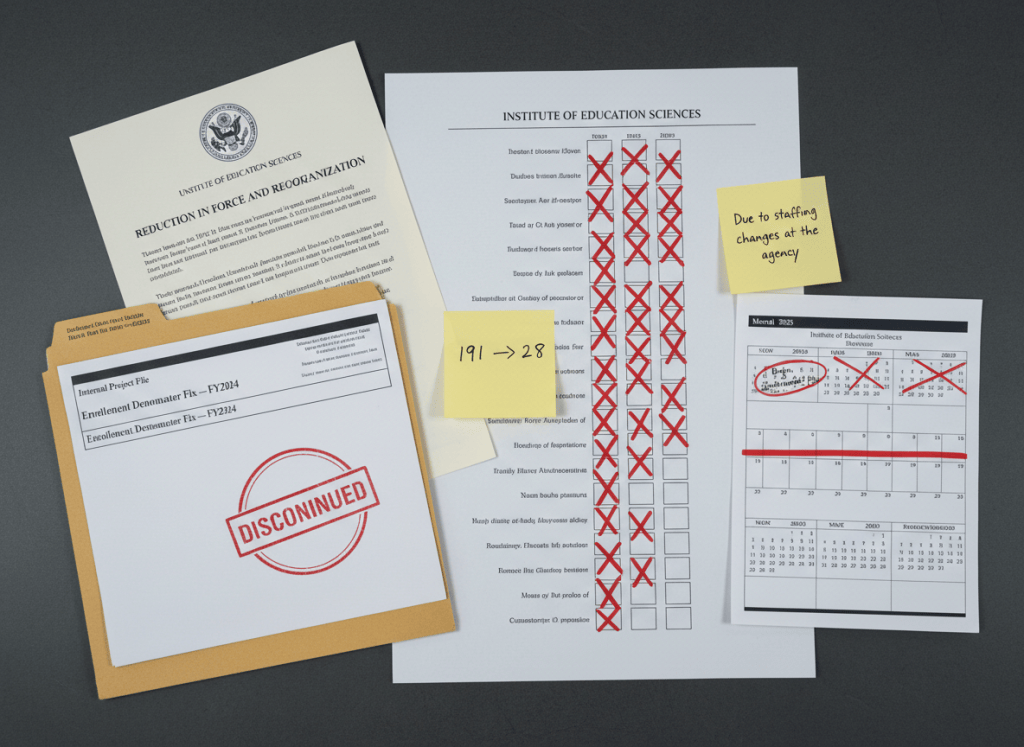
In March 2025, the Department announced a reduction in force and reorganization. The numbers, drawn from Office of Personnel Management data cited in GAO’s report, are not subtle. The Institute of Education Sciences, the statistical and research arm responsible for the EDFacts data collection that produces chronic absenteeism figures, went from 191 staff at the end of calendar year 2024 to 28 staff at the end of 2025, a reduction of more than 85 percent. The Office of Elementary and Secondary Education, which officials told GAO serves as data steward for the chronic absenteeism collection specifically, lost 43 percent of its workforce over the same period.
Officials were direct with GAO about the sequence of events. They began the enrollment fix in late 2024. They later decided not to proceed, “due to staffing changes at the agency.” That sentence, delivered without elaboration, is doing an enormous amount of work. It is the Department’s own explanation for why a known, documented flaw in a nationally reported education statistic will keep producing implausible numbers indefinitely. Not because the fix was hard. Because the people assigned to do it no longer worked there.
The Burden That Was Already Being Carried
What makes the abandonment particularly hard to defend on the merits, as opposed to the staffing chart, is how little the fix would have actually cost anyone. States are already required to identify which students were enrolled in a given school for at least 10 days, because that is the threshold used to determine who counts as chronically absent in the first place. GAO interviewed an outside expert on chronic absenteeism data who made the obvious point plainly, since states are already identifying and collecting these enrollment figures internally to comply with an existing requirement, reporting that same number to EDFacts, rather than the separate October 1 snapshot, would add minimal additional burden.
This is not a case of the Department discovering a fix that would require new infrastructure, new surveys, or new cooperation from fifty-one state agencies that would rather not be bothered. The data was already sitting in state files. The only missing step was an internal decision, at the Department, to accept it as the new denominator and update the collection specification accordingly. That decision got made, reversed, and shelved, all inside about a year, and the reversal had nothing to do with the states.
It is also worth noting what this same reorganization did not spare. The same Department that could not staff a straightforward denominator fix also suspended its consolidated monitoring of ESEA fiscal and programmatic requirements across all fifty one states in 2026, the subject of a separate finding in this same GAO report. These are not two unrelated cost-cutting decisions that happened to land in the same document. They are two downstream consequences of one upstream event, a reduction in force large enough to leave the agency unable to sustain either its oversight function or its data quality commitments, at the same time, in the same fiscal year. When an agency loses eighty five percent of a statistical office’s staff, it does not get to treat the resulting gaps as a series of isolated, defensible tradeoffs. It has one explanation, repeated in two different sections of the same audit.
A Strategic Plan That Reads Differently in Hindsight
The Department’s own Strategic Plan for fiscal years 2022 through 2026 identifies strengthening agencywide data governance as a stated goal, and names improving the quality of data collected from grantees and subrecipients as one of the strategies for getting there. GAO quotes this language back at the Department in its report, not unkindly, but not gently either. An agency does not get credit for a data governance strategy it wrote down and then failed to staff.
The Department’s public defense of the current approach, offered in its formal response to GAO’s recommendations, does not mention the reduction in force at all. It says only that the Department has “chosen to continue working with currently reported EDFacts data elements, highlighting limitations as needed, rather than imposing additional reporting burden on states.” That framing casts the decision as a considered tradeoff between data quality and administrative burden. GAO’s own reporting elsewhere in the same document shows it was not a tradeoff at all. It was a project that started, ran into a staffing cliff, and stopped, and the public explanation retroactively describes the stopping point as a choice.
There is a version of this story where an agency looks at its own reduced capacity, decides which existing commitments it can no longer keep, and says so plainly to Congress and the public. There is another version where the agency keeps the sentence about “highlighting limitations as needed” and quietly drops the sentence about staffing changes into an interview with an auditor, where it will only surface if someone reads a forty page report closely enough to notice the connection. The Department picked the second version. GAO just happened to be reading closely, and the version of events available to anyone who does not read forty page audit reports, meaning most parents, most school board members, and most of Congress, is still just the tidy line about choosing not to impose additional burden on states.
Source: U.S. Government Accountability Office, K-12 Education: Actions to Improve Oversight of Key Federal Programs and Address High Chronic Absenteeism (GAO-26-107920, September 2026). Related: Eighteen Billion Dollars, and Nobody Assigned to Watch It and A Chronic Absenteeism Rate of 125 Percent Is Still an Official Federal Statistic.

