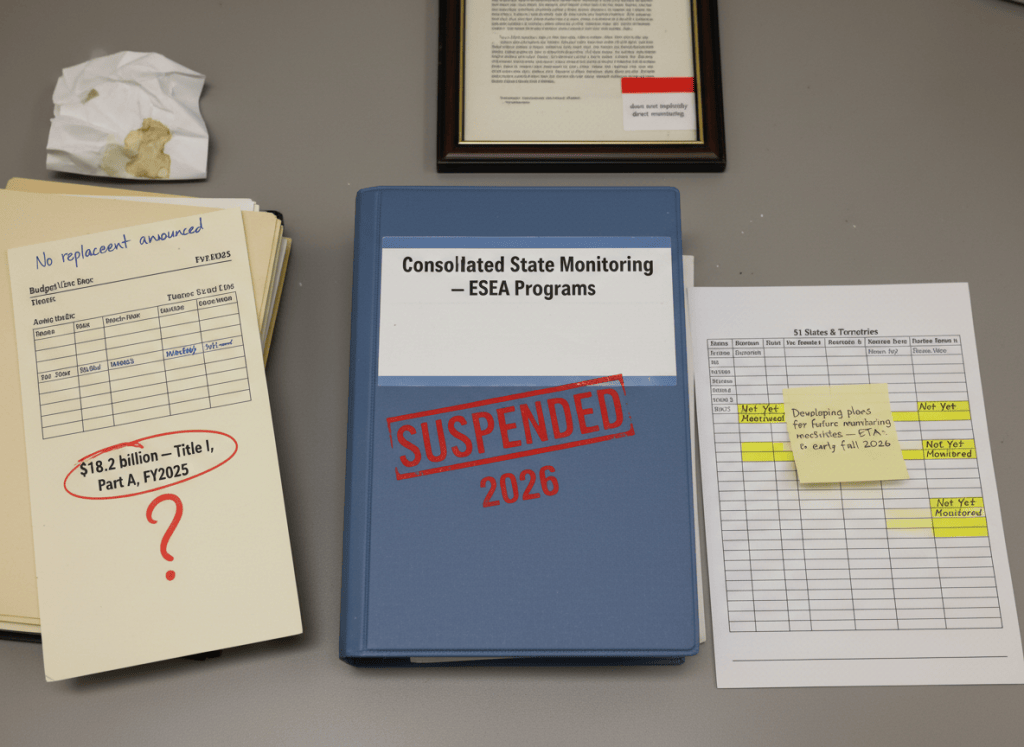
The Elementary and Secondary Education Act asks the Department of Education to do a great many things for the nation’s schoolchildren. Monitor how the money is spent is not, technically, one of them. Not with any specificity, anyway. Congress wrote a provision meant to improve oversight of ESEA funds that never actually orders the Department to monitor anyone, sets no required method, and specifies no frequency.
It is the legislative equivalent of telling a teenager to “keep the house clean” and then being surprised, four years later, when the sink is a biohazard.
The Government Accountability Office spent from November 2024 to September 2026 looking into how the Department watches over roughly twenty-seven billion dollars a year in K12 funding, ostensibly to examine chronic absenteeism policy. What it found along the way is a much bigger story than absent children.
In 2026, the Department of Education suspended its most comprehensive monitoring strategy for ESEA programs entirely. Thirty two of fifty one states have not undergone consolidated monitoring since the Department fully implemented the strategy in 2019. Officials could not tell GAO when monitoring might resume, or what would replace it, or really much of anything, other than a promise that a 2027 monitoring plan is coming “in early fall 2026.”
The Word That Isn’t in the Statute
Consolidated monitoring was the Department’s flagship tool for checking whether states receiving ESEA money, the great majority of it flowing through Title I, were actually complying with fiscal and programmatic requirements. It is a broad, single streamlined review of key ESEA programs, the kind of audit that catches the boring, unglamorous compliance failures before they become the interesting, headline generating kind.
GAO’s report is careful to note that the statute intended to strengthen this oversight does not “explicitly direct Education to monitor grantees,” nor does it set “specific requirements regarding the method or frequency of monitoring and oversight activities.” Officials told GAO, more or less accurately, that they have broad discretion in how they carry out oversight responsibilities and that nothing legally compels them to do it any particular way.
This is the sort of statutory gap that exists in dozens of federal programs and rarely matters, because agencies tend to keep doing the thing they were doing regardless of whether a statute makes them do so. It matters here because the Department stopped anyway, and did so with no announced replacement, no interim safeguard, and no explanation beyond “developing plans for future monitoring activities.”
Discretion is a wonderful thing to have written into law, right up until an agency uses it to simply not act.
Title I, Part A alone accounted for over eighteen billion dollars of the roughly twenty seven billion in ESEA formula funding in fiscal year 2025, about two thirds of the total. GAO’s own prior work, cited in this report, has already flagged the decentralized structure of state administered programs like Title I as a fraud vulnerability.
Suspending the primary mechanism for catching fiscal noncompliance in a decentralized, state administered, multibillion dollar program is not a small administrative housekeeping decision. It is the removal of the one instrument that was checking whether the money went where Congress said it should.
Half the States, Half the Time, and Two Findings That Stuck
Even before the 2026 suspension, the Department’s coverage was thinner than the “comprehensive” branding suggests. Of the thirty six states that chose to include chronic absenteeism as an indicator in their statewide accountability systems, only fourteen, under forty percent, had been monitored for compliance with the relevant indicator and support and improvement plan requirements since 2019.
Two of those fourteen, Maryland and New Mexico, actually turned up violations. Maryland could not demonstrate that any of its school quality indicators, including chronic absenteeism, meaningfully differentiated performance among schools, and New Mexico was not ensuring its support and improvement plans were informed by the chronic absenteeism indicator at all, as required.
Maryland has since fixed its paperwork. New Mexico, as of this report, has not.
Separately, on the more universal chronic absenteeism reporting requirements that apply to every state regardless of accountability system choice, the Department monitored twenty six of fifty one states between 2019 and 2025, and found missing required data in seven of them (Idaho, Mississippi, Nebraska, New Hampshire, Texas, Vermont, and Washington).
When GAO independently reviewed the 2025 report cards of those same seven states, meaning after the Department’s corrective actions were supposed to have taken effect, it still could not find required chronic absenteeism data on one state’s report card and could not find state level subgroup data on another. The corrective action, in other words, did not fully correct.
None of this is presented by GAO as scandalous in itself. Monitoring programs find problems; that is the point of monitoring programs. What is scandalous, or at least deeply irresponsible, is stopping the monitoring right as the backlog of unresolved findings was still being worked through, and doing so for a reason no more specific than institutional reorganization.
Congress Gets to Own This One Too
GAO’s response to all this is characteristically restrained. It is making three recommendations to the Department, resume comprehensive monitoring, fix a data reliability problem in how chronic absenteeism rates are calculated, and issue guidance for shared time schools.
One “matter for congressional consideration” is asking lawmakers to consider “clearly articulating ESEA monitoring requirements” so that the next Department that finds itself with unlimited discretion and limited enthusiasm cannot simply decline to use it.
The Department’s own written response, reproduced in the report, disagreed with the recommendation to resume monitoring, insisting it never stopped overseeing states at all and that consolidated monitoring is only “one aspect” of its work, citing more than one hundred other monitoring and oversight activities carried out since 2019.
GAO’s rebuttal, delivered with the flat patience of an auditor who has heard this argument before, notes that the alternative activities described are “limited in scope” and “substantively different than systematically assessing compliance with ESEA requirements more broadly.”
Translated out of GAO diplomacy, that reads as yes, you did some things; no, they were not the thing that was suspended; and no, a promised 2027 plan does not retroactively cover the eighteen months in between.
Congress wrote itself an escape hatch on oversight language decades ago, confident, presumably, that no administration would ever actually walk through it. The Individuals with Disabilities Education Act and the Child Care and Development Block Grant program both contain explicit, mandatory monitoring requirements, proof that Congress knows perfectly well how to write a statute that does not leave this to agency discretion.
ESEA does not have that language, and now it has a live demonstration of exactly what that omission costs. Eighteen billion dollars, and for the moment, nobody assigned to watch it.
Source: U.S. Government Accountability Office, K-12 Education: Actions to Improve Oversight of Key Federal Programs and Address High Chronic Absenteeism (GAO-26-107920, September 2026). Related: A Chronic Absenteeism Rate of 125 Percent Is Still an Official Federal Statistic and The Department Started Fixing Its Data, Then Fired the People Fixing It.

