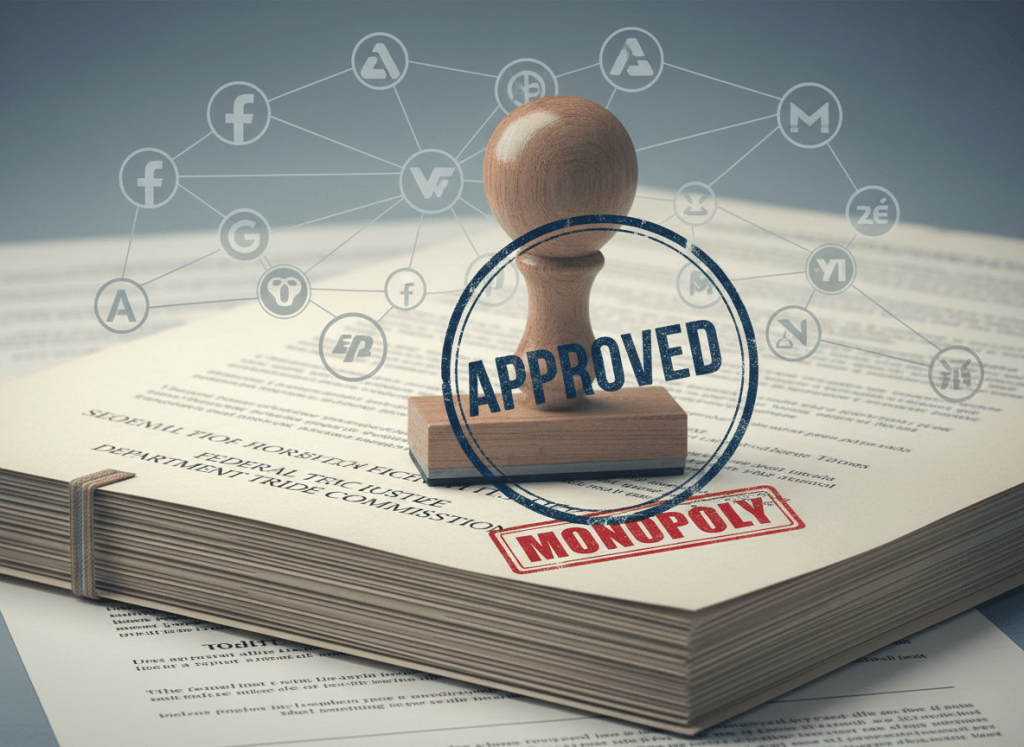
The Justice Department is celebrating a federal court order designed to loosen Google’s grip on online advertising technology.
There is just one awkward historical detail.
The federal government reviewed and cleared some of the acquisitions that helped Google build that grip in the first place.
On Sept. 16, the Justice Department announced what it called “substantial relief” in its antitrust case against Google. The U.S. District Court for the Eastern District of Virginia ordered Google to make important portions of its advertising technology work more readily with competing systems, allow publishers greater access to their own data, prohibit certain preferential bidding practices and submit to six years of outside monitoring.
It is the latest development in a case that produced a major government victory in April 2025, when U.S. District Judge Leonie Brinkema found that Google had unlawfully maintained monopolies in publisher ad servers and open-web display ad exchanges.
But getting from a collection of advertising businesses to an unlawful monopoly took years.
And Washington was watching for much of the trip.
The Government Approved the Building Blocks
In 2007, Google agreed to buy DoubleClick for $3.1 billion.
DoubleClick was no minor addition. Its technology included a publisher ad server that would eventually become Google’s DFP and technology that developed into Google’s AdX advertising exchange. Those products later became central to the Justice Department’s monopolization case.
The Federal Trade Commission investigated the DoubleClick acquisition for eight months.
Then it let the deal proceed.
The vote was 4-1.
At the time, the FTC concluded that the transaction was unlikely to substantially lessen competition. Regulators even considered the possibility that Google might combine or bundle DoubleClick’s products with its other advertising businesses.
The commission concluded that DoubleClick lacked the market power necessary to make such a strategy a significant competitive threat.
That prediction has not aged particularly gracefully.
Nearly two decades later, a federal court found that Google unlawfully tied its publisher ad server, DFP, to its AdX exchange as part of conduct that helped maintain its monopoly power.
There is an important distinction. The court did not rule that Google’s acquisition of DoubleClick itself was illegal. The government’s eventual case concerned what Google subsequently did with the market position it had assembled.
Still, Washington had examined one of the central building blocks before Google put it into the building.
Then Came More Pieces
Google acquired Invite Media in 2010 for approximately $81 million.
Invite Media provided technology on the advertiser side of the market and ultimately became part of Google’s advertiser-buying infrastructure. The Justice Department’s 2023 complaint would later identify the acquisition as another step in Google’s expansion across the advertising technology stack.
The transaction apparently fell below the threshold requiring federal premerger notification, meaning regulators did not conduct the same kind of review that DoubleClick received.
Then came AdMeld.
Google agreed to purchase the publisher advertising technology company in 2011 for roughly $400 million.
This time, the Justice Department investigated.
The Antitrust Division gathered information from Google, AdMeld and other participants in the advertising industry. It ultimately closed the investigation without challenging the acquisition, concluding that the deal was unlikely to substantially reduce competition.
One of the government’s assumptions was that publishers could use multiple advertising platforms and shift their business among them.
Years later, the Justice Department revisited that conclusion.
Principal Deputy Assistant Attorney General Doha Mekki described the government’s earlier reasoning in a 2023 speech and delivered an unusually concise bureaucratic postmortem.
“We were wrong.”
Google’s growing scale, DOJ subsequently argued, combined with exclusionary practices to undermine precisely the competitive alternatives regulators had expected would remain available.
Washington Comes Back With a Crowbar
By 2023, the Justice Department was telling a very different story about the advertising market.
Its antitrust complaint specifically traced Google’s expansion through DoubleClick, Invite Media and AdMeld, arguing that Google had established control across critical portions of the technology used to buy and sell open-web advertising.
Two years later, Judge Brinkema found Google liable for unlawfully maintaining monopolies in publisher ad servers and ad exchanges.
The government then sought something much more dramatic: structural relief that included forcing Google to divest its AdX exchange.
The court declined to go that far.
Instead, Google received what might best be described as federally mandated interoperability.
Under the final judgment, Google must create and support integrations connecting AdX and DFP with Prebid, an open-source advertising technology widely used by publishers. AdX must also be capable of submitting real-time bids into competing publisher ad servers.
Publishers must be allowed to access and export their data from Google’s systems, making it easier to migrate to competitors.
Google’s advertiser tools are prohibited from bidding preferentially into Google’s own advertising products simply because Google owns them.
And a monitor and technical committee will oversee Google’s compliance for six years.
The government helped open the door.
Now it is installing a monitor to make sure Google leaves it open for everyone else.
A Monopoly on Fixing Monopolies
There is a tempting joke here about the federal government objecting to monopolies while maintaining something of a monopoly on deciding what constitutes one.
Legally, however, the distinction matters.
Federal antitrust law does not prohibit a company simply because it becomes enormously successful or even obtains monopoly power. The Sherman Act targets acquiring or maintaining that power through unlawful exclusionary conduct.
Nor did the court retroactively declare Google’s major acquisitions illegal.
The more interesting story is institutional.
Federal regulators examined Google’s $3.1 billion DoubleClick acquisition and approved it. DOJ examined the roughly $400 million AdMeld acquisition and approved that too. Invite Media slipped beneath the federal premerger-review threshold.
Those three acquisitions subsequently appeared in the Justice Department’s own reconstruction of how Google built its position across the advertising technology stack.
The FTC made predictions about the competitive consequences of DoubleClick.
DOJ made predictions about AdMeld.
The market developed.
Google developed with it.
Eventually, DOJ acknowledged that at least one of those predictions had been wrong.
Now, almost two decades after the DoubleClick acquisition, the federal government has won a court order requiring Google to connect the resulting advertising infrastructure to competitors, share information with customers and operate under years of technical supervision.
The Justice Department calls that restoring competition.
It may also be something considerably more familiar in Washington.
Fixing yesterday’s regulatory assumptions with tomorrow’s regulatory oversight.

